


Quick Summary: Best AI tools for Marketing Measurement & Optimization in 2026
We evaluated 7 AI tools for Marketing Measurement & Optimization: Sellforte AI, Triple Whale Moby AI, Mutinex MAITE, Lifesight MIA, Fospha Spark AI, Funnel Data Chat and Haus Copilot. In-depth evaluation was based on 49 criteria in 9 categories that were derived from more than 1,660 real AI prompts and 700 discussions with marketers and marketing analytics professionals. Here is how the tools compare:
| Category | Sellforte AI | Triple Whale Moby AI | Mutinex MAITE | Lifesight MIA | Fospha Spark AI | Funnel Data Chat | Haus Copilot |
|---|---|---|---|---|---|---|---|
| 1. Marketing Data Reporting | 4 / 4 | 3 / 4 | 4 / 4 | 4 / 4 | 3 / 4 | 3 / 4 | 0 / 4 |
| 2. Historical Performance Insights & Causal Explanation | 5 / 5 | 2 / 5 | 4 / 5 | 5 / 5 | 3.5 / 5 | 0 / 5 | 1 / 5 |
| 3. Channel-Level Optimization | 4.5 / 5 | 4 / 5 | 5 / 5 | 5 / 5 | 0.5 / 5 | 0 / 5 | 0 / 5 |
| 4. Campaign & Ad Set-Level Optimization | 4 / 6 | 1.5 / 6 | 0 / 6 | 0 / 6 | 2 / 6 | 0 / 6 | 0 / 6 |
| 5. Incrementality Testing | 2.5 / 6 | 4.5 / 6 | 0 / 6 | 0 / 6 | 0 / 6 | 1 / 6 | 3 / 6 |
| 6. Agentic Execution & Autonomy | 2 / 4 | 4 / 4 | 1 / 4 | 0.5 / 4 | 0 / 4 | 0 / 4 | 0 / 4 |
| 7. UX & Conversational Interface | 6.5 / 8 | 7 / 8 | 5 / 8 | 5 / 8 | 5.5 / 8 | 6 / 8 | 1.5 / 8 |
| 8. Analytical Backbone | 4 / 4 | 3 / 4 | 2 / 4 | 3 / 4 | 2 / 4 | 0 / 4 | 0 / 4 |
| 9. Enterprise-Grade Platform | 7 / 7 | 2 / 7 | 4 / 7 | 1.5 / 7 | 1 / 7 | 5 / 7 | 2 / 7 |
| Total score out of 49 | 39.5 | 31 | 25 | 24 | 17.5 | 15 | 7.5 |
Sellforte ranked highest in the comparison scoring 39.5 out of 49, followed by Triple Whale Moby AI (31 out of 49), Mutinex MAITE (25 out of 49), Lifesight MIA (24 out of 49), Fospha Spark AI (17.5 out of 49), Funnel Data Chat (14 out of 49) and Haus Copilot (7.5 out of 49). Sellforte AI's high score compared to the other platforms is explained by Sellforte AI's extensive coverage of both channel- and campaign level optimization, robust analytical backbone built on best-in-class MMM, and Sellforte's ability to serve enterprise-level customers.
Sellforte AI is best for marketing teams looking for an enterprise-grade AI tool that supports channel- and campaign-level media spend optimization grounded in best-in-class analytical backbone covering MMM, incrementality testing and incrementality-corrected attribution. Sellforte is particularly strong in Retail and Ecommerce.
Triple Whale Moby AI is best for small and mid-sized ecommerce businesses requiring a strong AI tool, but for whom incrementality-based optimization at the campaign & ad set level and enterprise-grade MMM and is not a priority.
Mutinex MAITE is best for large enterprises who require an AI tool for optimizing media spend across channels, but for whom campaign & ad set level optimization or causal experimentation is not a priority.
Lifesight MIA is best for marketers requiring AI-based performance reporting and channel-level optimization on the Lifesight platform, but for whom campaign & ad set level optimization is not a priority.
Fospha Spark AI is best for small ecommerce businesses requiring historical performance reporting based on Fospha measurement, but for whom future-looking optimization and enterprise-grade measurement platform covering also causal experimentation is not a priority.
Funnel Data Chat is best for companies with an existing Funnel subscription needing a quick access to raw marketing data, but for whom incrementality-based marketing measurement is not a priority.
Haus Copilot is best for companies already using the Haus platform and benefit from AI's support for interpreting and designing geo tests.
Introduction and Table of Contents
AI tools for Marketing Measurement & Optimization are a new, rapidly developing product category. We are proud to publish the first in-depth tool evaluation research article on the topic.
While platform and tool reviews are typically in fact just tool listings with high-level remarks of each tool, our goal with this article was far more ambitious: we wanted to create an objective and verifiable comparison of AI tools for Marketing Measurement & Optimization, grounded in research on real usage patterns and requirements that modern marketers and marketing analytics teams have in 2026.
Here's what we're covering in this article:
- Quick Summary: Best AI tools for Marketing Measurement & Optimization in 2026
- What are AI tools for Marketing Measurement & Optimization?
- How to Choose an AI tool for Marketing Measurement & Optimization: Evaluation Criteria
- In-depth Comparison of AI tools for Marketing Measurement & Optimization
- Frequently Asked Questions
- Limitations & Disclosures
- Further Reading
What are AI tools for Marketing Measurement & Optimization?
AI tools for Marketing Measurement & Optimization help marketers measure media performance, optimize marketing spend allocation and execute optimization actions through a conversational, natural language interface.
Unlike traditional dashboards, which require users to navigate filters and find the right charts, AI tools for Marketing Measurement & Optimization let marketers interact with their measurement stack the way they would with a senior analyst: "Why did revenue drop last week?", "What's the incremental ROAS of Meta vs. TikTok?", "What happens if I cut re-allocate 20% from retargeting to prospecting?".
Unlike generic LLM chatbots (ChatGPT, Claude, Gemini), AI tools for Marketing Measurement & Optimization are purpose-built for marketing, grounded on advertiser's actual data and real incrementality-based measurement models.
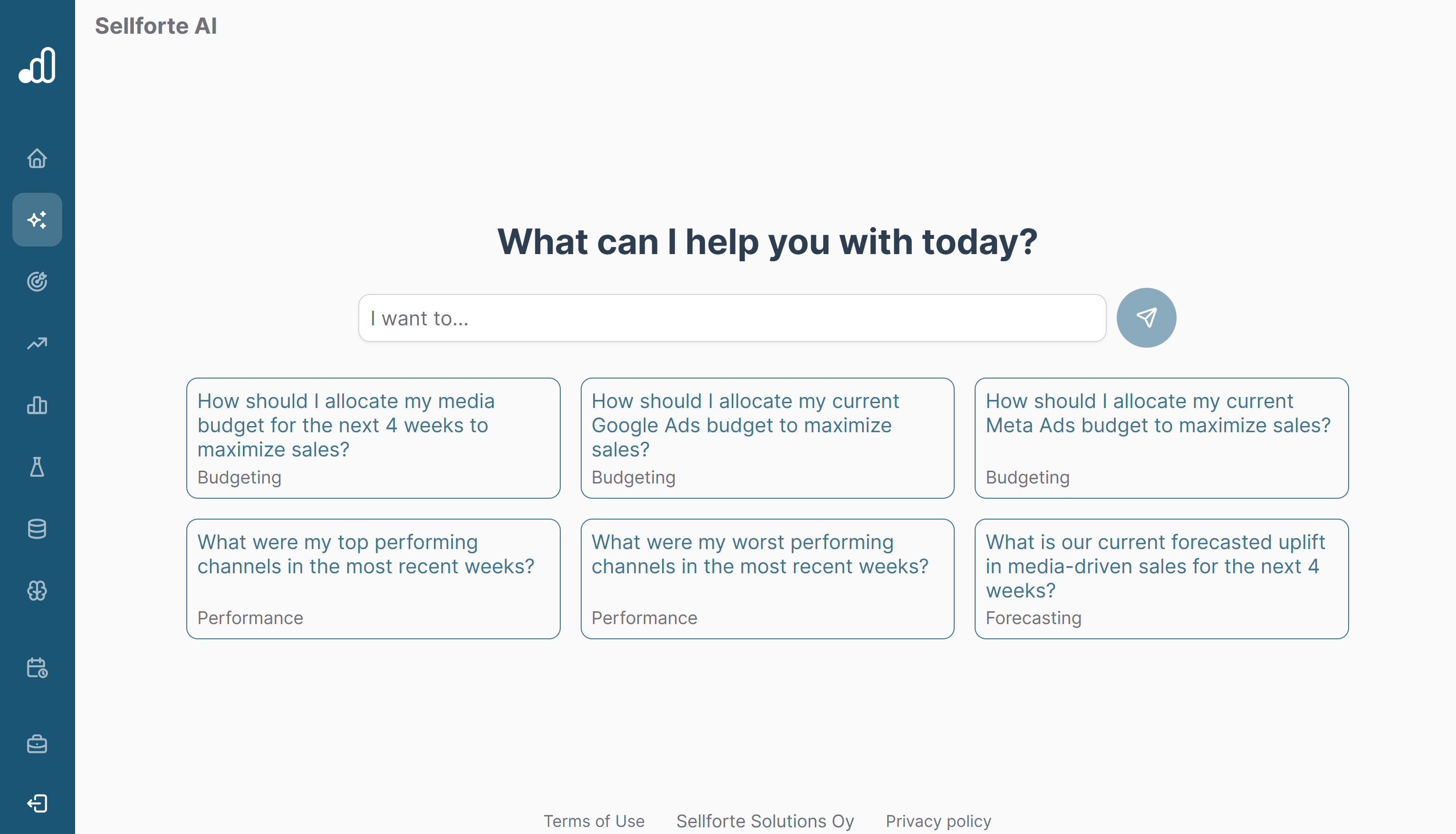
To illustrate an AI tool for Marketing Measurement & Optimization, below is a screenshot from Sellforte AI:
Categories of AI tools: What types of AI tools exist for Marketing Measurement & Optimization?
There's three categories of AI tools for Marketing Measurement & Optimization:
1. Marketing Data Reporting AI tools (e.g., Funnel Data Chat) provide marketers fast access to raw data from advertising platforms, ecommerce platforms or analytics tools. These types of tools are the most basic AI tools for Marketing Measurement & Optimization and are commonly found from for example from data connector companies. The main limitation of Marketing Data Reporting AI tools is that they lack the analytical backbone for measuring the true incremental impact of advertising, meaning that they are not relevant in optimizing media spend allocation.
2. Channel-Level Marketing Measurement & Optimization AI tools (e.g., Mutinex MAITE) help marketers optimize channel-level media spend allocation. Marketers can ask questions, such as "What's an optimal budget allocation for the next quarter?". These types of tools are commonly found from traditional Marketing Mix Modeling companies, who have started building AI on top of their MMM. AI Tools for Channel-Level Optimization are much more valuable than Marketing Data Reporting AI tools for marketers, but they have a limitation: they are not able to offer insights on the campaign & ad set level where the practical execution of media spend optimization happens. These means that they are also not able to offer autonomous agents for executing media spend optimization actions.
3. Agentic AI tools for Campaign & Ad set level Execution (e.g, Sellforte AI and Triple Whale Moby AI) help marketers measure marketing, optimize marketing spend allocation, and execute bidding changes on advertising platforms. This is technologically the most advanced AI tool category. These tools operate on the campaign & ad set level, enabling marketers execute bidding changes on ad platforms. These platforms provide AI Agents for autonomous media spend optimization, based on true incrementality.
How do AI tools for Marketing Measurement & Optimization work?
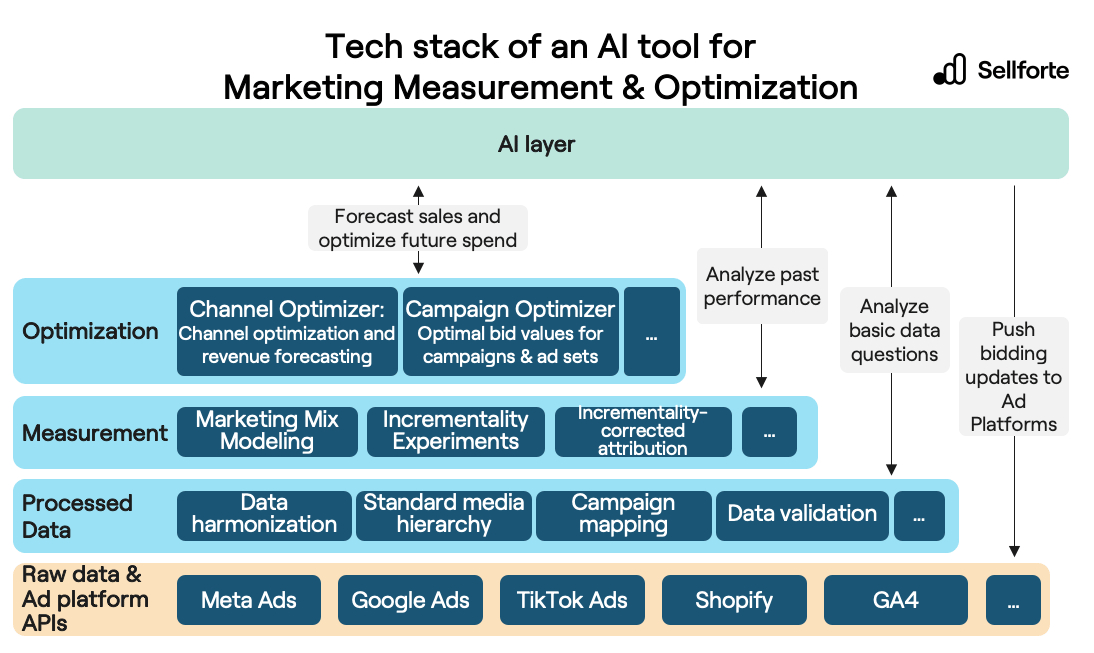
AI tools for Marketing Measurement & Optimization are an additional layer in an existing Measurement & Optimization stack, leveraging all the other layers in the technology stack to answer marketer's questions.
Here's a few examples:
- For basic data questions ("What was the spend on Google Performance Max last month?"), the AI connects with the Processed Data layer
- For questions on past performance ("What was the ROI for Google Performance Max last month?"), the AI connect with the data science layer, which has MMM's historical performance results
- For spend optimization questions ("What's the optimal spend allocation across channels for the next month?") , the AI connects with dynamic tools in the Optimization tools -layer
The tech stack of an AI tool for Marketing Measurement & Optimization is illustrated in the image below, using Sellforte as an example:
How to Choose an AI tool for Marketing Measurement & Optimization: Evaluation Criteria
Each AI tools for Marketing Measurement & Optimization in this article is evaluated against criteria that we formed through extensive primary research based on three lenses.
1. Actual AI tool usage today based on real prompts. We first investigated how marketers are actually using AI tools for Marketing Measurement & Optimization today. We collected 1,660 prompts recently made in the Sellforte AI by marketers and marketing analytics professionals, and categorized them based on the topic and specific use-case. We included all prompts, independent of whether Sellforte AI was capable of answering marketers.
2. Communicated expectations towards AI tools. We investigated the expectations that marketers and marketing analytics teams have for AI tools for Marketing Measurement & Optimization. We analyzed AI-related comments and statements in more than 700 discussions with Sellforte customers and prospects, including marketers, marketing analytics leads, and data scientists working in advertising-heavy industries such as retail, ecommerce, DTC, travel & hospitality, and restaurants. We also reviewed AI requirements in marketing measurement & optimization recent RFP documentations.
3. Existing capabilities in AI tools for Marketing Measurement & Optimization in the market. We reviewed 78 vendors operating in the marketing measurement space. We evaluated whether the vendors had an AI offering, and if so, we synthesized the capabilities that they communicate on the website, technical documentation or demos.
The result: 49 evaluation criteria across 9 categories.
Evaluation criteria for AI tools for Marketing Measurement & Optimization
This table summarizes our evaluation criteria for AI tools for Marketing Measurement & Optimization:
| ID | Category | Criterion | What it means |
|---|---|---|---|
| 1. Marketing data reporting | |||
| 1.1 | Marketing data reporting | AI reports sales progress for online sales | AI can report and summarize sales development in Ecommerce sales. |
| 1.2 | Marketing data reporting | AI reports sales progress for offline stores sales | AI can report and summarize sales development in offline store sales. |
| 1.3 | Marketing data reporting | AI reports digital media data (spend, impressions, clicks) | AI reports digital media performance (impressions, clicks, spend, conversions) natively across Meta, Google, TikTok, and other major paid platforms. |
| 1.4 | Marketing data reporting | AI reports offline media data | AI reports offline media (TV, podcasts, radio, OOH, direct mail) spend and KPIs (such as TRPs for TV) alongside digital. |
| 2. Historical performance insights & causal explanation | |||
| 2.1 | Historical performance insights & causal explanation | AI measures incremental ROAS and incremental revenue for each digital channel | AI is able to report and summarize incremental revenue and incremental ROAS driven by each digital channel (not just unprocessed ROAS). |
| 2.2 | Historical performance insights & causal explanation | AI measures incremental ROAS and incremental revenue for each offline channel | AI is able to report and summarize incremental revenue and incremental ROAS driven by each offline channel. |
| 2.3 | Historical performance insights & causal explanation | AI-reported incremental ROAS is updated daily | AI provides daily measurement of incremental ROAS. |
| 2.4 | Historical performance insights & causal explanation | AI reports promotion-driven revenue, in addition to media-driven | AI surfaces how promotions and pricing changes contributed to sales, not just paid media. |
| 2.5 | Historical performance insights & causal explanation | AI explains why performance has changed | AI is able to tie sales changes to specific drivers (promotions, seasonality, weather, media). |
| 3. Channel-level optimization | |||
| 3.1 | Channel-level optimization with AI | AI recommends optimal budget allocation by channel | AI recommends optimal budget allocation across channels (Meta, Google, TikTok, etc.). |
| 3.2 | Channel-level optimization with AI | AI forecasts total revenue based on optimal budget allocation | AI forecasts expected total revenue under the recommended budget allocation, including base sales, media-driven sales, and promo-driven sales. |
| 3.3 | Channel-level optimization with AI | AI provides miROAS and response curves for each channel | AI provides marginal incremental ROAS (miROAS) and saturation / response curves per channel. |
| 3.4 | Channel-level optimization with AI | AI supports basic custom scenario planning (e.g., "what if I cut Meta by 20%?") | Users can simulate custom what-if scenarios in the AI and see forecasted outcomes. |
| 3.5 | Channel-level optimization with AI | AI supports advanced scenario planning in natural language (constraints, multi-dimensional optimization..) | User can ask advanced scenario planning questions in natural language, including constraints, multi-dimensional optimization, and marginal budget recommendations. |
| 4. Campaign & ad set-level optimization | |||
| 4.1 | Campaign & ad set-level optimization | AI provides incremental ROAS of each campaign & ad set | AI is able to report and summarize incremental revenue and incremental ROAS driven by each campaign and ad set within Meta, Google, TikTok, and so on. |
| 4.2 | Campaign & ad set-level optimization | AI provides comparison of incremental ROAS to last-click and ad platform attribution ROAS | AI is able to compare incremental ROAS to last-click ROAS and ad platform ROAS. |
| 4.3 | Campaign & ad set-level optimization | AI provides miROAS for each campaign & ad set | AI provides marginal incremental ROAS (miROAS) at the campaign and ad-set level. |
| 4.4 | Campaign & ad set-level optimization | AI recommends optimal spend for each campaign & ad set | AI recommends optimal spend per campaign and ad set. |
| 4.5 | Campaign & ad set-level optimization | AI recommends optimal bid value for each campaign & ad set | AI recommends optimal bid values per campaign and ad set. |
| 4.6 | Campaign & ad set-level optimization | AI provides pre/post analysis for each bidding change | AI provides pre/post analysis after bidding/budget changes are applied — measures actual impact of executed changes. |
| 5. Incrementality testing | |||
| 5.1 | Incrementality testing | Summarizes all incrementality tests done by the company | AI summarizes all incrementality tests the company has run, in one accessible view. |
| 5.2 | Incrementality testing | Provides in-depth report for geo tests | AI generates in-depth reports for geo (matched-market) incrementality tests. |
| 5.3 | Incrementality testing | Provides in-depth report for own media A/B tests | AI generates in-depth reports for A/B / split incrementality tests. |
| 5.4 | Incrementality testing | Provides in-depth report for Conversion Lift tests | AI generates in-depth reports for Conversion Lift / platform-native lift tests. |
| 5.5 | Incrementality testing | Provides testing recommendations on which channels to test | AI recommends what to test next, given priors and prior test results. |
| 5.6 | Incrementality testing | Provides test design recommendations | AI recommends test designs (control group, test group, etc.). |
| 6. Agentic execution & autonomy | |||
| 6.1 | Agentic execution & autonomy | AI can push budget/bidding changes to Meta / Google / TikTok APIs | Platform can push budget/bidding changes to Meta / Google / TikTok APIs. |
| 6.2 | Agentic execution & autonomy | AI's level of autonomy for execution can be configured | Platform supports a clear spectrum: insight-only → recommendation-only → human-approved execution → fully autonomous execution. Users choose per use case. |
| 6.3 | Agentic execution & autonomy | AI has specialized agents for distinct workflows | Distinct agents for distinct workflows (planning, buying, experimentation) rather than a single general-purpose chatbot. |
| 6.4 | Agentic execution & autonomy | Proactive insights & alerts via AI | AI surfaces anomalies, narratives, and scheduled reports into Slack/email via subscription. |
| 7. UX & conversational interface | |||
| 7.1 | UX & conversational interface | Includes tables and charts inline in AI responses | AI inlines tables and charts inside chat responses, not just text. |
| 7.2 | UX & conversational interface | AI has conversation history & multi-turn context retention | Follow-up questions retain prior dimensions, filters, time windows, and named entities. "What about for the next 8 weeks" knows what "next" refers to. |
| 7.3 | UX & conversational interface | Allows convenient export of AI outputs (e.g., PDF, Slides, CSV) | AI outputs can be exported to PDF, Slides, or CSV for sharing outside the platform. |
| 7.4 | UX & conversational interface | AI grounds answers in data, providing links from outputs to deep-dive dashboards | AI outputs link out to deep-dive dashboards or detail views for further investigation. For example, a spend optimization recommendation has a link to the optimizer tool for further configuration. |
| 7.5 | UX & conversational interface | AI operates in embedded and multi-window mode (chat + dashboard side-by-side) | AI chat can be shown side-by-side with a dashboard, and the user can submit prompts about the dashboard/tool. |
| 7.6 | UX & conversational interface | AI shows its reasoning steps and logic while answering | AI surfaces its reasoning steps, the data sources it pulled from, and the assumptions behind each answer, as the answer is being constructed. |
| 7.7 | UX & conversational interface | AI handles non-English questions in production | AI responds in the customer's language for at least 5 major languages, maintaining domain accuracy across languages, not just translating. |
| 7.8 | UX & conversational interface | AI can be accessed via MCP server / external LLM | Tool exposes data via MCP server or equivalent, so external LLMs (Claude, ChatGPT, Cursor) can query directly. |
| 8. Analytical backbone | |||
| 8.1 | Analytical backbone | AI provides deterministic, model-backed answers with Bayesian MMM as backbone | Tool's recommendations are grounded in a Bayesian Marketing Mix Model (MMM), not last-click attribution or descriptive analytics. |
| 8.2 | Analytical backbone | Bayesian MMM used by the AI is calibrated with incrementality tests | Bayesian MMM is calibrated against incrementality test results — priors and posteriors informed by causal experiments. |
| 8.3 | Analytical backbone | AI reports model validation and other modelling KPIs | Tool reports model validation metrics (R², MAPE, posterior predictive checks, holdout performance) so customers can assess model quality. |
| 8.4 | Analytical backbone | Model calibration & configuration settings (e.g., priors) are auditable and editable in a self-serve UI | Customers can inspect and configure model priors and other key model parameters in a self-serve UI. |
| 9. Enterprise-grade platform | |||
| 9.1 | Enterprise-grade platform | At least 10 public reference customers from $1B+ revenue brands | At least 10 public reference customers from $1B+ revenue brands. |
| 9.2 | Enterprise-grade platform | SOC 2, ISO 27001, or audited IT security by a third-party cyber security auditor | Holds SOC 2, ISO 27001, or audited IT security from a third-party cyber security auditor. |
| 9.3 | Enterprise-grade platform | Data residency: geography option between US and EU | Offers data residency choice between US and EU. |
| 9.4 | Enterprise-grade platform | Multi-cloud: option between AWS, GCP, and Azure | Offers cloud deployment choice between AWS, GCP, and Azure (multi-cloud). |
| 9.5 | Enterprise-grade platform | Supports single sign-on (SSO) for enterprises | Supports Single Sign-On (SSO) for enterprise authentication. |
| 9.6 | Enterprise-grade platform | Customer data is not shared to a third-party LLM (LLM is deployed in a customer-specific cloud container) | AI inference runs within isolated cloud infrastructure (e.g., AWS Bedrock); customer data does not egress to third-party LLM APIs. |
| 9.7 | Enterprise-grade platform | Hands-on demo or trial of the AI is available without sales-call gating | Public no-sign-up demo specifically demonstrating the AI / conversational features. |
Let's next cover briefly what each of these categories mean and why they matter.
Category 1. Marketing data reporting
This category measures AI tools' capabilities to provide basic marketing data reporting.
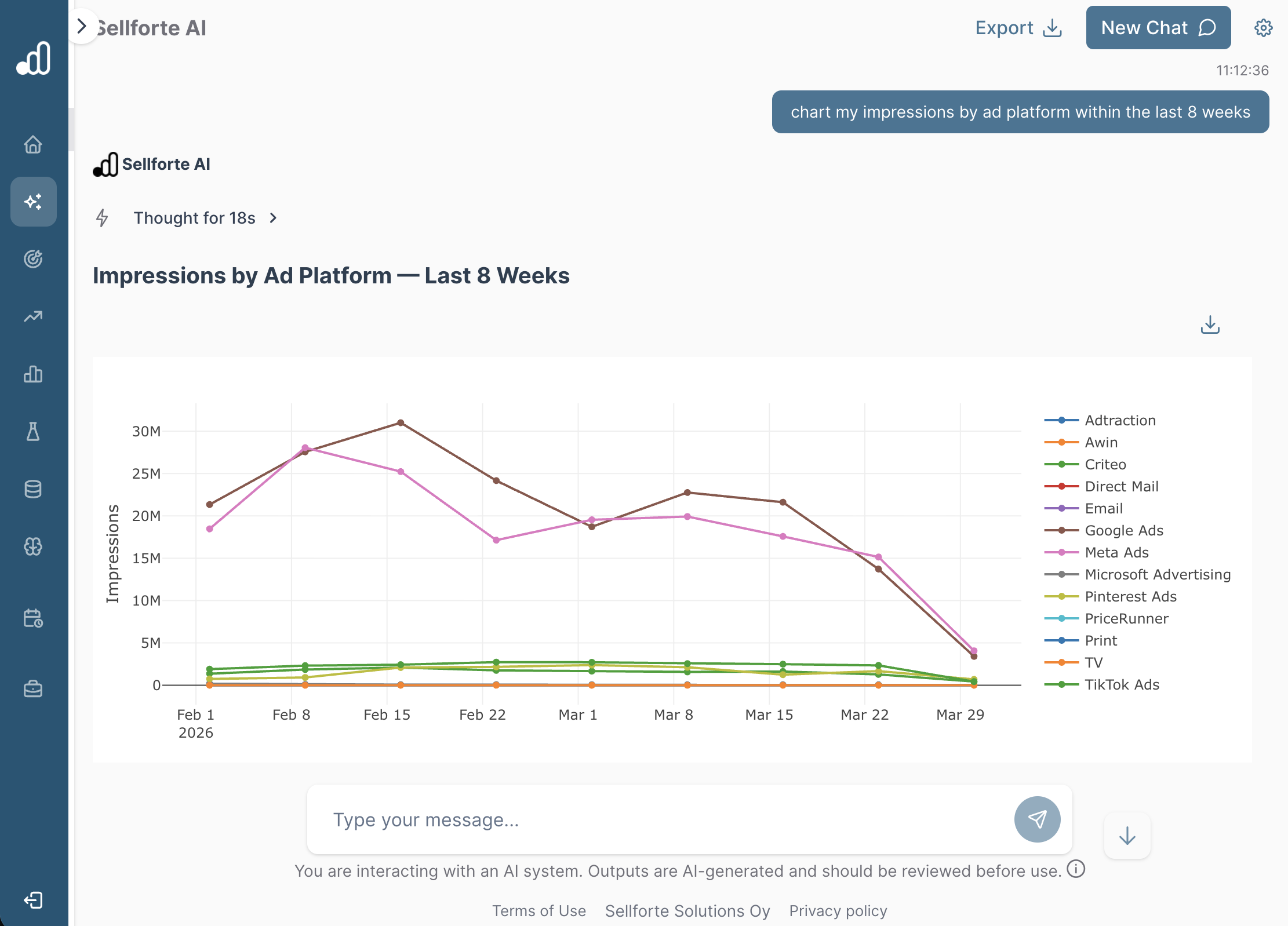
Summarizing historical data is the foundation for any marketing measurement AI tool for Marketing Measurement & Optimization. At the simplest level, this means surfacing raw data from ad platforms and ecommerce platforms, such as clicks, impressions, conversions, and ecommerce sales. Enterprise-grade platforms also cover offline store sales and offline media, which might require a data warehouse connection in the backend.
To illustrate marketing data reporting in action, below is a chart where Sellforte AI shows how impressions have developed across ad platforms for the last 8 weeks.
Category 2. Historical performance insights & causal explanation
This category measures AI tools' capabilities to provide historical performance insights grounded in true incremental sales impact of media, and ability to explain the causal drivers for performance changes.
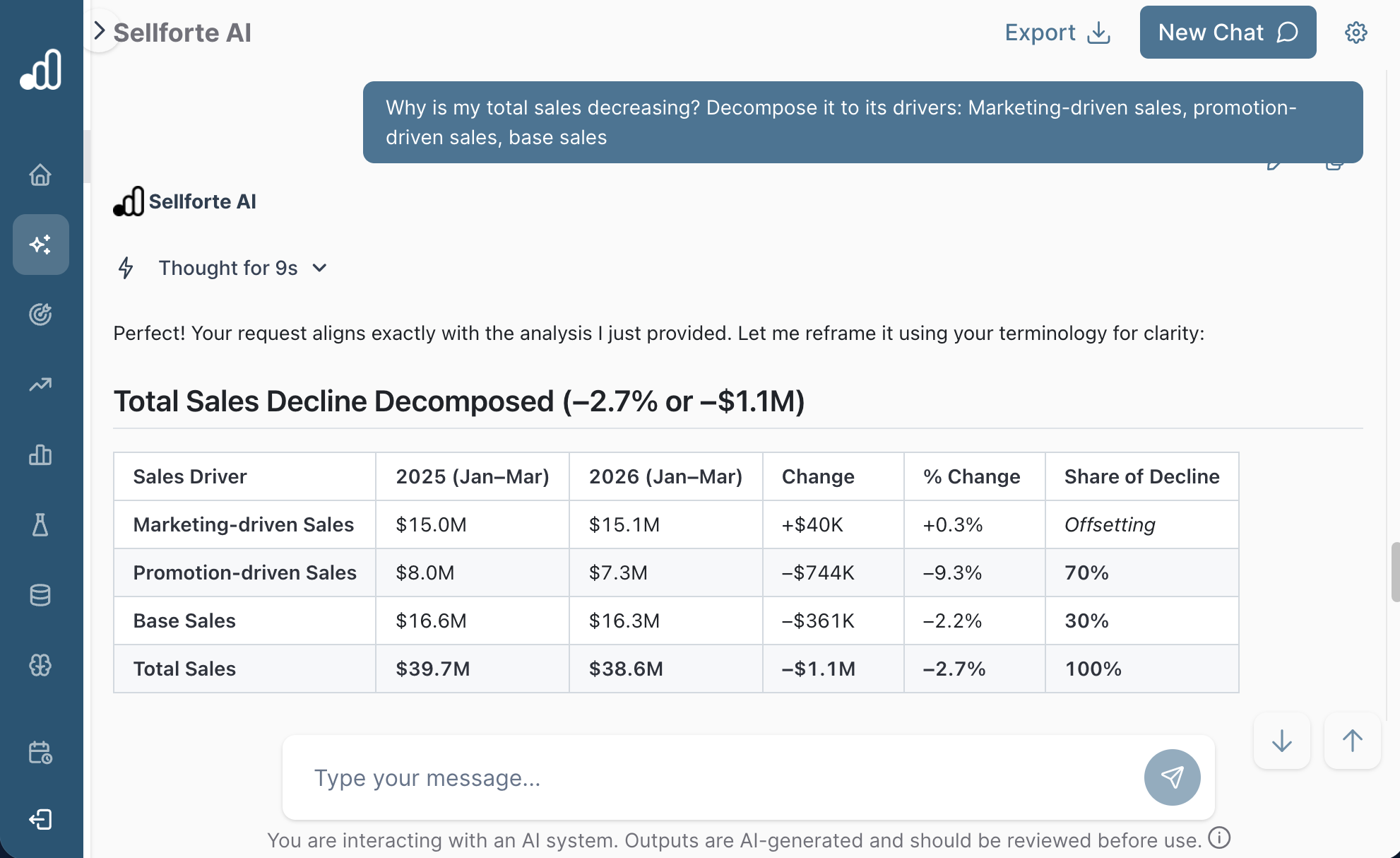
While some AI tools for Marketing Measurement & Optimization are satisfied reporting ROAS from last-click or ad platform attribution, modern AI tools are measuring the true incremental ROAS of each channel and campaign. Most advanced marketing AI tools can also explain the causal drivers behind historical KPI changes, such as changes in base sales, promotion-driven sales, seasonality, or weather.
To illustrate causal explanation in action, below is a screenshot where Sellforte AI decomposes year-over-year sales decline into its drivers.
Category 3. Channel-level optimization
This category measures AI tools' capabilities to help marketers optimize media spend allocation across channels. While the two previous categories covered reporting, telling you what happened, we now move to optimization, which tells you what to do next. This is where an AI tool starts becoming truly valuable for marketing teams.
Modern AI tools for Marketing Measurement & Optimization can recommend spend reallocation across channels and forecast the revenue impact of recommendations. They can answer "what if I cut Meta by 20% and shift it to YouTube?" in seconds rather than weeks. To do this credibly, the AI needs access to an optimization tool that leverages Marginal Incremental ROAS (miROAS) and Advertising Response Curves for each channel, and can project total revenue under different allocation scenarios.
The most sophisticated AI tools for Marketing Measurement & Optimization go further: handling natural-language constraints, multi-dimensional optimization across channel and geography, and marginal recommendations for "if I got an extra €500K, where should it go?"
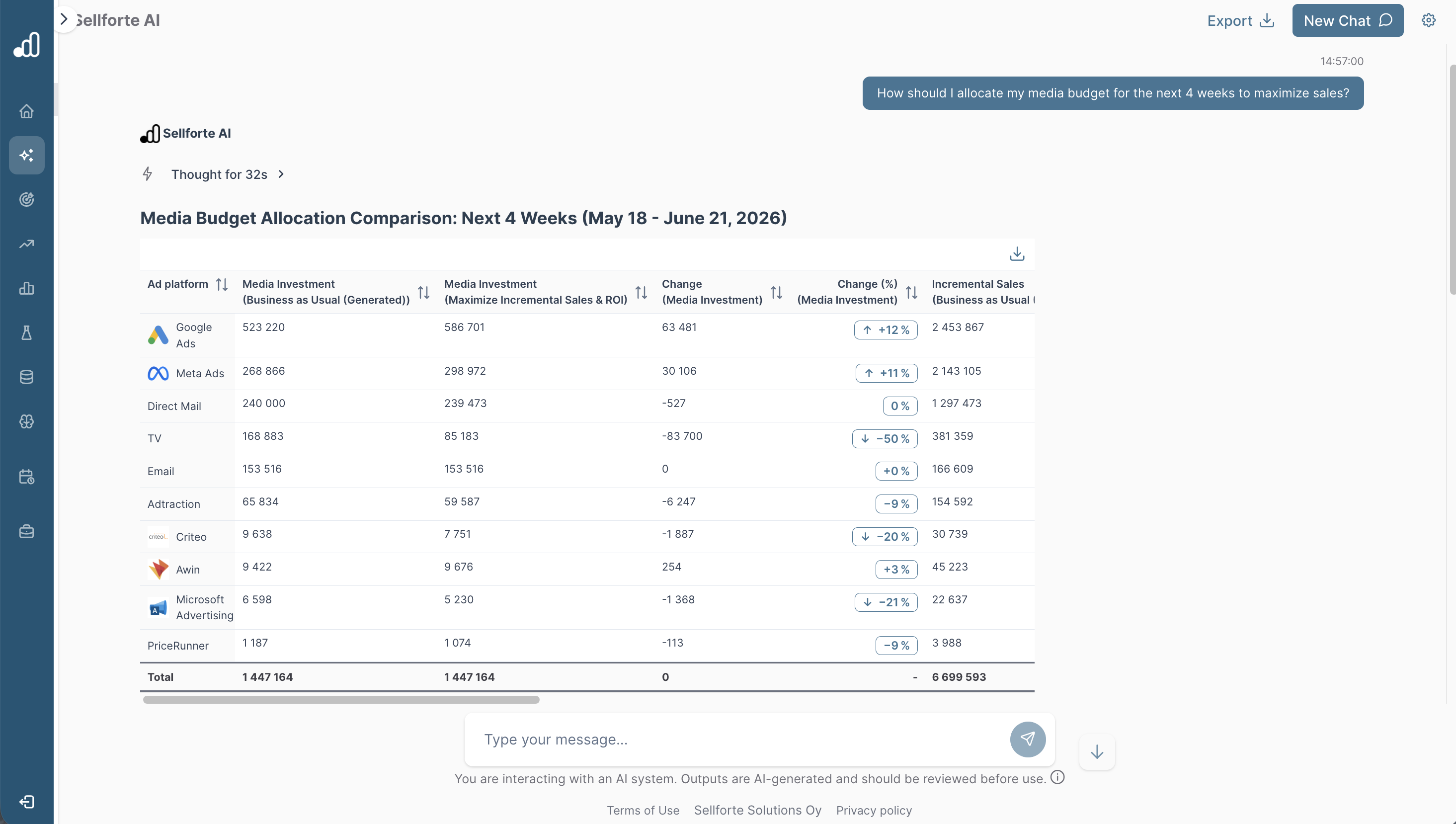
To illustrate channel-level optimization in action, below is a screenshot where Sellforte AI recommends optimal spend by channel for the next 3 months.
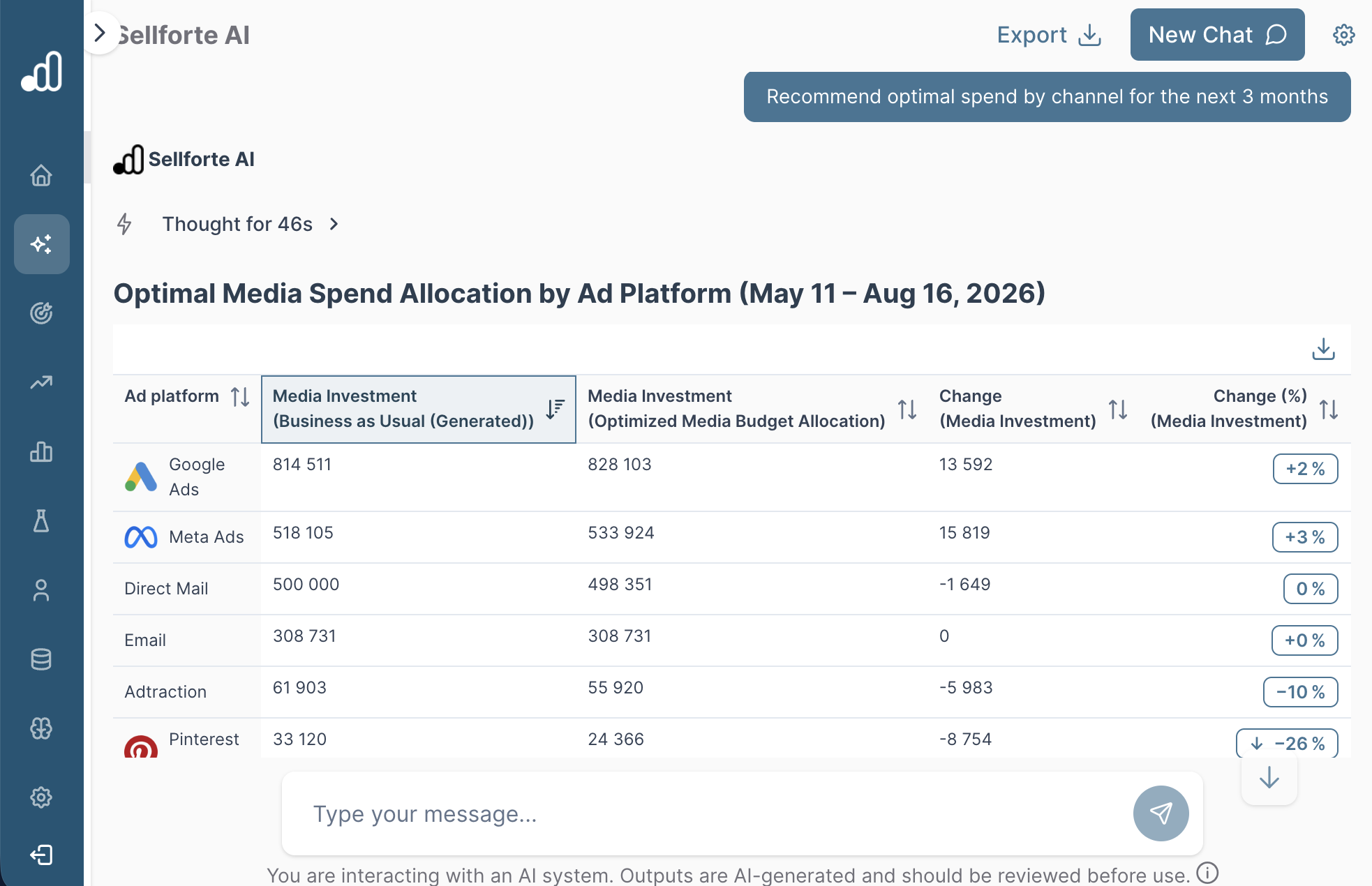
Category 4. Campaign & Ad set -level optimization
This category measures AI tools' capabilities to support spend optimization on tactical level: optimizing spend across campaigns and ad sets.
Campaign and ad set level is the most important granularity of optimization, because that's where budget execution practically happens. A budget shift from Meta to TikTok at the channel level is meaningless until it's executed as specific budget and bid changes across dozens or hundreds of individual campaigns and ad sets.
Most AI tools for Marketing Measurement & Optimization that handle channel-level optimization don't follow through to the campaign layer. The technical bar is higher here, as this level of optimization requires reliable reliable estimation of campaign and ad set level miROAS.
To illustrate campaign and ad set level optimization in action, below is a screenshot from Sellforte AI recommending Target ROAS bidding changes for specific Google Ads campaigns
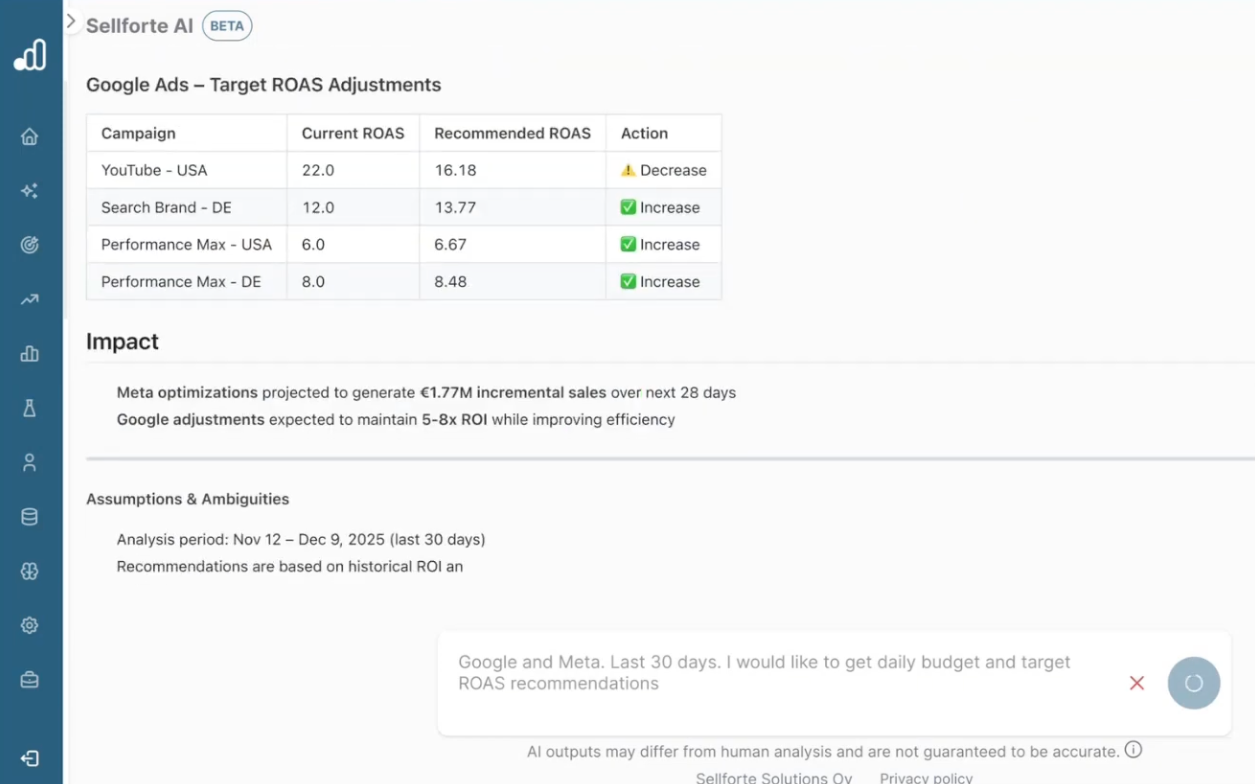
Category 5. Incrementality testing
This category measures AI tools' capabilities to analyze and plan incrementality tests.
Incrementality testing is used in modern measurement to calibrate Marketing Mix Models, as they can provide ground truth for a channel's incremental ROAS at a specific point in time and at a specific spend level. Advanced AI tools for Marketing Measurement & Optimization have access to an incrementality test library that contain all incrementality tests done by a company, across geo tests, own media A/B tests and conversion lift tests. They can summmarize the main insights from tests, including iROAS and confidence intervals. The most advanced tools also help recommending channels to tests, as well as give guidance for test design.
To illustrate how modern AI tools for Marketing Measurement & Optimization can integrate with incrementality tests, below is a screenshot from Sellforte AI embedded into an incrementality testing dashboard providing a summary of how to interpret a test.
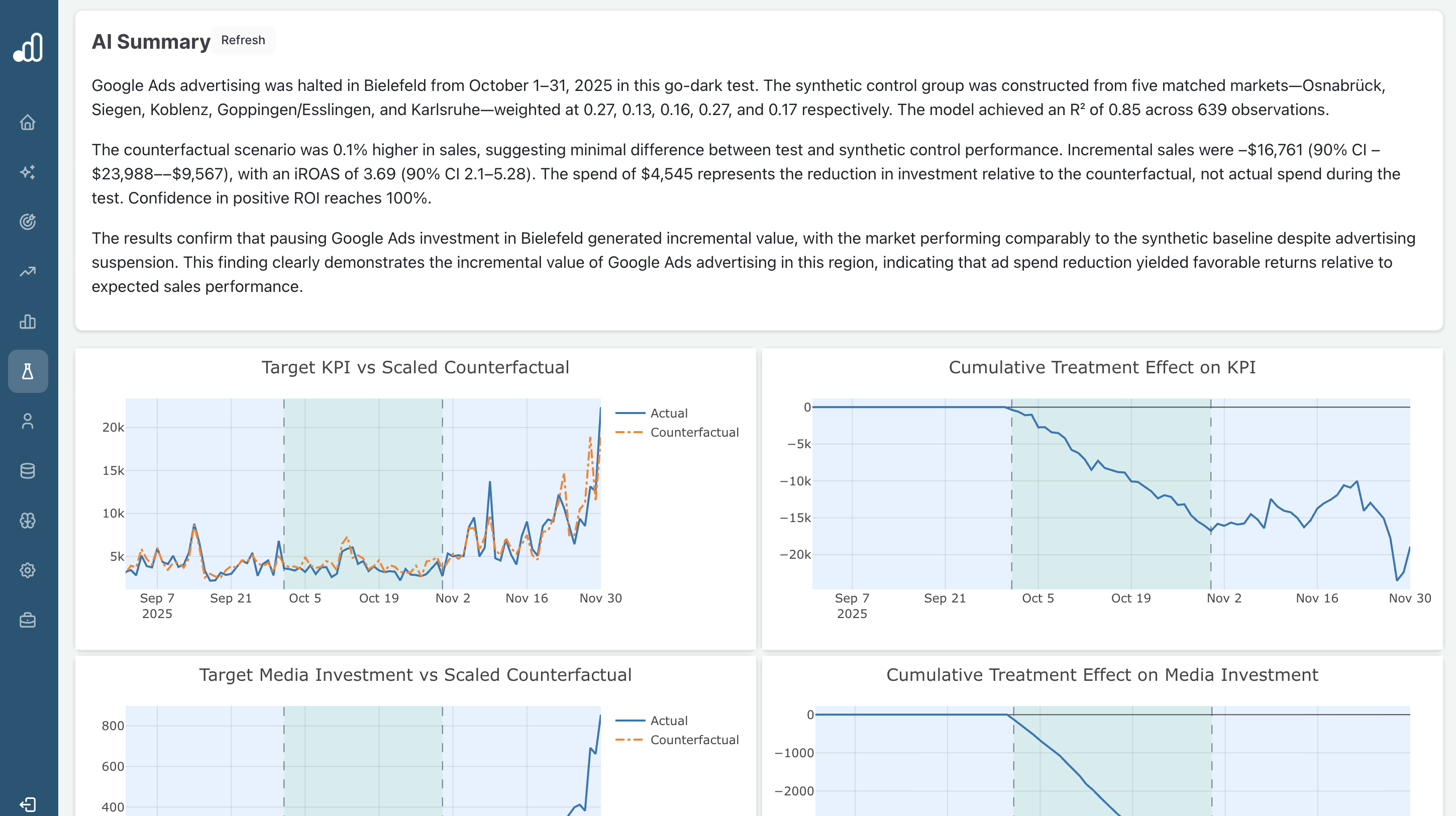
Category 6. Agentic Execution & Autonomy
This category measures AI tools' capabilities for agentic execution.
The next generation of AI tools for Marketing Measurement & Optimization have agents that take action by adjusting bidding parameters directly in ad platforms. This is a fundamentally different product category, and it requires different design choices: clear autonomy boundaries, approval workflows for high-impact actions, audit logs, and rollback capabilities.
To illustrate how modern AI tools for Marketing Measurement & Optimization can adjust bidding parameters, below is a screenshot from Sellforte AI's approval flow for adjusting Target ROAS for a Google Ads campaign.
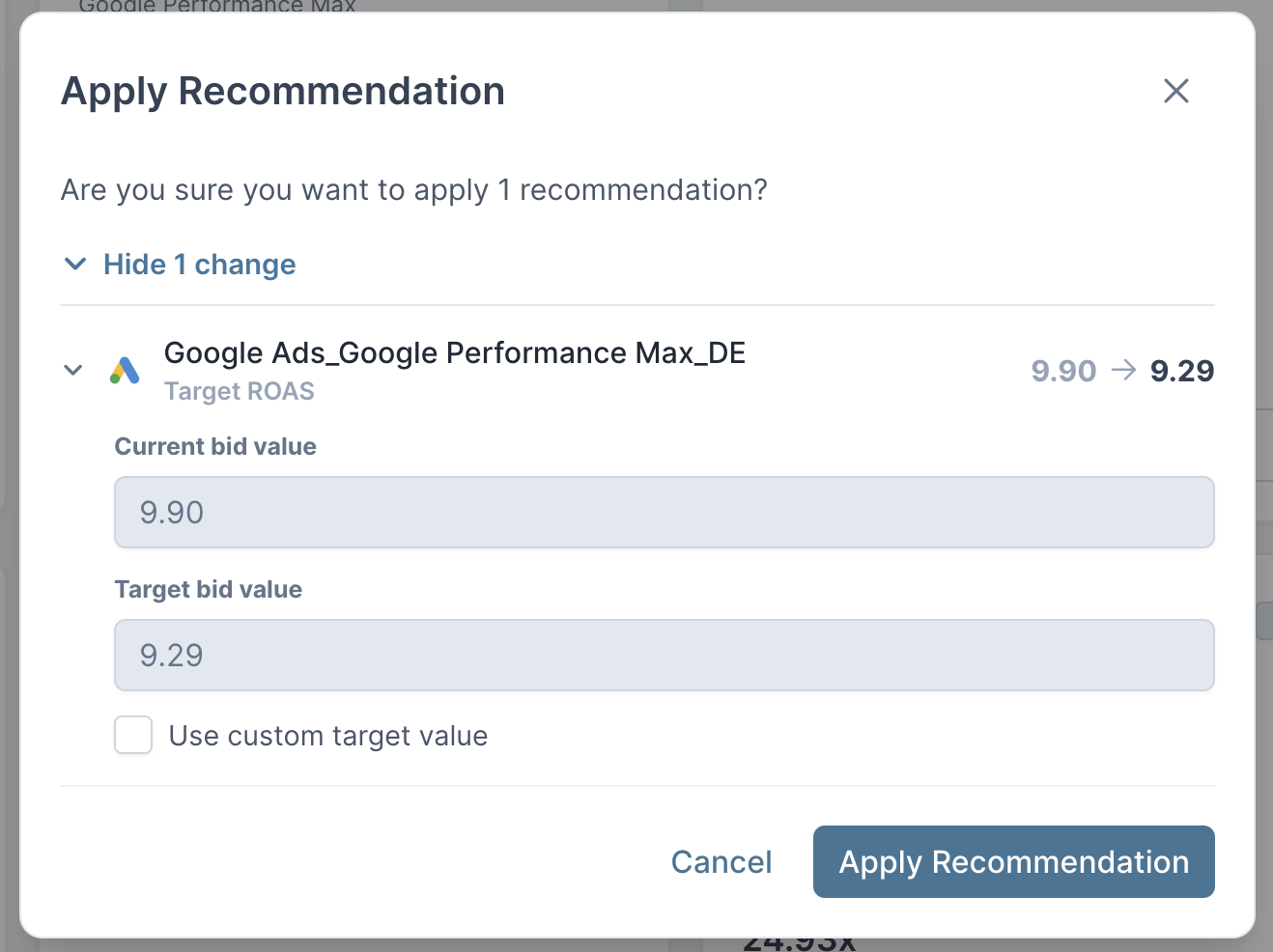
Category 7. UX & Conversational Interface
This category measures AI tools' user-experience and features available in the conversational chat interface.
Tested features in this category include chat history, context retention, ability to provide inline tables and charts, multi-window mode, and exportable outputs (PDF, Slides, CSV). We also test features building trust, such as ability to provide reasoning flow and links from AI answers to source data and deep-dive dashboards.
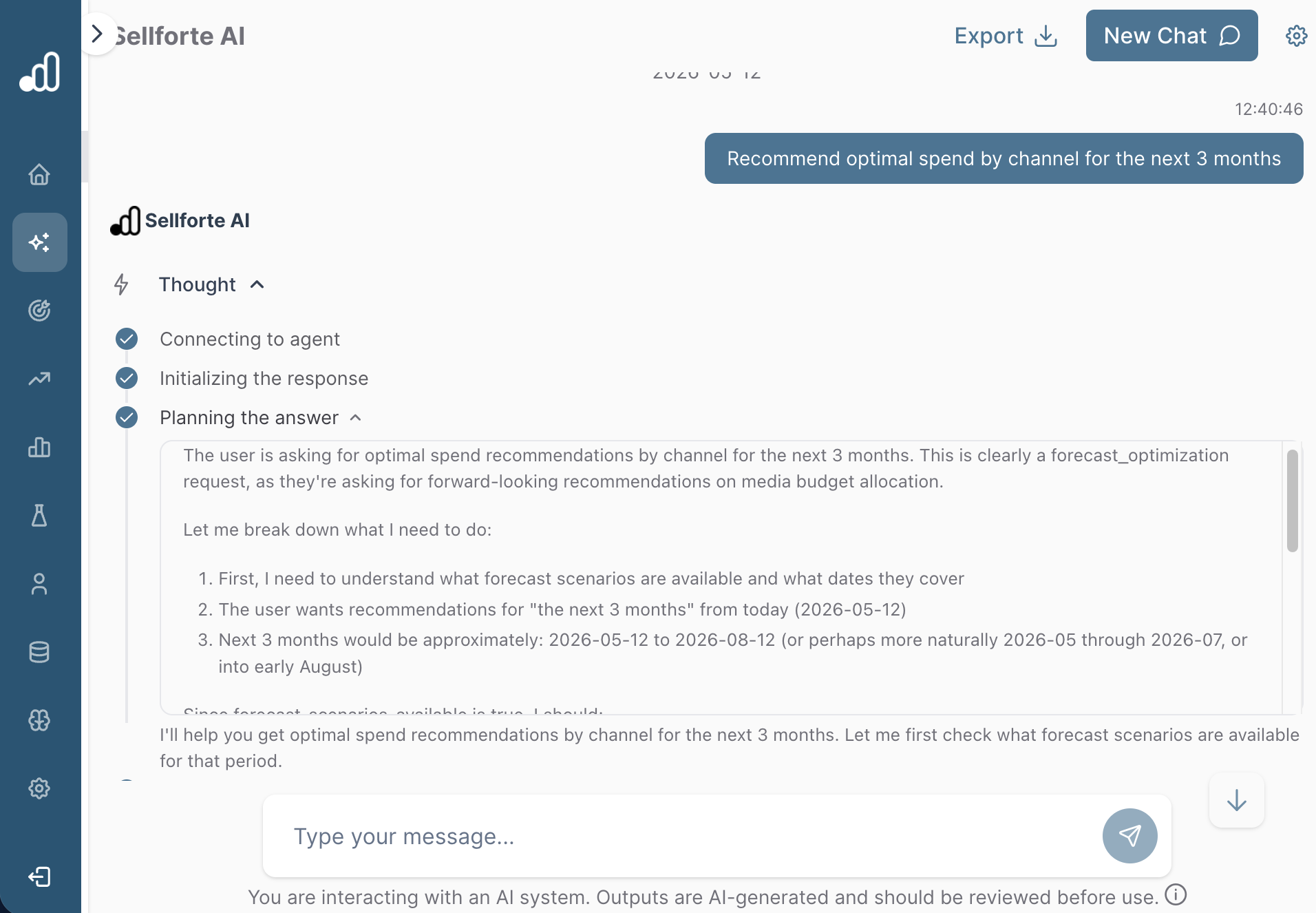
To illustrate reasoning flows in action, below is a screenshot from a Sellforte AI describing its interpretation of a user prompt as well as steps its taking to reply to it.
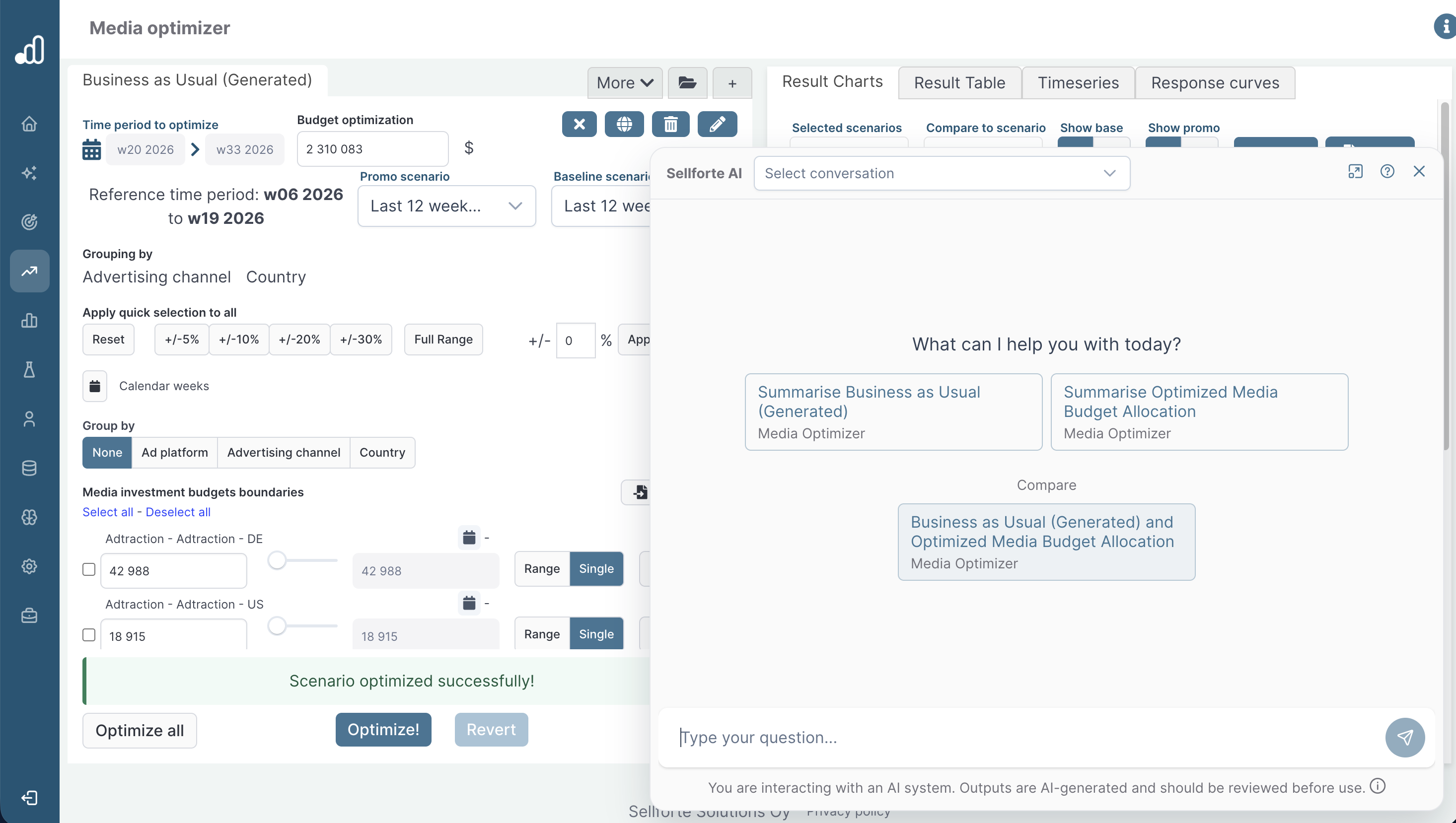
To illustrate a dual-window mode in action, below is a screenshot from a Sellforte AI interface over a budget optimizer tool. The AI on the right side of the screen can be asked to use the optimizer to find optimal budget allocations, and the user can continue scenario configuration in a manual mode on the left side of the screen if needed.
Category 8. Analytical Backbone
Everything in the previous categories measured what the AI does. This category is about what the AI is built on.
Modern marketing measurement and optimisation systems are built on three core methodologies: Marketing Mix Modeling, incrementality testing and attribution, as illustrated in the chart below.
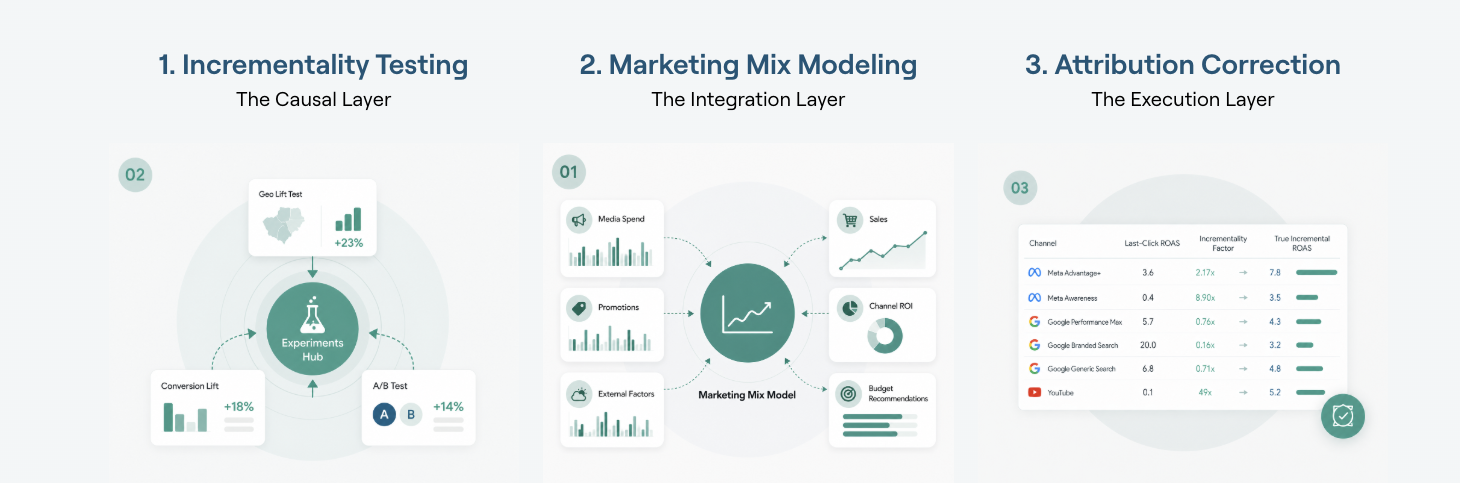
We evaluate whether the AI tool for Marketing Measurement & Optimization is powered by a Bayesian Marketing Mix Model calibrated with incrementality tests, whether model validation features are available, and whether there are transparent model configuration and calibration tools available for the user.
Category 9. Enterprise-grade platform
This final category measures whether the AI tools can operate in an enterprise environment, serving large organizations with mature IT policies.
The dimensions scored include large client references, security certifications (SOC 2, ISO 27001), data residency options between US and EU regions, multi-cloud support across AWS, GCP, and Azure, and enterprise authentication via single sign-on.
While mid-sized brands might not yet express all of these requirements, they will ultimately grow into a size where such requirements become not just relevant but mandatory for procurement approval.
Scoring the AI tools for Marketing Measurement & Optimization
For each of the criteria, we assigned a score:
- Score of 1: The platform fully supports the capability, based on clear evidence such as product screenshots or technical documentation.
- Score of 0.5: The platform partially supports the capability, or there is weak but inconclusive evidence for the existence of the capability on the platform.
- Score of 0: The platform does not support the capability, or we could not find public evidence that it does. Per our conservative scoring rule, the absence of evidence resulted in a 0 rather than a benefit of the doubt.
Scores were assigned based on three sources of evidence, in order of priority:
- Public vendor-provided clickable demo: This is the most valuable evidence, as we can validate capabilities first-hand.
- Public vendor-provided technical documentation and product demonstrations: help center articles, technical documentation, product videos, webinar recordings, case studies where product was presented.
- Vendor-disclosed screenshots and product demonstrations on third party platforms: Webinars, podcasts, conference presentations, G2, TrustRadius, and analyst reports where available.
In addition to the hard product evidence above, we sometimes considered vendors' marketing material, such as marketing claims on product pages, as supportive evidence. However, if we couldn't confirm these claims with the other sources mentioned above, we considered this weak evidence.
As a disclaimer, this scoring approach can be biased towards vendors who are transparent and open about the strengths and weaknesses about their product. It is harsh towards vendors who are not backing their marketing claims with actual product videos, demos and documentation. At the same time, this approach prevents vendors lacking an actual product scoring high.
What tools we evaluated: AI tools for Marketing Measurement & Optimization
We focused this article on AI tools for Marketing Measurement & Optimization that meet all three of the following criteria:
- Real product: Proven AI tool (with a conversational interface) for Marketing Measurement & Optimization that is offered as a dedicated tool or as part of a broader measurement platform.
- Used by recognized advertisers: The tool is used in production by enterprise brands, with at least some publicly verifiable customer references.
- Recognized by the industry: The tool has visible market presence, including coverage in industry press, analyst reports, social media discussion, or conference talks.
When searching for tools that would meet these criteria we looked into multiple product categories: Data connector companies, traditional Marketing Mix Modeling providers, next gen MMM vendors, Incrementality testing tools, attribution tools and generic AI tools. Surprisingly, we found out that AI adoption is still low in many of these categories. As an example, we found out that only 13% of Marketing Mix Modeling vendors have implemented AI. Many notable MMM players, such as Measured, Recast, Paramark, Incrmntal, Keen Decision Systems and Prescient AI don't have AI in their product.
For the first analysis batch, we evaluated seven AI tools for Marketing Measurement & Optimization matching the criteria above: Sellforte AI, Triple Whale Moby AI, Mutinex MAITE, Lifesight MIA, Fospha Spark AI, Funnel Data Chat and Haus Copilot.
We are updating this article with additional vendors during 2026, as new AI tools are introduced.
In-depth Comparison of AI tools for Marketing Measurement & Optimization
Here's the detailed in-depth comparison of AI tools for Marketing Measurement & Optimization:
| Category | Criterion | Sellforte AI | Triple Whale Moby AI | Mutinex MAITE | Lifesight MIA | Fospha Spark AI | Funnel Data Chat | Haus Copilot |
|---|---|---|---|---|---|---|---|---|
| 1. Marketing Data Reporting | ||||||||
| Marketing Data Reporting | 1.1 AI reports sales progress for online sales | 1 | 1 | 1 | 1 | 1 | 1 | 0 |
| 1.2 AI reports sales progress for offline store sales | 1 | 0.5 | 1 | 1 | 0 | 0.5 | 0 | |
| 1.3 AI reports digital media data (spend, impressions, clicks) | 1 | 1 | 1 | 1 | 1 | 1 | 0 | |
| 1.4 AI reports offline media data | 1 | 0.5 | 1 | 1 | 1 | 0.5 | 0 | |
| 2. Historical Performance Insights & Causal Explanation | ||||||||
| Historical Performance Insights & Causal Explanation | 2.1 AI measures incremental ROAS and incremental revenue for each digital channel | 1 | 1 | 1 | 1 | 1 | 0 | 0.5 |
| 2.2 AI measures incremental ROAS and incremental revenue for each offline channel | 1 | 0.5 | 1 | 1 | 1 | 0 | 0.5 | |
| 2.3 AI-reported incremental ROAS is updated daily | 1 | 0 | 0 | 1 | 1 | 0 | 0 | |
| 2.4 AI reports promotion-driven revenue, in addition to media-driven | 1 | 0 | 1 | 1 | 0 | 0 | 0 | |
| 2.5 AI explains why performance has changed (promotions, seasonality, weather, saturation…) | 1 | 0.5 | 1 | 1 | 0.5 | 0 | 0 | |
| 3. Channel-Level Optimization | ||||||||
| Channel-Level Optimization | 3.1 AI recommends optimal budget allocation by channel | 1 | 1 | 1 | 1 | 0 | 0 | 0 |
| 3.2 AI forecasts total revenue based on optimal budget allocation | 1 | 1 | 1 | 1 | 0 | 0 | 0 | |
| 3.3 AI provides miROAS and response curves for each channel | 0.5 | 0 | 1 | 1 | 0.5 | 0 | 0 | |
| 3.4 AI supports basic custom scenario planning (e.g., "what if I cut Meta by 20%?") | 1 | 1 | 1 | 1 | 0 | 0 | 0 | |
| 3.5 AI supports advanced scenario planning in natural language (constraints, multi-dimensional optimization…) | 1 | 1 | 1 | 1 | 0 | 0 | 0 | |
| 4. Campaign & Ad Set-Level Optimization | ||||||||
| Campaign & Ad Set-Level Optimization | 4.1 AI provides incremental ROAS of each campaign & ad set | 1 | 0 | 0 | 0 | 1 | 0 | 0 |
| 4.2 AI compares incremental ROAS to last-click and ad platform attribution ROAS | 1 | 0 | 0 | 0 | 1 | 0 | 0 | |
| 4.3 AI provides miROAS for each campaign & ad set | 0.5 | 0 | 0 | 0 | 0 | 0 | 0 | |
| 4.4 AI recommends optimal spend for each campaign & ad set | 0.5 | 1 | 0 | 0 | 0 | 0 | 0 | |
| 4.5 AI recommends optimal bid value for each campaign & ad set | 0.5 | 0.5 | 0 | 0 | 0 | 0 | 0 | |
| 4.6 AI provides pre/post analysis for each bidding change | 0.5 | 0 | 0 | 0 | 0 | 0 | 0 | |
| 5. Incrementality Testing | ||||||||
| Incrementality Testing | 5.1 Summarizes all incrementality tests done by the company | 0.5 | 0.5 | 0 | 0 | 0 | 0.5 | 0 |
| 5.2 Provides in-depth report for geo tests | 0.5 | 1 | 0 | 0 | 0 | 0.5 | 1 | |
| 5.3 Provides in-depth report for own media A/B tests | 0.5 | 0 | 0 | 0 | 0 | 0 | 0 | |
| 5.4 Provides in-depth report for Conversion Lift tests | 0.5 | 1 | 0 | 0 | 0 | 0 | 0 | |
| 5.5 Provides testing recommendations on which channels to test | 0.5 | 1 | 0 | 0 | 0 | 0 | 1 | |
| 5.6 Provides test design recommendations | 0 | 1 | 0 | 0 | 0 | 0 | 1 | |
| 6. Agentic Execution & Autonomy | ||||||||
| Agentic Execution & Autonomy | 6.1 AI can push budget/bidding changes to Meta / Google / TikTok APIs | 0.5 | 1 | 0 | 0 | 0 | 0 | 0 |
| 6.2 AI's level of autonomy for execution can be configured | 0.5 | 1 | 0 | 0 | 0 | 0 | 0 | |
| 6.3 AI has specialized agents for distinct workflows | 1 | 1 | 1 | 0.5 | 0 | 0 | 0 | |
| 6.4 Proactive insights & alerts via AI | 0 | 1 | 0 | 0 | 0 | 0 | 0 | |
| 7. UX & Conversational Interface | ||||||||
| UX & Conversational Interface | 7.1 Includes tables and charts inline in AI responses | 1 | 1 | 1 | 1 | 1 | 1 | 0 |
| 7.2 AI has conversation history & multi-turn context retention | 1 | 1 | 1 | 1 | 0.5 | 1 | 0.5 | |
| 7.3 Allows convenient export of AI outputs (e.g., PDF, Slides, CSV) | 0.5 | 0.5 | 1 | 1 | 0 | 1 | 0 | |
| 7.4 AI grounds answers in data, providing links from outputs to deep-dive dashboards | 1 | 1 | 0.5 | 0.5 | 1 | 1 | 0 | |
| 7.5 AI operates in embedded and multi-window mode (chat + dashboard side-by-side) | 1 | 1 | 1 | 0 | 1 | 0 | 1 | |
| 7.6 AI shows its reasoning steps and logic while answering | 1 | 1 | 0.5 | 0.5 | 0.5 | 1 | 0 | |
| 7.7 AI handles non-English questions in production | 1 | 0.5 | 0 | 0 | 0.5 | 0 | 0 | |
| 7.8 AI can be accessed via MCP server / external LLM | 0 | 1 | 0 | 1 | 1 | 1 | 0 | |
| 8. Analytical Backbone | ||||||||
| Analytical Backbone | 8.1 AI provides deterministic, model-backed answers with Bayesian MMM as backbone | 1 | 1 | 1 | 1 | 1 | 0 | 0 |
| 8.2 Bayesian MMM used by the AI is calibrated with incrementality tests | 1 | 1 | 0 | 1 | 1 | 0 | 0 | |
| 8.3 AI reports model validation and other modelling KPIs | 1 | 1 | 1 | 1 | 0 | 0 | 0 | |
| 8.4 Model calibration & configuration settings (e.g., priors) are auditable and editable in a self-serve UI | 1 | 0 | 0 | 0 | 0 | 0 | 0 | |
| 9. Enterprise-Grade Platform | ||||||||
| Enterprise-Grade Platform | 9.1 At least 10 public reference customers from $1B+ revenue brands | 1 | 0 | 1 | 0.5 | 0 | 1 | 1 |
| 9.2 SOC 2, ISO 27001, or audited IT security by a third-party cyber security auditor | 1 | 1 | 1 | 1 | 1 | 1 | 1 | |
| 9.3 Data residency: geography option between US and EU | 1 | 0 | 0 | 0 | 0 | 1 | 0 | |
| 9.4 Multi-cloud: option between AWS, GCP, and Azure | 1 | 0 | 0 | 0 | 0 | 0 | 0 | |
| 9.5 Supports single sign-on (SSO) for enterprises | 1 | 0 | 1 | 0 | 0 | 1 | 0 | |
| 9.6 Customer data is not shared to a third-party LLM (LLM deployed in customer-specific cloud container) | 1 | 0 | 1 | 0 | 0 | 1 | 0 | |
| 9.7 Hands-on demo or trial of the AI is available without sales-call gating | 1 | 1 | 0 | 0 | 0 | 0 | 0 | |
| Total | 39.5 / 49 | 31 / 49 | 25 / 49 | 24 / 49 | 17.5 / 49 | 15 / 49 | 7.5 / 49 | |
1. Sellforte AI (scoring 39.5 out of 49): Enterprise-grade AI tool for Channel and Campaign-level optimization
Overview
Sellforte AI is an enterprise-grade AI tool for marketing teams, supporting channel- and campaign-level media spend optimization, grounded in Sellforte's best-in-class analytical backbone covering MMM, incrementality testing and incrementality-corrected attribution.
Sellforte AI scores 39.5 out of 49, placing it on the first place in this comparison. While performing well in most assessed categories in this evaluation, its main differentiator is campaign & ad set level optimization, providing advertisers with spend and bidding recommendations for each campaign and ad set, that can be executed on the ad platforms. Sellforte AI's main limitation is that all the capabilities of the broader Sellforte platform are not yet available via the AI, and Sellforte AI lacks an MCP.
Evaluation summary
| Category | Sellforte AI |
|---|---|
| 1. Marketing Data Reporting | 4 / 4 |
| 2. Historical Performance Insights & Causal Explanation | 5 / 5 |
| 3. Channel-Level Optimization | 4.5 / 5 |
| 4. Campaign & Ad Set-Level Optimization | 4 / 6 |
| 5. Incrementality Testing | 2.5 / 6 |
| 6. Agentic Execution & Autonomy | 2 / 4 |
| 7. UX & Conversational Interface | 6.5 / 8 |
| 8. Analytical Backbone | 4 / 4 |
| 9. Enterprise-Grade Platform | 7 / 7 |
| Total score out of 49 | 39.5 |
Strengths
Only AI in this comparison with strong campaign and ad-set-level optimization capabilties. Sellforte scores 4 out of 6 on Campaign and ad-set-level optimization, the highest in this category. The AI surfaces incremental ROAS for each campaign and ad set, compares it to last-click and platform-reported ROAS, and recommends optimal spend and bidding parameters for each campaign and ad set. This makes Sellforte AI a strong choice for marketers looking for an optimization & execution tools, not just a measurement tool.
Strong channel-level optimization. Sellforte AI scores 4.5 out of 5 on Channel-level optimization. The AI recommends optimal budget allocation across Meta, Google, TikTok, and other channels; forecasts expected total revenue under the recommended allocation broken down into base, media-driven, and promo-driven sales; supports custom what-if scenarios; and handles advanced scenario planning in natural language including multi-dimensional optimization and arbitrary constraints.
Strongest analytical backbone and model transparency. Sellforte AI scores 4 out of 4 on Analytical Backbone, the only full score in this category. The Bayesian MMM is calibrated with incrementality tests, the AI reports model-validation KPIs. Model priors and calibration parameters are inspectable and editable in a self-serve UI. Data science and analytics teams that want to access model configuration will find Sellforte AI a strong choice.
Enterprise-grade platform coverage. Sellforte AI scores 7 out of 7 on Enterprise-Grade Platform. It has more strong list of $1B+ revenue reference customers, strong IT security compliance, offers US and EU data residency options, supports multi-cloud deployment across AWS, GCP, and Azure, supports SSO, isolates LLM inference inside customer-specific cloud infrastructure with no customer data shared to third-party LLMs, and provides a hands-on demo of the AI without sales-call gating.
Limitations
Partial incrementality test coverage in the AI chat. Sellforte AI scores 2.5 out of 6 on Incrementality testing. This reflects the fact that experimentation capabilities of the Sellforte platform are still being integrated to Sellforte AI, with integration expected to be completed during 2026.
Partial agentic execution and autonomy. Sellforte AI scores 2 out of 4 on Agentic Execution and Autonomy. While the Sellforte platform can execute bidding changes on advertising platforms, Sellforte has yet to announce a full autonomous agent into the Sellforte AI with configurable levels of autonomy.
No MCP server for external LLM access. Sellforte scores 6.5 out of 8 on UX and Conversational Interface. This is strong overall, with inline charts and tables, multi-turn context retention, partial export to PDF and Slides and CSV, deep-links from AI outputs into dashboards, embedded side-by-side mode against a live dashboard, reasoning steps shown while answering, and multilingual production support across at least five major languages. However, Sellforte currently lacks MCP server access for external LLMs.
Notable Reference Customers
Sellforte lists following companies as examples of public reference customers:
- Fashion Ecommerce: bonprix, Azzas 2154, Represent, Odlo
- Home & Furniture Ecommerce: Finnish Design Shop
- Specialty Ecommerce: FCP Euro, Smartphoto, Caseking
- Grocery Retail: Lidl
- Fashion Retail: C&A, KIK
- Cosmetics Retail: Douglas
- Sport Retail: Interpsort
- Pet Retail: Fressnapf, Musti Group
- Specialty Retail: Tchibo
- Electronics Retail: Verkkokauppa.com
- Other segments: Telenor (Telecommunications), Paysafe (Payments), eBilet (part of Allegro Group, Events)
Best for
Sellforte AI is best for marketing teams looking for an enterprise-grade AI tool that supports channel- and campaign-level media spend optimization, grounded in best-in-class analytical backbone covering MMM, incrementality testing and incrementality-corrected attribution. Sellforte is particularly strong in Retail and Ecommerce.
Comments about evaluation
Sellforte AI was the only AI tool whose features and capabilities could be evaluated and verified in a real-life public demo that can be accessed without sign-up: https://demo.sellforte.com/. This made Sellforte AI's assessment easier and high-quality than for the other AI tools in this in-depth review. Sellforte's reference customers were also convenient to check, as the company has a practice of announcing new customers in their blog and the company inlcludes logos on their website.
2. Triple Whale Moby AI (scoring 31 out of 49): Advanced AI tool for small- and mid-size ecoms
Overview
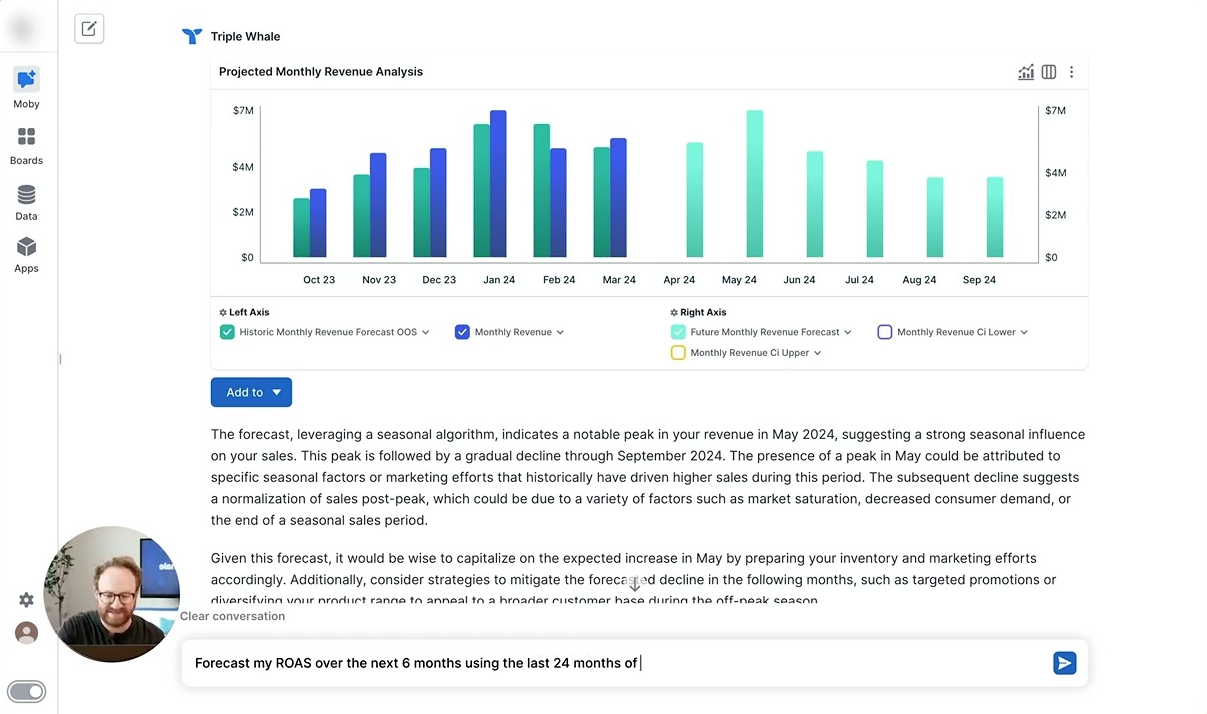
Triple Whale Moby AI is a conversational AI built primarily for small and mid-sized ecommerce & DTC brands. The AI layer and the conversational UX of the tool is the strongest in this review, but the robustness of the underlying Marketing Mix Model, that is required for high-quality optimization, is lighter compared to full-scale MMM providers.
Triple Whale has started invest in AI capabilities earlier than many other vendors, and that also shows in high scores that it's earning in this review.
Evaluation summary
| Category | Triple Whale Moby AI |
|---|---|
| 1. Marketing Data Reporting | 3 / 4 |
| 2. Historical Performance Insights & Causal Explanation | 2 / 5 |
| 3. Channel-Level Optimization | 4 / 5 |
| 4. Campaign & Ad Set-Level Optimization | 1.5 / 6 |
| 5. Incrementality Testing | 4.5 / 6 |
| 6. Agentic Execution & Autonomy | 4 / 4 |
| 7. UX & Conversational Interface | 7 / 8 |
| 8. Analytical Backbone | 3 / 4 |
| 9. Enterprise-Grade Platform | 2 / 7 |
| Total score out of 49 | 31 |
Strengths
Solid channel-level optimization and scenario planning. Triple Whale Moby AI scores 4 / 5 on Channel-Level Optimization. It recommends optimal budget allocation across channels, forecasts revenue under the recommended allocation, and supports both basic ("what if I cut Meta by 20%?").
Best-scoring vendor in agentic execution and autonomy. Triple Whale Moby AI scores 4 / 4 on Agentic Execution & Autonomy. It can push budget and bidding changes directly to Meta, Google, and TikTok APIs, supports a configurable spectrum from insight-only to fully autonomous execution, runs specialized agents for distinct workflows rather than a single general-purpose chatbot, and can proactively surfaces anomalies and scheduled reports via Slack and email.
Strong conversational UX. Triple Whale Moby AI scores 7 / 8 on UX & Conversational Interface, earning it the top score in this category. It includes inline tables and charts in responses, retains multi-turn conversation context, surfaces reasoning steps and assumptions while answering, operates in side-by-side embedded mode, and is accessible via MCP server so external LLMs can query it directly.
Limitations
Limited causal explanation of past performance. Triple Whale Moby AI scores 2 / 5 on Historical Performance Insights & Causal Explanation. Incremental ROAS is reported for digital, but measurement for offline channels is limited. The underlying Marketing Mix Model for causal explanation not updated daily and the AI lacks the ability to tie sales changes to promotions, pricing, seasonality, and other non-media drivers, leaving users with attribution-style answers rather than true causal explanations of why performance moved.
Limited ability to support with campaign and ad-set-level optimization. Triple Whale Moby AI scores 1.5 / 6 on Campaign & Ad Set-Level Optimization. It does not report incremental ROAS or miROAS for each campaign and ad set. It also does not provide a comparison of incremental ROAS to last-click or platform ROAS, and it does not provide pre/post analysis of executed bidding changes, making it hard to evaluate whether tactical optimizations are actually driving incremental revenue.
Analytical backbone is lighter compared to full-scale MMM providers. Triple Whale Moby AI scores 3 / 4 on Analytical Backbone. Triple Whale Moby AI's roots are in multi-touch attribution and while it has a Bayesian MMM, the model doesn't have similar robustness and configurability one would expect from a full-scale MMM. As an example, it's priors and configuration settings are not auditable or editable in a self-serve UI, so customers cannot inspect or adjust the assumptions behind the AI's recommendations.
Enterprise-grade gaps. Triple Whale Moby AI scores 2 / 7 on Enterprise-Grade Platform, making it one the lowest scoring platforms on this dimensions. We couldn't find 10+ public reference customers from $1B+ revenue brands, there is no US/EU data residency choice and we couldn't find a multi-cloud deployment option or SSO. Customer data is not isolated from third-party LLM APIs, making it unclear how the data is protected. Additionally, Triple Whale Moby AI is not built for multi-language companies, as verified operability on multiple languages is missing. This positions Triple Whale Moby AI more for DTC and mid-market than for enterprise procurement.
Best for
Triple Whale Moby AI is best for small and mid-sized ecommerce businesses requiring a strong AI tool, but for whom incrementality-based optimization at the campaign & ad set level and enterprise-grade MMM and is not a priority.
Comments about evaluation
While not providing a public no-sign-up demo for verified capabilities of Triple Whale Moby AI, they have a reasonable amount product demo videos (example: Moby 2 product video), documentation and screenshots available for evaluating its capabilities. Companies can also evaluate Triple Whale Moby AI by using Triple Whale's 30-day money-back guarantee option.
3. Mutinex MAITE (scoring 25 out of 49): Enterprise-focused AI tool for channel-level spend optimization
Overview
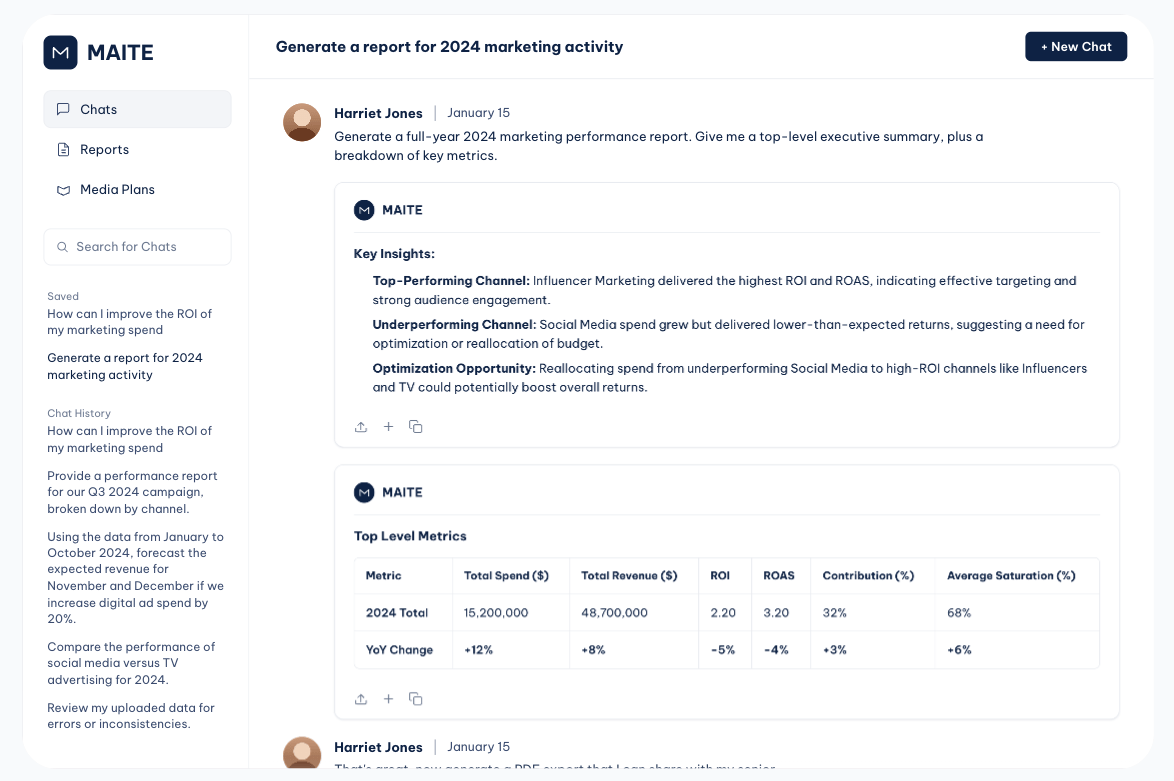
Mutinex MAITE is a conversational AI built on top of Mutinex's GrowthOS MMM platform. Mutinex MAITE has solid features for channel-level optimization and a good conversational UX. However, Mutinex MAITE does not provide campaign & ad set level spend or bidding recommendations, and it is not able to execute bidding changes on Meta, Google and other ad platforms. Mutinex MMM is also not calibrated with incrementality tests, and the platform lacks incrementality testing features, such as geo test analysis, conversion lift test analysis and A/B test analysis, in general.
Evaluation summary
| Category | Mutinex MAITE |
|---|---|
| 1. Marketing Data Reporting | 4 / 4 |
| 2. Historical Performance Insights & Causal Explanation | 4 / 5 |
| 3. Channel-Level Optimization | 5 / 5 |
| 4. Campaign & Ad Set-Level Optimization | 0 / 6 |
| 5. Incrementality Testing | 0 / 6 |
| 6. Agentic Execution & Autonomy | 1 / 4 |
| 7. UX & Conversational Interface | 5 / 8 |
| 8. Analytical Backbone | 2 / 4 |
| 9. Enterprise-Grade Platform | 4 / 7 |
| Total score out of 49 | 25 |
Strengths
Strong channel-level optimization. Mutinex MAITE scores 5 / 5 on Channel-Level Optimization due to its background as an MMM provider. It recommends optimal budget allocation across channels, forecasts total revenue under the recommended allocation, provides miROAS and response curves per channel, and supports both basic and more scenario planning.
Solid causal explanation of past performance. Mutinex MAITE scores 4 / 5 on Historical Performance Insights & Causal Explanation. It reports incremental ROAS and incremental revenue for both digital and offline channels, surfaces promotion-driven revenue alongside media-driven revenue, and ties sales changes to specific drivers like promotions, seasonality, and weather, giving users genuine causal explanations rather than attribution-style answers.
Enterprise credibility. Mutinex MAITE scores 4 / 7 on Enterprise-Grade Platform. It has 10+ public reference customers from $1B+ revenue brands, holds SOC 2 / ISO 27001 certification, supports SSO for enterprise authentication, and runs AI inference within isolated cloud infrastructure so customer data does not egress to third-party LLM APIs.
Limitations
No campaign or ad-set-level optimization. MAITE scores 0 / 6 on Campaign & Ad Set-Level Optimization. It does not report incremental ROAS or miROAS per campaign and ad set, does not compare incremental ROAS to last-click or platform ROAS, does not recommend optimal spend or bid values at the campaign and ad-set level, and does not provide pre/post analysis of executed bidding changes, leaving a gap for teams that want to push MMM-driven insights down to tactical execution.
No incrementality testing capabilities. Mutinex MAITE scores 0 / 6 on Incrementality Testing because Mutinex platform does not provide incrementality testing . The AI does not summarize past incrementality tests, does not generate in-depth reports for geo, A/B, or Conversion Lift tests, and does not recommend what to test next or how to design tests. Mutinex MMM is also not calibrated with incrementality tests,.
Limited agentic execution and autonomy. Mutinex MAITE scores 1 / 4 on Agentic Execution & Autonomy, the main gap being the inability to push budget or bidding changes to Meta, Google, or TikTok APIs.
Best for
Mutinex MAITE is best for large enterprises who require an AI tool for optimizing media spend across channels, but for whom campaign & ad set level optimization or causal experimentation is not a priority.
Comments about evaluation
Mutinex is not actively sharing detailed information about MAITE. The evaluation in this article is primarily based on the Mutinex MAITE product marketing page, which includes short video demonstration of the product. Mutinex does not provide a public demo, where the features of Mutinex MAITE could be verified through first-hand testing.
4. Lifesight MIA (scoring 24 out of 49): AI for channel-level spend optimization on the Lifesight platform
Overview
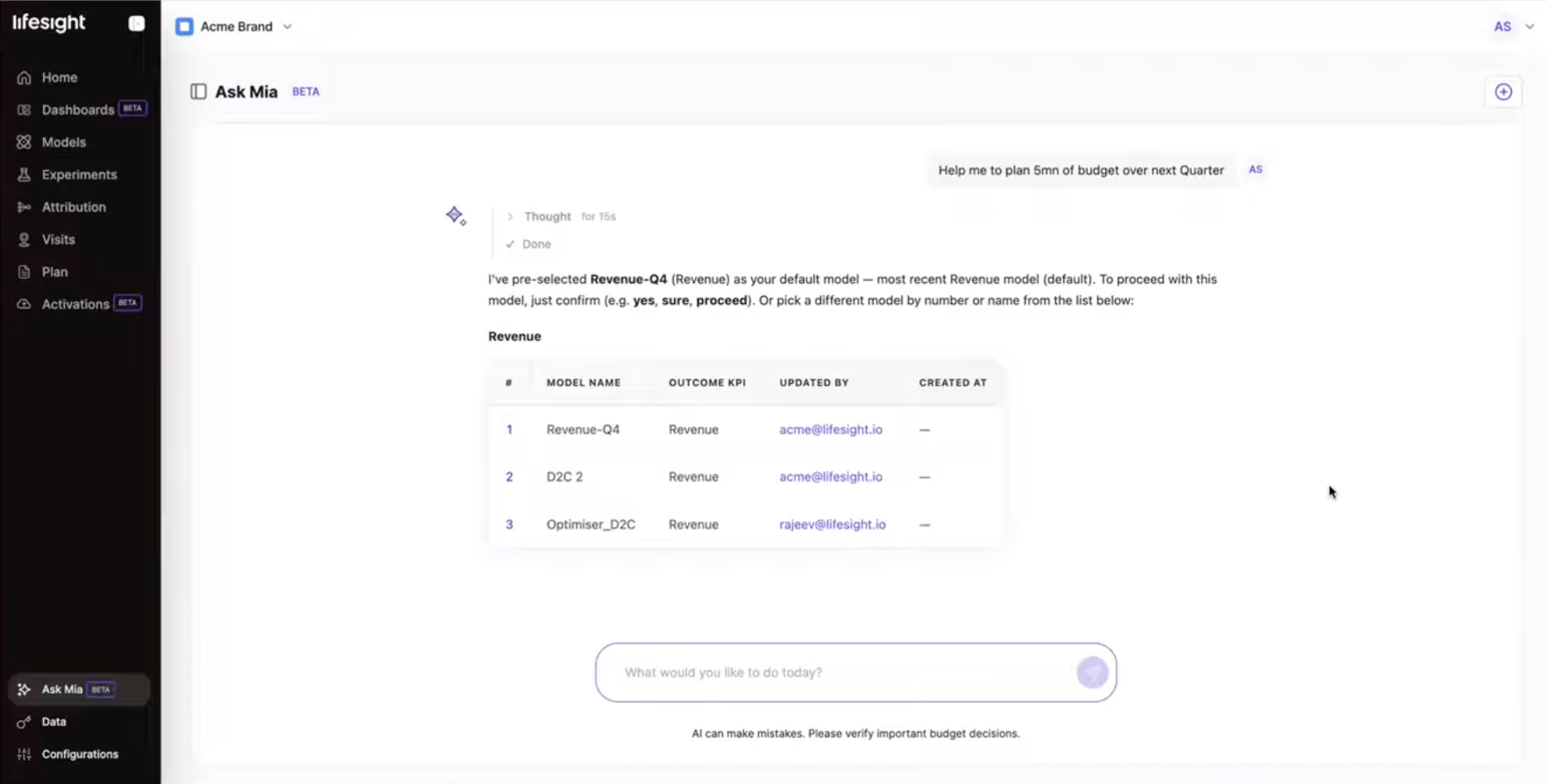
Lifesight MIA is an AI layer on top of Lifesight's Unified Measurement OS, covering MMM and geo lift tests. Lifesight MIA is strongest in marketing data reporting, historical performance insights, and channel-level optimization. It's main gaps are in incrementality testing, campaign and ad ad set level optimization, and agentic execution.
Evaluation summary
| Category | Lifesight MIA |
|---|---|
| 1. Marketing Data Reporting | 4 / 4 |
| 2. Historical Performance Insights & Causal Explanation | 5 / 5 |
| 3. Channel-Level Optimization | 5 / 5 |
| 4. Campaign & Ad Set-Level Optimization | 0 / 6 |
| 5. Incrementality Testing | 0 / 6 |
| 6. Agentic Execution & Autonomy | 0.5 / 4 |
| 7. UX & Conversational Interface | 5 / 8 |
| 8. Analytical Backbone | 3 / 4 |
| 9. Enterprise-Grade Platform | 1.5 / 7 |
| Total score out of 49 | 24 |
Strengths
Strong historical performance insights and causal explanation. Lifesight MIA scores 5 out of 5 in this category. Lifesight MIA reports incremental ROAS and incremental revenue for both online and offline channels grounded in Lifesight's MMM. It surfaces promotion-driven revenue alongside media-driven revenue, and explains performance changes by tying them to specific drivers.
Solid channel-level optimization. Lifesight MIA scores 5 out of 5 in this category. It gives natural language recommendations for spend allocations across channels, taking into account saturation/response curves per channel. The platform supports both basic what-if questions and advanced natural-language scenario planning.
MCP server for external LLM access. Lifesight MIA can be accessesd through an MCP server, allowing Claude and ChatGP Tto query Lifesight directly.
Limitations
No campaign and ad-set-level optimization. Lifesight MIA scores 0 out of 6 in this category. Lifesight MIA can reallocate budget across channels but does not provide optimal spend or bidding parameters for each campaign and ad set. It also lacks pre/post analysis on executed bidding changes.
No incrementality test analysis or recommendations. Lifesight MIA scores 0 out of 6 in this category. Although Lifesight platform covers one of the three incrementality test methods, geo-lift testing, we couldn't find evidence those being available for Lifesight MIA. Lifesight also lacks a unified incrementality experiment library covering also conversion lift tests and own media A/B tests.
Lack of agentic execution and autonomy. Lifesight MIA scores 0.5 out of 4 in this category. We couldn't find public evidence of Lifesight's MIA's agentic execution capabilities, such as ability to to bidding paramters changes directly through Meta, Google, or TikTok APIs. Buyers who want autonomous execution should pressure-test these claims in a demo.
Not ideal for buyers requiring enteprise capabilities. Lifesight MIA scores 1.5 out of 7. The platform is SOC 2 compliant. However, we couldn't confirm several features important for major multi-country advertisers, such as US/EU data residency option, multi-cloud option, SSO, and customer data isolation from third-party LLMs. Additionally, there is no public no-sign-up demo of Lifesight MIA, every entry point is sales-gated.
Best for
Lifesight MIA is best for marketers requiring AI-based performance reporting and channel-level optimization on the Lifesight platform, but for whom campaign & ad set level optimization is not a priority.
Comments about evaluation
Public details about Lifesight MIA are scarce. Our main source for verifying MIA's capabilities was a 1-hour product discussion posted by Lifesight: An Insider's Look at How to Use Marketing Intelligence Agents. Even in this video, it seems Lifesight is playing product videos for the audience and not actually live-demonstrating the product. Lifesight does not provide a public demo, where the features of Lifesight MIA could be verified through first-hand testing.
5. Fospha Spark AI (scoring 17.5 out of 49): AI insights for the Fospha platform
Overview
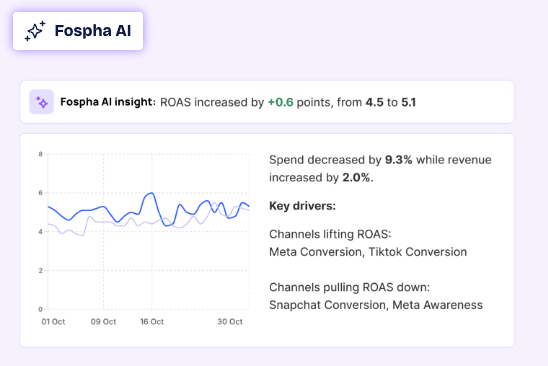
Fospha Spark AI is the AI layer on top of Fospha's measurement platform covering MTA and bayesian MMM, positioned for DTC and consumer brands.
Fospha Spark AI scored 17.5 out of 49, making it one of the less mature AI tools in the market. While it can provide basic marketing data reporting & historical performance insights for digital channels, it lacks robust future-looking optimization capabilities due to a lighter MMM compared to the more advanced MMM vendors.
Evaluation summary
| Category | Fospha Spark AI |
|---|---|
| 1. Marketing Data Reporting | 3 / 4 |
| 2. Historical Performance Insights & Causal Explanation | 3.5 / 5 |
| 3. Channel-Level Optimization | 0.5 / 5 |
| 4. Campaign & Ad Set-Level Optimization | 2 / 6 |
| 5. Incrementality Testing | 0 / 6 |
| 6. Agentic Execution & Autonomy | 0 / 4 |
| 7. UX & Conversational Interface | 5.5 / 8 |
| 8. Analytical Backbone | 2 / 4 |
| 9. Enterprise-Grade Platform | 1 / 7 |
| Total score out of 49 | 17.5 |
Strengths
Marketing data reporting. Fospha Spark AI scores 3 out of 4 in this category. It reports digital media KPIs (impressions, clicks, spend, conversions) natively across Meta, Google, TikTok and surfaces ecommerce sales development.
Historical performance insights and causal explanation. Fospha Spark AI scores 3.5 out of 5 in this category. Spark reports incremental ROAS and incremental revenue, grounded in Fospha's MMM.
MCP server. Fospha Spark AI exposes data through an MCP server for external LLMs to query directly.
Limitations
Limited channel-level optimization. Fospha Spark AI scores 0.5 out of 5 in this category. There is no documented optimal budget allocator returning a full cross-channel plan via natural language, no forecast of total revenue under a recommended allocation, no documented what-if scenario engine surfaced through chat.
Lack of campaign and ad-set optimization, no bid-level coverage. Fospha Spark AI scores 2 out of 6 in this category. It does not surface campaign- or ad-set-level marginal incremental ROAS, and does not recommend optimal spend or bids per campaign. There is no pre/post analysis of executed bidding changes available through chat.
No incrementality testing. Fospha Spark AI scores 0 out of 6 in this category. Fospha platform does not cover geo testing, Conversion Lift tests, or A/B testing, making this a gap also for Fospha Spark AI.
No agentic execution or autonomy. Fospha Spark AI scores 0 out of 4 in this category. As an example. there is no documented capability to push budget or bidding changes to Meta, Google, or TikTok APIs
Best for
Fospha Spark AI is best for small ecommerce businesses requiring historical performance reporting based on Fospha measurement, but for whom future-looking optimization and enterprise-grade measurement platform covering also causal experimentation is not a priority.
Comments about evaluation
Detailed public information about Fospha Spark AI is limited. The evaluation in this article is primarily based on the Fospha Spark AI product page, and Fospha MCP support center article. Fospha does not provide a public demo for Fospha Spark AI, where the features of Fospha Spark AI could be verified through first-hand testing.
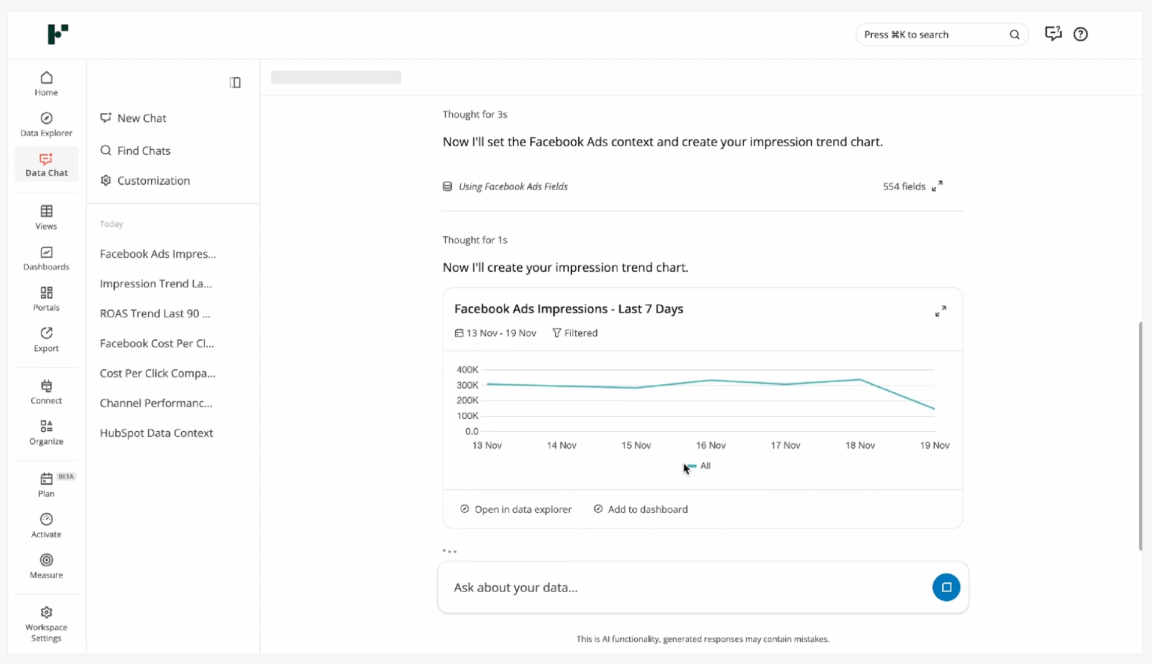
6. Funnel Data Chat (scoring 15 out of 49): AI tool for marketing data reporting
Overview
Fospha Data Chat is the AI layer on top of Funnel's data connectors, focused on basic marketing data reporting.
Funnel Data Chat scores 15 out of 49, placing sixth in this comparison. Funnel's positioning is data infrastructure first, with Funnel Data Chat layered on top as a natural language interface for marketing data. Funnel Data Chat lacks analytical backbone based on MMM, meaning that it is not able to support optimization or historical performance based on incrementality. This might change in the future, as Funnel's broader offering includes MMM.
Evaluation summary
| Category | Funnel Data Chat |
|---|---|
| 1. Marketing Data Reporting | 3 / 4 |
| 2. Historical Performance Insights & Causal Explanation | 0 / 5 |
| 3. Channel-Level Optimization | 0 / 5 |
| 4. Campaign & Ad Set-Level Optimization | 0 / 6 |
| 5. Incrementality Testing | 1 / 6 |
| 6. Agentic Execution & Autonomy | 0 / 4 |
| 7. UX & Conversational Interface | 6 / 8 |
| 8. Analytical Backbone | 0 / 4 |
| 9. Enterprise-Grade Platform | 5 / 7 |
| Total score out of 49 | 15 |
Strengths
Strong marketing data reporting. Funnel data Chat scores 3 out of 4 in this category. It reports spend, impressions, clicks, and conversions natively across Meta, Google, TikTok, and other major paid platforms,
Strong UX and conversational interface. Funnel Data Chat scores 6 out of 8 in this category. Strengths include inline charts and tables in chat responses, multi-turn context retention, conversation history and a seamless pivot from chat into Data Explorer for deeper analysis. It also includes MCP that can be accessed by Claude and ChatGPT.
Enterprise-grade platform. Funnel Data Chat scores 5 out of 7 on Enterprise-Grade Platform, a capability Funnel has built over the years of providing data connector services to companies of all size.
Limitations
No historical performance insights or causal explanation. Funnel Data Chat scores 0 out of 5 in this category. Not provided as Funnel Data Chat is not connected to an MMM.
No channel-level optimization. Funnel Data Chat scores 0 out of 5 in this category. Not provided as Funnel Data Chat is not connected to an MMM.
No campaign or ad-set-level optimization. Funnel Data Chat scores 0 out of 6 in this category. Not provided as Funnel Data Chat is not connected to an MMM.
Best for
Funnel Data Chat is best for companies with an existing Funnel subscription needing a quick access to raw marketing data, but for whom incrementality-based marketing measurement is not a priority.
Comments about evaluation
In-depth public information about Funnel Data Chat is limited. The evaluation in this article is largely based on the Funnel Data Chat product page, and Funnel Data Chat support center article. Funnel lacks a public demo for Funnel Data Chat, meaning that we couldn't verify features by directly testing the features.
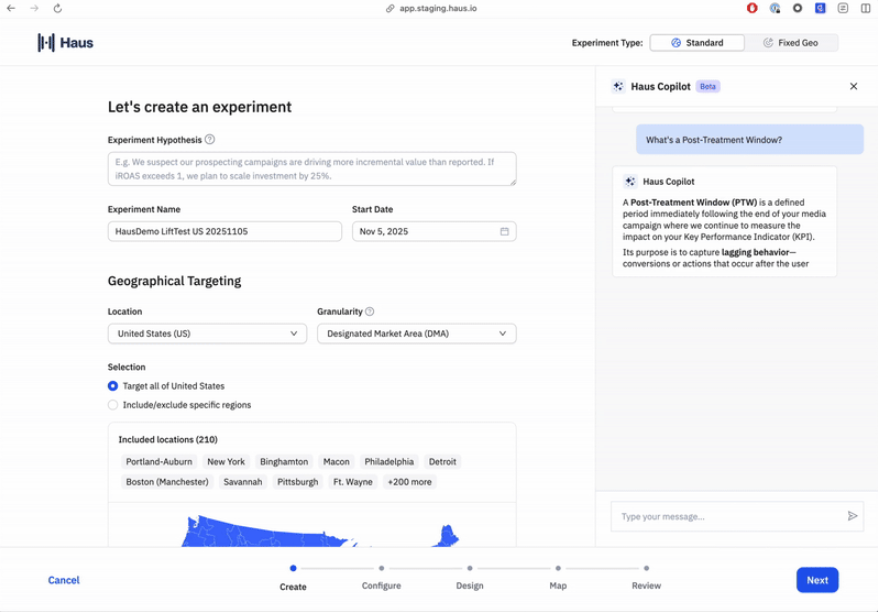
7. Haus Copilot (scoring 7.5 out of 49): AI helper for Geo tests on the Haus platform
Overview
Haus Copilot is an AI helper tool for the Haus geo testing platform. It scores 7.5 out of 49, the lowest score in this comparison. It helps users with Haus geo tests, but has significant gaps in all other evaluated areas, including measurement, channel optimization and campaign-level optimisation.
Evaluation summary
| Category | Haus Copilot |
|---|---|
| 1. Marketing Data Reporting | 0 / 4 |
| 2. Historical Performance Insights & Causal Explanation | 1 / 5 |
| 3. Channel-Level Optimization | 0 / 5 |
| 4. Campaign & Ad Set-Level Optimization | 0 / 6 |
| 5. Incrementality Testing | 3 / 6 |
| 6. Agentic Execution & Autonomy | 0 / 4 |
| 7. UX & Conversational Interface | 1.5 / 8 |
| 8. Analytical Backbone | 0 / 4 |
| 9. Enterprise-Grade Platform | 2 / 7 |
| Total score out of 49 | 7.5 |
Strengths
Incrementality testing (focus on geo tests). Haus Copilot scores 3 out of 6 in this category. Haus Copilot summarizes geo test results and support in geo test design & planning.
Limitations
No marketing data reporting. Haus Copilot scores 0 out of 4 in this category.
No channel-level optimization. Haus Copilot scores 0 out of 5 in this category.
No campaign or ad-set-level optimization. Haus Copilot scores 0 out of 6 in this category.
Best for
Haus Copilot is best for companies already using the Haus platform and benefit from AI's support for interpreting and designing geo tests.
Comments about evaluation
In-depth public information about Haus Copilot is not available. The evaluation in this article is largely based on Haus's article on AI features of the Haus platform, which shows a demonstration video of Haus Copilot. Haus does not provide a public demo for Haus Copilot, meaning that we couldn't verify features by directly testing the features.
Frequently Asked Questions (FAQ)
1. What are AI tools for Marketing Measurement & Optimization?
AI tools for Marketing Measurement & Optimization help marketers measure media performance, optimize marketing spend allocation and execute optimization actions through a conversational, natural language interface.
2. What the best-performing AI tools for Marketing Measurement & Optimization?
Sellforte AI, Triple Whale Moby AI, and Mutinex MAITE are currently the leading AI tools for Marketing Measurement & Optimization, based on the 49-criteria evaluation in this article.
Limitations & Disclosures
Author affiliation. This comparison is published by Sellforte, one of the platforms evaluated. We have made every effort to score competitors fairly using the same evidence standards we applied to ourselves, and we deliberately included criteria that customers value but where Sellforte does not score perfectly. That said, readers should weigh our affiliation when interpreting the results, and we encourage cross-referencing with vendor documentation, customer references, and independent analyst coverage.
Scope. This comparison primarily focuses on recognized commercial vendors.
Snapshot in time. Vendor capabilities evolve quickly, particularly in AI-powered insights, ad platform integrations, and security certifications. This comparison reflects publicly available information as of May 2026. Features released after that date are not yet reflected.
Corrections welcome. We will revise this comparison as new information becomes available. If a vendor believes a score is inaccurate, we welcome corrections with supporting documentation. Please email sales@sellforte.com.
Recommendation for buyers. Use this comparison as a structured starting point for your own evaluation, not as a final answer. We strongly recommend conducting evaluation calls or demos with at least three of the top-scoring vendors to verify fit against your organization's specific requirements. Pricing, services model, regional support, and integrations with your data infrastructure are factors no rubric can fully capture.
Further Reading & Resources
Methdology
- Calibrating Marketing Mix Models with Experiments and Attribution data
- Advertising response curves: What are they and why do you need them?
- What is Causal Marketing Mix Modeling (MMM)?
- Understanding R2 in Marketing Mix Modeling: A Guide for Marketers
- MMM for Ecommerce: How Marketing Mix Modeling (MMM) Works for Online DTC Brands
- What does "Enterprise-Grade" Mean in Marketing Mix Modeling (MMM)?
- What is Incrementality Testing? Guide for Marketers
- Marginal Incremental ROAS (miROAS): What is it? And why does it matter to marketers?
- How Much Ad Spend Is Needed for Marketing Mix Modeling?
AI and Agents in Marketing Measurement
- The Rise of Agentic MMM (Marketing Mix Modeling): How AI Is Transforming Media Optimization
- State of AI in MMM: Only 13% of MMM Vendors Implementing AI
- Webinar: Agentic MMM in Action: The Future of Autonomous Media Planning and Buying in Real Time
Use-cases on media spend optimization
- 11 Benefits of Marketing Mix Modeling (MMM) Every Marketer Should Know
- 6 Reasons eCommerce & DTC Brands Should Use Marketing Mix Modeling (MMM)
- The Shift in Marketing Mix Modeling: Why Campaign-Level Optimization is Taking Over
- The Five Requirements of Autonomous Media Buying and Optimization: M.A.G.I.C.
- Bid Optimization: How to Calculate the Optimal Bid Values for Your Campaigns Using miROAS
- ROAS, iROAS, miROAS: Choosing the Right KPI for Optimizing Media Spend
Original Marketing Measurement Research by Sellforte Labs
- The 3 Danger Zones of Last-Click (And How to Avoid Them)
- How to measure Meta correctly? GA4 vs. MTA vs. MMM
- How to Measure the True Effectiveness of TikTok Ads?
- From Last-click to Marketing Mix Modeling (MMM): Unlock +6.5% more sales
- The Missing 24%: Why MMM Without Promotions Behaves Like Last-Click
Practical hands-on guides
- How to Integrate Experiments Into an MMM Platform: A Practical Guide
- MMM Pilot Best Practices: 4 Steps to Plan, Run & Scale Your Marketing Mix Modeling Pilot
Marketing Measurement Tools, software and vendors
MMM tools, software and vendors for Ecommerce
- Best MMM Tools for Ecommerce Brands: Top 10 Software
- Best Real-Time MMM Tools for Ecommerce Brands: Software That Delivers Instant Marketing Insights
- Top 5 Enterprise MMM Software for Large Ecommerce Brands ($1B+ in Sales)
- Top 5 Mid-Market MMM Software for Medium-Sized Ecommerce Brands ($50M–$1B Revenue)
- Top 5 SMB MMM Software for Small Ecommerce Brands ($0–$50M Annual Revenue)
MMM tools, software and vendors more broadly
- 30 Marketing Mix Modeling Tools for Accelerating Growth
- Meridian vs. Sellforte MMM SaaS: The Complete Comparison
Incrementality testing tools
Review Sellforte AI Product Features
- Visit Sellforte demo (no sign-up required): Sellforte demo
- Sellforte AI product page
Authors

Lauri Potka is the Chief Operating Officer at Sellforte, with over 15 years of experience in Marketing Mix Modeling, marketing measurement, and media spend optimization. Before joining Sellforte, he worked as a management consultant at the Boston Consulting Group, advising some of the world’s largest advertisers on data-driven marketing optimization. Follow Lauri in LinkedIn, where he is one of the leading voices in MMM and marketing measurement.

Emil Kauppi-Hoyer is Sellforte's Lead AI Engineer, leading the development of Sellforte AI. With a data science background, Emil belongs to Sellforte's engineering leadership. During his Sellforte career, Emil has implemented Marketing Mix Models and incrementality testing solutions to Sellforte's customers, while at the same time developing Sellforte's AI capabilities. Follow Emil in LinkedIn.

Juha Nuutinen is the Chief Executive Officer and co-founder at Sellforte, with over 15 years of experience in optimizing marketing spend and promotional activity for the largest advertisers in the world. Before co-founding Sellforte, he worked as a management consultant at the Boston Consulting Group, specializing in promotion optimization. Follow Juha in LinkedIn, where he is actively sharing his views on marketing measurement.
Best Incrementality Testing Tools in 2026: In-depth Vendor Comparison
Fospha vs. Sellforte: Comparison of Marketing Mix Modeling (MMM) Providers