

It is not easy to optimize spend allocation across digital channels in ecommerce. You're being shown conflicting ROAS estimates from ad platform attribution, last-click attribution and/or multi-touch attribution, and have to make the difficult decision which one to trust.
An alternative approach has recently emerged. Marketing mix modeling (MMM) has advanced to a level where it can provide campaign & ad set level recommendations that performance marketers in ecommerce businesses need for driving growth and profit.
In this article, we'll review the top 10 marketing mix modeling tools for ecommerce brands. We'll break down the pros and cons of each solution, and discuss the situations each option is best suited for.
Updated and reviewed on 2026-11-19 by Sellforte. Vendor information is based on each vendor's public website and materials as of that date.
1. Sellforte
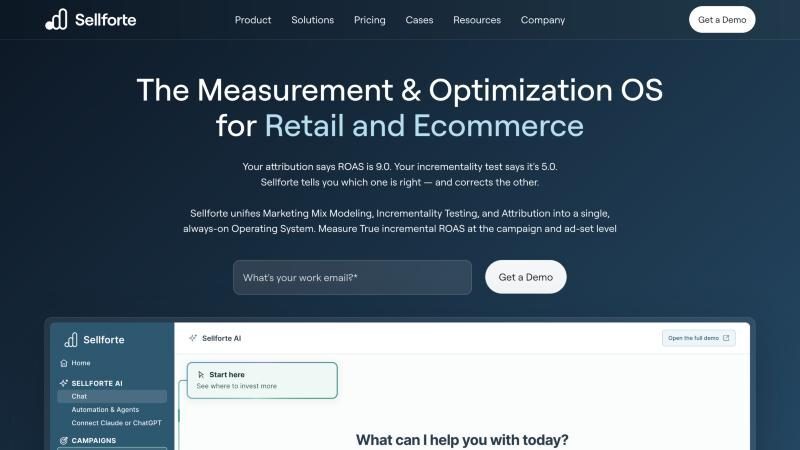
Overview: Sellforte is a marketing mix modeling platform for ecommerce, DTC and retail brands, founded in 2017. It combines MMM with incrementality testing and causal attribution. It measures every campaign and ad set daily and gives spend and bid recommendations based on marginal incremental ROAS. Pricing is published, starting at $1,900 per month (see pricing). Public customer references include bonprix, ALOHAS and Azzas 2154.
Pros:
- Spend and bid recommendations for each campaign and ad set, based on marginal incremental ROAS (miROAS)
- Daily updates: causal attribution factors refresh every day, so campaign results don't lag a week behind
- Built for ecommerce and retail: models all sales channels (online store, physical stores, Amazon), offline media and promotions
- Experiments calibrate the MMM, and AI agents and an MCP server let teams use the results in their AI tools
Cons:
- Focused only on ecommerce, DTC and retail, so not the right fit for B2B companies or FMCG brands that don't have their own online or physical store
- Covers measuring and optimizing media spend, not other ecommerce needs such as inventory management
Best for: Mid-sized and large ecommerce and retail businesses that want to optimize spend at both channel and campaign/ad set level, with results updated daily.
Comparing Sellforte with a specific vendor? See our head-to-head comparisons.
See incremental ROAS for every campaign and ad set
We'll walk you through Sellforte with campaigns like yours: daily results, budget and bid recommendations, and the tests that calibrate the model.
2. Analytic Partners: GPS Enterprise
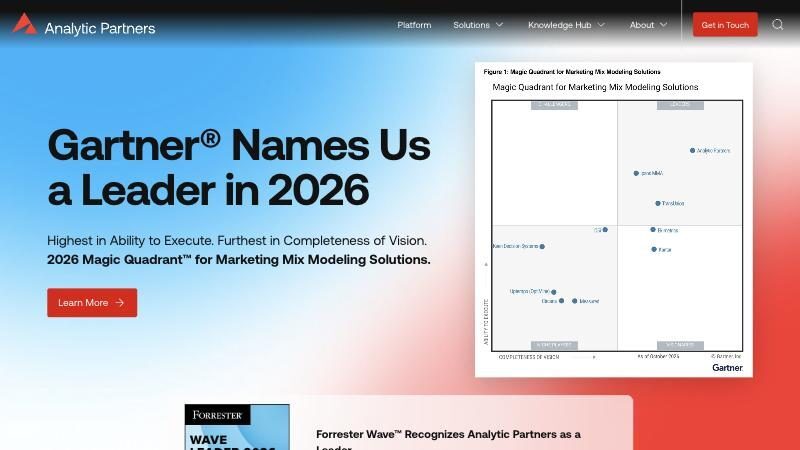
Overview: US-based Analytic Partners is one of the most well-known consultancies for marketing measurement, often earning them a seat at Marketing Mix Modeling RFPs with large ecommerce businesses. While still appearing high in Gartner's reports, Analytic Partners has started to fall behind competitors in terms of technology and methodology.
Pros:
- Strong enterprise references
- Mentioned as a leading consultancy in Gartner's reports
- Beyond MMM, covers other commercial use-cases as well, such as customer segmentation or pricing analysis
Cons:
- No campaign / ad set level measurement or optimization
- No daily updates
- More consultancy than software (service quality depends on people assigned on the customer)
- Consultancy-cost structure makes them 4-8x more expensive than MMM product companies, such as Sellforte
Best for: Large ecommerce businesses who want MMM to help with high-level budget guidance, but not necessarily with granular campaign optimization.
3. Ekimetrics: One.Vision

Overview: France-based Ekimetrics is a well-known Marketing Mix Modeling consultancy in Europe, often part of MMM tender processes for European enterprises.
Pros:
- Strong enterprise references in UK and France
- More software-focused than other consultancy providers
- Beyond MMM, covers other commercial use-cases as well, such as customer analytics
Cons:
- No campaign / ad set level measurement or optimization
- More consultancy than software (service quality depends on people assigned on the customer)
- Consultancy-cost structure makes them more expensive than MMM product companies, such as Sellforte
Best for: UK and France -based enterprises who want MMM to help with high-level budget guidance, but not necessarily with granular campaign optimization.
4. Measured
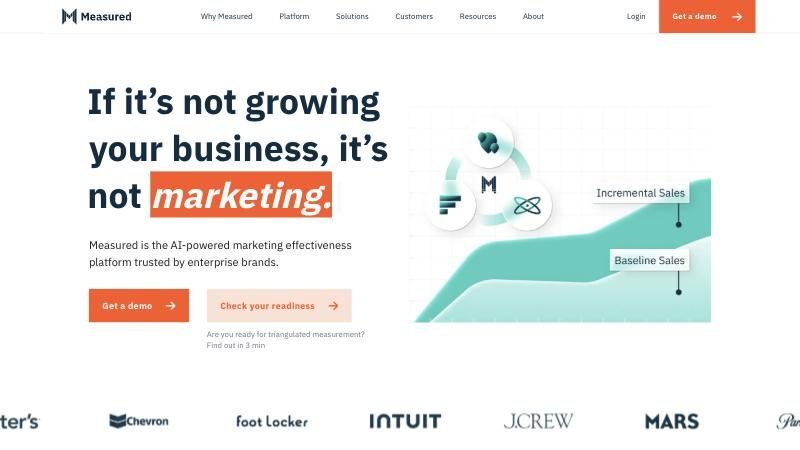
Overview: Measured is an incrementality measurement and marketing mix modeling platform, founded in 2017. It combines incrementality testing with a causal MMM calibrated with test results, and uses the model to correct what ad platforms report. Measured lists omnichannel retail, technology, CPG, financial services, hospitality and automotive as its industries.
Pros:
- Extensive incrementality testing program: geo tests that can be set up and ended in ad platforms automatically, plus A/B tests on first-party audiences
- MMM is calibrated with incrementality tests, and an admin interface shows which variables and test priors drive the results
- Peer benchmarks for spend and ROAS against more than 150 brands, backed by a database of more than 30,000 experiments
- SOC 2 Type 2 and ISO/IEC 27001 certified, with an MCP server for AI assistants
Cons:
- MMM is updated weekly, not daily
- Limited campaign & ad set level optimization, as marginal returns, spend recommendations and bidding recommendations are not available at that level
- Promotions not measured, reducing its value to retailers and ecommerce businesses
- No published pricing or self-serve demo
Best for: US brands that want an always-on incrementality testing program with peer benchmarks, and for whom campaign-level results updated weekly are enough.
Comparing Measured and Sellforte? Read our in-depth comparison: Measured vs Sellforte for MMM, incrementality testing and attribution.
5. Keen Decision Systems
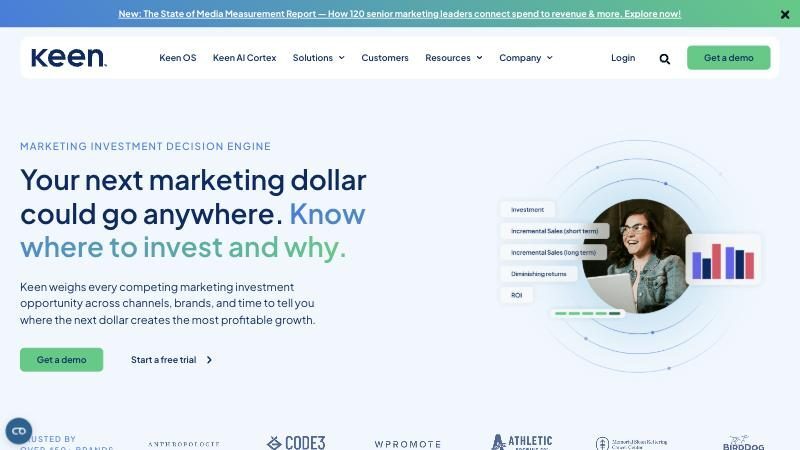
Overview: Keen’s platform centers on marketing mix modeling and optimization with an explicit goal of connecting marketing investment to revenue/profit and bridging marketing + finance planning.
Pros:
- Measures the ROI of media across channels
- Has an optimizer tool for media planning
- Dedicated features for CPG / FMCG brands, such a demand planning
Cons:
- Limited ability to support digital teams in optimization due to lack of campaign & ad set level measurement and recommendations
- No daily updates
- No analysis of marketing experiments
Best for: Mid-sized brands, especially in CPG / FMCG, who want to understand channel level performance, but not optimize digital spend on a granular level.
6. Recast
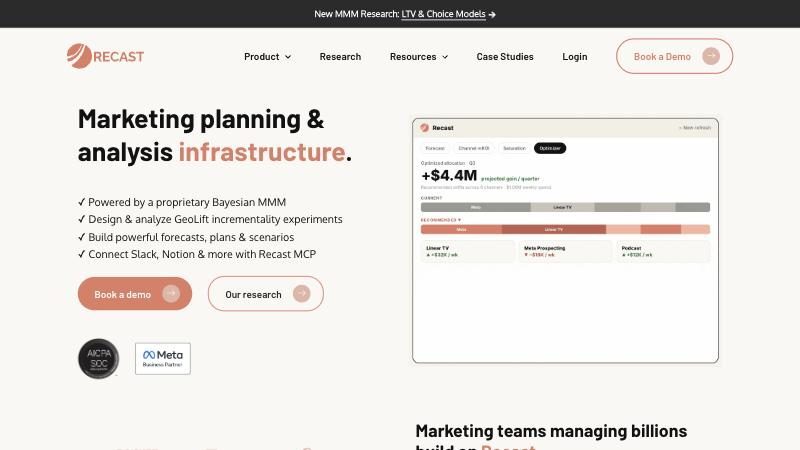
Overview: Recast is a Bayesian marketing mix modeling platform. It offers Recast MMM, GeoLift by Recast for geo experiments, forecasting and planning tools and a budget optimizer. Its references include Canva, Block, Harry's, PODS and GetYourGuide.
Pros:
- Re-estimates channel ROIs every week, with on-demand refreshes available
- Strong focus on forecast accuracy: weekly out-of-sample accuracy reports for every customer and built-in backtesting
- Geo tests with GeoLift by Recast, and results from in-platform lift studies, such as Meta conversion lift, can be added to the model
- MCP server with access to most of its reports, alongside public APIs
Cons:
- Measures at channel and tactic level: campaigns get directional performance indices instead of incremental ROAS, and there are no ad set level results or bidding recommendations
- No daily updates: models refresh weekly
- No attribution: does not correct platform-reported campaign results with incrementality, and does not push changes to ad platforms
- Pricing for MMM is not published, and the Recast team or a certified partner configures each model
Best for: Brands for whom channel-level measurement refreshed weekly is enough, and who are not looking to optimize digital channels at the campaign & ad set level.
Comparing Recast and Sellforte? Read our in-depth comparison: Recast vs Sellforte: channel vs campaign-level MMM.
7. Liftlab
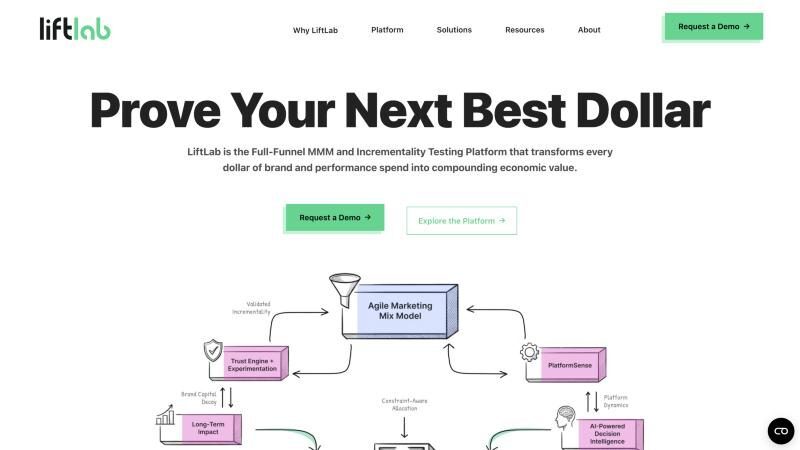
Overview: LiftLab positions itself an agile marketing mix modeling platform, combining MMM, experimentation, and AI-assisted insights.
Pros:
- Enables marketers to measure media ROI on channel level
- Experiments are part of the platform
- Similar to Sellforte, Liftlab is among the small number of MMM providers who have introduced AI to their platform
Cons:
- Lacks campaign & ad set level spend and bidding recommendations
- Modeling is lighter than with more comprehensive marketing mix models, e.g., weather not included
- No daily updates
Best for: Mid-sized ecommerce brands who are looking for support in allocating spend across channels (but not necessarily across campaigns and ad sets)
8. Triple Whale
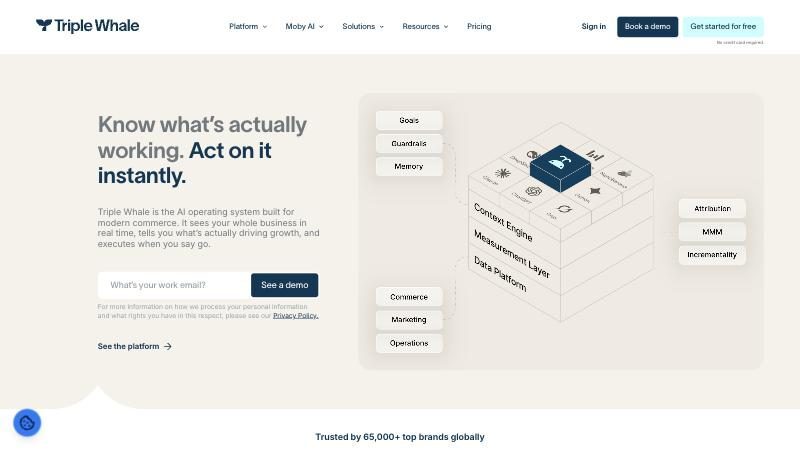
Overview: Triple Whale is known as an ecommerce analytics and multi-touch attribution platform for Shopify vendors, but it has also expanded into MMM.
Pros:
- Combines MTA and MMM in one platform. Easy to adopt for brands already using Triple Whale for MTA or other use-cases
- Good integrations for ecommerce brands, especially Shopify
- Is building AI capabilities to the solution
- Provides campaign-level measurement
Cons:
- MMM is more lightweight compared to MMM-first platforms. As an example, promotions are missing from the model, increasing bias toward bottom-of-funnel channels
- Does not scale with the business: Not capable of serving larger ecommerce brands due to simple modeling approach
- Does not provide campaign-level Marginal Incremental ROAS (miROAS), decreasing credibility of recommendations
Best for: Small ecommerce teams that want an approachable entry point into MMM without adding a standalone measurement platform, especially if they’re already using Triple Whale for attribution and reporting.
Comparing Triple Whale and Sellforte? Read our in-depth comparison: Triple Whale vs Sellforte for MMM, incrementality testing and attribution.
9. Fospha
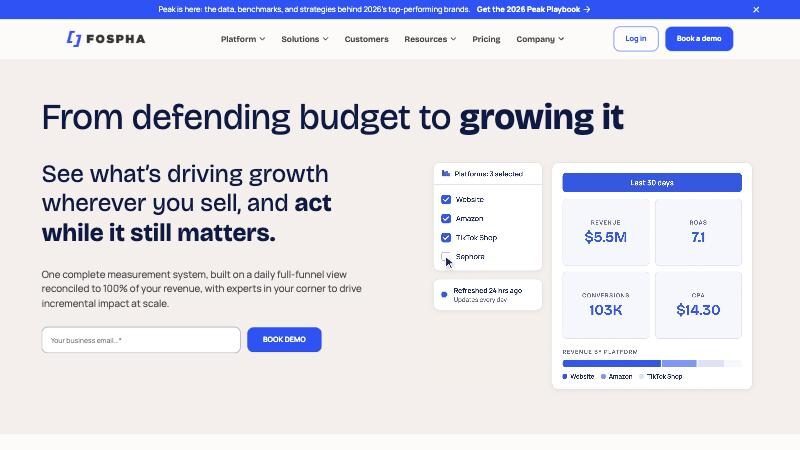
Overview: Fospha started as a multi-touch attribution platform and now combines attribution and Bayesian MMM ("Media Mix Attribution"), positioned for enterprise retail brands. It has been a measurement partner for TikTok and Snapchat since 2024. References include Gymshark, Lululemon, Dyson and Huel.
Pros:
- Daily, ad-level measurement reconciled to total revenue
- Measures Amazon and TikTok Shop sales alongside the brand's own site
- Its in-house team designs and runs geo-lift tests that calibrate the MMM and forecasts
- AI Actions push approved budget changes to ad platforms, and an MCP server connects results to Claude
Cons:
- Promotions and physical store sales are not modeled, which limits its value for omnichannel retailers
- No marginal ROAS (miROAS) or bid recommendations at campaign and ad set level
- Every customer starts with the attribution product, and MCP access needs an enterprise AI account set up through an account manager
- No published prices; built for brands spending $150K+ per month on ads
Best for: Ecommerce and marketplace-led brands spending $150K+ per month on ads, especially those scaling paid social, TikTok Shop or Amazon, that want daily ad-level reads and don't need promotions or store sales measured.
10. Prescient AI
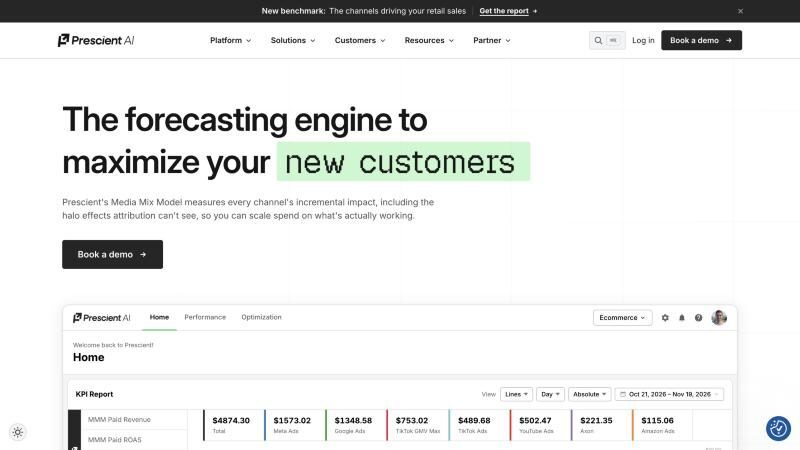
Overview: Prescient AI is a Miami-based MMM platform founded in 2019. Unlike Fospha and Triple Whale, which started as MTA platforms, Prescient AI focused on MMM from the start. Its models retrain daily and measure DTC, retail and Amazon sales.
Pros:
- US DTC and omnichannel brand references such as HexClad, Saatva and BrüMate
- Daily-updating models with campaign-level measurement
- Measures retail and Amazon sales alongside DTC, plus halo effects
- Fast onboarding through 112 integrations
Cons:
- No ad set level measurement, miROAS or bid recommendations; budget recommendations are at channel level
- No built-in experiment design: incrementality tests are run elsewhere and imported to calibrate the model
- No MCP access to your own results: Prescient's MCP server only provides public product information such as integrations, pricing and documentation
- No published prices: quotes come after a demo, and contracts are annual
Best for: US DTC and omnichannel brands spending $100K+ per month on ads that want daily campaign-level MMM, and don't need ad set level bid recommendations.
Conclusions
When choosing an MMM for an ecommerce brand, it is important to choose the right vendor for your needs.
For small ecommerce businesses with up to $50M in sales:
-
Choose Sellforte if it is important to have spend and bid recommendations for each campaign and ad set, and a tool that can serve the brand from a small business all the way to a large enterprise.
-
Consider also Triple Whale if you are interested in testing MMM for the first time with a simple solution, and it is not critical to have spend and bid recommendations for each campaign and ad set. We have seen smaller brands moving to Sellforte later as they have started growing and started requiring more complex/demanding MMM needs.
For mid-sized ecommerce businesses with $50M-$1B in sales:
-
Choose Sellforte if granular spend optimization across campaigns & ad sets is important (in addition to optimizing spend allocation on the higher channel-level).
- Consider also Recast, Liftlab, Keen, if channel-level insights are sufficient, Measured if campaign-level results updated weekly are enough, Prescient AI if daily campaign-level results are enough without ad set level bid recommendations, or Fospha if daily ad-level reads for paid social and marketplaces matter more than promotions or store sales.
For large ecommerce businesses with more than $1B in sales:
-
Choose Sellforte whose enterprise-grade MMM covers all media spend optimization use-cases from channel-level budget planning to tactical campaign optimization.
-
Consider also Analytic Partners, Ekimetrics or one of the other high-touch consultancy options if high-level channel optimization is sufficient and consulting support is critical. In this model, you need to trust MTA, GA4, ad platform attribution, or other tool for campaign-level spend optimization.
To learn more, book a demo with Sellforte.
Authors

Lauri Potka is the Chief Operating Officer at Sellforte, with over 15 years of experience in Marketing Mix Modeling, marketing measurement, and media spend optimization. Before joining Sellforte, he worked as a management consultant at the Boston Consulting Group, advising some of the world’s largest advertisers on data-driven marketing optimization. Follow Lauri in LinkedIn, where he is one of the leading voices in MMM and marketing measurement.

Isn’t MMM just a quarterly project?

Is attribution enough on its own? Why MMM and incrementality testing are required