


The landscape of Marketing Mix Modeling (MMM) is shifting faster than any of us predicted, especially when it comes to optimizing decisions that MMM drive.
Not long ago, the marketers looking into MMM were mostly interested in channel/tactic-level optimization, for example re-allocating spend between Meta Prospecting, Meta Retargeting, Google Performance Max and so on.
In 2025, the landscape started changing, when the first solutions offering campaign and ad set level optimisation based on miROAS (Marginal Incremental ROAS) hit the market. miROAS is one of the key outputs of MMM and the key data required in optimization. See for example: Introducing Sellforte Performance: Turning MMM Into Daily Action.
Right now, we are seeing a massive surge in demand from marketers for MMMs that can provide spend optimization at the campaign and ad set level.
Why is this happening? Why are marketers suddenly complementing channel-level optimization with more granular optimization?

In this article, I’ll break down the four types of MMM solutions currently on the market, why the industry is rushing toward granular optimization, and what this means for your marketing strategy.
The 4 Types of Marketing Mix Modeling Solutions
To understand where the market is going, you first need to understand the options available. For a marketer, comparing MMM solutions can be tough. I know, because I’ve done it many times myself.
If I were a marketer today, I would start evaluating an MMM solution based on two questions:
-
Granularity of Measurement (iROAS): How detailed is the view of past performance?
-
Granularity of Optimization (miROAS): On what level can I optimize future spend?
Based on these dimensions, we can categorize the landscape into four solutions, illustrated in the picture below.
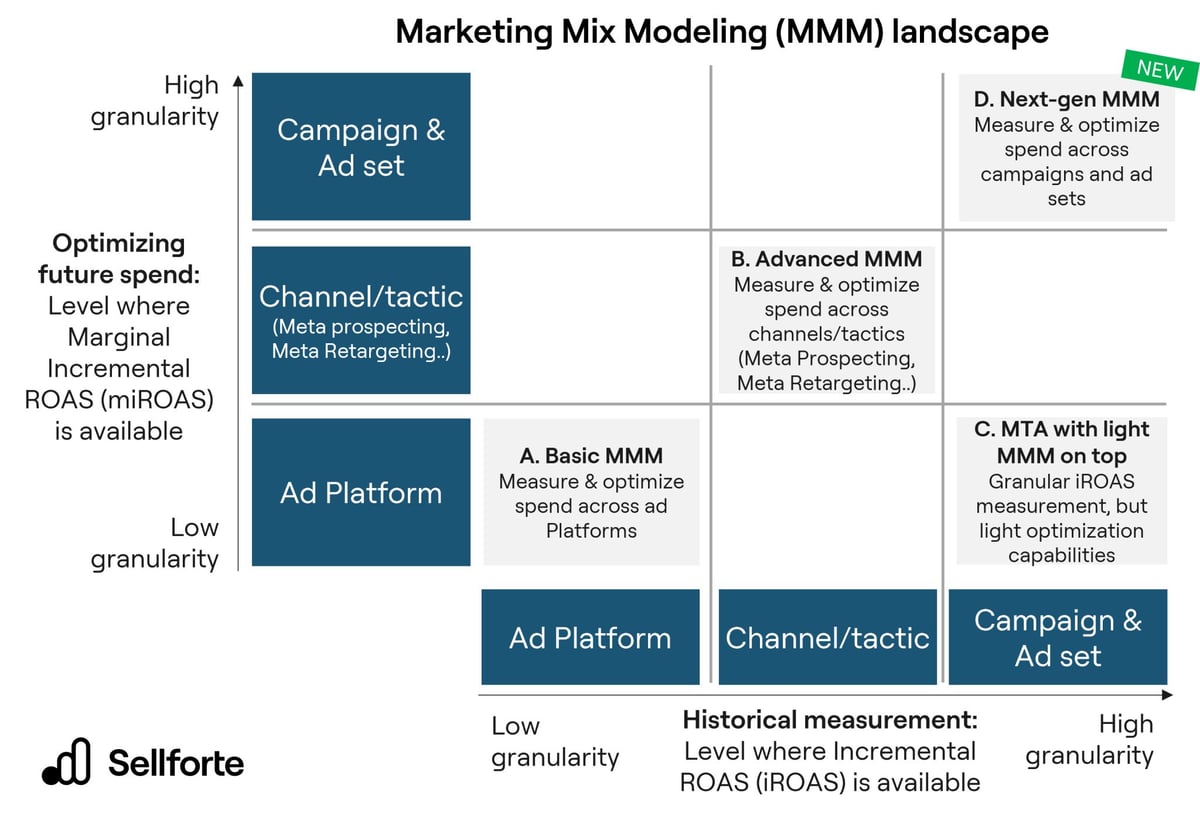
Let's walk through these one by one.
A. Basic MMM
✅ iROAS: Ad Platform level
✅ miROAS: Ad Platform level
If you are fine measuring Google as whole, maybe comparing that to Meta or even TV, you could consider Basic MMM. This MMM type can be bought for example from local marketing consultants using Meridian. If you just want to know if you should shift money from TV to Digital, this could work, but in practice there are very few serious marketers satisfied with this level of insights.
B. Advanced MMM
✅ iROAS: Channel/tactic level
✅ miROAS: Channel/tactic level
This goes one step deeper to the channel/tactic level (e.g., Meta Prospecting vs. Meta Retargeting). This requires more advanced data processing and modeling capabilities, as the solution needs to robustly estimate response curves for each channel/tactic.
Advanced MMM has been standard MMM configuration in recent years, and it can be bought from MMM SaaS vendors or the more expensive consultants who nowadays often use Google's Meridian to build a custom solution.
C. MTA with Light MMM
✅ iROAS: Campaign/ad set level
⚠️ miROAS: Typically ad platform level
This category is somewhat different from others: There's Multi-touch attribution companies who have integrated light MMM into their solution. They use incrementality factors from MMM and attribution data to estimate iROAS for each campaign and ad set.
Here's comes the twist though: Because their MMM is not built as robustly as with category B solutions, they cannot provide miROAS on a granular level. This means their optimization tools are typically light or non-existent.
These solutions can work for marketers who are focused on historical measurement. You know what worked, but not necessarily where to spend the next dollar.
D. Next-Gen MMM
✅ iROAS: Campaign/Ad set
✅ miROAS: Campaign/Ad set
This is the new frontier. These solutions provide iROAS and miROAS on the Campaign and Ad Set level. They don't just tell you how you did; they tell you exactly which ad sets have room to scale and which are saturated.
To give you an example, below is a screenshot from Sellforte Performance, showing miROAS and recommend spend for each campaign and ad set.

Why the Rush to Campaign-level optimization?
Recently, we’ve seen a pivot. Even larger enterprises are now bypassing channel-level MMMs (Solution B) and looking straight at Next-Gen MMM (Solution D) that can provide campaign and ad set level optimization.
Here is why this shift is accelerating.
1. Largest Optimization Potential is at the Campaign and Ad set level
Smart marketers follow the money and spend their optimization efforts where the optimization potential is largest.
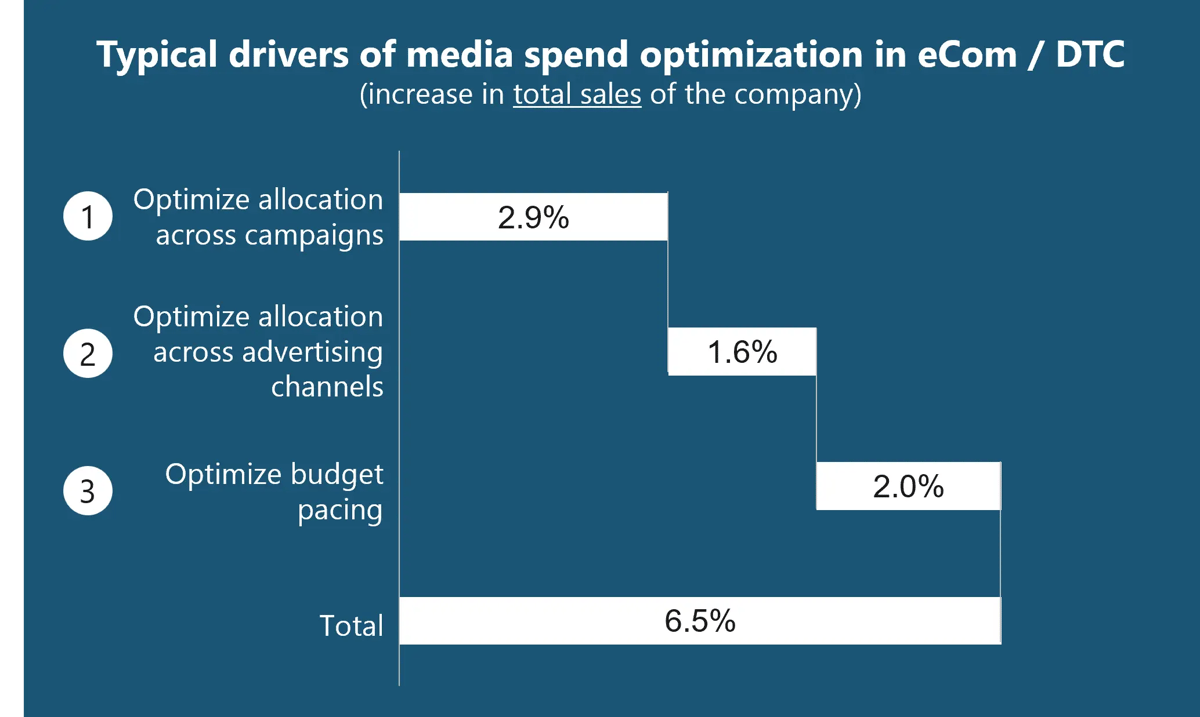
And the potential is large in campaign optimization: Shifting spend between campaigns is a significantly larger optimization lever than shifting spend between channels. The data below is from our 2025 study Unlock 6.5% More Sales with Marketing Mix Modeling, and shows that campaign-level allocation is the largest lever in media spend optimization.
2. The Rise of miROAS (Marginal Incremental ROAS) at the Campaign and Ad set level
Solutions offering miROAS at the campaign and ad set level, and thus enabling incrementality-based optimization on that level, have arrived only in 2025. The recent increase in awareness has already increased demand for campaign-level MMM, and the gradual increase in awareness throughout 2026 will continue to do so.
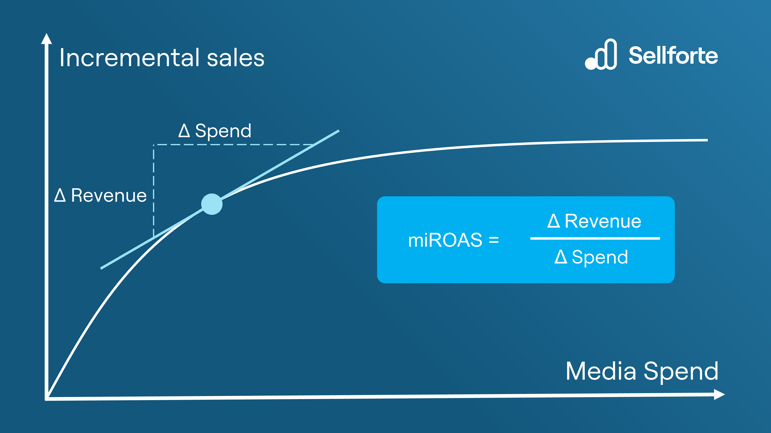
Why is miROAS such a big thing? Because it tells you whether your campaign/ad set is saturated, or if it still has room to scale.
Let's take the illustrative response curve on the attached picture. miROAS can be calculated the slope of the response curve at a given spend level. If your spend is low, meaning that your are on the left, the curve is steep, miROAS is high, and each new dollar spent on the campaign/ad set delivers high return. If you are far on the right, each new spent dollar brings very little back in revenue, meaning that miROAS is low.
3. Digital Spend is Increasing
A clear third driver for increased demand for campaign and ad set level is the increasing share of digital spend in every marketers' budgets. This means that digital media optimization decisions get far more attention from businesses than they used to.
Since the practical execution in digital channels happens on campaign/ad set level, it is natural for marketers to seek for solutions that can best help them with those decisions.
The Implications for Marketers
This shift toward campaign and ad set level optimization has two major implications for marketers and marketing analytics teams.
👉 The Opportunity: If you have a high share of digital spend but are still using channel-level MMM (Solution B) or basic attribution, you are leaving growth on the table. In this case, you should investigate campaign optimization with MMM.
👉 The Competitive Threat: If your competitors start optimizing bids based on true incrementality (miROAS) and you are still optimizing based on Last-Click or Platform ROAS, their growth will outpace yours. They will bid more aggressively on the high-incrementality users you are missing, and they will stop wasting money on the low-incrementality users you are overpaying for.
The technology has evolved. The question is, has your measurement strategy evolved with it?
To learn more about campaign and ad set level optimization, book a demo with Sellforte.
Authors

Lauri Potka is the Chief Operating Officer at Sellforte, with over 15 years of experience in Marketing Mix Modeling, marketing measurement, and media spend optimization. Before joining Sellforte, he worked as a management consultant at the Boston Consulting Group, advising some of the world’s largest advertisers on data-driven marketing optimization. Follow Lauri in LinkedIn, where he is one of the leading voices in MMM and marketing measurement.
Marginal Incremental ROAS (miROAS): What is it? And why does it matter to marketers?

The Rise of Agentic MMM (Marketing Mix Modeling): How AI Is Transforming Media Optimization