


Consumer Payments
How Paysafe Validated Marketing ROI Across 8 Channels in the US with Sellforte Experiments & MMM
Media channels validated through experiments
US states used in the test vs. control setup
Validation outputs: numerical, visual & text insights
Paysafe: Powering Payments Across Global Markets
Paysafe is a leading global payments platform headquartered in the UK enabling businesses and consumers to transact seamlessly through a range of digital payment solutions.
Operating across multiple brands and markets worldwide, the United States represents one of its key growth markets.
Paysafe’s marketing and analytics teams already had experience building internal models to measure marketing impact. As media investments expanded, however, the team wanted a more scalable and automated way to validate marketing ROI and calibrate their Marketing Mix Model (MMM).
To achieve this, Paysafe partnered with Sellforte, combining MMM insights with controlled geo-based experiments to validate the true incremental impact of marketing investments.

Validating MMM with Real-World Experiments
To measure true incremental impact, Paysafe ran state-level experiments across the United States.
The methodology used a classic test vs control design:
- Increased media investment in a single US state (test group)
- Compared sales trends against the remaining US states (control group)
- Measured incremental lift caused by the marketing activity
This approach allowed the team to isolate the causal impact of marketing channels, independent of platform attribution or external demand changes.
The experiments also gave the Paysafe team the opportunity to validate their MMM outputs with real-world evidence, ensuring that the model accurately reflected the true incremental impact of media investments.
Automated Experiments Replace Manual Analysis
Before implementing Sellforte’s experimentation module, Paysafe already had a methodology in place to analyze experiments.
While this approach produced reliable insights, it was cumbersome to apply. Running and validating experiments required significant manual effort and time, which limited how quickly and how often experiments could be executed.
Sellforte’s experimentation module automated large parts of the process, making it possible to run experiments across North America more quickly and analyze results through multiple validation perspectives, including:
- numerical experiment results
- visual experiment impact charts
- text-based summaries of results and insights
This significantly reduced the time required to conduct and analyze experiments while improving transparency and usability for the marketing and analytics teams.

As Dr. Alexander Wasserburger, Director of Marketing Analytics at Paysafe, explains, “We had already run similar experiment analyses ourselves using BSTS modeling in Python, but applying this methodology was slow and labor-intensive. Sellforte makes the process much easier and significantly faster, allowing us to reach conclusions more quickly with numerical, visual, and written validation.”
Sellforte makes the process much easier and significantly faster, allowing us to reach conclusions more quickly with numerical, visual, and written validation.

Dr. Alexander Wasserburger
Director of Marketing Analytics, Paysafe
Confirming MMM Accuracy Across Channels
The experiment results confirmed that Sellforte’s MMM had accurately captured the impact of most channels.
Across the eight tested media channels, experimental ROI results closely matched the model’s predicted ROI, providing strong validation that the MMM outputs reflected real incremental performance.
One channel, Paid Search, showed slightly different results compared to the model.
Rather than being a limitation, this insight allowed the Paysafe team to improve the model itself. The experiment results were used to adjust Google priors within the MMM, bringing the model assumptions closer to real-world behavior and improving future accuracy.
This combination of modeling and experimentation created a powerful feedback loop for continuously improving measurement.
Beyond validating the model, the experiments also revealed how different media channels influenced demand during and after campaigns.
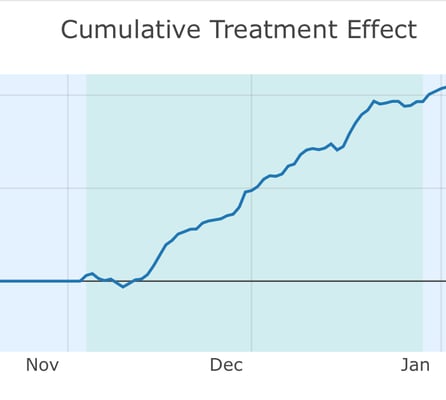
Social Media: Sustained Impact
The experiments showed that social media generated a strong impact during the treatment period, with effects continuing even after the experiment ended.
This suggests that social media activity helps build longer-term demand and awareness, not just immediate conversions.
Paid Search: Immediate but Short-Term Impact
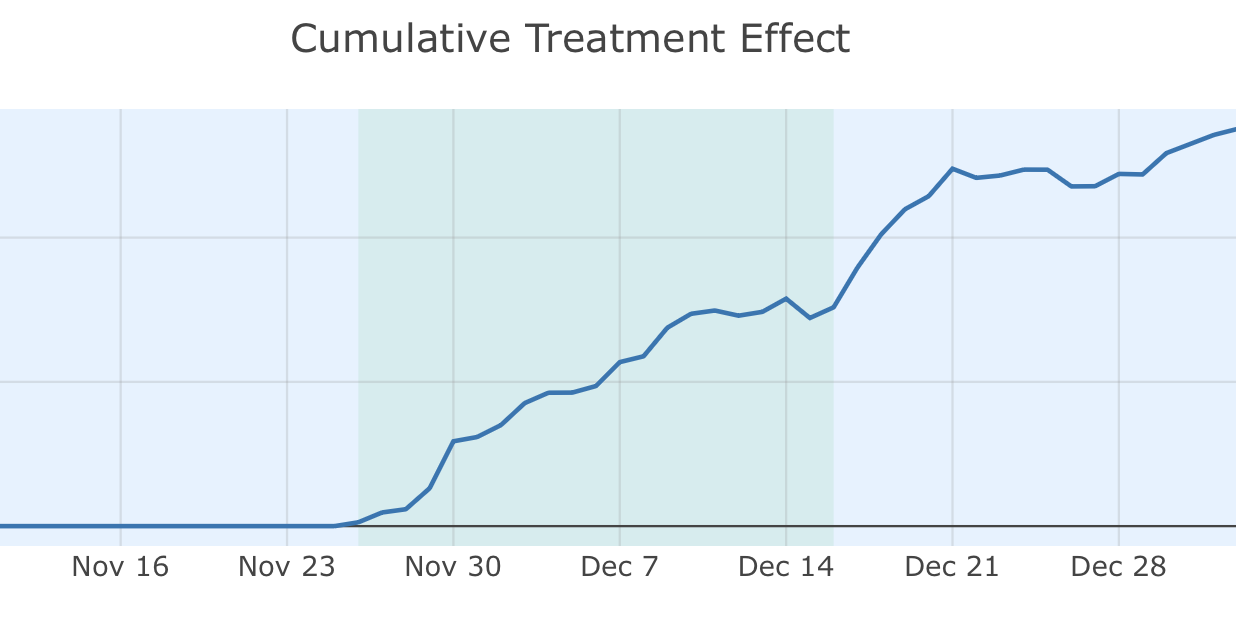
Paid Search showed a different pattern.
The channel delivered clear and measurable impact during the experiment period, but the effect faded quickly once the campaign ended.
This confirms Paid Search’s role as a strong short-term demand capture channel, with less persistent impact compared to upper-funnel channels.
Expanding Experimentation in the Next Phase
Following the successful validation of MMM results, the Paysafe team is now planning the next phase of measurement innovation.
This includes integrating Meta lift studies alongside the existing experimentation framework to further validate and deepen insights into social media performance.
By combining MMM, geo experiments, and platform lift studies, Paysafe is building a robust, multi-method measurement approach that supports confident marketing investment decisions.
Results at a Glance
With Sellforte, Paysafe achieved:
- Validation of MMM ROI predictions across 8 media channels
- Confirmation that experimental results closely match model outputs
- Improved Paid Search modeling through updated priors
- Faster experimentation through automated analysis instead of manual Excel workflows
- Clear insights into short-term vs long-term media impact
Ready to Transform How You Measure Marketing?
Paysafe’s journey shows how combining Marketing Mix Modeling with automated experiments can validate marketing ROI and bring greater confidence to data-driven decision making.
👉 Book a demo today to see how Sellforte can help you validate marketing impact, optimize ROI, and turn experiments into scalable insights for smarter media investments.
