MMM Use Case

Your media plan depends on what you assume about future channel performance. A recent strong period may continue, fade or reflect conditions that will not repeat. Comparing performance assumptions shows how much your allocation and sales forecast depend on that choice.
This guide creates three matched scenarios in the public Sellforte Media Optimizer demo. Each uses the same budget, planning period and channel limits. Only the media-performance assumption changes.
Before you start: Choose the planning weeks, total budget, reference period and channel constraints before creating the comparison.
What you will produce: Three comparable plans showing the sales forecast and allocation under different performance assumptions.
1. Understand the three performance options
Open Media optimizer and select the plus icon to create a scenario. Under Media performance selection, the options are:
| Option | What it uses | Question it helps answer |
|---|---|---|
| Use Sellforte performance forecast | Forecast channel performance for the planning period | What allocation follows from Sellforte’s current performance forecast? |
| Use reference period media performance | Recorded channel performance in the selected reference period | What if performance resembles this particular historical period? |
| Use historical average performance | Average channel performance over the full modeled history | What if longer-run average performance is a better guide? |
Sellforte recommends the performance forecast as the default in its scenario-creation guide. The alternatives let you assess the dependence on that forecast. Selecting a reference period for budget boundaries is separate from choosing which performance assumption drives the optimization.
2. Create three scenarios with matching constraints
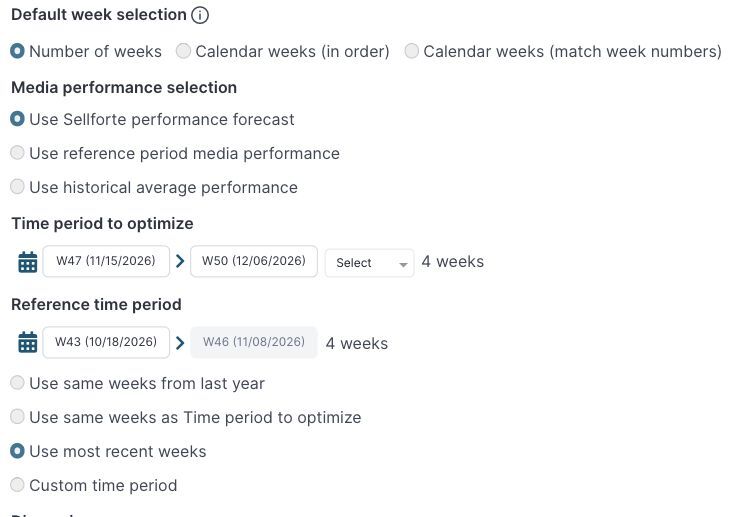
Select Sales (MMM) as the optimization KPI, Budget optimization as the mode and Number of weeks as the default week selection. Use these settings in all three scenarios:
- Planning period: weeks W47–W50 in 2026, shown with week-start dates November 15–December 6.
- Reference period: the most recent four weeks, W43–W46, shown with week-start dates October 18–November 8.
- Total budget: $4,268,724.
- Scope: US, all advertising channels, both customer types and sales channels, Product category Overall. Group by Advertising channel.
- Channel boundaries: ±30% around the reference investment; Email fixed at $40,466. TV, Direct Mail and DOOH remain at zero.
- Baseline and promo scenarios: Last 12 weeks YOY in all three.
Name the scenarios Recent forecast, Reference period and Historical average. Choose the corresponding media-performance option during creation. Confirm the displayed reference dates before creating each scenario, apply the same limits, then optimize.
If a field changes the date range or budget automatically, restore the agreed setting before running the scenario. Otherwise, the comparison will mix a performance-assumption change with a different budget or reference plan.
3. Compare forecast sales at the same spend
In Result Charts, select the three scenarios under Open scenarios. Turn Show base and Show promo off to focus on the incremental media-sales contribution. These switches change the displayed breakdown; the baseline and promo assumptions remain the same across the scenarios.
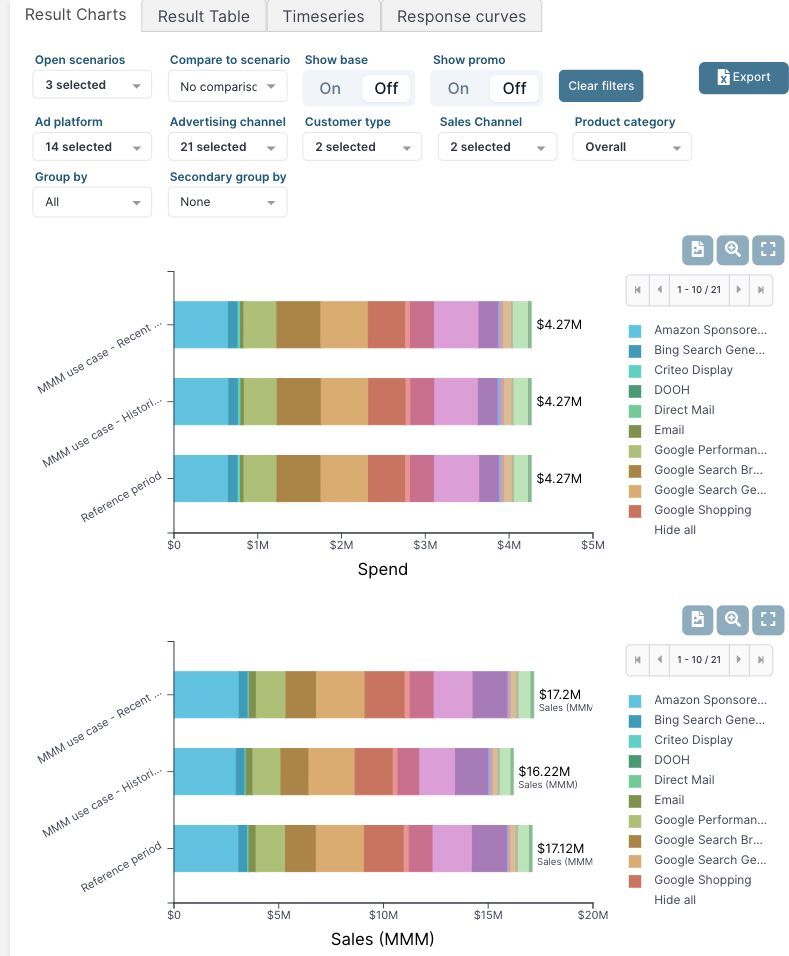
| Performance assumption | Media budget | Forecast incremental media sales | Average iROAS |
|---|---|---|---|
| Sellforte performance forecast | $4.27M | $17.20M | 4.03 |
| Reference-period performance | $4.27M | $17.12M | 4.01 |
| Historical average | $4.27M | $16.22M | 3.80 |
Based on the rounded displayed totals, the performance forecast is about $80,000 above the reference-period scenario and $980,000 above the historical-average scenario. The recent and reference assumptions give similar aggregate outcomes; the historical average produces a lower sales forecast.
These are three conditional forecasts, each with its own optimized allocation. The $980,000 spread describes sensitivity to the assumptions and resulting plans. It is not extra sales earned merely by selecting the more optimistic option.
4. Review the channels that change
Open Result Table for each scenario. The demo allocates Pinterest Prospecting about $25.47k under the performance forecast, $28.06k under reference-period performance and $39.78k under historical averages. TikTok Prospecting receives $180.74k, $168.30k and $173.04k respectively.
Inspect the channels with the largest allocation differences first. Look at recent performance changes, upcoming creative, audience conditions and planned promotions to decide which assumptions best reflect the coming period.
Use the performance forecast as the working plan when its assumptions fit those conditions. Keep the historical-average result as a sensitivity case when recent strength may be temporary. If a major channel allocation depends heavily on one assumption, consider a staged budget change and reassess as new results arrive. For a separate question about weaker underlying demand, use the baseline-demand stress test.
Further Reading and Resources
About the author

Lauri Potka is the Chief Operating Officer at Sellforte, with over 15 years of experience in Marketing Mix Modeling, marketing measurement and media spend optimization. Before joining Sellforte, he worked as a management consultant at the Boston Consulting Group, advising some of the world’s largest advertisers on marketing optimization. Follow Lauri on LinkedIn.
How to Stress-Test a Media Plan Against Weaker Demand
How to Find the Media Budget Needed for a Sales Target