

MMM Use Case

To stress-test a media plan against weaker demand, copy the plan, lower its baseline-sales assumption, and optimize it again with the same budget and operating constraints. Compare total sales and their baseline, promotion and media components. This shows how much of the sales target depends on demand conditions beyond the media plan.
This worked example uses simulated US data in the public Sellforte demo. The four-week planning window runs from the week beginning November 15 to the week beginning December 6, 2026. Both scenarios use the same weeks from the previous year as their reference.
Before you start: A media budget, realistic channel boundaries and a reference period for baseline demand.
What you will produce: A downside sales forecast and a view of which parts of the plan change when baseline demand weakens.
1. Create a plan with flat baseline demand
In Planning → Media optimizer, create a Budget optimization scenario for Sales (MMM). Select Use Sellforte performance forecast. The demo uses all US customer types and sales channels, with budgets grouped by Advertising channel.
Set the total budget to $10,858,172. Give paid channels roughly ±30% budget flexibility around the reference period and keep Email fixed at $85,599. Retain the same channel durations throughout the comparison. Set Baseline scenario to YOY growth 0.0% and leave Promo scenario at Last 12 weeks YOY. Name the plan Demand: flat baseline and optimize it.
Flat baseline growth means the baseline assumption is unchanged from the comparable prior-year period. It does not mean every part of total sales is flat: media and promotions still contribute to the forecast.
2. Change only the baseline assumption
Use + and Copy own scenario to copy the flat-baseline plan. Name the copy Demand: weaker baseline. Change Baseline scenario to YOY growth -10.0%, then optimize again.
Keep the total budget, forecast method, date range, promotion assumption, channel boundaries and channel durations the same. Both plans are optimized under their respective demand assumptions, so this compares the feasible media plan in each environment. It is not a fixed-allocation sensitivity test.
3. Compare total sales and their components
Open Result Charts. Under Open scenarios, select only the flat and weaker baseline plans. Set Compare to scenario to No comparison to see their absolute totals. Leave Show base and Show promo on, then expand the Sales (MMM) chart.
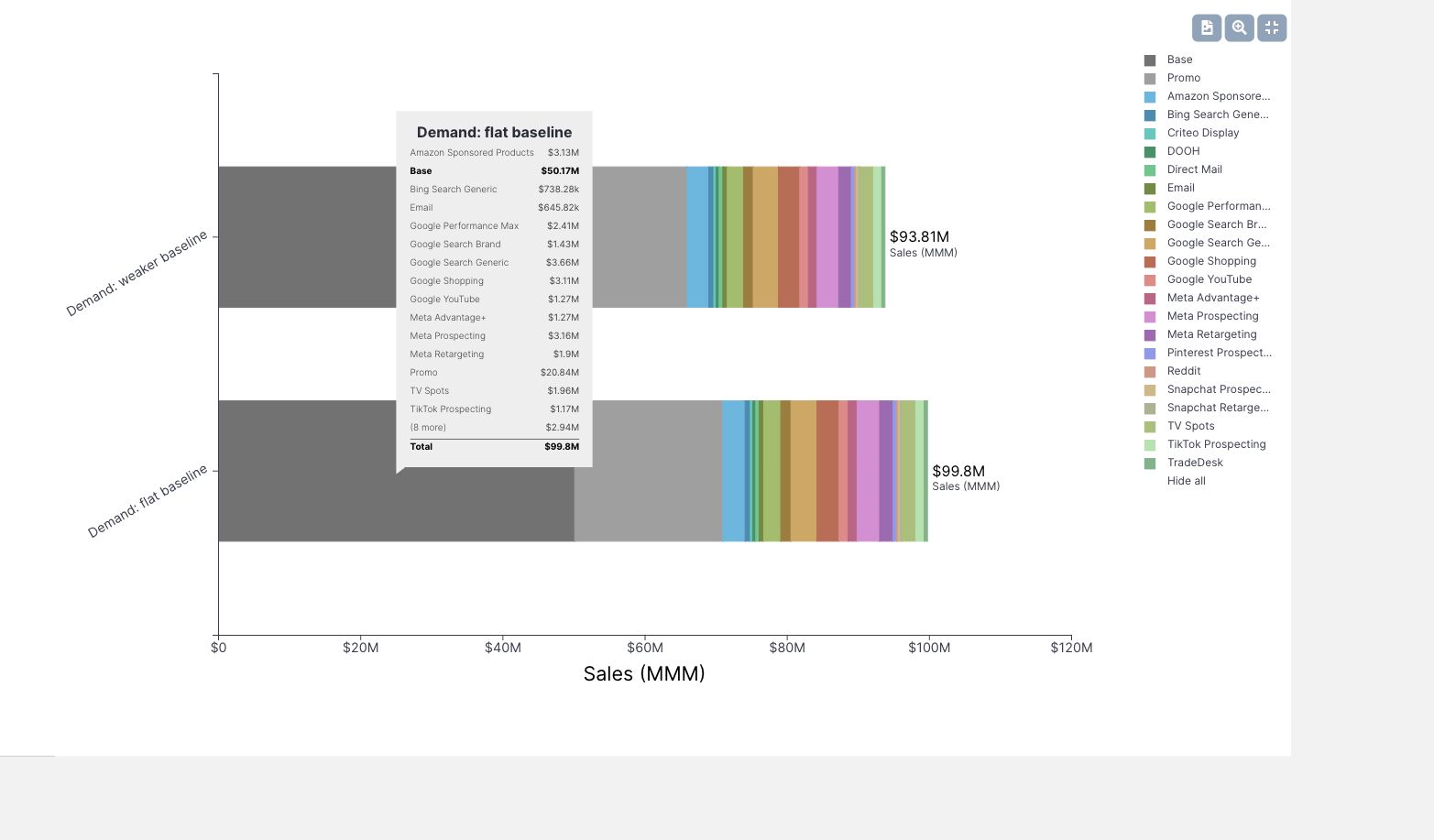
| Forecast component | Flat baseline | Weaker baseline |
|---|---|---|
| Baseline assumption | 0% year over year | −10% year over year |
| Media budget | $10.86M | $10.86M |
| Baseline sales | $50.17M | $45.15M |
| Promotion sales | $20.84M | $20.84M |
| Total sales (MMM) | $99.80M | $93.81M |
These figures are rounded values displayed in the demo. Total forecast sales fall by about $5.99M, or 6.0%, despite keeping the media budget unchanged. Baseline sales account for about $5.02M of that reduction. The promotion contribution stays at $20.84M.
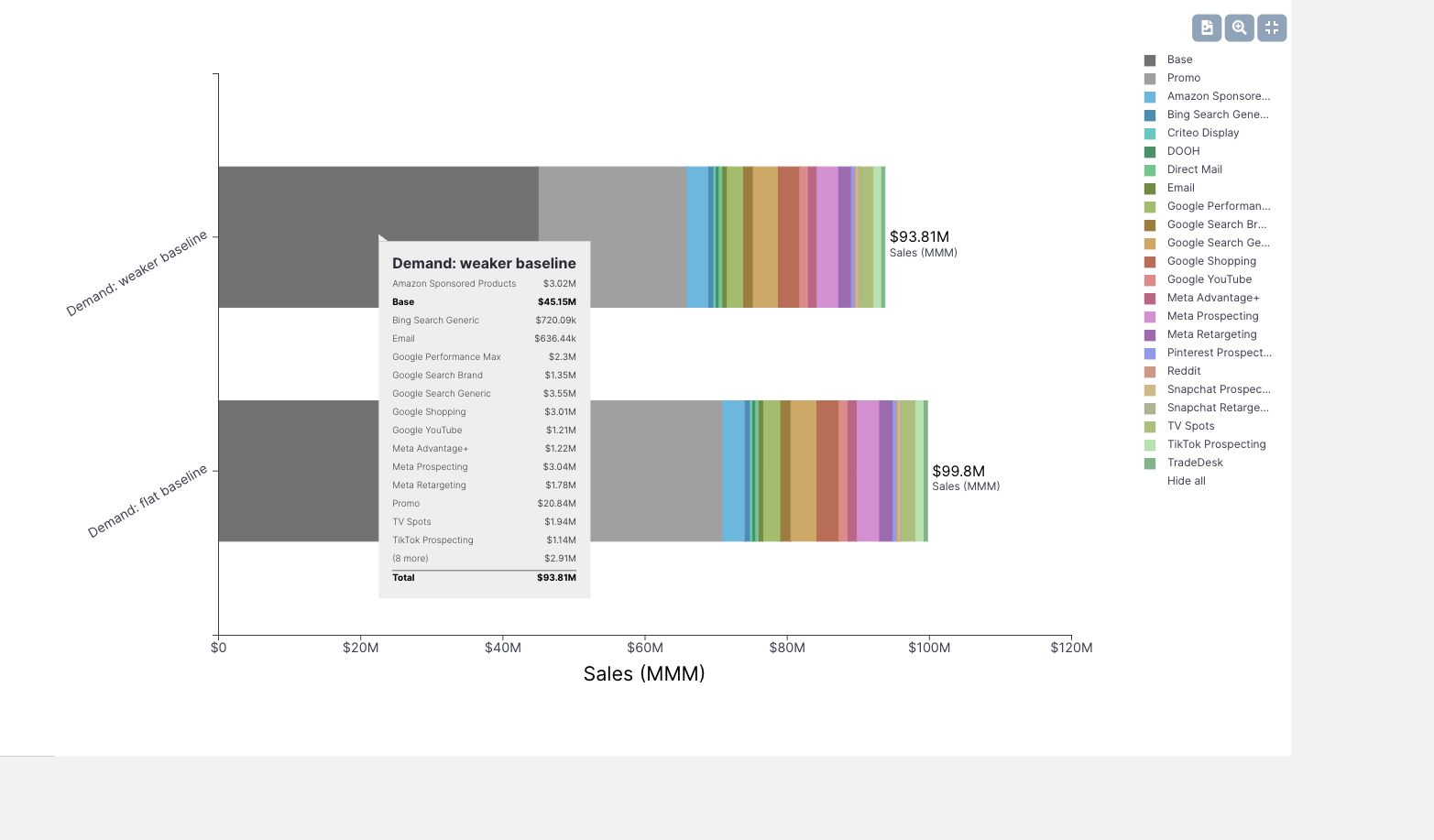
The total decline is larger than the baseline reduction alone. With Sellforte performance forecast selected and the plans reoptimized, the modeled media contribution also changes. Do not treat a 10% decrease in the baseline assumption as either a 10% cut to total sales or a uniform 10% reduction in every channel’s iROAS.
4. Turn the downside forecast into a planning decision
Use the weaker-demand forecast to assess whether the sales target remains achievable under a plausible downside. A target between $93.81M and $99.80M would be reached by the flat-baseline plan in this example but missed by the weaker-baseline plan.
Open Result Table to inspect where the optimized allocation changes, then check whether those shifts are operationally feasible. If the sales target must stay fixed, build a separate sales-target scenario to estimate the required budget under the weaker assumption. The budget-change forecasting guide can help compare smaller funding adjustments.
Discuss the gap with the commercial team as well as the media team. A baseline-demand shortfall may require a revised sales expectation, a different promotion plan or other business action. Increasing media spend should be assessed through the additional sales it is expected to generate, including saturation, rather than assuming advertising can replace the whole demand gap.
Further Reading and Resources
Build demand scenarios
Respond to the sales gap
About the author

Lauri Potka is the Chief Operating Officer at Sellforte, with over 15 years of experience in Marketing Mix Modeling, marketing measurement and media spend optimization. Before joining Sellforte, he worked as a management consultant at the Boston Consulting Group, advising some of the world’s largest advertisers on marketing optimization. Follow Lauri on LinkedIn.


