


Quick Answer: The Best Real-Time Marketing Mix Modeling Tool in 2026
Sellforte is the best Real-Time Marketing Mix Modeling software for Ecommerce in 2026, providing campaign & ad set level measurement, daily updates, and AI Agents that help marketers optimize their spend allocation.
Other MMM tools to evaluate for real-time MMM in ecommerce include Google Meridian, Meta Robyn, Prescient AI, Fospha, Northbean, Triple Whale, Measured, Recast, Liftlab.
In this guide, we will evaluate best Real-Time MMM solutions for ecommerce in detail.

What Are Real-Time MMM Tools for Ecommerce?
Real-time MMM tools for Ecommerce brands are Marketing Mix Modeling (MMM) platforms that update performance insights and recommendations on a daily or weekly basis, instead of providing monthly, quarterly or annual updates.
For ecommerce teams managing hundreds of campaigns and millions in ad spend, waiting months for updated marketing insights is simply too slow. Media performance changes daily. Promotions come and go. Algorithms adjust. Customer demand shifts.
Real-time marketing mix modeling (MMM) addresses this problem by providing continuously updated insights into what is actually driving incremental revenue. Instead of retrospective analysis, marketers can use MMM to guide day-to-day budget decisions.
To qualify as a real-time MMM tool for Ecommerce, it should include:
- Frequent model refreshes: Daily or near-daily updates
- Automated data streams: Integrations to advertising platforms and revenue data sources
- Granular measurement: Campaign-level performance
- Granular optimization: Campaign and ad set level miROAS, spend recommendations, and bidding recommendations
Platforms that update models only quarterly or require manual analyst work are not truly real-time.
Platforms that do not provide granular measurement and optimization are not a fit for ecommerce.
The 4 Categories of Real-Time MMM Tools and Software
Not all tools labeled as Real-time MMM work the same way. In practice, the market falls into four distinct categories based on how models are built, how frequently insights update, and how actionable the outputs are for marketers. Some solutions are frameworks that require heavy internal work, while others are fully automated systems designed for daily decision-making.
1. Open-Source Modeling Libraries
Examples: Google Meridian, Meta Robyn
Open-source MMM libraries are statistical frameworks that allow data science teams to build their own marketing mix models from scratch.
They provide modeling techniques and example workflows, but they are not complete software platforms. Companies must build their own data pipelines, model automation, dashboards, and optimization tools around them. The speed of updates depends entirely on the internal infrastructure a company builds. Some organizations run these models weekly, while others update them monthly. However, daily updates are not possible.
2. MMM SaaS Platforms with Weekly updates
Examples: Recast, Liftlab
MMM SaaS platforms automate model building and provide a user interface for marketing teams, but most update models on a weekly cadence. With some exceptions, these tools typically measure marketing impact at the channel.
Ecommerce teams often use these platforms to guide how spend should shift between major channels. However, here's the challenge: because these tools can't provide campaign & ad set level measurement, Ecommerce teams need to have different tools for granular optimization, such as Multi-Touch Attribution (MTA).
MMM+MTA combination make optimization challenging because they give conflicting direction. Your MMM might tell you to reduce retargeting spend, but your team might still act against this advice because MTA consistently shows high ROAS for retargeting campaigns. Compare it to investing in stocks: It's like carefully picking which funds to invest in (=MMM), but then letting the fund managers pick the individual stocks with metrics that don't reflect real growth potential of each stock (=MTA).
3. MTA Platforms with Light MMM
Examples: Fospha, Triple Whale
Some multi-touch attribution (MTA) platforms have added simple MMM models to improve their measurement capabilities. These systems can achieve daily updates using attribution data and MMM together.
While this approach can produce fast updates, it often lacks the causal validation and statistical rigor you find from a full-scale marketing mix modeling solutions. Their optimization capabilities are also lighter. As a result, these tools are often used by small ecommerce businesses and later upgraded to enterprise-grade MMM when the business grows.
4. Next-Gen MMM: Daily updates, Campaign-Level Recommendations, AI Agents
Examples: Sellforte
Next Gen MMMs are Real-time MMM tools that deliver daily updates, campaign & Ad set level recommendation, and have built-in AI agents.
These platforms work well for ecommerce teams, because they are
- Granular: They measure Marginal Incremental ROAS and response curves at the Campaign and Ad Set level
- Optimization-focused: They have advanced optimization features, such as bidding recommendations, scenario planning tools
- Agentic: They AI Agent automating marketers workflows, such as Media Planner Agent, Media Buyer Agent, Experiments Agent
This approach is designed for ecommerce brands that want MMM to guide daily marketing decisions rather than periodic reporting.
How This Comparison Was Created
To create this article, we assessed the readiness of 10 marketing mix modeling tools to support ecommerce businesses optimize their media spend real-time. We evaluated five key dimensions: approach, update frequency, measurement granularity, recommendations granularity, AI agents for optimization.
Tools were selected based on their ability to measure marketing frequently and fit for ecommerce.
Quick Comparison: Best Real-Time MMM Software and tools in 2026
| # | Tool / Software | Approach | Focus | Update frequency | Measurement Granularity | Bidding recom-mendations for campaigns | AI Agents for optimization |
| 1 | Sellforte | Bayesian MMM, Experiments | Mid-market to Enterprise | Daily | Campaign & ad set | Yes | Media Buyer Agent, Media Planner Agent |
| 2 | Google Meridian | Bayesian MMM | Enterprise | Weekly or monthly | Channel | Not available | Not available |
| 3 | Meta Robyn | MMM based on ridge regression | Enterprise | Weekly or monthly | Channel | Not available | Not available |
| 4 | Prescient AI | Bayesian MMM | SMB to mid-market | Daily | Campaign & ad set | Not available | Not available |
| 5 | Fospha | MTA, Bayesian MMM | SMB | Daily | Campaign & ad set | Not available | Not available (Spark ROAS Agent in Beta for historical analysis) |
| 6 | Northbeam | MTA, MMM | SMB | Daily | Campaign & ad set | Not available | Not available |
| 7 | Triple Whale | MTA, Bayesian MMM | SMB | Daily | Campaign & ad set | Not available | Moby Agents |
| 8 | Measured | MMM, Experiments | Mid-market to Enterprise |
Weekly | Campaign & ad set | Not available | Not available |
| 9 | Recast | Bayesian MMM, Experiments | Mid-market to Enterprise | Weekly | Channel | Not available | Not available |
| 10 | Liftlab | Bayesian MMM, Experiments | Mid-market | Weekly | Channel | Not available | Not available (Miles Agent for historical analysis) |
1. Sellforte: Best Overall Real-Time Marketing Mix Modeling Platform
Summary
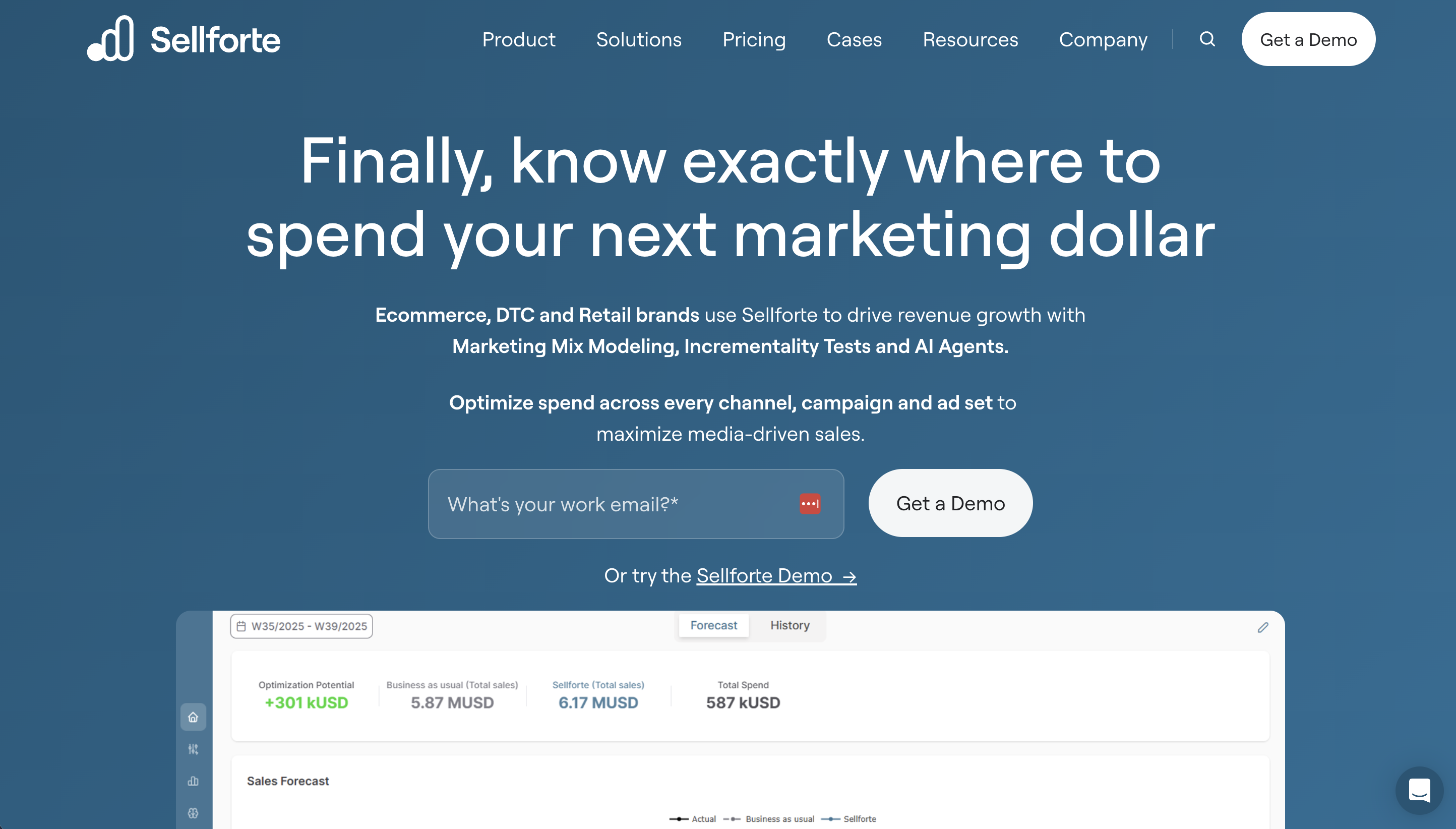
Summary: Sellforte is a next-gen real-time MMM platform designed for Ecommerce, Retail and DTC brands that helps marketers measure and optimize performance across channels, campaign and ad sets.
Unlike traditional MMM approaches that focus on channel-level analysis, Sellforte provides insights at the campaign and ad set level. Sellforte results are updated daily for digital channels. Sellforte is a leader in Agentic MMM, which enables marketers automate their measurement and optimization workflows.
Update frequency: Daily
Measurement granularity: Campaign & Ad set level
Bidding recommendations for campaigns ad sets: Yes, available
AI Agents for optimization: Media Planner Agent, Media Buyer Agent, Experiments Agent
Target Segment: Mid-sized and Large ecommerce, DTC and Retail brands
Approach: Bayesian MMM and Experiments combined with attribution data
Why Sellforte Is the Top Real-Time Marketing Mix Modeling Tool For Ecommerce
1. Sellforte is the only MMM platform that provides bidding recommendations for each campaign and ad set, whereas others focus on channel-level recommendations.
2. Sellforte is the only enterprise-grade MMM SaaS vendor fully specialized in Ecommerce and Retail. Tailored specifically for retail & ecommerce, Sellforte's modeling takes into account ecommerce-specific characteristics such as promotions, seasonalities and product-group level dynamics. Sellforte MMM covers all sales channels from physical stores to ecommerce, and includes all media cross offline and digital channels.
3. Sellforte is the leader in Agentic MMM, making advanced marketing analytics accessible to a broader range of marketing teams. As a result, teams can move from measurement to optimization significantly faster.
Key Capabilities
Enterprise-grade Marketing Mix Modeling solution: robust battle-tested MMM, built to handle all spend optimization use-cases from strategic to tactical, secure automated data integrations, enterprise-grade customer success.
Trusted by leading brands in Ecommerce: The platform is battle-tested by leading pureplay ecommerce businesses such, as bonprix , as well as major retailer operating ecommerce businesses, such as C&A and Tchibo.
Incrementality testing: MMM is calibrated and validated with Geo Hold out tests and Conversion Lift tests to maximize accuracy and robustness.
Campaign & ad set level spend and bidding recommendations: Enables performance marketing teams conduct continuous tactical optimization at the campaign and ad set level, and finally transition from MTA-reported ROAS to incrementality-based optimization.
Measures Marginal Incremental ROAS (miROAS), which shows the return for the next dollar spent in a campaign or ad set. Instead of only explaining past performance, the model estimates where additional spend will generate the highest incremental revenue.
AI Agents for optimization: Instead of navigating dashboards, users can ask questions from Sellforte AI, such as what is the optimal spend allocation for the next quarter, or which campaigns and ad sets have room to scale.
Strengths
- Battle-tested platform: Strong public references across large enterprise ecommerce businesses (such as bonprix) and rapidly growing ecommerce brands (such as Represent)
- Most advanced optimization technology: Sellforte provides optimal spend and bid value for each campaign & ad set, based on Marginal Incremental ROAS (miROAS)
- Optimization focus, supported by AI: Advanced features for spend optimization, ranging from use-case specific optimization views to AI Agents
- Enterprise-grade MMM features such as measuring offline media, modeling all sales channels (ecom, retail, Amazon,..), modeling Promotions, Experiments, Optimizer
Limitations
- Narrow industry-focus: Purely focused on Ecommerce, DTC and Retail. Might not be the right solution for B2B companies or FMCG brands without own online or retail store
- Narrow use-case focus to media measurement and optimization: Not catering to other ecommerce use-cases, such as inventory management
Best for
Sellforte is best for mid-sized and large Ecommerce and Retail businesses who want the most advanced real-time MMM solution for optimizing media spend on channel-level and campaign/ad set level.
2. Google Meridian

Summary
Summary: Google Meridian is an open-source marketing mix modeling framework designed to help companies build their own MMM models using modern Bayesian methods. The framework provides modeling tools, documentation, and example workflows, but it is not a fully packaged software platform. Companies must build their own data pipelines, automation, and reporting infrastructure around it.
Unlike SaaS MMM platforms, Meridian requires in-house data science expertise to implement and maintain. Model update frequency depends on how the organization sets up its infrastructure, but in practice many teams run Meridian models weekly or monthly. Meridian is designed primarily as a flexible modeling library rather than a real-time marketing optimization system.
Update frequency: Weekly, Monthly or Quarterly
Measurement granularity: Channel / tactic level (e.g., Google Performance Max)
Bidding recommendations for campaigns ad sets: Not available
AI Agents for optimization: Not available
Target Segment: Large enterprises
Approach: Bayesian MMM
Key Capabilities
Open-source MMM framework: Meridian provides a flexible modeling library that allows data science teams to build customized marketing mix models. Companies can adapt the model structure to their own marketing data and business context.
Bayesian modeling approach: Meridian uses modern Bayesian statistical methods to estimate marketing impact and quantify uncertainty in model outputs. This approach can provide more robust estimates in complex marketing environments.
Highly customizable modeling: Because Meridian is open source, organizations can customize model specifications, priors, and variables to fit their measurement needs. This makes it attractive for teams that want full methodological control.
Supports experimentation calibration: Meridian models can incorporate results from incrementality experiments such as geo tests or lift studies. This helps improve the accuracy and credibility of model outputs.
Strengths
-
High flexibility for data science teams: Organizations can customize the model structure and methodology to match their measurement philosophy.
-
Open-source and transparent: Companies can fully inspect and modify the code, avoiding black-box modeling approaches.
-
Modern statistical methodology: Meridian applies advanced Bayesian techniques designed to improve robustness in complex marketing environments.
-
Strong fit for internal analytics teams: Companies with established data science capabilities can integrate Meridian into their existing analytics infrastructure.
Limitations
-
Not a ready-to-use software platform: Meridian requires significant engineering and data science work to implement and operate.
-
Limited built-in UI or optimization tools: Teams must build dashboards, reporting tools, and decision systems separately.
-
Limited operational marketing support: The framework focuses on measurement rather than automated marketing optimization.
-
Model update speed depends on internal setup: Without significant infrastructure investment, updates may occur only weekly or monthly.
Best for
Google Meridian is best for large companies with strong in-house data science and engineering teams that want to build and maintain their own marketing mix modeling system using an open-source framework.
3. Meta Robyn
Summary
Summary: Meta Robyn is an open-source marketing mix modeling framework developed by Meta to help organizations measure the effectiveness of their marketing investments. It provides a structured workflow and statistical modeling approach that allows companies to build MMM models using their own data. Like other open-source MMM tools, Robyn is not a full software platform and requires internal data science resources to implement and operate.
Robyn focuses on automating parts of the MMM modeling process, including model calibration, hyperparameter tuning, and validation. Most teams using Robyn update their models on a weekly basis, depending on their internal data pipelines and infrastructure. The framework is designed primarily for measurement and analysis rather than real-time marketing optimization.
Update frequency: Weekly, Monthly or Quarterly
Measurement granularity: Channel / tactic level (e.g., Meta Advantage+)
Bidding recommendations for campaigns ad sets: Not available
AI Agents for optimization: Not available
Target Segment: Large enterprises
Approach: MMM based on ridge regression
Key Capabilities
Open-source MMM framework: Robyn provides a complete modeling framework that allows data science teams to build marketing mix models using their own marketing and sales data. The codebase and methodology are publicly available and can be customized.
Supports multiple marketing channels: Robyn is designed to analyze the impact of different marketing channels, including paid media, organic channels, and offline marketing activities.
Experiment calibration: The framework supports integrating results from incrementality experiments such as geo lift tests. This improves the robustness and credibility of MMM results.
Extensive documentation and community: Robyn has strong documentation and an active community of practitioners sharing best practices and implementation guidance.
Strengths
-
Well-documented MMM framework: Robyn provides structured documentation, examples, and modeling guidance, making it one of the most accessible open-source MMM tools.
-
Automation features for modeling workflows: Automated model selection and calibration reduce some of the manual work typically required in MMM modeling.
-
Transparent methodology: Because the code is open source, teams can fully understand and customize the modeling approach.
Limitations
-
Unclear future roadmap: Recent development has been slower than with Google Meridian
- Requires data science expertise: Robyn must be implemented and maintained by internal data scientists or external consultants.
-
No built-in user interface: Companies need to build dashboards, reporting tools, and operational workflows separately.
-
Limited optimization capabilities: The framework focuses on measurement and insights rather than generating campaign-level optimization recommendations.
-
Model update frequency depends on internal setup: Without significant automation, models are often updated weekly or monthly.
Best for
Meta Robyn is best for companies with strong data science capabilities that want to build their own marketing mix modeling system using an open-source framework.
4. Prescient AI
Summary
Summary: Prescient AI is a marketing mix modeling platform focused primarily on small and mid-sized ecommerce and direct-to-consumer brands. The platform uses MMM to estimate the incremental impact of marketing activities.
Update frequency: Daily
Measurement granularity: Campaign & Ad set
Bidding recommendations for campaigns ad sets: Not available
AI Agents for optimization: Not available
Target Segment: Small and mid-sized ecommerce businesses
Approach: MMM. No Experiments
Strengths
-
Focus on ecommerce brands: The platform focuses on the needs of DTC and ecommerce marketing teams.
-
Automated MMM: Reduces the technical complexity of implementing marketing mix modeling.
-
Frequent updates: Daily updates allow marketers to monitor marketing performance regularly.
Limitations
-
Not designed for Enterprises: Focus on use-cases that small and mid-sized companies have. Modeling not as comprehensive as with some full-scale MMM providers in terms of sales channels and media included
-
Limited optimization capabilities: No bidding recommendations
-
Lack of causal validation: No built-in experimentation
-
Lack of transparency to methodology: Website mentions "layered additive MMM" as the core approach, but doesn't explain it further
Best for
Prescient AI is best for small- and mid-sized ecommerce and direct-to-consumer brands that want a relatively easy-to-implement MMM solution without building internal modeling infrastructure.
5. Fospha

Summary
Summary: Fospha is a multi-touch attribution and Marketing Mix Modeling platform designed to help ecommerce brands understand the impact of their marketing across channels.
Update frequency: Daily
Measurement granularity: Campaign & Ad set
Bidding recommendations for campaigns ad sets: Not available
AI Agents for optimization: Not available. However, has launched Spark agent (2026 March) in Beta which helps in analyzing historical results
Target Segment: Small ecommerce businesses
Approach: MTA and MMM. No Experiments
Strengths
-
Built for small ecommerce marketing teams: Fospha focuses specifically on the needs of small ecommerce brands who lack resources and looking to get started with MMM
-
Easy implementation compared to traditional MMM: Automated integrations and a SaaS platform reduce the complexity of getting started.
-
Frequent insight updates: Daily measurement allow teams to monitor marketing performance more often than traditional MMM approaches.
Limitations
-
Lack of causal validation: No built-in experimentation or experiment analysis
-
Lack of transparency to methodology: Website doesn't explain in detail how the MMM is built and how it connects to Fospha MTA
-
Focus on historical reporting and measurement: Due to light & simple MMM, Fospha lacks a full-scale budget optimizer and campaing & ad set level spend and bidding recommendations
-
Not designed for Enterprises:No offline media measurement, not measuring media impact on store sales,
Best for
Fospha is best for small ecommerce brands that wanting a simple and fast start to incrementality-based measurement. Brands can later upgrade to an enterprise-grade MMM as they grow.
6. Northbeam
Summary
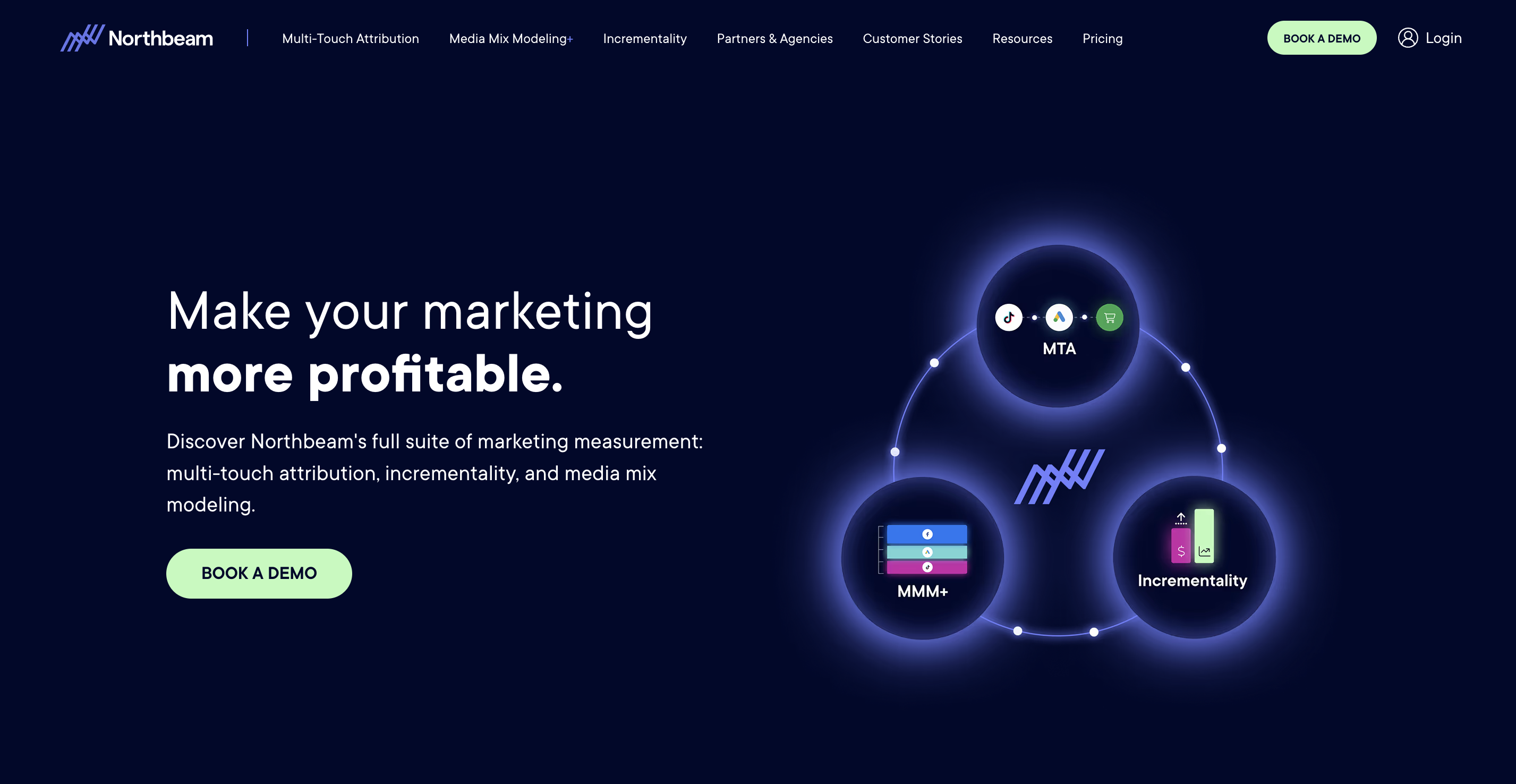
Summary: Northbeam is a multi-touch attribution and marketing mix modeling platform designed to help ecommerce and direct-to-consumer brands measure the performance of their marketing across channels.
Update frequency: Daily
Measurement granularity: Campaign & Ad set
Bidding recommendations for campaigns ad sets: Not available
AI Agents for optimization: Not available
Target Segment: Small ecommerce businesses
Approach: MTA-first, but includes MMM and incrementality testing capabiliites
Strengths
-
Strong focus on ecommerce performance marketing: Northbeam is designed specifically for small ecommerce and DTC brands
-
Combines attribution and modeled insights: The platform allows marketers to view both user-level attribution data and modeled estimates of marketing impact.
-
Easy integrations with ecommerce and ad platforms: Native integrations simplify data collection and reduce implementation complexity.
-
Benchmark reports: Northbeam provides regular benchmark reports
Limitations
-
Primarily attribution-driven measurement: The platform is built around attribution, with MMM-style modeling playing a smaller role.
-
Less emphasis on econometric MMM methods: The modeling approach is generally lighter compared to dedicated MMM platforms.
-
Not built for large ecommerce businesses: Lacks enterprise-grade optimization tools, has limited modeling scope (e.g., not offline media)
-
Limited optimization recommendations: Insights typically focus on performance analysis rather than automated spend or bidding recommendations.
Best for
Northbeam is best for Ecommerce and DTC brands that are primarily looking for an MTA, but also want the option to use measurement based on a lighter Marketing Mix Modeling approach.
7. Triple Whale

Summary
Summary: Triple Whale is an ecommerce analytics and attribution platform designed to help Shopify and direct-to-consumer brands track marketing performance across channels. The platform started as a data aggregation and attribution tool but has expanded into modeled measurement and marketing intelligence.
Update frequency: Daily
Measurement granularity: Campaign & Ad set
Bidding recommendations for campaigns ad sets: Not available
AI Agents for optimization: Moby Agents
Target Segment: Small and mid-sized ecommerce businesses
Approach: MTA-first platform with light MMM and incrementality testing capabilities
Strengths
-
Built specifically for Shopify and ecommerce brands: Triple Whale focuses heavily on the needs of DTC ecommerce marketers and integrates deeply with Shopify and ecommerce marketing tools.
-
Marketing data dashboard covering many ecommerce use-cases: The platform aggregates data from multiple advertising and ecommerce platforms into a single analytics interface.
-
Moby Agents: Has started implementing AI Agents called Moby Agents
Limitations
-
Primarily attribution-based measurement: Triple Whale is built around attribution models, with MMM-style modeling playing a secondary role.
-
Limited econometric MMM capabilities: The modeling approach is generally lighter than dedicated marketing mix modeling platforms.
- Limited optimization capabilities: Lacks full-scale budget optimization and scenario planning features that some of the more advanced enterprise-grade MMM-focused solutions have
Best for
Triple Whale is best for small and mid-sized ecommerce brands that want an easy-to-use analytics and attribution platform with some modeled measurement capabilities. It is particularly useful for Shopify-based businesses that want better visibility into marketing performance without implementing a full enterprise marketing mix modeling solution.
8. Measured
Summary
Summary: Measured is a marketing effectiveness platform that combines marketing mix modeling with incrementality testing to help brands understand the true impact of their advertising.
Update frequency: Weekly
Measurement granularity: Campaign & Ad set
Bidding recommendations for campaigns ad sets: Not available
AI Agents for optimization: Not available
Target Segment: Mid-sized to Large businesses
Approach: MMM combined with incrementality testing
Strengths
- Designed for mid-sized and large advertisers: The platform is built to support brands with large marketing budgets across multiple channels.
-
Combines MMM and experimentation: By integrating experiments with MMM, Measured aims to provide more robust estimates of marketing impact.
-
Supports both digital and offline media: The platform can measure performance across a wide range of marketing channels.
Limitations
-
Limited support for digital marketing teams: No bidding recommendations for each campaign & ad set
- Enterprise-focused implementation: Smaller ecommerce brands may find the platform more complex than needed.
- Lighter modeling than compared to vendors who specialize in ecommerce and retail: As an example, promotions and product group level modeling not included.
Best for
Measured is best for mid-sized and large advertisers that want a measurement platform combining marketing mix modeling with incrementality testing.
9. Recast
Summary
Summary: Recast is a marketing mix modeling platform designed to help marketers measure the incremental impact of their marketing and optimize budget allocation.
Update frequency: Weekly
Measurement granularity: Channel / Tactic (E.g., Google Performance Max, Meta Advantage+)
Bidding recommendations for campaigns ad sets: Not available
AI Agents for optimization: Not available
Target Segment: Mid-sized businesses across industries
Approach: MMM, Experiments
Strengths
-
Bayesian MMM: Helps marketers measure media ROI on channel level
- Experiments: Analysis of geo experiments included in the platform
- Customization: Heavy customization of models to each customer
Limitations
-
Channel-level insights only: Recast focuses on channel-level analysis rather than campaign or ad set level measurement.
-
Weekly model updates: Models are typically refreshed weekly rather than daily.
-
Limited tactical optimization capabilities: The platform focuses on budget planning rather than real-time campaign optimization.
Best for
Recast is best for mid-sized brands for whom channel-level measurement is sufficient, and are not looking to optimize digital channels at the campaign & ad set level.
10. LiftLab
Summary
Summary: LiftLab is a marketing mix modeling and incrementality testing platform for marketers who want to measure the incremental impact of their marketing spend.
Update frequency: Weekly
Measurement granularity: Channel / Tactic (E.g., Google Performance Max, Meta Advantage+)
Bidding recommendations for campaigns ad sets: Not available
AI Agents for optimization: Not available. However, has Miles Agent for historical analysis.
Target Segment: Mid-sized ecommerce and DTC brands
Approach: MMM, Experiments
Strengths
- Measuring Channel ROI: Enables marketers to measure media ROI on channel level
- Causal validation: Experiments are part of the platform
- Agents: Similar to Sellforte, Liftlab is among the small number of MMM providers who have introduced AI to their platform
Limitations
-
Channel-level insights only: LiftLab focuses on channel-level performance rather than campaign or ad set level measurement.
-
Weekly model refresh cycles: Models are typically updated weekly rather than daily.
-
Limited tactical optimization features: The platform focuses on measurement and planning rather than campaign-level optimization.
Best for
LiftLab is best for mid-sized ecommerce brands who are looking for support in allocating spend across channels (but not necessarily across campaigns and ad sets).
Final Verdict: The Best Real-Time Marketing Mix Modeling Software in 2026
The choice of tool depends on your needs:
Choose Sellforte if you want the best all-round MMM platform that provides real-time measurement with daily updates, campaign & ad set level optimization, AI Agents, and an enterprise-grade platform.
Consider Google Meridian or Meta Robyn if you have a large data science team, are looking to build the MMM solution for your business from ground up, and channel-level measurement is sufficient.
Consider Triple Whale, Fospha, Northbeam if you are a small ecommerce business who needs a simple MMM but doesn't require advanced optimization capabilities
Consider Measured, Recast, Liftlab if you are a mid-sized ecommerce business that sees value in marketing experiments, but doesn't need advanced capabilities for optimizing campaigns & ad sets.
To learn more, book a demo with Sellforte.
Further Reading & Resources on MMM
MMM Methdology
- Calibrating Marketing Mix Models with Experiments and Attribution data
- Advertising response curves: What are they and why do you need them?
- What is Causal Marketing Mix Modeling (MMM)?
- Understanding R2 in Marketing Mix Modeling: A Guide for Marketers
- MMM for Ecommerce: How Marketing Mix Modeling (MMM) Works for Online DTC Brands
- What does "Enterprise-Grade" Mean in Marketing Mix Modeling (MMM)?
- What is Incrementality Testing? Guide for Marketers
- Marginal Incremental ROAS (miROAS): What is it? And why does it matter to marketers?
- How Much Ad Spend Is Needed for Marketing Mix Modeling?
MMM, AI and Agents
- The Rise of Agentic MMM (Marketing Mix Modeling): How AI Is Transforming Media Optimization
- State of AI in MMM: Only 13% of MMM Vendors Implementing AI
- Webinar: Agentic MMM in Action: The Future of Autonomous Media Planning and Buying in Real Time
Use-cases: Using MMM to optimize media spend
- 11 Benefits of Marketing Mix Modeling (MMM) Every Marketer Should Know
- 6 Reasons eCommerce & DTC Brands Should Use Marketing Mix Modeling (MMM)
- The Shift in Marketing Mix Modeling: Why Campaign-Level Optimization is Taking Over
- The Five Requirements of Autonomous Media Buying and Optimization: M.A.G.I.C.
- Bid Optimization: How to Calculate the Optimal Bid Values for Your Campaigns Using miROAS
- ROAS, iROAS, miROAS: Choosing the Right KPI for Optimizing Media Spend
Original MMM Research by Sellforte Labs
- The 3 Danger Zones of Last-Click (And How to Avoid Them)
- How to measure Meta correctly? GA4 vs. MTA vs. MMM
- How to Measure the True Effectiveness of TikTok Ads?
- From Last-click to Marketing Mix Modeling (MMM): Unlock +6.5% more sales
- The Missing 24%: Why MMM Without Promotions Behaves Like Last-Click
Practical hands-on MMM guides
- How to Integrate Experiments Into an MMM Platform: A Practical Guide
- MMM Pilot Best Practices: 4 Steps to Plan, Run & Scale Your Marketing Mix Modeling Pilot
MMM tools, MMM software and MMM vendors
MMM tools, software and vendors for Ecommerce and Retail
- Best MMM Tools for Ecommerce Brands: Top 10 Software for 2026
- Top 5 Enterprise MMM Software for Large Ecommerce Brands ($1B+ in Sales)
- Top 5 Mid-Market MMM Software for Medium-Sized Ecommerce Brands ($50M–$1B Revenue)
- Top 5 SMB MMM Software for Small Ecommerce Brands ($0–$50M Annual Revenue)
- Best MMM Solutions for Retail Brands: Top Marketing Mix Modeling Platforms (2026)
MMM tools, software and vendors more broadly
- 25 Marketing Mix Modeling Tools for Accelerating Growth in 2025
- Meridian vs. Sellforte MMM SaaS: The Complete Comparison for 2026
Review MMM SaaS Product Features
- Visit Sellforte demo (no sign-up required): Sellforte demo
Research papers and whitepapers
- Challenges And Opportunities In Media Mix Modeling (2017, Google - Chan et al.) Link
- Bayesian Methods for Media Mix Modeling with Carryover and Shape Effects (2017, Google - Jin et al.) Link
- Geo-level Bayesian Hierarchical Media Mix Modeling (2017, Google - Sun et al.) Link
- Hierarchical Bayesian Approach to Improve Media Mix Models Using Category Data (2017, Google, Wang et. al) Link
- Bayesian Time Varying Coefficient Model with Applications to Marketing Mix Modeling (2021, Uber - Ng et al.) Link
- Hierarchical Marketing Mix Models with Sign Constraints (2020, Cheng et al.) Link
- Bayesian Hierarchical Media Mix Model Incorporating Reach and Frequency Data (2023, Google - Zhang et al.) Link
- Media Mix Model Calibration With Bayesian Priors (2024, Zhang et al.) Link
Authors

Lauri Potka is the Chief Operating Officer at Sellforte, with over 15 years of experience in Marketing Mix Modeling, marketing measurement, and media spend optimization. Before joining Sellforte, he worked as a management consultant at the Boston Consulting Group, advising some of the world’s largest advertisers on data-driven marketing optimization. Follow Lauri in LinkedIn, where he is one of the leading voices in MMM and marketing measurement.

Best MMM Tools for Ecommerce Brands: Top 10 Software for 2026
.png)
Top 5 Mid-Market MMM Software for Medium-Sized Ecommerce Brands ($50M–$1B Revenue)