

RFP season is here. At Sellforte, we typically see requests for proposals for Marketing Mix Modeling (MMM) and incrementality testing pick up in September, accelerate through October and November, and slow down in December as brands finish planning next year's budgets.
This year, our experts have been answering questions from marketing analytics and martech procurement teams across the US, Europe, Australia, and South America. The questions give us a useful view of what brands expect from marketing measurement.
In ecommerce and retail, the scope is expanding. Buyers want to understand incremental performance, use it in everyday media decisions, and give their own teams more control over the process. These are eight trends I'm seeing across recent RFPs and customer discussions.
1. RFPs are getting longer and more comprehensive
LLMs are being adopted across business functions, and procurement is no exception. My impression is that they are helping teams build more extensive question lists. The breadth of questions now stretches from modeling methodology and experimentation to technical architecture, business impact, and deployment.
I see this as a positive development. A thorough RFP gives buyers more opportunities to understand where vendors differ. It also brings questions into the process that might otherwise surface only after implementation has started.
The challenge is making the answers comparable. Almost any vendor can say it supports calibration, granular reporting, or AI. Those answers become more useful when buyers ask how a capability works, who operates it, and what data it requires.
For example, a question about campaign-level measurement should also ask how the vendor handles sparse data. A question about model refreshes should distinguish between importing new data and re-estimating the model. A question about experimentation should ask what happens to a completed test result.
A practical improvement is to ask vendors to demonstrate the capabilities that matter most to the buying decision. Longer questionnaires are useful when they lead to clearer comparisons.
2. Buyers want a connected measurement system
MMM-only requests are becoming less common in the conversations we're having. Teams increasingly want MMM, incrementality testing, and incrementality-corrected attribution to work together.
Recent retail RFPs ask explicitly how experiments and modeling interact, how test results feed into future planning, and how MMM should coexist with or calibrate attribution. These are questions about the connections between methods.
Each method has a different job. A well-designed incrementality test estimates causal impact for a defined scope. MMM brings that evidence into a wider view of sales, media, and other business drivers. Incremental attribution uses incrementality evidence to correct the signals teams rely on for more frequent campaign decisions.
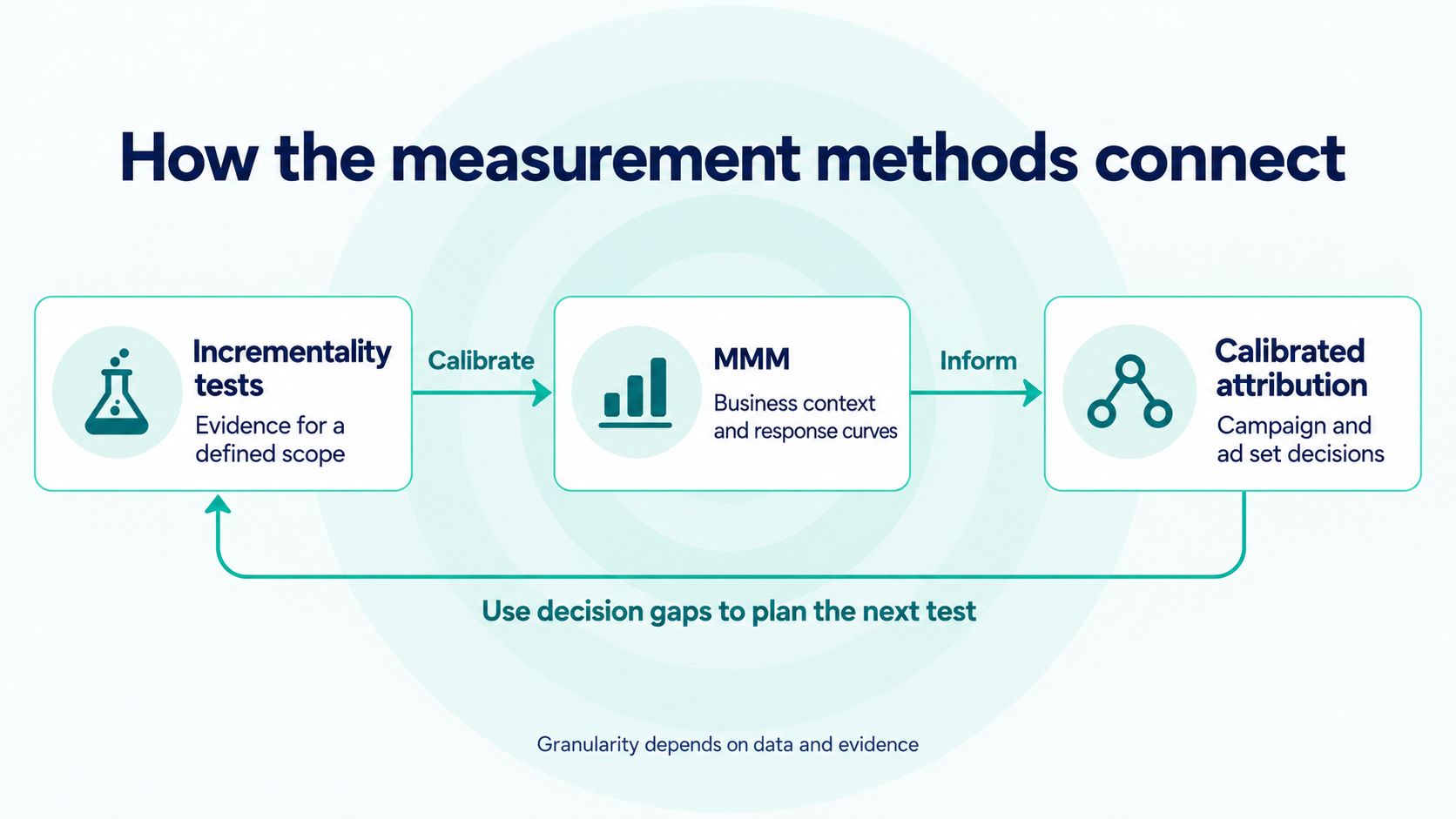
In practice, the connections require work. A test might cover one country and a group of campaigns over a few weeks. The MMM might cover several years. The attribution data might use a different conversion window or include a different mix of web and app sales. Teams need a documented way to handle those differences.
Google's Meridian calibration guidance makes the same methodological point: experiment results are useful evidence for priors, but differences in timing, population, media scope, and measurement goals introduce additional uncertainty.
For buyers, the useful demonstration is a complete journey: a test is recorded, its evidence informs the model, and the updated measurement changes a planning or optimization decision.
3. Campaign and ad set insights are becoming a core requirement
Channel-level results remain useful for annual planning. More RFPs now also ask for incremental ROAS at campaign and ad set level, where media teams make day-to-day decisions.
The operational need is easy to understand. If a measurement system suggests increasing investment in paid social, the buyer still needs to decide which campaigns should receive that investment and which settings should change.
Recent questionnaires go further by asking about creative and product-category granularity, as well as how vendors handle limited data at those levels. That second question deserves as much attention as the first.
Our calibration discussions with marketing analytics teams show why. Campaigns grouped under the same platform can have different objectives, audiences, and attribution signals. A single correction factor applied to all of them may conceal differences that matter for buying decisions.
Buyers should ask which results are estimated directly by the model, which are informed by experiments, and which are allocated through attribution. Applying a channel-level factor to campaign data does not create a separate causal experiment for every campaign.
A useful system makes those distinctions visible and explains when the data supports a detailed decision, when campaigns need to be grouped, and where another test would help.
4. Brands are putting more emphasis on technology
Many large retail and ecommerce brands have traditionally relied on consultants for marketing measurement. The RFPs we're seeing place more emphasis on technology that internal teams can use throughout the year.
Requirements include interactive interfaces, automated data integration, self-service scenario planning, and structured exports into existing reporting systems. Buyers want to explore a budget question while they are working on the plan.
The expertise still matters. Someone has to assess data quality, make modeling choices, and help teams interpret uncertainty. Procurement teams increasingly want clarity on how that expertise is delivered alongside the software.
One useful way to assess the operating model is to ask a vendor to show what happens when a user changes a budget constraint, adds a new test result, or wants to review a different market. Which steps can the team complete in the platform? Which require specialist support? How long do they take?
This also makes commercial comparisons more meaningful. Buyers can distinguish the software subscription from implementation work, ongoing analysis, and changes that require a separate project.
5. Measurement is becoming infrastructure for AI agents
Some of the most forward-looking conversations concern the systems that will consume measurement outputs next. Brands are already considering how incrementality data could support agents that recommend or execute media changes.
That creates a requirement for machine-readable access through APIs or the Model Context Protocol (MCP), a standard for connecting AI applications to tools and data. Structured exports and downstream access are already appearing in procurement requirements; agent workflows make the quality of those interfaces more consequential.
An optimization agent needs more than a performance ranking. It needs to understand the metric, the scope of the estimate, and the action that the evidence supports:
- Incremental ROAS (iROAS) estimates the incremental revenue generated per unit of spend.
- Marginal incremental ROAS (miROAS) estimates the incremental revenue from an additional unit of spend at the current spending level.
- Budget and bidding recommendations translate those estimates into settings at the campaign or ad set level.
- Data freshness, uncertainty, and business constraints tell the agent how to interpret and use the recommendation.
The distinction between average and marginal return matters. A campaign can have strong average iROAS while offering a relatively low return on the next euro because it is already heavily funded. Budget allocation needs a view of the additional spend.
There are already practical examples of this access. Sellforte's MCP reporting documentation describes access to incremental revenue and ROAS across the channel, campaign, and ad set dimensions available in the model.
Buyers should evaluate permissions as part of the workflow. Reading a recommendation and changing a live campaign are different capabilities. The MCP tools specification recommends keeping people able to review and deny tool actions. For media buying, I would ask vendors to demonstrate approval controls, spend limits, and a record of changes alongside the data connection.
6. Analytics teams want more control over the model
Marketing analytics teams increasingly want to inspect and configure how measurement works. MMM calibration is one of the clearest examples.
When I discuss this topic with marketing analytics teams, the questions quickly become specific. Which tests are being used? Should an older experiment carry the same weight as a recent one? Do the test and model cover the same campaign objectives? What happens when the experiment measures a different revenue definition?
Those choices can affect the model's estimates and the budgets recommended from them. Teams need a way to understand the choices, challenge them, and assess the consequences of a change.
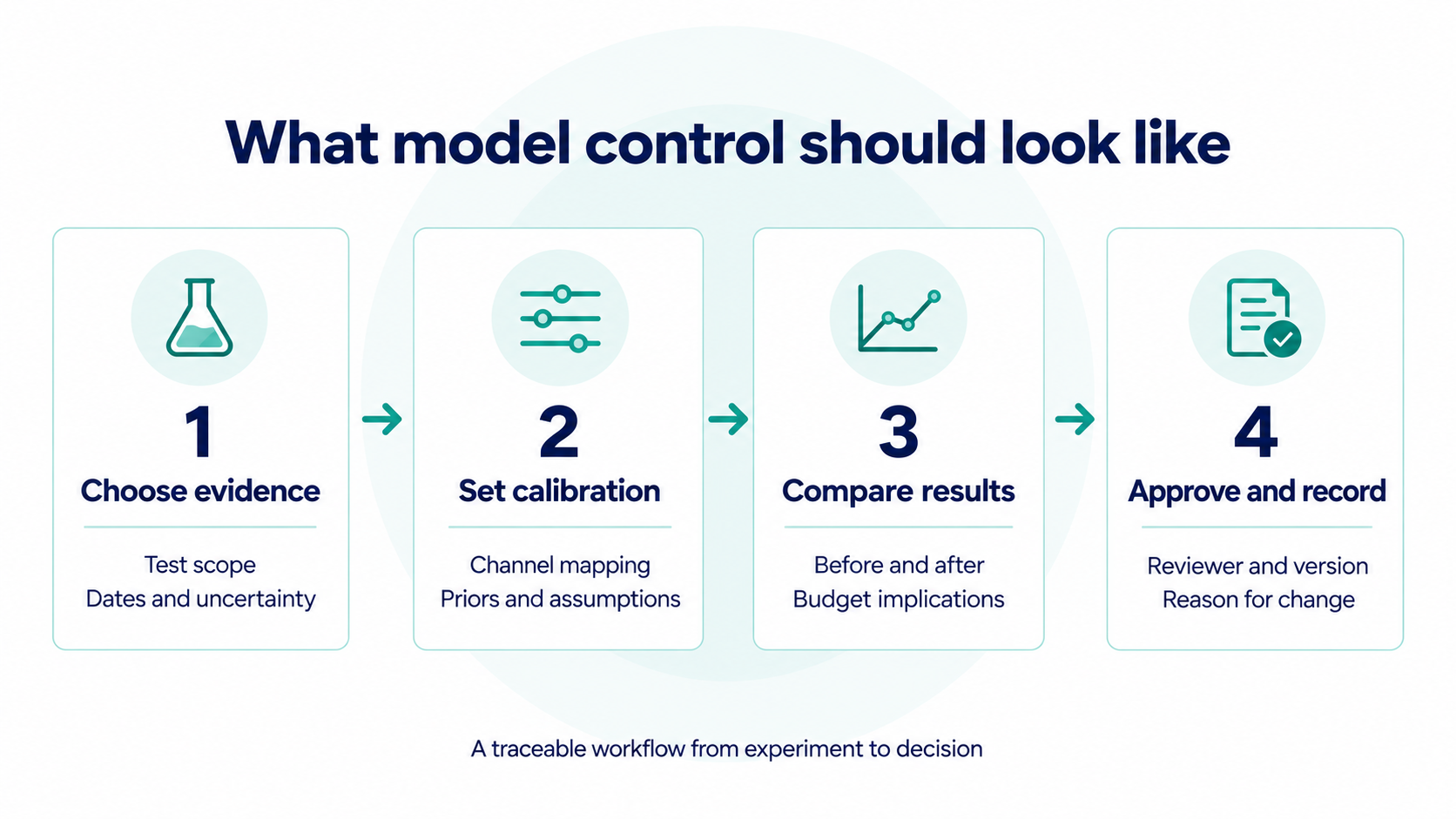
A useful calibration interface should let the team inspect the underlying evidence, see how it maps to the model, and compare the results before and after a change. Access controls and version history help make the process accountable.
The starting point is often an experiment library connected to a calibration interface. The library preserves the test's scope, dates, results, and uncertainty. The interface makes its use in the model visible.
Control should help teams apply evidence consistently. If users can change assumptions, they should also be able to see what changed, why it changed, and who approved it.
7. Time to action is getting more scrutiny
Beyond the original measurement questions, recent RFPs put considerable attention on speed. Buyers ask about the time to first usable insights, the frequency of updates, and whether outputs can inform a campaign while it is still running.
This is particularly relevant in retail. A recommendation that arrives after a promotion or seasonal campaign has ended has a different use from one available while spend can still be adjusted.
The details matter here. Data ingestion, dashboard refreshes, model re-estimation, and recommendation updates can all run on different schedules. A daily interface does not mean every source is current or every model parameter has been re-estimated that day.
A good RFP asks vendors to explain those schedules and what happens when some inputs arrive late. It should also establish the client's responsibilities, especially for sales, promotions, and offline media data.
Proofs of concept are a useful place to make this concrete. Agree on a decision the pilot should improve, the data required, the person responsible for acting, and how the outcome will be assessed. Then evaluate the time from usable data to an implemented decision.
8. Retail economics are becoming more prominent
The measurement brief is also widening beyond media performance. Retail questionnaires ask about profit, customer value, product categories, and the effects of pricing and promotions. They ask vendors to distinguish ecommerce from physical-store performance and explain the factors driving both.
That makes sense. A sales increase during a promotion may reflect the discount, advertising, product availability, or several factors working together. A model that misses those drivers can give the media team a misleading view of its contribution.
For a retailer, the buying decision should therefore include how the system handles promotions, stock availability, and differences between categories. It should also define the outcome being optimized. Revenue, contribution margin, new-customer acquisition, and expected lifetime value answer different business questions.
The same discipline applies to calibration. If a test measures gross revenue but the business plans against revenue after returns or cancellations, the team needs to reconcile those definitions before using the result. Web-only evidence also needs care when the model covers app and store sales.
Scenario planning should reflect the commercial constraints teams actually face, including committed media budgets, category priorities, and minimum or maximum spend. That is where a measurement system can become useful to finance and trading teams as well as marketing.
What I would ask vendors to demonstrate
These trends give procurement teams plenty to add to a questionnaire. I would also ask each shortlisted vendor to work through one realistic decision using a consistent example:
- Show the business question, the relevant data, and the limits of that data.
- Explain how an incrementality test informs the model, including differences in scope and uncertainty.
- Trace a campaign or ad set recommendation back to the measurement evidence.
- Change a calibration assumption or budget constraint and show the effect on the recommendation.
- Demonstrate how the team can approve, export, or apply the change and review the outcome.
That exercise gives marketing, analytics, finance, and procurement a shared basis for assessing the solution. It also reveals the work each team will need to do after the contract is signed.
For brands preparing an MMM or incrementality testing RFP, I would start by agreeing which decisions the system must support. Use those decisions to set the required granularity, update frequency, level of control, and integration needs. The questionnaire then has a clear purpose, and the vendor demonstration has something concrete to prove.
Further Reading and Resources
Build your RFP and compare vendors with Sellforte Solution Research, then explore practical guides to calibration and campaign optimization.
Retail RFPs and vendor selection
Incrementality testing tools
AI and MCP comparisons
About the author

Lauri Potka is the Chief Operating Officer at Sellforte, with over 15 years of experience in Marketing Mix Modeling, marketing measurement and media spend optimization. Before joining Sellforte, he worked as a management consultant at the Boston Consulting Group, advising some of the world’s largest advertisers on marketing optimization. Follow Lauri on LinkedIn.

How to choose a Marketing Mix Modeling solution in Retail: 69 Criteria

How to choose an MCP Server for Marketing Mix Modeling (MMM) and Incrementality Testing