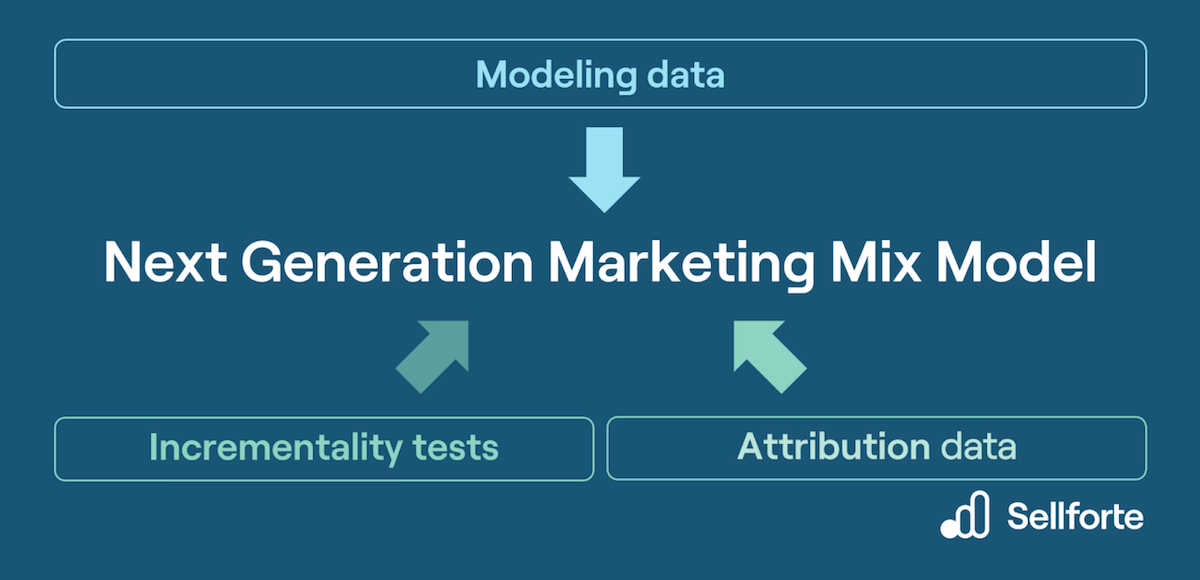


MMM calibration is the process of using incrementality tests and other relevant data to improve a Marketing Mix Model's (MMM) accuracy. It gives the model evidence about marketing effectiveness that it would otherwise have to estimate from historical sales and marketing data alone.
A calibrated MMM can use a lift study to inform the estimated effect of a channel, then combine that evidence with sales history, other media, and business conditions. The aim is to make its estimates of incremental impact more credible for budget decisions.
The practical challenge is getting the evidence into the model correctly. A test may cover selected campaigns for a few weeks, while the MMM covers several years and a broader definition of sales. This guide explains what you can calibrate, which evidence to use, how the process works, and how to assess the result.
What is MMM calibration?
A marketing mix model estimates how marketing and other business drivers contribute to an outcome such as sales. Calibration brings additional evidence into that estimation process. A well-matched incrementality experiment, for example, can inform how much effect the model assigns to the activity tested.
In a Bayesian MMM, calibration evidence usually enters through priors. The process involves:
- A model feature is the activity being estimated, such as Meta sales campaigns in one country or branded search in a particular market.
- A prior is a probability distribution describing plausible values for a model parameter before fitting. It expresses both the expected effect and uncertainty about it.
- A posterior is the updated distribution after the model combines the prior with the data. It describes the fitted estimate and its uncertainty.
For example, a precise experiment on the same campaigns and sales outcome can support a narrower prior than evidence borrowed from a different market. The prior influences the model without requiring its final estimate to reproduce one experimental point estimate exactly.
Calibration is also possible outside Bayesian MMM. Meta's Robyn documentation describes using disagreement between experimental lift and modeled contribution as an objective during model optimization. The implementation differs, but the purpose is the same: external evidence informs the model's estimates. The workflow below focuses on Bayesian priors.
Why does MMM calibration matter?
Marketing activities often move together. Several channels increase spending during a promotion, while seasonal demand is also rising. Historical data can make it difficult to determine how much of the sales increase each activity caused.
A model may predict total sales well while allocating the effect incorrectly between channels. Calibration adds evidence from situations where the advertiser deliberately changed marketing activity and measured what happened. That gives the model more information about the contribution of the tested activity.
Experiments have limits too. A study measures a particular intervention under particular conditions. It cannot tell you the return on every channel, in every country, at every possible budget. MMM brings that evidence into a broader view of the business and estimates how returns change with spending. Those response curves support decisions about where the next euro should go.
Calibration therefore needs scrutiny at both ends: the experiment must be credible, and the way its result enters the model must be defensible.
What can you calibrate in an MMM?
The most familiar calibration target is the size of a channel's incremental effect, often expressed as incremental return on ad spend (iROAS). An MMM also needs assumptions about when that effect occurs and how it changes as spending rises.
Channel effectiveness
A lift study can inform the plausible incremental revenue or conversions generated by the tested activity. Mapping that evidence to the correct feature matters: a result for Meta sales campaigns does not directly establish the effect of Meta awareness campaigns.
Delayed effects and carryover
Advertising can affect purchases after the initial exposure. Observing outcomes after a holdout ends can help inform how long an effect persists. The model's carryover assumptions should reflect the evidence available for that activity. A short study cannot, by itself, establish the size of brand effects several months later. See how long to measure sales after an incrementality test ends for guidance on observation windows and delayed or reversed effects.
Response curves and diminishing returns
A response curve describes how incremental outcomes change with spending. Its shape matters because budget allocation depends on the return from additional spend. One experiment at one spend level helps inform the effect in that setting; it cannot establish the full curve. Wider claims about scaling need support from spend variation, further experiments, or explicit modeling assumptions.
Effects across business segments
Experiments that measure outcomes separately for new and returning customers, or web and app sales, can inform those parts of the model. Where only the total is measured, allocating the effect between segments requires additional evidence or assumptions. Our guide to using web-only tests to calibrate app sales in MMM explains how to distinguish measured evidence from assumptions when a test covers only part of the sales outcome.
Calibrating one of these components does not validate all the others. A model can have credible average iROAS while still having uncertainty about the return from doubling a channel's budget.
Which evidence should you use for MMM calibration?
Choose evidence according to the question the model must answer. Conversion-lift and geo-lift studies can both be useful, and each has limits. Method labels alone are a poor basis for deciding which result should dominate.
| Evidence | What it can inform | What to check |
|---|---|---|
| Platform conversion-lift studies | The effect of selected platform campaigns on the measured conversion outcome. | Audience eligibility, campaign scope, tracking, sales definition, and observation window. |
| Geo-lift experiments | The effect of a regional marketing change on a business outcome, potentially including store sales. | Regional comparability, spillover, concurrent changes, outcome coverage, and statistical power. |
| Customer holdout tests | The incremental effect of addressable activity such as email, push notifications, or direct mail. | Whether the control actually receives none of the activity being measured, and whether other sends contaminate it. |
| Experiments from related activities or markets | An interim prior where directly matched evidence is unavailable. | Differences in campaign objective, brand strength, customer behavior, media conditions, and local economics. |
| Attribution data combined with incrementality factor benchmarks | A rough prior where experiment data is absent. | Comparability of benchmarks: industry, marketing activity, spend level. |
| Benchmarks, business knowledge and other data | Initial priors and assumptions about feature or segment behavior. | Relevance and measurement bias. These inputs do not carry the same causal evidence as a controlled experiment. |
Distinguish calibration evidence from ordinary model inputs. Sales history, media delivery, promotions, and other demand drivers are needed to fit the model. Adding them does not establish that a channel's effect has been calibrated against an independent experiment.
For a closer look at test design, see which incrementality test to use for different channels. Our article on using Meta Conversion Lift tests for MMM calibration explains the checks for platform evidence.
How to calibrate an MMM: a six-step process
The sequence below takes you from an existing evidence library to a fitted model that can be reviewed. The people running experiments and the people building the MMM need to agree on the definitions before the results enter calibration.
1. Define the outcome and the activity you want to calibrate
Start with the business question. If you need to allocate budgets between sales and awareness campaigns, a single prior for all paid social may be too broad. If the data cannot support separate estimates, that limitation needs to remain visible in the budget decision.
Write down the model's sales definition before selecting a test result. Revenue before returns differs from net revenue. Ecommerce sales differ from total sales across ecommerce and stores. Leads differ from purchases, and neither automatically measures customer lifetime value.
Match the experiment and the model across:
- The country, advertising account, and campaigns included.
- The campaign objective and audience, where these define separate model features.
- The outcome, including sales channels, returns, currency, and conversion events.
- The test dates, spending level, and period over which effects were measured.
Also check what changed in the experiment. Turning a channel off and reducing its budget answer different questions. A partial reduction measures the return on the spending change; it should not automatically become an estimate of the channel's average return against zero spend.
These distinctions matter when choosing a prior. Google's guidance on using experiments for MMM calibration also identifies differences in timing, duration, channel scope, and the experiment's comparison as reasons a result may need adjustment before use.
2. Build an experiment library you can audit
Collect the relevant studies in one place. Include conversion-lift studies, geo-lift experiments, and suitable holdout tests on your own audiences. Each study should retain its result and uncertainty, along with the information needed to reconstruct what was tested.
Keep campaign and account IDs wherever possible. Campaign names and broad labels can be ambiguous, especially when accounts span markets or naming conventions change. In practice, a discrepancy between an experiment report and a calibration table can come from a mismatched filter or missing identifier.
Check the study's execution and outcome data before using it. Was the intended activity withheld? Did tracking change? Were conversions duplicated or omitted? Was another intervention happening at the same time? A confidence interval cannot repair a badly defined outcome. If two analyses of the same experiment disagree, see how to reconcile different lift estimates from the same holdout test before choosing a result for calibration.
A valid but inconclusive test still contains information about uncertainty. Keep it in the library. Record why you excluded or reduced the influence of a study so the next person reviewing the model can follow the decision. Our article on how to judge whether an incrementality test is credible covers this assessment in more detail.
For each study, keep a record of:
- The study ID, source report, market, and participating campaign or account IDs.
- The treatment, control, test dates, spend change, and post-test observation period.
- The KPI definition, effect estimate, uncertainty interval, and stated confidence level.
- The MMM feature it informs, any allocation assumptions, and overlap with other studies.
- Data-quality checks, exclusions, and the rationale for its use in calibration.
Agree on these fields before the next study starts. It is much easier to plan an experiment around the required outcome and campaign grouping than to reconstruct them afterward.
3. Map each test to the model features it can inform
In a perfect world, each test maps cleanly to a feature in MMM. This happens, but not always. One conversion-lift study may include traffic, engagement, and sales campaigns, while the MMM estimates those activities separately. The experiment gives you evidence about their combined effect. It does not directly identify each campaign group's contribution.
For future tests, consider whether the test cells can match the model features more closely. Balance that benefit against statistical power and the risk of contamination between cells. Where a reliable split is unavailable, use the evidence at the combined level.
Campaign objectives deserve particular attention. See why traffic, engagement, awareness, and sales campaigns may need separate calibration.
4. Combine multiple tests without losing their uncertainty
Several tests may inform the same model feature. First check that they measure sufficiently comparable activity. Then decide how much influence each should have.
Sellforte has used spend-based weighting as a practical starting point in customer implementations, with additional choices around recency and confidence. There is no universal weighting rule that makes mismatched tests comparable.
Consider how closely each study matches the feature, whether the conditions remain relevant, how much spending it covers, and how precisely it estimates the effect. A recent study may deserve more influence after a substantial change in targeting or campaign mix. An older, closely matched study can still be useful when conditions remain similar.
Be precise about what you mean by confidence. The width of an uncertainty interval and whether a result crosses a significance threshold are different considerations. Selecting only significant positive results can favor tests that report larger effects. A weak or negative result deserves investigation, not automatic removal.
When studies disagree, inspect their scope and execution before combining them. Geo-lift may measure total business sales while a conversion-lift study covers platform-observed purchases. Tests of the same intervention can also overlap, so counting them as fully independent evidence can overstate certainty.
We discuss these choices in how to weight multiple incrementality tests and how to combine geo-lift and conversion-lift evidence.
5. Translate the evidence into a prior
Use the experiment's incremental return and uncertainty to inform the prior for the corresponding model feature. This works most cleanly when the test and model use compatible outcomes and the calibration refers to the relevant period and spending conditions.
The prior needs a plausible level of effectiveness and a range of uncertainty. Its central value can be informed by the experiment's iROAS estimate. Its width should reflect both the experiment's uncertainty and how confidently the result can be applied to the model feature.
A precise study of the same activity in the same market can justify a narrower prior than a study covering a different campaign mix or period. The experiment's confidence interval provides information for this choice, but its endpoints are not hard limits on what the model can estimate.
Record the reason for the prior settings, including the studies used and any adjustments for differences in scope. Inspect the full distribution: an acceptable central estimate can still sit inside a prior that allows implausibly large effects or expresses too much certainty.
6. Fit the model and save the calibration record
Fit the MMM using the calibrated priors and the sales and marketing data. The model estimates the feature's effect alongside the other components of the business, including seasonality and promotions.
Save the model version, data period, feature definitions, and prior settings together. Review the diagnostics and the movement from prior to posterior before using the results for budgeting. The validation checks below help distinguish a useful update from a result that needs investigation.
An example: using a lift study to calibrate MMM
Consider a model feature representing Meta sales campaigns in one country. A conversion-lift study covers that activity and reports an iROAS of 4.34, with a 90% confidence interval of 3.74 to 4.94. These are illustrative figures from the demo study in our campaign-objective calibration article.
Before using the study, the team confirms that its campaigns, sales definition, and effect window are compatible with the feature being modeled. The calibration then proceeds as follows:
| Stage | What the team does |
|---|---|
| Prepare the evidence | Map the study to the Meta sales feature and retain its iROAS estimate and confidence interval. |
| Set the prior | Use 4.34 to inform the prior's central value. Choose a width that reflects the study's uncertainty and any uncertainty about transferring it to the MMM. |
| Fit the MMM | Estimate the feature's effect using this prior alongside the historical sales and marketing data. |
| Review the posterior | Compare the fitted estimate with the prior and the experiment on a consistent basis. Investigate material disagreement. |
The outcome is a newly fitted MMM informed by experimental evidence. Its estimate need not equal 4.34 exactly, especially when reporting over a different period or spending level. The team should be able to explain any difference and show how uncertainty was retained throughout the process.
How do you know whether the calibration worked?
A calibrated model needs to pass more than a sales-fit check. Review whether its channel estimates respect the evidence, whether the model behaves sensibly, and whether the resulting budget decisions depend heavily on uncertain assumptions.
Compare the evidence, prior, and posterior
Rebuild the comparison on the same campaigns, KPI, period, and spending basis. Show the experimental estimate and uncertainty alongside the prior and fitted result. A difference can be reasonable when the model uses a broader period or incorporates other evidence, but the explanation should be traceable.
A large movement from prior to posterior deserves investigation. Check the input data and baseline assumptions, along with promotions and other channels that may be competing to explain the same sales. Our guide to differences between calibrated MMM and conversion-lift results covers the scope checks in detail.
Test sensitivity to reasonable assumptions
Review what happens when you use defensible alternatives for prior width, study weights, or uncertain carryover assumptions. If a modest change reverses a major budget recommendation, that decision needs more evidence or a more cautious implementation. Agreement between two runs is more useful when you understand what varied between them.
Check the model's diagnostics and business behavior
For a Bayesian model, review convergence as well as model fit. Examine the baseline, channel contributions, response curves, and uncertainty. Use out-of-sample prediction checks where possible. A model that predicts sales accurately can still assign the wrong contribution to individual channels, so prediction and causal calibration need separate scrutiny.
Use independent evidence where available
A study already used to set a prior is a consistency check. Matching it does not independently validate the model. Further experiments can test predictions for a defined intervention, provided the comparison uses compatible outcomes and timing.
Document unresolved differences before acting. That record should identify the affected decision and what further analysis or experiment would reduce the uncertainty.
What if you do not have an experiment for every channel?
Most advertisers cannot test every combination of channel, objective, and country. You can still build an MMM while making the evidence gaps explicit.
Start with directly relevant experiments where they exist. For untested features, consider evidence from a related activity or a structurally comparable market, followed by relevant benchmarks and business knowledge. Use wider uncertainty when the connection is weaker.
Comparability depends on the channel. Two neighboring countries may differ substantially in brand strength, customer behavior, or the role a channel plays. A relationship that transfers reasonably for one paid-social objective may be unsuitable for direct mail or branded search. Our guide to using incrementality evidence across countries explains what to check.
Turn those gaps into a testing roadmap. Prioritize activities where substantial spending depends on uncertain estimates and where a feasible experiment could change a budget decision. Include the business teams in that discussion: the easiest channel to test may not be the one where better evidence would matter most.
Statistical feasibility matters too. A small channel's effect may be difficult to detect in total sales. Assess the expected effect and the precision needed for the decision before committing to a test. See when a market or channel is too small to justify a test.
Build the roadmap around business impact, evidence gaps, feasibility, and the commercial cost of withholding marketing. The detailed framework for prioritizing incrementality tests across markets and channels helps turn calibration gaps into a testing plan.
Common MMM calibration mistakes
Review these possible sources of error when a model's results seem implausible or change substantially after calibration:
- Applying one study to a broader activity than it measured. A sales-campaign test cannot directly calibrate all paid social, and a combined-channel experiment does not identify each channel separately.
- Mixing outcome definitions. Gross and net revenue, platform-observed purchases, and omnichannel sales need reconciliation before their returns can be compared.
- Turning a point estimate into certainty. Keep the experiment's uncertainty and allow for the additional uncertainty of transferring it into MMM.
- Keeping only favorable results. Valid weak or negative evidence belongs in the review. Exclusion should follow an identified design, data, or relevance problem.
- Counting overlapping studies as independent. Two methods observing the same intervention may provide useful perspectives without supplying two independent pieces of evidence.
- Treating a calibrated average return as proof of the whole response curve. Evidence at one spend level does not establish the return at every other level.
- Adjusting priors until the output matches expectations. Business knowledge should be documented as an assumption; an uncomfortable experiment result is a reason to investigate.
How often should you recalibrate MMM?
Review calibration when new studies become available, when campaign strategy or tracking changes, and when the model and experiments begin telling different stories. Updating the sales dataset and refitting the model does not automatically update the experimental evidence behind its priors.
Keep a record of the studies used, their mapping and weights, the prior settings, and the model version. That makes it possible to explain whether a changed recommendation comes from new sales data, new experimental evidence, or a revised assumption.
Calibration can also inform how you plan the next experiment. If a mixed-objective study leaves the model uncertain about awareness versus traffic campaigns, design the next study to resolve that question where feasible. If the gap concerns delayed sales, plan the observation window accordingly.
Separate the cadence of data refreshes from the cadence of new evidence. A model may retrain daily while its experimental priors change only when a study is completed or the evidence is reviewed. Our guide to how often to retrain an MMM explains the operational side.
Assign responsibility for maintaining the evidence library, assessing study quality, and reviewing model changes. Automated imports reduce manual work, but someone still needs to resolve mismatched outcomes, conflicting studies, and changes in campaign definitions.
MMM calibration review checklist
Before using a newly calibrated model for a material budget decision, confirm that:
- The model KPI and the experimental outcome are compatible.
- Every study is mapped to the feature, market, and period it can inform.
- Uncertainty, exclusions, and any allocation of mixed studies are documented.
- Study weights account for relevance and do not silently double-count evidence.
- The chosen priors and fitted results can be inspected side by side.
- Model diagnostics and sensitivity checks support the intended use.
- Untested features and extrapolation beyond observed spending remain visible.
- The model version and next testing priorities are recorded.
If an item is missing, identify which decisions it affects. A gap in a small, stable channel has different consequences from uncertainty in the channel receiving most of the next budget increase.
Frequently asked questions about MMM calibration
How many incrementality tests do you need to calibrate MMM?
There is no universal minimum. One credible, closely matched study can inform a particular feature. Several studies can add coverage across conditions, but their usefulness depends on relevance and quality. A large experiment library can still leave an important channel or market untested.
Can calibration make an MMM less accurate?
Yes. A mismatched outcome, invalid study, or overly restrictive prior can pull the model toward the wrong estimate. Calibration quality depends on the evidence and its translation into the model. The label alone is not a guarantee of accuracy.
Does calibration always reduce uncertainty?
No. Consistent, relevant evidence can support more precise estimates. Conflicting studies may expose uncertainty that was previously hidden. A wider, better-supported range can be more useful than an unjustifiably precise result.
What is the difference between calibration and validation?
Calibration uses evidence to inform the model. Validation assesses whether the resulting model is suitable for its intended use. Comparing the model with a study used in calibration checks consistency; independent experiments provide a separate test of its estimates.
How Sellforte supports MMM calibration
Sellforte connects experimental evidence to the MMM features it can inform and makes the calibration available for review. Its Meta Conversion Lift integration retrieves studies through the native connector, matches relevant results to the MMM data, and updates Bayesian priors as part of the daily modeling workflow.
For a team reviewing its calibration, start with one important channel. Trace its estimate back to the studies, inspect the campaign and sales definitions, and compare the prior with the fitted result. Use any unexplained step to define the next analysis or experiment.
To see how that process works in Sellforte, explore the product tour. For detailed answers to specific measurement questions, visit Asked by Marketers.
About the author

Lauri Potka is the Chief Operating Officer at Sellforte. He has over 15 years of experience in Marketing Mix Modeling, marketing measurement, and media spend optimization. Before joining Sellforte, he worked as a management consultant at the Boston Consulting Group, advising some of the world’s largest advertisers on how to use data to optimize marketing. Follow Lauri on LinkedIn.

Can you trust a generic AI to do reliable media spend optimization with raw marketing data?

How should geo-lift and conversion-lift studies be combined when calibrating MMM?