


The short answer
No. Attribution is essential for providing data on a campaign, ad-set, and keyword level, but it cannot establish causality or measure the full funnel consistently. Incrementality tests reveal what sales advertising caused, while MMM scales that evidence across channels, markets, time horizons, and budget levels. Use attribution for execution, experiments for truth, and MMM for allocation.
Sellforte CEO and co-founder Juha Nuutinen explains the two biggest gaps in attribution-only measurement in this short video:
This article is part of Asked by Marketers, a series answering real questions from marketing leaders.
Sellforte's team holds more than 1,450 meetings each year with marketing leaders in Ecommerce and Retail about Marketing Mix Modeling and incrementality testing. Each week, we anonymize at least one question from those conversations and answer it in depth, based on what marketers are actually struggling with, not what keyword tools suggest. About the series →
Why do marketers ask this?
Attribution earns trust because it is close to the work. A performance team can open a dashboard in the morning and see results by campaign, ad set, keyword, creative, or audience. The numbers update quickly, and the controls that change them are only a few clicks away.
The problem appears when that useful operating view becomes the company's complete measurement system. Attribution can show which touchpoint received credit for an observed conversion. It cannot show whether the customer would have converted anyway. It also struggles with advertising that creates demand without producing an identifiable click, including awareness video, influencers, TV, radio, and out of home.
This creates a predictable budget fight. Retargeting and branded search look efficient because they sit close to the sale. Mid-funnel and awareness campaigns look weak because much of their effect appears later or somewhere else. A team can have an excellent attribution model and still lack a defensible answer to the strategic question: where should the next euro go?
What is attribution actually good for?
Attribution is best used as a granular execution signal. It helps a team compare campaigns that operate under similar measurement rules, react to changes quickly, and translate a channel-level direction into bids, budgets, and target ROAS settings.
That role matters. An MMM may indicate that Google Performance Max should receive more investment, but the account may contain 20 campaigns. The performance team still needs to know which campaign to scale, how much to change its budget, and whether the change worked. Attribution supplies the detail and cadence needed for that job.
The mistake is not using attribution. The mistake is asking it to answer a causal or cross-channel question it was not designed to answer. Attribution allocates credit among observed interactions. It does not create the counterfactual needed to estimate what would have happened without the advertising.
Why can't attribution prove incrementality?
Attribution cannot prove incrementality because it observes customer journeys, not untreated alternatives. A sale that follows a click is observable. The same customer's behavior without the ad is not.
This matters most in channels that reach people with high existing purchase intent. Someone who searches for the brand name or returns through a retargeting ad may already have decided to buy. Attribution can correctly record the interaction and still overstate the advertising's causal contribution.
An incrementality test creates the missing comparison. A randomized conversion-lift test, a matched geo-lift study, or a customer holdout compares an exposed group with a credible control group. The difference estimates the additional outcome caused by the marketing activity for that setup, market, KPI, and period.
That does not mean a low-incrementality channel should automatically be switched off. Branded search and retargeting can still have positive marginal value. It means their attributed ROAS should not be treated as if every credited sale disappeared without the ads.
Why does attribution undercount demand creation?
Attribution undercounts demand creation when the effect does not leave a trackable path to purchase. A customer may see a YouTube ad, hear a radio spot, pass an out-of-home placement, or remember an influencer recommendation and buy days or weeks later. The eventual conversion may be credited to direct traffic, branded search, an email, or a retargeting ad instead.
The bias is not limited to offline media. Paid social awareness and traffic campaigns often optimize for reach, views, or visits rather than immediate purchases. A click-based attribution model can capture only a fraction of their effect, and it may capture nothing for an awareness campaign that still changes later demand.
This is why attribution-only reporting tends to reward channels that harvest demand and punish channels that create it. If the dashboard is also the budget allocator, the system can push spend toward the bottom of the funnel until future demand starts to weaken.
Why is attributed ROAS not a budget-allocation rule?
Attributed ROAS is an average historical ratio under one measurement system. Budget allocation requires a marginal forecast: what return should the business expect from the next euro at the current spend level?
A channel with a high average ROAS may already be close to saturation. Another channel with a lower average return may have more room to scale. Advertising response curves make that difference visible by estimating how incremental sales change as spend rises or falls.
Raw attribution usually cannot make this comparison consistently across branded search, prospecting social, YouTube, influencers, TV, and other channels with different levels of observability. This is the third problem with relying on attribution alone: it can rank what received credit, but it does not tell you which investment has the best marginal opportunity.
What do MMM and incrementality testing add?
Incrementality testing adds causal anchors. It is the strongest way to answer whether a specific activity created additional sales or another business outcome under the tested conditions. Tests are deliberately narrow, however. A company cannot run a well-powered experiment for every channel, campaign type, market, and week.
Marketing Mix Modeling adds the integration layer. MMM combines test results with historical spend, sales, attribution signals, promotions, seasonality, pricing, weather, and other business drivers. It can estimate incremental effects across the full media plan, including channels that are difficult to test or track, and it can model both average and marginal returns.
Neither method makes attribution obsolete. Experiments provide credible truth at selected points. MMM carries that evidence across the wider decision space. Attribution retains the campaign-level detail needed to execute the resulting direction.
How should the three methods work together?
The three methods should operate as one learning loop, with a clear job for each number. Google's modern measurement framework makes the same point: attribution, MMM, and incrementality complement one another when they exchange evidence instead of running in separate silos.
- Test the important uncertainty. Run an incrementality experiment where the budget is material, the current evidence is weak, or attribution looks implausibly strong or weak.
- Calibrate MMM with the result. Map the experiment to the channel, market, objective, KPI, and dates it actually measured. Preserve its confidence interval rather than turning one test into a universal truth.
- Estimate the whole plan. Use MMM to combine the causal anchor with attribution and business data, estimate untested channels, and calculate marginal returns across the media mix.
- Return the correction to execution. Translate the calibrated result into an incrementality factor or another decision rule that can be applied to campaign and ad-set signals.
- Act, monitor, and learn. Change budgets or bids, check whether the outcome follows the forecast, and use new tests and data to update the next model run.
This loop does not require every method to display the same raw number. It requires the differences to be explainable, scoped, and connected to a decision.
How this looks in practice
Consider an illustrative ecommerce comparison from Sellforte demo data. The same two channels tell almost opposite stories depending on whether the team reads attributed or incremental results.
| Channel | Ad-platform ROAS | Experiment-calibrated MMM iROAS | Risk of using attribution alone |
|---|---|---|---|
| Google Search Brand | 29.57 | 3.02 | Existing demand receives too much credit |
| Google YouTube | 0.74 | 5.17 | Demand created outside the conversion path is missed |
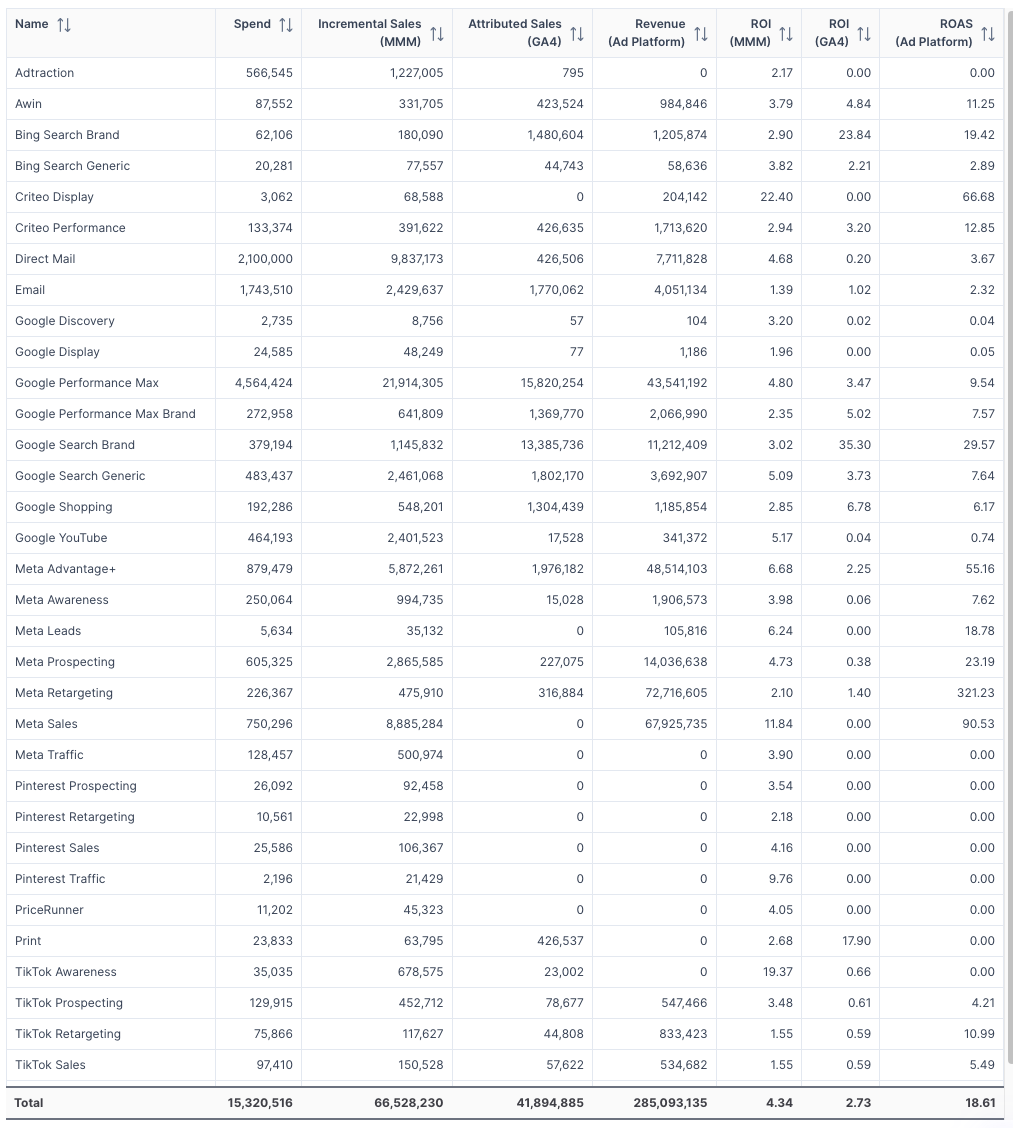
If the team followed attribution alone, it would likely move money from YouTube to branded search. The calibrated view changes the question. Branded search may still deserve funding, but its 29.57 attributed ROAS is not a causal return. YouTube may look weak in the platform because the platform cannot observe much of the demand it creates.
The point is not that MMM always produces the lower number or that upper-funnel media always wins. The point is that budget decisions should use a comparable incremental measure, while campaign execution should keep the granular signals attribution does well.
Related questions
Is attribution wrong?
No. Attribution answers which observed interactions received credit under a defined set of rules. It becomes misleading only when attributed conversions are presented as incremental sales or when unlike channels are ranked as if their measurement coverage were equal. See why platform ROAS and incremental ROAS can tell different stories.
Can incrementality tests replace MMM?
No. A test is causal evidence for a specific setup and period, but testing every channel in every market is impractical. MMM integrates the experiments that are available and estimates the rest of the media plan, with uncertainty kept visible.
Does MMM replace attribution?
Not when the team needs frequent campaign, ad-set, keyword, or creative decisions. MMM sets the cross-channel direction and supplies incremental calibration, while attribution provides the execution detail. The two should exchange evidence rather than compete for ownership of every decision. See when an omnichannel retailer should use MMM, MTA, or incrementality testing.
Should we cut branded search and retargeting?
Not based on a category label alone. Measure their incremental and marginal return, then compare that opportunity with the rest of the media plan. A channel can capture existing demand and still produce profitable incremental sales at its current or next spend level.
How Sellforte helps
Sellforte connects attribution, incrementality experiments, and always-on MMM in one measurement workflow. Teams can compare attributed and incremental results, calibrate the full media plan with causal evidence, and translate marginal channel insights into campaign-level budget and bidding recommendations. Book a demo.
Authors

Lauri Potka is the Chief Operating Officer at Sellforte and has over 15 years of experience in Marketing Mix Modeling, marketing measurement, and media spend optimization. Before joining Sellforte, he worked as a management consultant at the Boston Consulting Group, advising some of the world's largest advertisers on data-driven marketing optimization. Follow Lauri on LinkedIn, where he is one of the leading voices in MMM and marketing measurement.

When should an omnichannel retailer use MMM, MTA, or incrementality testing?

What changes when an ecommerce or retail company adopts incrementality?