


Base sales are the sales a brand would expect to make in a given period without its current media advertising and price promotions. In marketing mix modeling (MMM), base sales are the part of the sales decomposition explained by trend, seasonality, holidays, regular price, distribution and underlying organic demand, as opposed to the incremental sales driven by marketing.
Base sales in the MMM decomposition
A marketing mix model explains total sales as the sum of contributions from different drivers. The classic market response literature splits these drivers into a baseline and the incremental effects of marketing instruments such as advertising, price promotions and in-store activity (Hanssens, Parsons & Schultz, 2001). In simplified form:
Total sales = Base sales + Incremental sales from media + Incremental sales from promotions
The table below shows an illustrative weekly decomposition for an ecommerce brand. The numbers are made up for the example.
| Sales driver | Sales (EUR) | Share |
| Base sales | 700 000 | 70% |
| Meta ads (incremental) | 100 000 | 10% |
| Paid search (incremental) | 80 000 | 8% |
| TV (incremental) | 70 000 | 7% |
| Price promotions (incremental) | 50 000 | 5% |
| Total sales | 1 000 000 | 100% |
The share of base sales varies a lot between brands and categories. An established brand with high awareness and loyal repeat customers typically has a larger base than a young direct-to-consumer brand that depends on paid acquisition.
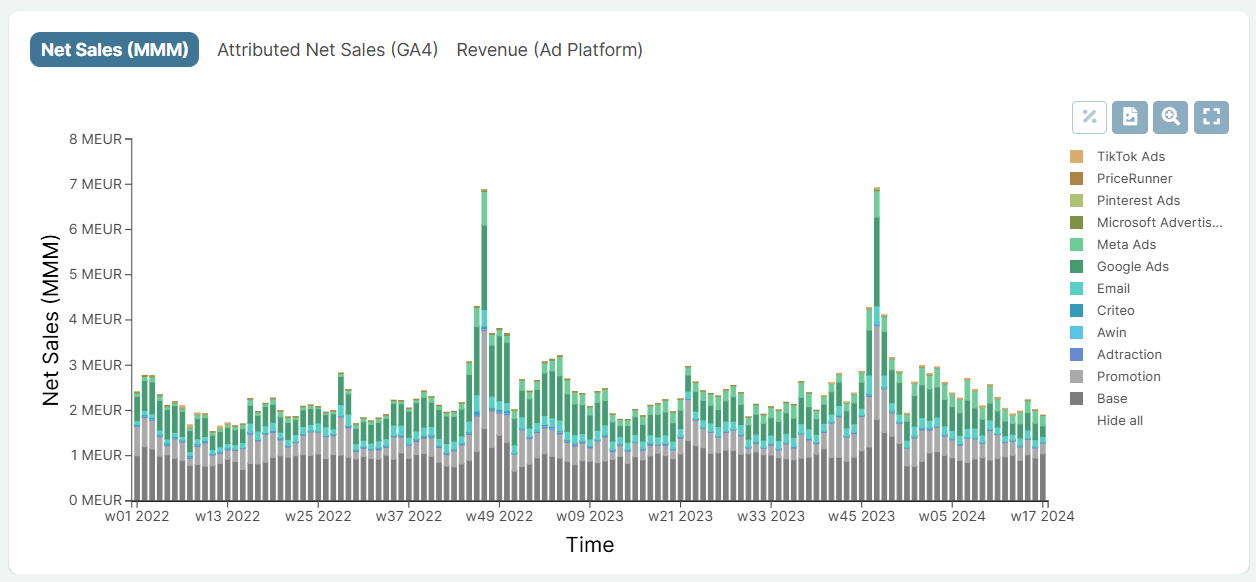
Below is a sales decomposition from the Sellforte demo (demo data): the gray area at the bottom is base sales, with promotion-driven and media-driven sales stacked on top.
How MMM estimates base sales
Base sales are not observed directly. The model estimates them from the variables that explain sales when media and promotions are held at zero. Typical components are:
- Trend: long-term growth or decline from changes in the customer base, category growth, competition or product range.
- Seasonality: recurring weekly and yearly patterns, such as weekend peaks or a summer slowdown.
- Holidays and events: Black Friday, Christmas, Easter and local holidays, which shift demand independently of advertising.
- Regular price: the non-promotional price level, which sets the baseline volume. Temporary discounts are modeled separately as promotions.
- Distribution: the number of stores, markets, product availability and assortment.
- Macroeconomic and external factors: consumer confidence, inflation, and weather for weather-sensitive categories.
- Organic demand: the remaining level of demand from brand awareness, word of mouth and existing customers.
Modern Bayesian MMMs estimate the baseline together with media effects that include carryover (adstock) and diminishing returns (Jin et al., 2017). This matters because the baseline and media effects compete for the same variation in sales. If the model gives too little weight to seasonality, a channel that always spends more in high season gets credit for seasonal demand. If the model gives too much weight to the trend, it can absorb the effect of an always-on channel. Chan and Perry (2017) list data limitations, selection bias and model specification among the main challenges of MMM, and each of them affects how sales are split between base and media.
For this reason, the baseline estimate should be validated. Useful checks are out-of-sample fit, the stability of the baseline when the model is re-estimated with new data, and calibration of media effects with experiments such as geo tests and conversion lift studies (see calibrating MMM with experiments and attribution data).
Base sales vs incremental sales
Incremental sales are the additional sales caused by a marketing activity, compared with what would have happened without it (see incrementality). Base sales are the counterfactual level of sales against which this lift is measured. The two concepts are complementary:
- Base sales answer the question "how much would we sell if we stopped current advertising and promotions?"
- Incremental sales answer the question "how much did this channel, campaign or promotion add on top of the base?"
Incremental ROI and incremental ROAS are calculated from incremental sales only. A metric that divides total revenue by spend, such as attributed ROAS or a blended efficiency ratio, also includes base sales and therefore overstates what marketing caused (see ROAS).
Promotions need special care in retail. A price promotion can create incremental sales, but part of its volume is often pulled forward from later weeks or comes from customers who would have bought at full price. MMM separates the promotional lift from the base so that the promotion is not credited with sales the base would have produced anyway (see promotions in marketing mix modeling).
Base sales are not direct traffic
A common mistake is to equate base sales with direct or organic traffic in web analytics. They are different concepts:
- Direct traffic is a tracking category. In Google Analytics 4, it covers sessions with no known referral source, including typed URLs, bookmarks and sessions where tracking information was lost.
- Base sales are a causal concept. They are the sales that would happen without current marketing, regardless of which channel the customer used to reach the store.
A customer who saw a TV ad and then typed the store address appears as direct traffic, but the sale is incremental to TV. Conversely, a loyal customer who would have bought anyway may click a branded search ad, so the sale appears as paid search even though it belongs to the base. The direct traffic entry explains the GA4 side in more detail.
Why base sales change over time
Base sales are not a constant. They move for reasons that can be outside marketing, such as distribution changes, competition and the economy, but also for reasons that are partly caused by past marketing:
- Brand building: sustained advertising builds awareness and mental availability, which raises the level of sales the brand gets without current advertising.
- Customer base: customers acquired by earlier campaigns keep buying, and their repeat purchases show up as base sales in later periods.
- Long-term effects: Binet and Field (2013) analyzed the IPA Effectiveness Databank and found that campaigns that perform well on long-term measures do not necessarily generate strong short-term responses.
This has a practical consequence. A model with a short carryover window measures the short-term effect of media and assigns the long-term effect to the base. Cutting brand advertising can therefore look free in the short run while the base slowly declines. Tracking the base over several years, and modeling longer carryover for brand-building channels where the data supports it, helps make this visible.
Why base sales matter for planning
- Forecasting: the base forecast is the starting point for sales targets and budget scenarios.
- Budgeting: knowing how much of sales depends on current marketing shows how much revenue is at risk if budgets are cut. The post How much of your Black Friday sales are marketing-driven? shows this split for a peak season.
- Fair evaluation of channels: separating the base from media effects prevents channels from being credited with seasonal or organic demand.
Key takeaways
- Base sales are the counterfactual sales without current media and promotions, estimated in the MMM decomposition from trend, seasonality, holidays, price, distribution and organic demand.
- Base sales are a causal concept, not a web analytics channel, so they are not the same as direct traffic.
- The base changes over time, partly because of earlier brand building, so it should be monitored rather than treated as fixed.
Related terms
- Incrementality
- Adstock
- Direct traffic in Google Analytics 4
- Return on Advertising Spend (ROAS)
- Causal inference
Further reading on Sellforte
- What is Marketing Mix Modeling (MMM)? A complete guide for marketers
- The missing 24%: Why MMM without promotions behaves like last-click
- How much of your Black Friday sales are marketing-driven?
- Calibrating marketing mix models with experiments and attribution data
References
- Binet, L., & Field, P. (2013). The long and the short of it: Balancing short and long-term marketing strategies. Institute of Practitioners in Advertising (IPA). https://ipa.co.uk/knowledge/documents/the-long-and-the-short-of-it-presentation
- Chan, D., & Perry, M. (2017). Challenges and opportunities in media mix modeling. Google Inc. https://research.google/pubs/challenges-and-opportunities-in-media-mix-modeling/
- Hanssens, D. M., Parsons, L. J., & Schultz, R. L. (2001). Market response models: Econometric and time series analysis (2nd ed.). Kluwer Academic Publishers. https://doi.org/10.1007/b109775
- Jin, Y., Wang, Y., Sun, Y., Chan, D., & Koehler, J. (2017). Bayesian methods for media mix modeling with carryover and shape effects. Google Inc. https://research.google/pubs/bayesian-methods-for-media-mix-modeling-with-carryover-and-shape-effects/
Authors

Lauri Potka is the Chief Operating Officer at Sellforte, with over 15 years of experience in Marketing Mix Modeling, marketing measurement, and media spend optimization. Before joining Sellforte, he worked as a management consultant at the Boston Consulting Group, advising some of the world’s largest advertisers on data-driven marketing optimization. Follow Lauri in LinkedIn, where he is one of the leading voices in MMM and marketing measurement.


