

Incrementality Testing Use Case

To find gaps in your incrementality test coverage in Sellforte, open Experiments → Recommendations. Review the coverage summary, select a recommendation, and inspect its Campaigns and Past experiments tabs. Check which activity is missing useful evidence and which studies exist but are not counted for that recommendation.
This guide uses Meta Prospecting in the United States in the public Sellforte demo. All figures and screenshots use simulated data.
Before you start: You need access to Experiments and its Recommendations view. Have the original study scope available when reviewing related or unmatched records.
What you will produce: A short list of evidence gaps, record checks and testing actions for the media you manage.
1. Start with the coverage overview
Choose Experiments in the left navigation and open Recommendations. The summary in this example shows that 5 of 19 features have been tested and that tested features represent 43% of spend in the last 12 months.
These numbers answer different questions. The feature count describes how widely testing reaches across the media mix. The spend percentage describes how much investment sits in the covered features. Neither number says that 43% of spend is profitable, nor does it measure the statistical confidence of the results.
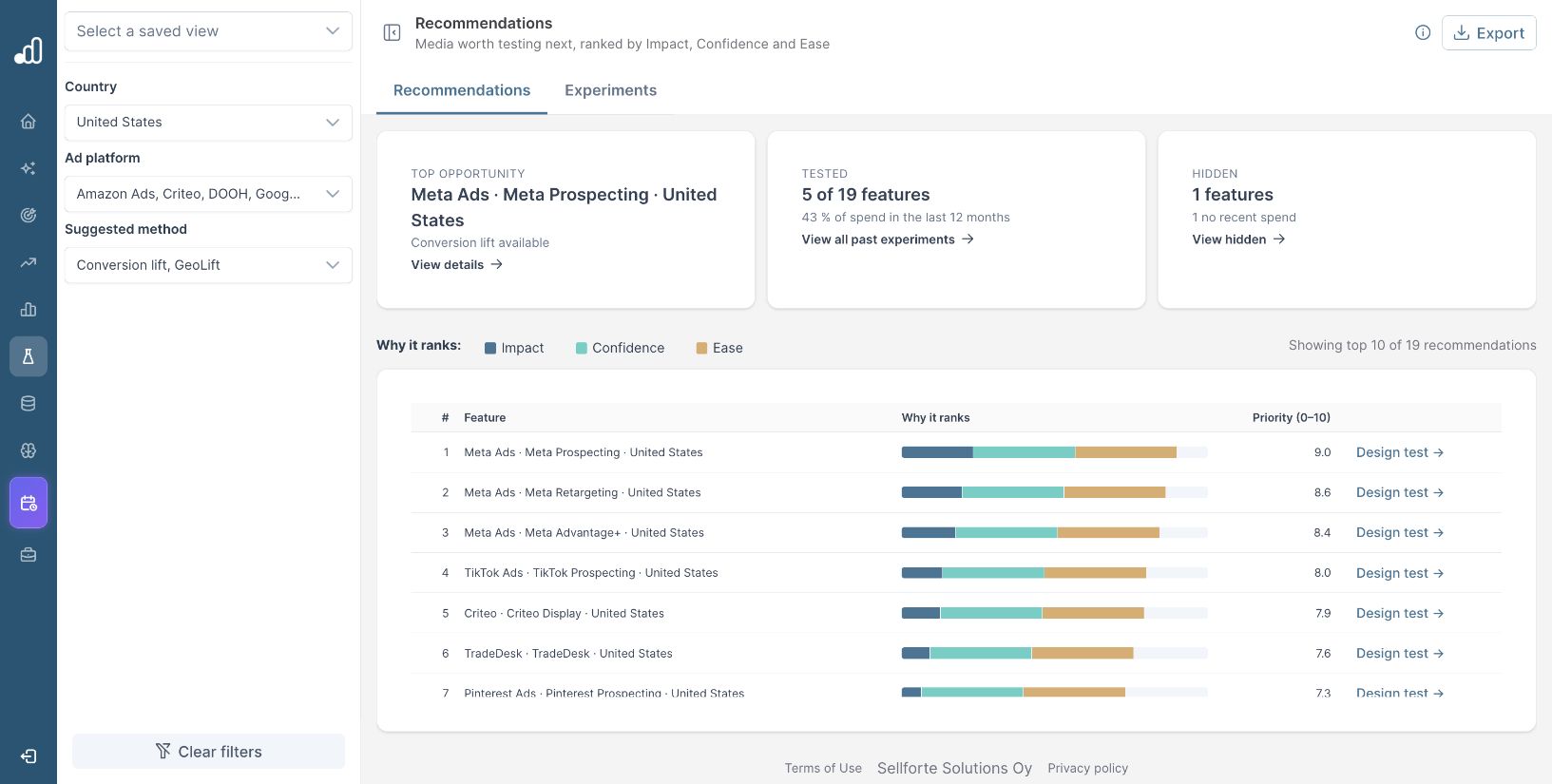
Read the period before interpreting a gap. A test from several years ago may provide useful context without counting as recent coverage. The summary describes the overall media mix; use the country and platform filters to focus the recommendation list on the activity you manage.
2. Open a high-impact recommendation
Select Meta Ads · Meta Prospecting · United States. The demo shows $6.49 million of spend over the last 12 months and a priority score of 9.0. Its evidence status says Never tested.
That combination makes the feature worth investigating: substantial investment is associated with a recommendation that lacks counted test evidence. It does not yet establish that nobody has ever tested any of its campaigns.
Read the explanation alongside the scores. Impact helps identify decisions where better evidence could matter. Confidence in the prioritizer concerns the evidence behind the recommendation; it is not the confidence percentage on a completed lift study. Ease helps assess whether the proposed test is practical. The guide to deciding what to test next covers the ranking workflow in more detail.
3. Inspect the campaigns behind the gap
Open Campaigns (2) in the recommendation details. Here, two campaigns account for the feature’s spend:
| Campaign | Share of spend | Last tested shown |
|---|---|---|
| US_Meta_Prospecting | 76% | August 2026* |
| US_Meta_Prospecting_Video | 24% | May 2026* |
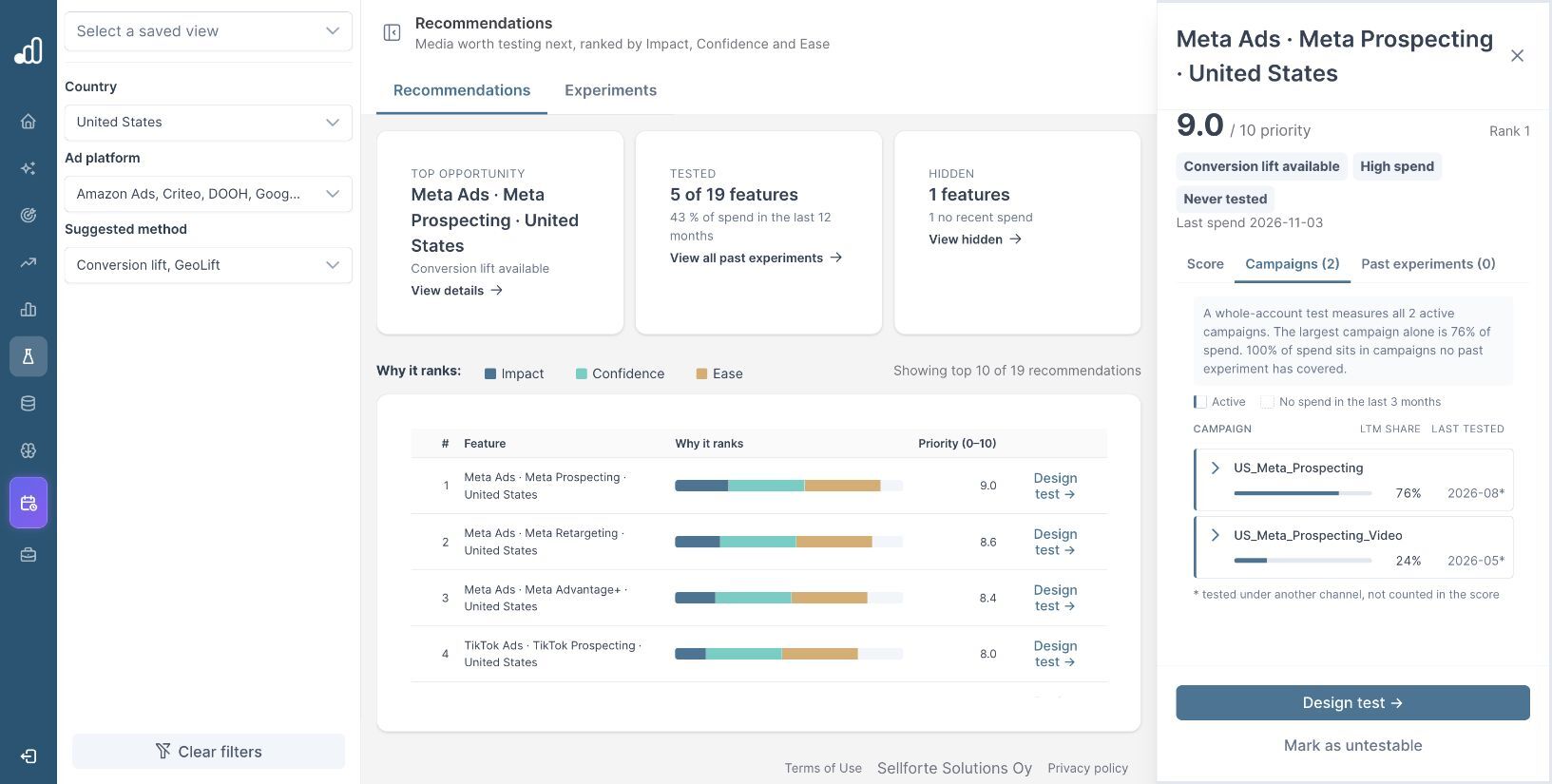
The asterisk matters. The panel explains that these campaigns were tested under another channel and are not counted in the score. It also reports that 100% of spend is in campaigns with no counted past experiment coverage.
Read those statements together. There is a gap in the evidence counted for this recommendation, but the campaign history contains related tests. Calling both campaigns completely untested would lose that distinction.
4. Review related studies and their scope
Open Past experiments (0), then select Show 4 related, not counted. The demo reveals a full-funnel Meta study, a July Meta Prospecting repeat study, a video prospecting study and an older prospecting study.
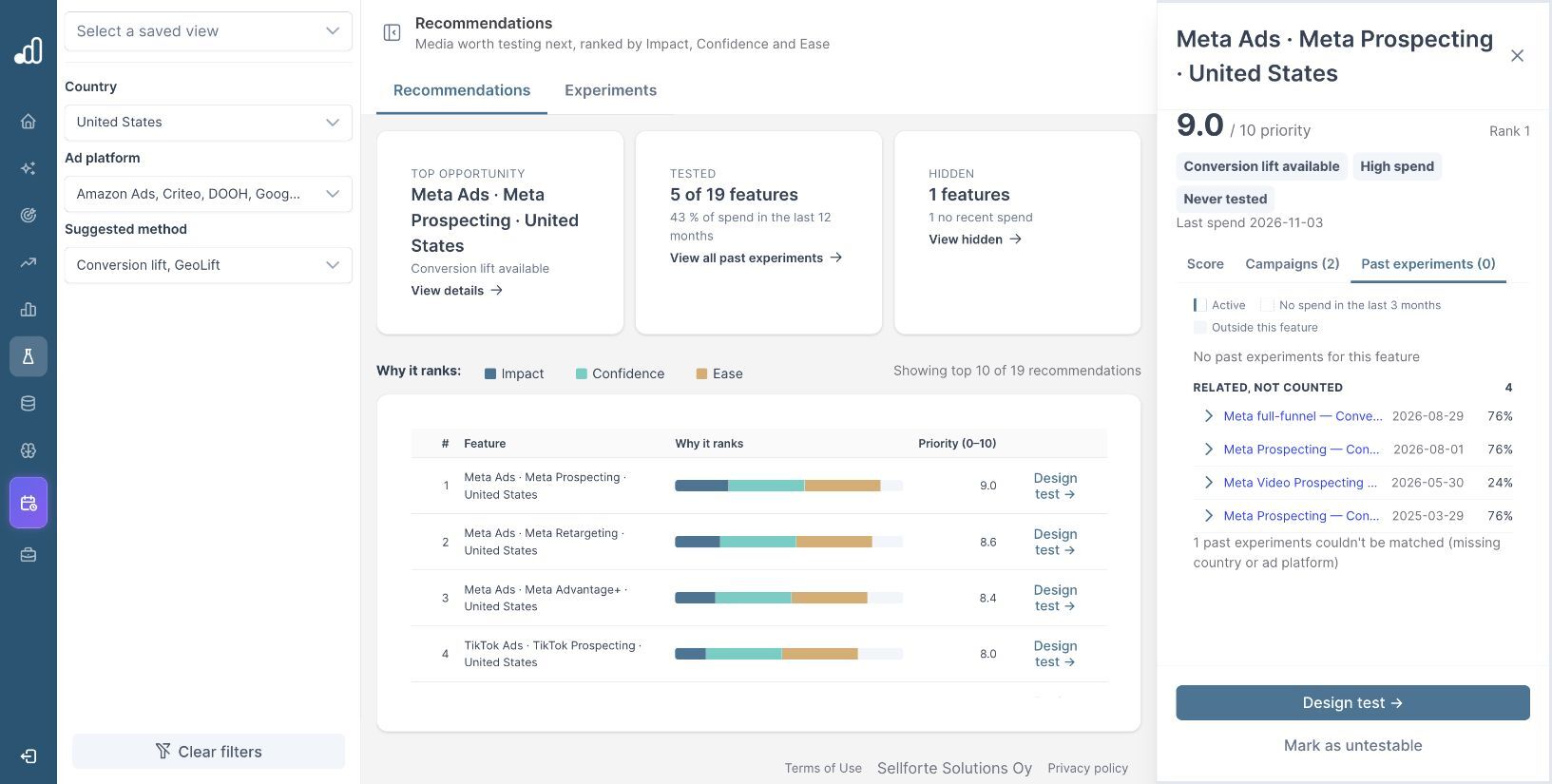
Expand a related study to inspect what it actually covered. The July repeat study ran from July 5 to August 1, 2026. Its details show the US_Meta_Prospecting campaign and three ad sets, with campaign coverage corresponding to the 76% share shown above.
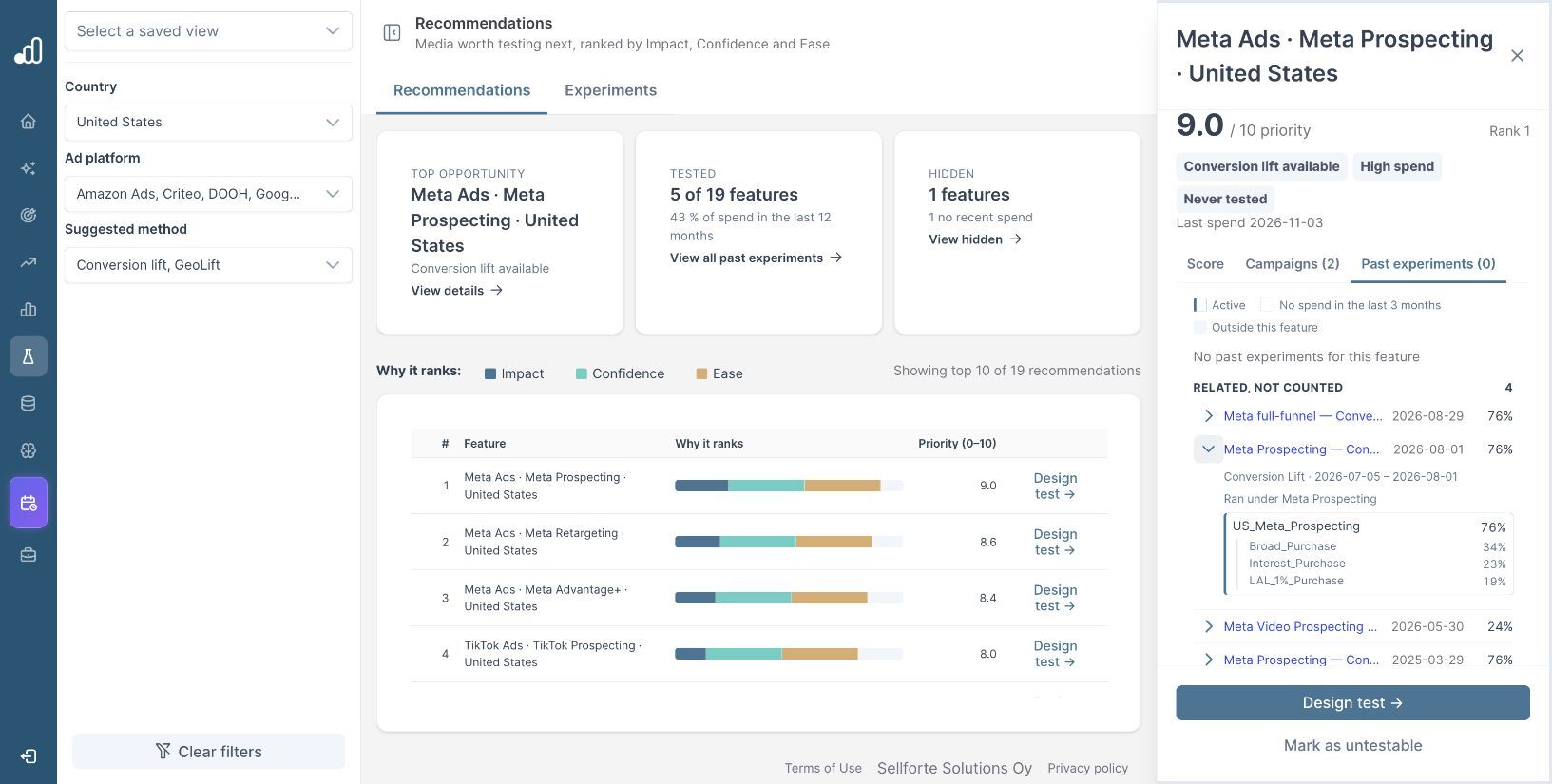
Check the country, platform, channel, campaign and ad-set scope against the activity you plan to test now. A full-funnel result may include more activity than a prospecting-only decision. An older study may use a different audience, creative mix or budget level.
The panel also warns that one past experiment could not be matched because country or platform information is missing. Treat that as a record to investigate. Check the original study and its saved metadata, and ask your Sellforte contact to review the mapping if the reason remains unclear. This walkthrough does not change any study mappings.
Do not add the coverage percentages of overlapping studies. Several studies can cover the same campaign; 76% plus another 76% does not create 152% coverage.
5. Turn the findings into a testing action
Separate the next steps by what is missing:
| What you find | Useful next action |
|---|---|
| No relevant study exists. | Plan a test for the decision, prioritizing material spend and a feasible design. |
| A relevant study exists but is not counted. | Review scope and metadata before paying to repeat the same work. |
| The study covers only part of today’s activity. | Define the remaining campaign, audience or market gap explicitly. |
| The study is old or too uncertain for today’s decision. | Plan a targeted repeat or stronger design and state what it should resolve. |
For this example, a useful planning note is:
“US Meta Prospecting has no counted tests in the current recommendation, despite related studies covering its two campaigns. Review the channel mapping and the unmatched study first. Then assess whether those studies answer the current prospecting budget question or whether a new test is needed.”
That note gives the team a concrete action without confusing a missing record, an incomplete scope and a genuine lack of test evidence. Once the gap is clear, use the guide to choosing an analysis type to identify the appropriate route in Sellforte.
Further Reading and Resources
Review coverage and priorities
Check and organize the evidence
About the author

Lauri Potka is the Chief Operating Officer at Sellforte, with over 15 years of experience in Marketing Mix Modeling, marketing measurement and media spend optimization. Before joining Sellforte, he worked as a management consultant at the Boston Consulting Group, advising some of the world’s largest advertisers on marketing optimization. Follow Lauri on LinkedIn.


