
To find previous tests for a channel or market in Sellforte, open Experiments and combine the Country, Ad platform and Status filters with a name search. Sort the matching studies by end date, then open the relevant experiment to check its scope and results.
This guide answers a practical question: “What have we already tested for Meta retargeting in the United States?” It follows that search in the public Sellforte demo. All screenshots and figures use simulated data.
Before you start: You need access to Experiments and a clear question about a market, platform, campaign or audience.
What you will produce: A shortlist of relevant completed tests, with links and enough context to reuse the evidence.
1. Open the library and define your search
Select Experiments in the left navigation. Keep the Experiments tab selected, then use the Experiment view above the table to see individual analyses.
Start with the decision you need to inform. “Find previous US Meta retargeting tests” gives you a market, a platform and an activity to search for. “Find our best test” leaves too much room to select a result that does not fit the current question.
If old selections are still active, choose Clear filters before starting. Check the count above the table as you narrow the list.
2. Filter to completed tests in your market
For this walkthrough, apply the following scope:
- Open Status, choose Deselect all, then select Analyzed. Click in the main table area to close the filter.
- Check Country. The demo has United States selected. In your workspace, select the country relevant to your decision.
- Open Ad platform, choose Deselect all, then select Facebook Ads. Close the filter by clicking in the main table area.
The library uses the label Facebook Ads for these Meta studies. Use the labels available in the filter. Keep Experiment type broad at first so that you can see evidence from different testing methods.
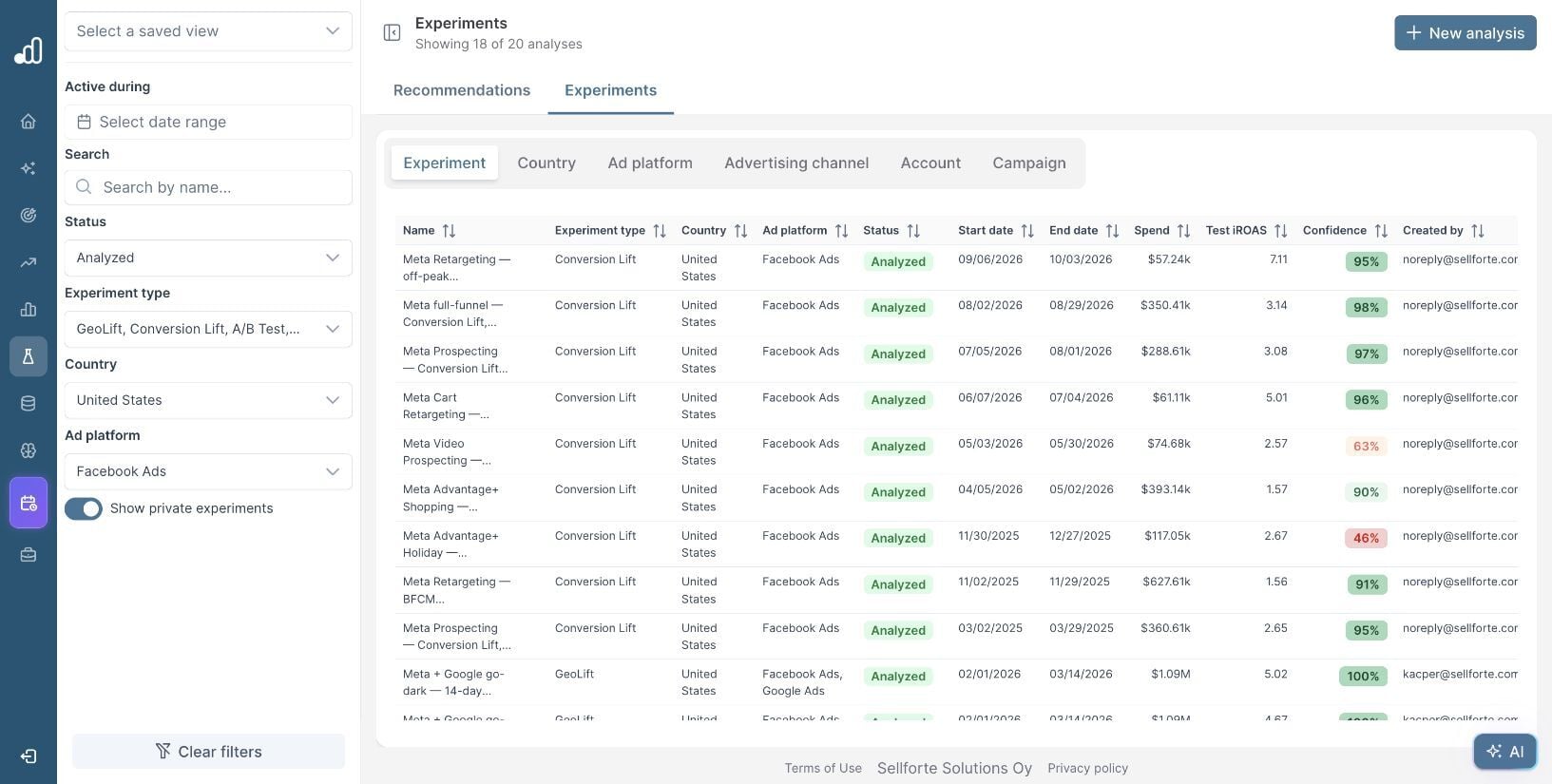
A platform filter can also return experiments covering several platforms. In this demo, the filtered list includes combined Meta and Google geo tests. Open those studies and check their scope before treating their result as evidence for Meta alone.
3. Search for the activity and sort by test date
Enter retargeting in the Search field. Its placeholder, “Search by name…”, describes what it searches: experiment names. A study named only with an internal project code may need a different search term.
The demo now shows 3 of 20 analyses. Click the End date column heading to sort the list, and check that the latest end date appears first. Use the experiment’s dates when judging recency; Created at and Modified at describe the record’s history.
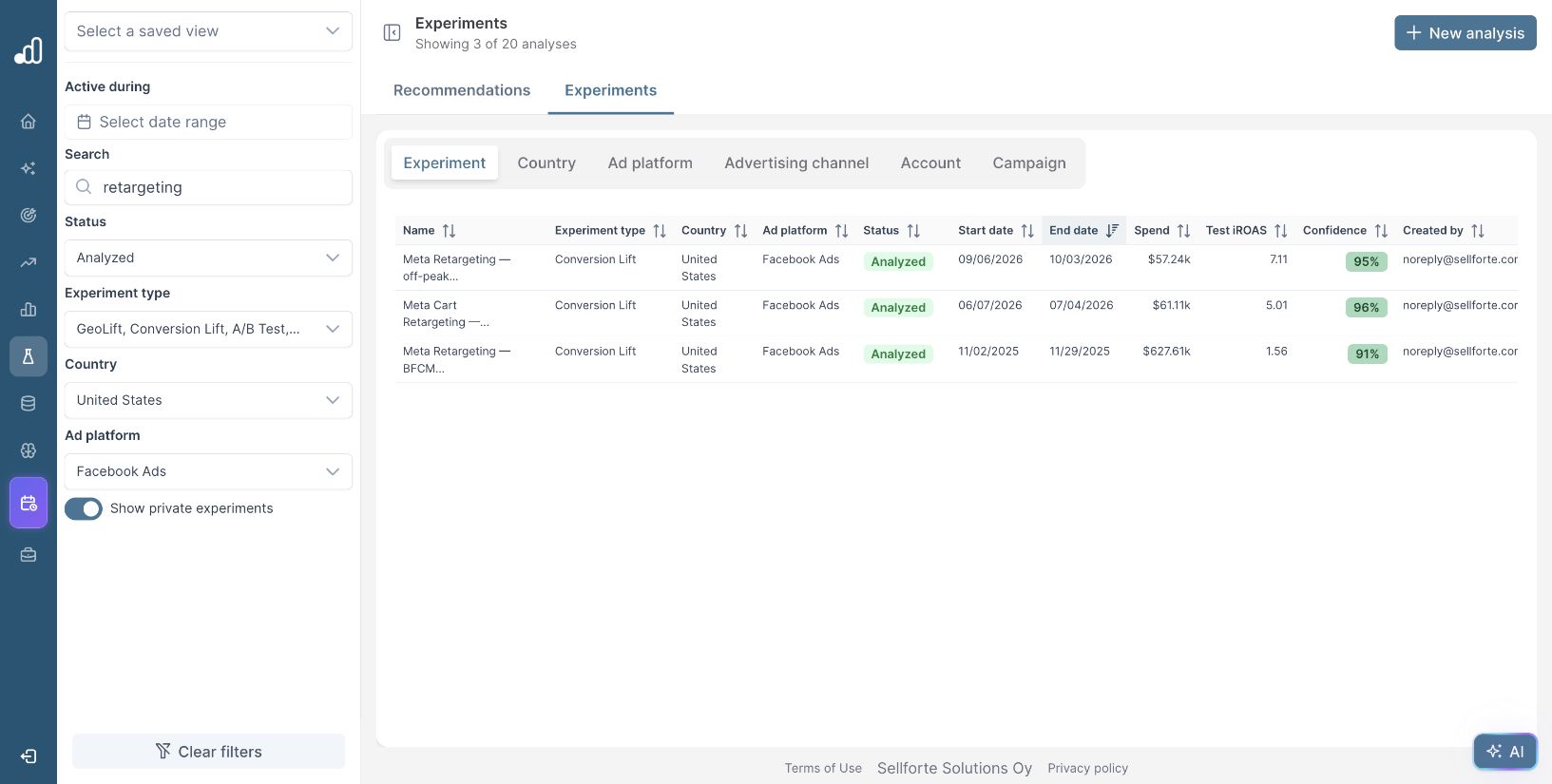
| Matching study | Test period | Test iROAS |
|---|---|---|
| Meta Retargeting, off-peak | September 6 to October 3, 2026 | 7.11 |
| Meta Cart Retargeting | June 7 to July 4, 2026 | 5.01 |
| Meta Retargeting, BFCM holdout | November 2 to 29, 2025 | 1.56 |
These are three pieces of evidence with different contexts. The off-peak, cart-retargeting and Black Friday/Cyber Monday studies should not be treated as interchangeable measurements of one campaign. The latest result may be a useful starting point; the audience and season still determine how well it fits your question.
Use Active during → Select date range if you need a particular period. Keep the range broad enough to include older relevant studies; the date picker also offers Full date range. You can narrow Experiment type when the question specifically calls for GeoLift, Conversion Lift or A/B Test evidence.
4. Open the result and verify its scope
Click the name of Meta Retargeting: off-peak Conversion Lift, Sep 2026. The result header confirms the Conversion Lift method, Analyzed status, United States, Facebook Ads, and the September 6 to October 3 treatment period.
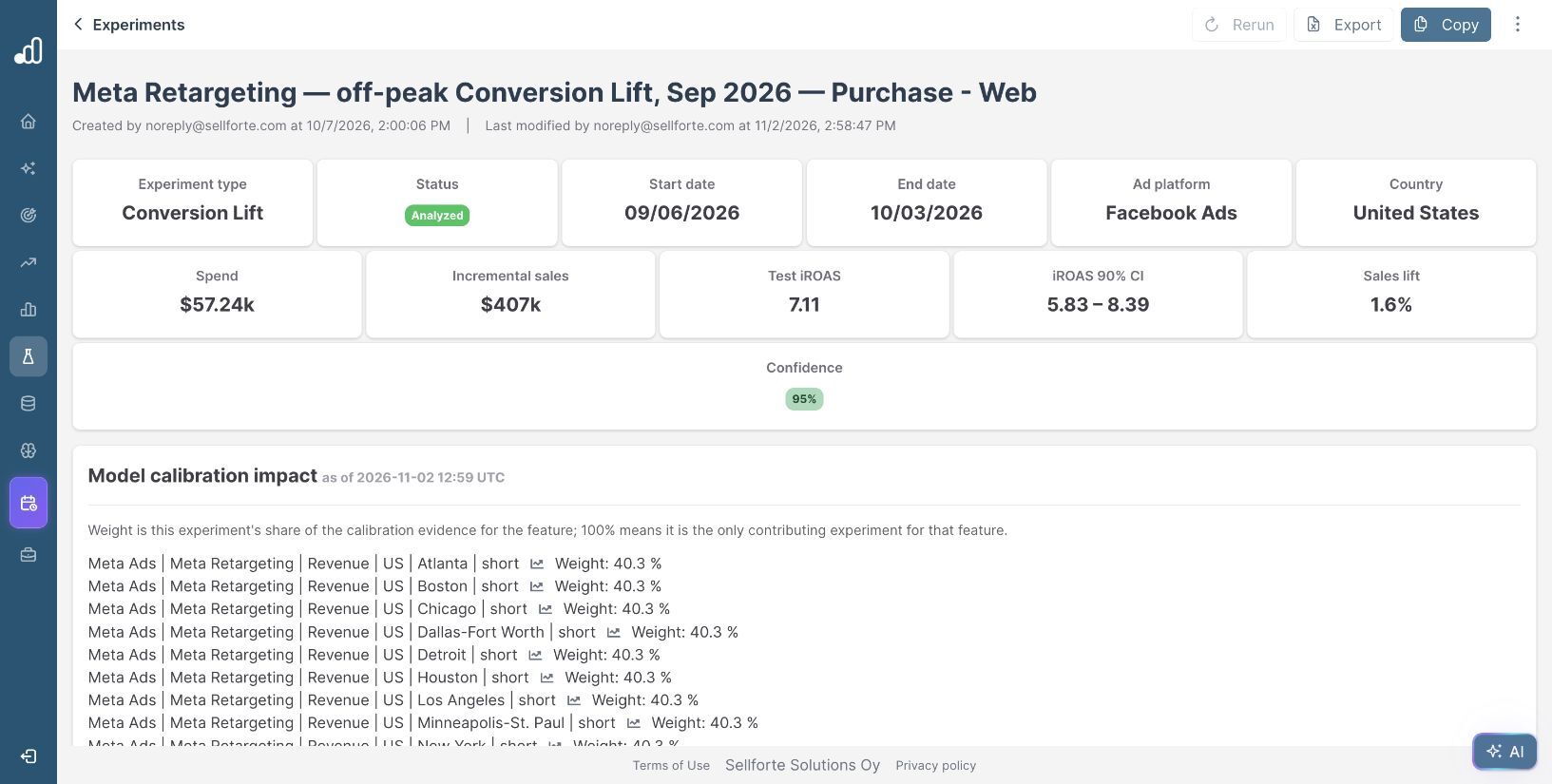
The current result cards show $57.24k spend, $407k incremental sales, 7.11 test iROAS and an iROAS 90% CI of 5.83 to 8.39. The displayed confidence is 95%. These values describe this particular study.
Before reusing a result, confirm the tested audience and campaigns, conversion event, market and period. Check the uncertainty as well as the point estimate. If you use the AI Summary, verify its numbers against the current result cards and resolve any discrepancy before sharing them.
For a question about off-peak retargeting, this study may be the closest match in the shortlist. For a holiday budget decision, inspect the BFCM study as well. A high iROAS alone does not establish which experiment is most relevant.
5. Keep the evidence with your decision
Copy the experiment’s URL from your browser and include it in your working notes or readout. Record the question, scope, dates, key results and why you selected that study.
For our US Meta retargeting review, the demo library contains three completed studies matching “retargeting”. The latest is the off-peak Conversion Lift test from September 6 to October 3, 2026, with 7.11 test iROAS and a 90% interval of 5.83 to 8.39. We will review the separate BFCM study before applying this evidence to holiday planning.
If the search returns nothing, remove the name search first, broaden the date range, and check the platform and country selections. Review Show private experiments for studies your account can access. Use Clear filters to restart if the combined selections have become too narrow.
For a broader overview, the controls above the table also group analyses by Country, Ad platform or Advertising channel. Expand a group with Show analyses, or return to Experiment for the individual records. Grouping depends on the metadata recorded for each test; name search remains useful for locating a specific activity.
Once you know what evidence already exists, use Sellforte’s test recommendations to decide what to test next.
Further Reading and Resources
Work with your experiment results
Plan the next question
About the author

Lauri Potka is the Chief Operating Officer at Sellforte, with over 15 years of experience in Marketing Mix Modeling, marketing measurement and media spend optimization. Before joining Sellforte, he worked as a management consultant at the Boston Consulting Group, advising some of the world’s largest advertisers on marketing optimization. Follow Lauri on LinkedIn.
How to Decide What to Test Next | Incrementality Testing Use Case
How to Analyze an A/B Test from Your Own Files | Incrementality Testing Use Case