
To decide what to test next in Sellforte, open Experiments → Recommendations, filter to the markets and platforms you manage, and compare the recommended tests. Read the Impact, Confidence, and Ease scores together, then open the details to understand why a candidate ranks highly.
This guide follows that workflow in the public Sellforte demo. The example is Meta Prospecting in the United States. All figures and screenshots use simulated demo data.
Before you start: You need access to Experiments and its Recommendations view. Know which markets and ad platforms are within your testing scope.
What you will produce: A testing priority with a clear explanation of the budget at stake, the measurement gap, and the available testing method.
1. Open your test recommendations
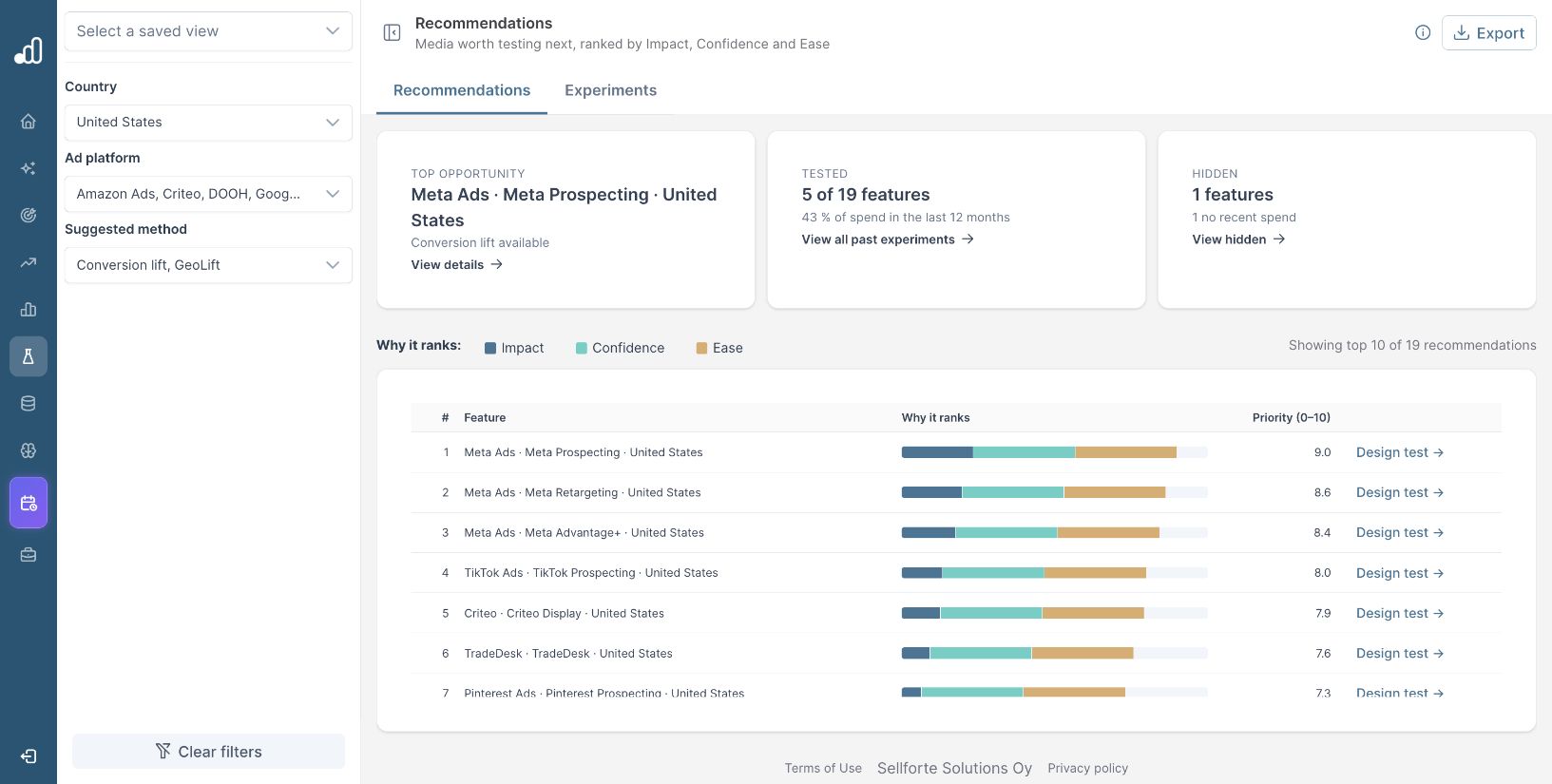
Choose Experiments in the left navigation, then open Recommendations. The view brings potential tests into a ranked list so you can compare where another piece of evidence could be most useful.
Start with the testing coverage summary. In the demo, 5 of 19 features have been tested, representing 43% of spend over the last 12 months. This gives context for the recommendations: coverage by count and coverage by spend tell you different things about how much of your marketing activity has been tested.
The next step is to narrow the list to the decisions you can act on. A high-ranked opportunity in another market may be important for the company, but it may not be the right starting point for your team.
2. Focus on the markets and platforms you manage
Use the filters to define the scope of your review:
- Country: Focus on the market where you are considering a test.
- Ad platform: Narrow the recommendations to the platforms you manage.
- Suggested method: Review opportunities that use a particular testing method.
For this walkthrough, keep Country set to United States. Open Ad platform, choose Deselect all, then select Meta Ads. Click outside the filter to return to the list. Start broadly enough to compare alternatives, then narrow the list when you have a practical constraint, such as responsibility for one market or access to a particular testing method.
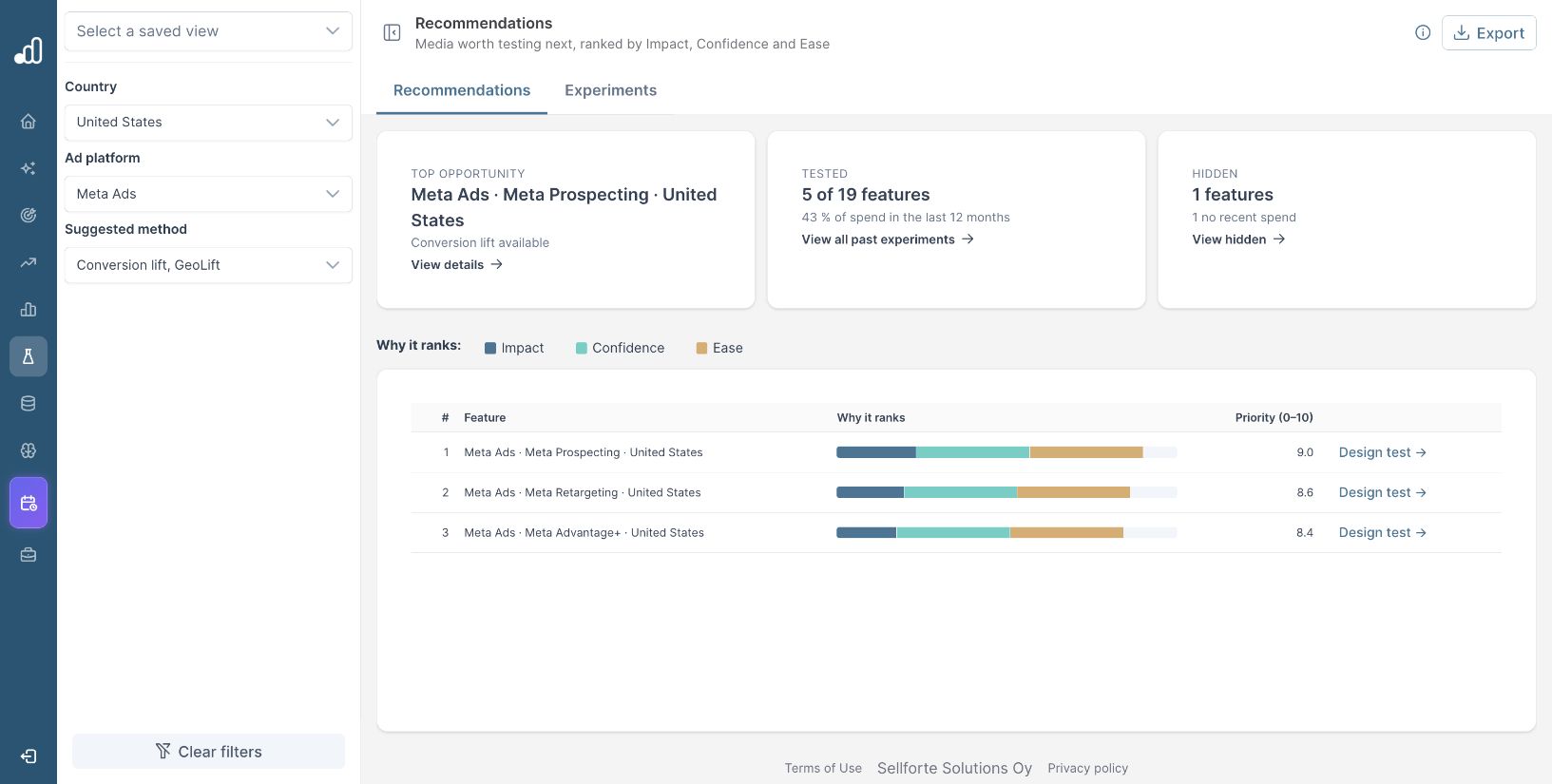
Keep the selected scope in your final readout. “Our highest-priority test in the US” is a more precise conclusion than “our highest-priority test” when you have filtered out other markets.
3. Read the priority score and its components
The recommendations combine Impact, Confidence, and Ease into a priority score out of 10. Read the component scores and their explanations before choosing a candidate.
| Component | What to look for |
|---|---|
| Impact | The spend at stake and any difference between the activity’s ROAS and its country average. |
| Confidence | The measurement evidence or gap identified in the recommendation, including whether the activity has been tested. |
| Ease | The available testing method and the practical effort described for running it. |
The priority score helps you compare testing opportunities. It does not predict the iROAS you will measure. Likewise, the Confidence component in this view is part of the recommendation logic; it should not be read as the statistical confidence of a completed experiment.
For example, a recommendation can rank highly because it combines substantial spend with a gap in testing evidence and an accessible test method. That is a useful reason to investigate the activity, even before you know what its incremental return will be.
4. Understand why Meta Prospecting ranks first
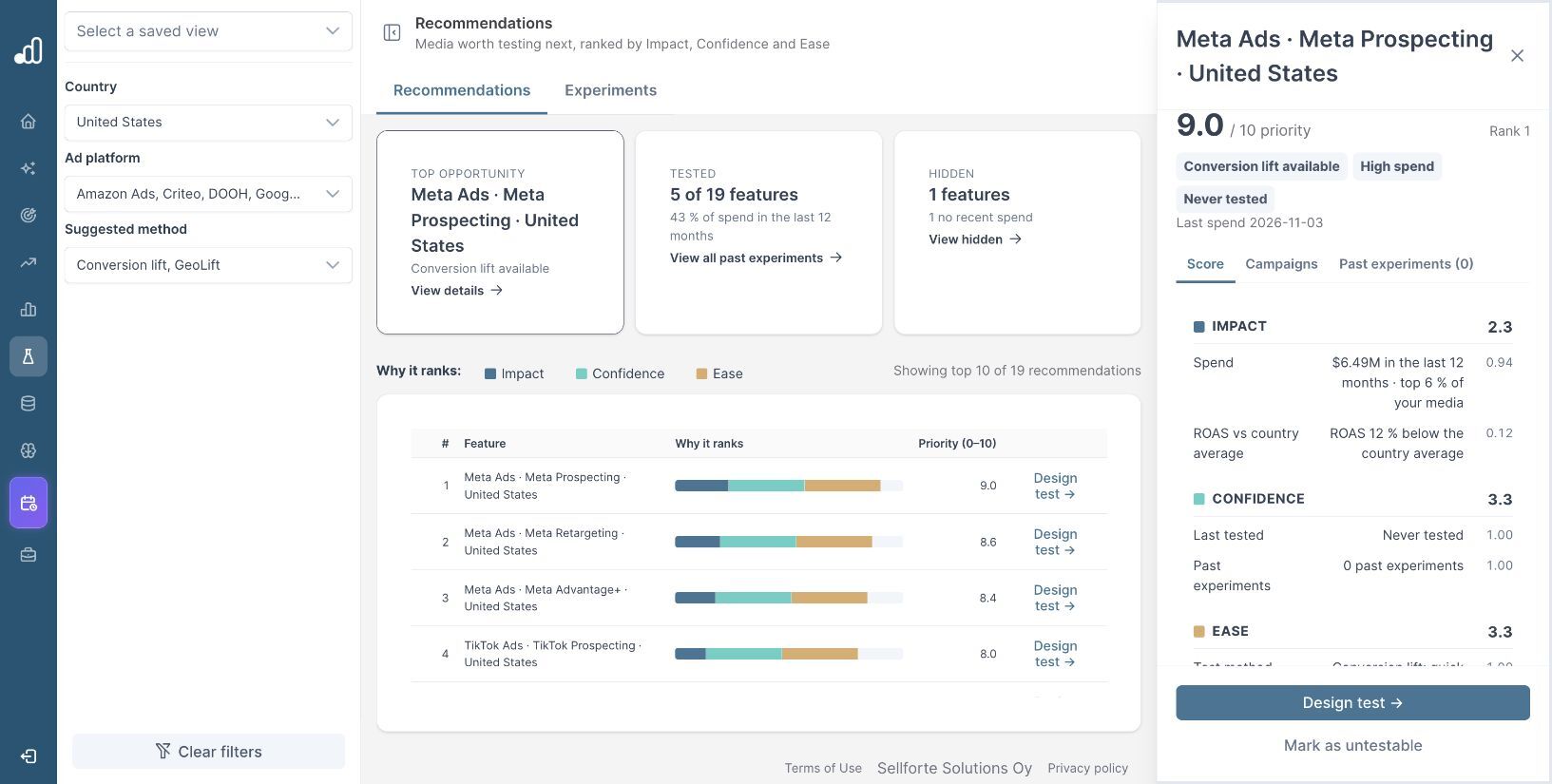
Open View details for the top-ranked Meta Prospecting opportunity. In the demo, US Meta Prospecting ranks first with a priority score of 9.0/10.
| Component | Demo value | Why it matters |
|---|---|---|
| Impact | 2.3 | $6.49M in spend over the last 12 months, in the top 6% of media. A decision about this activity affects a substantial budget. |
| Confidence | 3.3 | The recommendation shows “Never tested,” identifying a gap in the testing evidence used for this recommendation. |
| Ease | 3.3 | Conversion lift is available, with the demo describing quick setup and a small holdout. |
Together, these reasons make Meta Prospecting a strong candidate for the next test: there is meaningful spend at stake, the recommendation identifies a measurement gap, and an available method provides a practical route to gathering evidence.
Use the displayed overall score rather than recalculating it from rounded component values. The purpose of the walkthrough is to understand the reasons behind the ranking and decide whether they fit your current priorities.
5. Turn the recommendation into a clear testing priority
Before sharing the recommendation, connect it to the decision your team needs to make. For example, would better evidence about Meta Prospecting help you decide whether to maintain, increase, or reduce its budget?
Then summarize the candidate, the scope, and the reason for prioritizing it. For this demo example, a short team readout could be:
We recommend prioritizing US Meta Prospecting for our next incrementality test. It ranks first in the demo with a priority score of 9.0/10. The recommendation combines $6.49M in annual spend, a “Never tested” status, and an available conversion lift method. The next decision is whether this opportunity fits our current testing capacity and the budget decision we need to inform.
Include the selected market, platform and review date when you share your recommendation. You can use the Campaigns and Past experiments tabs in the details panel to investigate its scope. Once your team has agreed on the priority, use Design test → to continue into the separate setup workflow.
Open Recommendations in the Sellforte demo to follow the workflow.
Further Reading and Resources
Continue with incrementality testing
About the author

Lauri Potka is the Chief Operating Officer at Sellforte, with over 15 years of experience in Marketing Mix Modeling, marketing measurement and media spend optimization. Before joining Sellforte, he worked as a management consultant at the Boston Consulting Group, advising some of the world’s largest advertisers on marketing optimization. Follow Lauri on LinkedIn.
How to Find Previous Tests for a Channel or Market | Incrementality Testing Use Case
How to Analyze Your Latest Geo Test | Incrementality Testing Use Case