


Unified Marketing Measurement (UMM) is an approach that combines marketing mix modeling (MMM), incrementality experiments and attribution into one consistent view of marketing impact. Each method covers the blind spots of the others: experiments supply causal ground truth, MMM covers every channel and offline sales, and attribution adds granular, near-real-time signals for daily optimization.
Why marketers combine measurement methods
No single method answers every measurement question well. Attribution tracks individual user paths, but it only sees tracked digital touchpoints, and it credits conversions that would have happened anyway. When Gordon, Zettelmeyer, Bhargava & Chapsky (2019) compared observational methods with 15 large randomized experiments at Facebook, they found that the observational approaches often failed to recover the effects measured in the experiments.
MMM uses aggregate time-series data, so it covers online and offline channels and needs no user-level tracking. It has well-documented limitations of its own. Chan & Perry (2017) group them into data limitations, selection bias and modeling challenges. Experiments such as geo lift and conversion lift tests identify causal effects, but each test covers one channel, one period and one spend level, and running them continuously is costly.
UMM treats these methods as complementary inputs, not competitors. For a detailed comparison of the two observational methods, see MTA and MMM compared.
Strengths and weaknesses of each method
| Method | Strengths | Weaknesses |
| Marketing mix modeling (MMM) | Covers all channels, including offline media and store sales; no user tracking needed; models carryover and saturation; supports budget planning. | Correlational by nature; channels that move together are hard to separate; needs long history; weekly or daily granularity only. |
| Incrementality experiments (geo lift, conversion lift) | Randomization or a controlled comparison identifies causal impact directly; easy to explain to finance. | One channel, one period and one spend level at a time; costs revenue in holdout groups; small effects need large tests. |
| Attribution (last-click, multi-touch) | Granular to campaign, ad set and keyword level; available daily; already built into ad platforms and analytics tools. | Measures correlation, not incrementality; misses offline and untracked touchpoints; weakened by consent loss and cookie restrictions. |
Triangulation versus a truly unified model
In practice, "UMM" describes two quite different setups.
Triangulation runs the three methods side by side and compares their outputs. An analyst looks at the incremental ROAS (iROAS) from the MMM, the latest lift test and the platform-reported ROAS for a channel and forms a judgment. This is better than relying on one number, but the methods are never reconciled. When they disagree, which they usually do, teams have no rule for which result to trust, and different stakeholders tend to pick the number that suits them.
A unified, calibrated model feeds the results of one method into another so that the outputs are consistent by construction. Experiments calibrate the MMM, and the calibrated MMM in turn is used to adjust attribution data, so that granular attributed conversions are scaled to incremental levels. The output is one set of iROAS estimates that agrees with the experimental evidence, covers all channels and can be broken down to the campaign level.
How experiments calibrate MMM priors
In a Bayesian MMM, each channel's effect has a prior distribution, which states what is plausible before the model sees the sales data. Calibration uses experiment results to set these priors.
Wurm, Price & Liu (2024) propose reparameterizing the model so that the channel's return on ad spend, which in an MMM is incremental (iROAS), becomes a model parameter itself. A prior can then be placed directly on iROAS and matched to an experiment result. Their simulations show reduced bias and uncertainty in the posterior estimates. Google's open-source MMM Meridian follows the same logic and documents how incrementality experiment results are translated into what Meridian calls ROI priors (Google, n.d.).
A simplified example: a geo lift test on paid social shows an iROAS of 2.0 with a standard error of 0.4. The modeler sets the channel's iROAS prior to a distribution centered near 2.0, with a spread that reflects the test's uncertainty. If the test was small or old, the prior is widened. The model then combines this prior with the time-series data. Where the sales data are informative, the posterior can move away from the test result; where they are not, the experiment anchors the estimate.
Three practical points matter:
- Match the estimand. An MMM typically compares actual spend with zero spend, while a test may compare normal spend with reduced spend, so the two iROAS figures are not directly comparable. The Meridian documentation notes that the ROI an experiment measures rarely aligns perfectly with the ROI in an MMM, because the two have different estimands.
- Adjust for context. A test run in one country, season or spend level does not transfer one-to-one to another. Calibration is a judgment that combines data with domain knowledge, not a mechanical copy.
- Keep calibrating. Effects change as creative, competition and budgets change, so a library of repeated tests keeps priors current.
A step-by-step guide to MMM calibration covers the process in detail, and Calibrating Marketing Mix Models with Experiments and Attribution data explains how attribution data fits into the same framework.
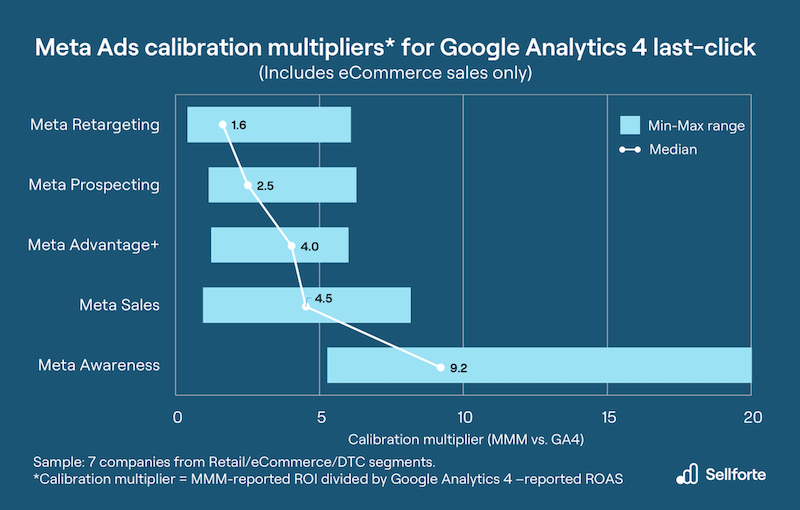
Calibration often shows how far attribution is from incrementality. The chart below shows typical multipliers between Google Analytics 4 last-click and incrementality-based results for Meta Ads in Sellforte's calibrations.
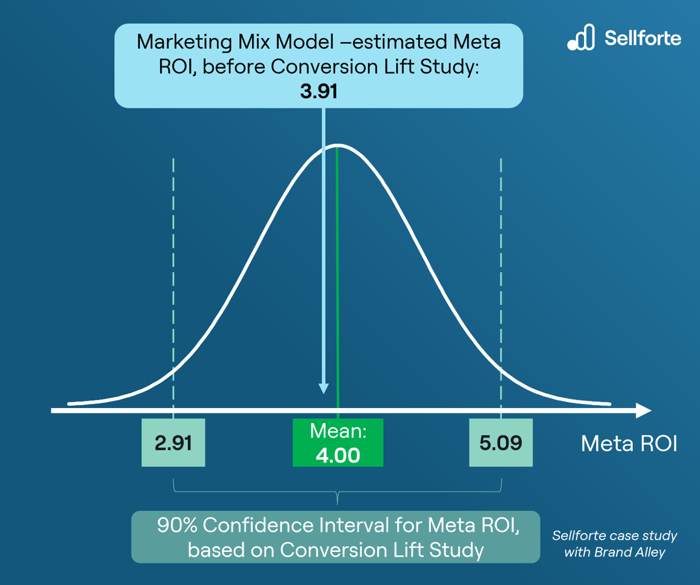
Experiments can also validate a model directly. In the BrandAlley case, a Meta Conversion Lift study was compared with the MMM estimate for the same period:
UMM in marketing mix modeling practice
For ecommerce and retail brands, a unified setup usually works in three layers:
- Experiments establish causal anchors for the largest or most uncertain channels, such as paid social, branded search or TV.
- A calibrated MMM estimates incremental return (iROAS) and saturation for every channel, including those without tests, and supports budget allocation across channels.
- Calibrated attribution scales platform or analytics data with the MMM's incrementality factors, so that teams can optimize campaigns and ad sets daily against iROAS rather than attributed ROAS.
This order matters. When attribution data is used without calibration, it repeats the bias that UMM aims to remove. When MMM runs without experiments, its estimates for correlated channels can drift without anyone noticing. Sellforte builds its measurement around this calibrated approach, which you can explore in the no-sign-up demo.
Key takeaways
- UMM combines MMM, experiments and attribution because each method has blind spots that the others cover.
- Comparing three numbers side by side (triangulation) differs from a calibrated model in which experiments set MMM priors and the MMM scales attribution.
- Calibration requires matching estimands and adjusting test results for context; it is not a one-to-one copy of a test result.
Related terms
- Incrementality
- Geo lift test
- Holdout group
- Causal inference
- Bayesian statistics
- Hierarchical Bayesian modeling
- Return on advertising spend (ROAS)
Further reading on Sellforte
- MTA and MMM compared: which one is better for you?
- MMM Calibration Explained: What It Is, Why It Matters, and How to Do It
- Calibrating Marketing Mix Models with Experiments and Attribution data
- How should geo-lift and conversion-lift studies be combined when calibrating MMM?
References
- Chan, D., & Perry, M. (2017). Challenges and opportunities in media mix modeling. Google Inc. https://research.google/pubs/challenges-and-opportunities-in-media-mix-modeling/
- Gordon, B. R., Zettelmeyer, F., Bhargava, N., & Chapsky, D. (2019). A comparison of approaches to advertising measurement: Evidence from big field experiments at Facebook. Marketing Science, 38(2), 193–225. https://doi.org/10.1287/mksc.2018.1135
- Google. (n.d.). Calibrate treatment priors. Meridian documentation. https://developers.google.com/meridian/docs/advanced-modeling/roi-priors-and-calibration
- Wurm, M., Price, B., & Liu, Y. (2024). Media mix model calibration with Bayesian priors. Google Research. https://research.google/pubs/media-mix-model-calibration-with-bayesian-priors/
Authors

Lauri Potka is the Chief Operating Officer at Sellforte, with over 15 years of experience in Marketing Mix Modeling, marketing measurement, and media spend optimization. Before joining Sellforte, he worked as a management consultant at the Boston Consulting Group, advising some of the world’s largest advertisers on data-driven marketing optimization. Follow Lauri in LinkedIn, where he is one of the leading voices in MMM and marketing measurement.


