

Incrementality testing helps marketers understand what their advertising actually contributes to sales. But while running and analyzing incrementality tests has become easier, deciding which tests to run in the first place remains a challenge.
Should you test Meta in Germany? Validate the incremental impact of TikTok? Run a test on a channel where your marketing measurement results look unusually strong?
For many marketing teams, these decisions are still made through a combination of experience, intuition, and ad hoc discussions. And with incrementality tests typically taking four to eight weeks to complete, choosing the wrong test can mean spending months answering a question that wasn't particularly important.
Today, we're introducing Test Prioritizer, a new capability in Sellforte Incrementality Testing that helps marketers identify and rank the most valuable incrementality tests to run next.
Test Prioritizer analyzes your media investments and previous testing activity to identify opportunities across online and offline media. It then ranks those opportunities using the Impact, Confidence, Ease (ICE) framework, giving marketers a clear, data-driven starting point for their testing roadmap.
For customers also using Sellforte Marketing Mix Modeling (MMM), model results can provide additional evidence to make these recommendations even more targeted.
The goal is simple: stop guessing what to test next and focus your experiments where new evidence can make the biggest difference.
From Ad Hoc Testing to a Systematic Incrementality Testing Roadmap
Most marketing teams have more potential tests than they have the time or resources to run.
Consider an ecommerce brand advertising across Google, Meta, TikTok, and TV in multiple countries. There could be dozens of potential tests worth considering, but testing every channel, campaign, and market simply isn't realistic.
Traditionally, deciding what to test next might involve looking at the largest media investments, identifying channels where results seem questionable, or choosing a test based on what the team is most interested in understanding.
But the largest channel isn't necessarily the one that needs testing most. A channel with significant investment may already have strong experimental evidence supporting its performance, while another may have no recent incrementality tests to validate its contribution.
Test Prioritizer brings these considerations together, helping teams identify where new tests can provide the most valuable evidence and build a systematic incrementality testing roadmap.
How Test Prioritizer Works
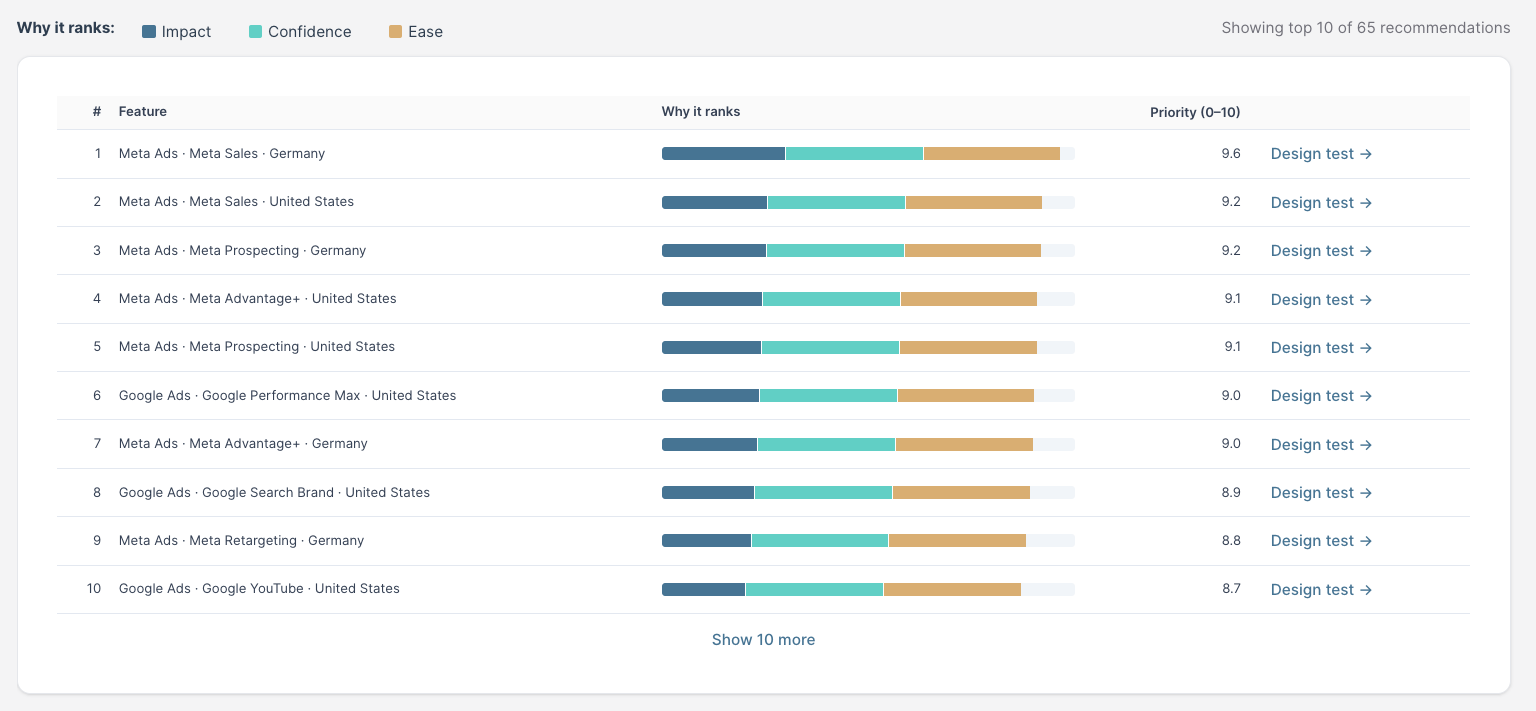
When you open Test Prioritizer, Sellforte presents a ranked list of incrementality testing opportunities across your media mix.
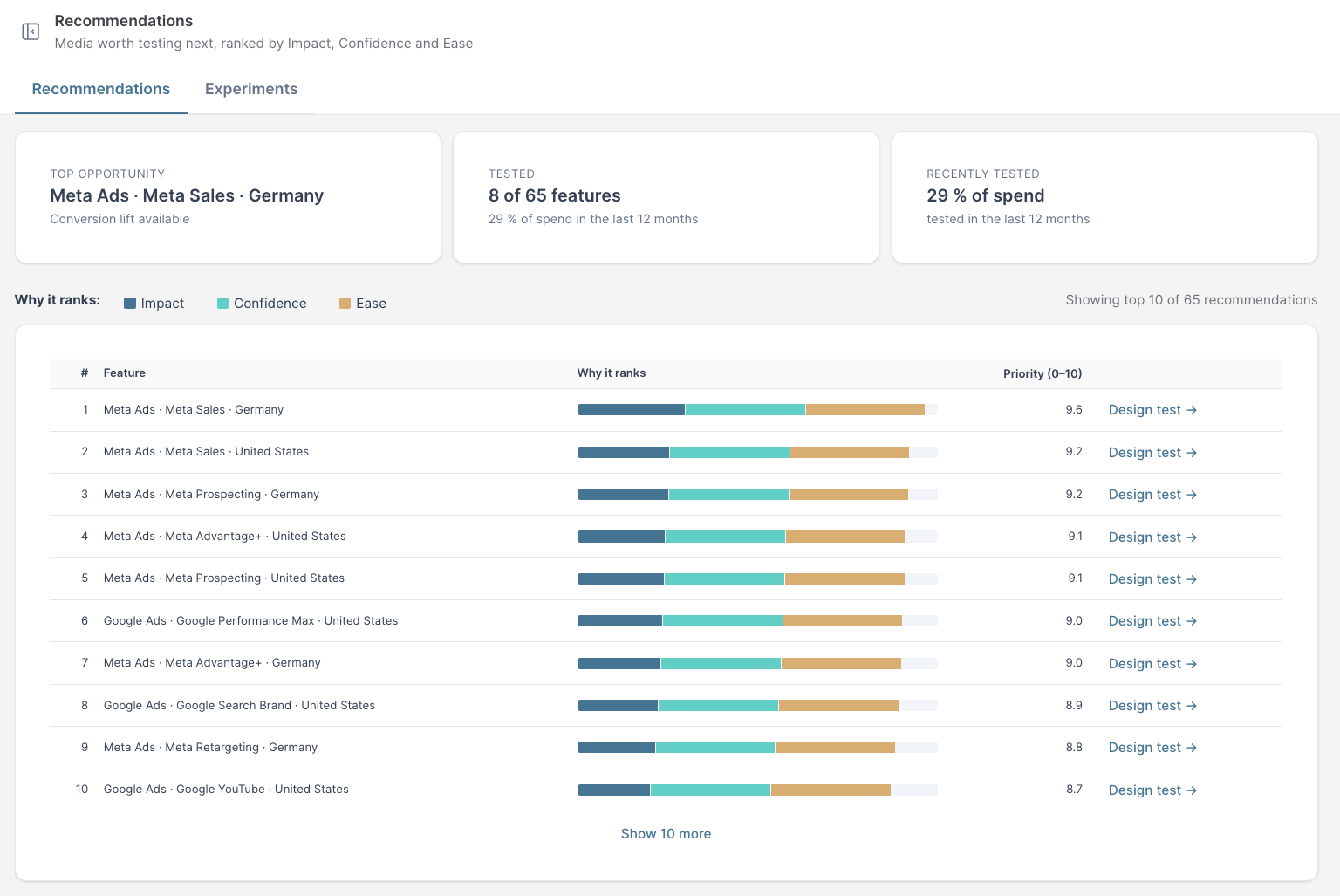
Each opportunity receives a priority score between 0 and 10, calculated using the ICE framework:
- Impact: Evaluates the importance of the testing opportunity based on factors such as media investment. For customers using Sellforte MMM, model-based incremental ROAS estimates can also help identify channels with unusually high or low returns.
- Confidence: Identifies gaps in existing experimental evidence by considering how many tests have been conducted and how recently.
- Ease: Considers how straightforward the proposed testing methodology would be to implement.
Together, these three factors help identify opportunities where additional incrementality evidence could be particularly valuable.
Each recommendation includes a breakdown of its Impact, Confidence, and Ease scores, making it easy to compare testing opportunities and understand why they rank where they do.
From a Recommendation to Your Next Incrementality Test
Let's look at a practical example.
Imagine you're managing marketing for an ecommerce business operating across several markets, including the United States and Germany.
Your company invests heavily in Meta, Google, and other advertising channels. You've already conducted several incrementality tests, but there are still gaps in your measurement that you want to address.
When you open Test Prioritizer, you can immediately see the current state of your testing program.
In the example shown earlier, eight of 65 media features have been tested, and 29% of media spend has been covered by recent testing over the past 12 months.
Sellforte has also identified and ranked 65 potential testing opportunities based on their ICE scores.
One of the highest-ranked opportunities is Meta Ads, Meta Sales, United States, with a priority score of 9.2 out of 10.
Selecting the recommendation reveals exactly why it ranks so highly.
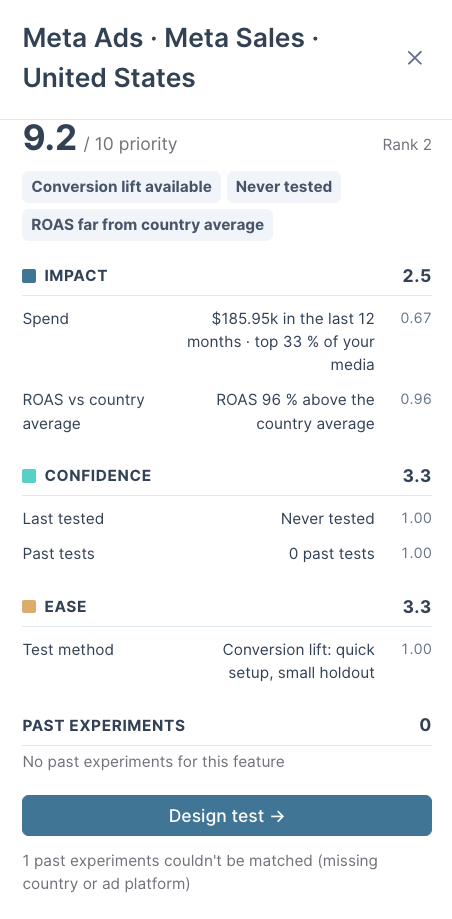
Impact: 2.5 out of 3.3
The channel received $185,950 in media investment over the past 12 months, putting it among the top 33% of media features by spend. In this example, Sellforte's MMM also estimates its ROAS to be 96% above the country average, making it an interesting candidate for further validation.
Confidence: 3.3 out of 3.3
Despite its significant investment and strong MMM-based returns, this particular media feature has never been tested. There are no previous matched incrementality tests providing direct experimental evidence of its contribution. This gives it a high testing priority because additional validation is needed.
Ease: 3.3 out of 3.3
A conversion lift test is available, offering a relatively straightforward testing methodology with a quick setup and small holdout group.
Together, these factors give Meta Sales in the United States a priority score of 9.2, making it the second-highest-ranked testing opportunity.
The recommendation provides a clear rationale for running a test. The team can then use its existing testing workflow to set up and execute the conversion lift study.
Instead of relying on intuition, the team knows what to test next and, importantly, why.
From Incrementality Testing to Better Marketing Decisions
Identifying the right test is only the beginning. The real value comes from understanding what the results mean and using those insights to improve marketing decisions.
With Sellforte Incrementality Testing, marketers can measure the true causal impact of their advertising through conversion lift, geo lift, and A/B testing, independently of platform-reported attribution.
For example, a conversion lift test on Meta Sales in the United States could reveal whether the channel is genuinely generating the incremental sales indicated by its existing measurement.
Once completed, the results can be analyzed in Sellforte, helping the team understand how much incremental revenue the advertising generated and whether its investment is delivering genuine business value.
These insights are valuable on their own. Sellforte Incrementality Testing is available as a standalone solution, allowing marketers to validate channel performance and make more informed investment decisions without needing a full MMM implementation.
For teams also using Sellforte MMM, the same testing evidence becomes part of a broader measurement and optimization workflow.
If an incrementality test reveals that a channel is generating more or fewer incremental sales than MMM initially estimated, those results can be used to calibrate the model.
The calibrated MMM then feeds into Sellforte's Media Optimizer, which identifies opportunities to improve marketing investment, including recommendations at the granular campaign and ad set level.
This creates a connected workflow:
Prioritize what to test → Measure incremental impact → Calibrate MMM → Optimize media investment.
And as new experiments are completed, that evidence can inform future testing priorities, helping marketers continuously improve their understanding of what actually drives sales.
Whether you're using Sellforte as a standalone incrementality testing solution or combining testing with MMM and media optimization, the objective is the same: make better marketing decisions based on what actually drives incremental sales.
Coming Next: Test Designer
Test Prioritizer is the first step toward a more automated and connected incrementality testing workflow in Sellforte.
Today, it helps marketing teams answer the question: What should we test next?
The next step is helping them answer: How should we design that test?
In early 2027, we plan to introduce Test Designer, extending the workflow from test prioritization into test design.
The goal is to help marketers translate recommended testing opportunities into structured tests, with guidance on the appropriate methodology and configuration.
For now, test setup continues through existing testing workflows. The Design test option visible in the interface is part of the upcoming functionality.
Together, Test Prioritizer and Test Designer will help teams move from identifying the most valuable testing opportunities to designing the tests needed to validate them.
Start Prioritizing Your Next Incrementality Test
Every incrementality test is an opportunity to learn something valuable about your marketing. But deciding which tests to run shouldn't be a guessing game.
With Test Prioritizer, marketers can build a systematic, data-driven incrementality testing roadmap that focuses their efforts where additional evidence matters most.
Test Prioritizer is rolling out to customers from today onwards.
Want to see how Sellforte can help you prioritize, run, and analyze incrementality tests, and turn those results into better marketing decisions?

How should we prioritize incrementality tests across markets and channels?

Introducing Sellforte MMM Calibration with Meta Conversion Lift Studies: The New Industry Standard