


Meta Conversion Lift studies should not sit in a separate measurement lane from Marketing Mix Modeling.
Yet for many marketing teams, that is exactly what happens.
A business runs a Conversion Lift study, reviews the result, and perhaps uses it to inform a campaign or budget decision. Bringing that evidence into MMM, however, requires a separate manual process.
Someone needs to export the study results, identify the relevant outcome, match the study to the correct media activity, decide how much confidence to place in the result, and manually update the model calibration.
That may be manageable when you have one or two studies.
It becomes a much bigger problem when you have run tens or hundreds of Meta Conversion Lift studies across different markets, campaigns, objectives, and time periods.
At that point, the challenge is organizing the available evidence, deciding which studies should carry the most weight, and using the results to keep your MMM calibration current.
Today, we're launching Sellforte MMM Calibration with Meta Conversion Lift Studies.
Once Meta is connected, Sellforte automatically retrieves your Conversion Lift studies, processes the relevant results, matches them to your MMM, weights the available evidence, and updates the model's Bayesian priors every day.
This removes the need for recurring data exports, separate spreadsheets of study results, and manual recalibration whenever a new study finishes.
This is the first release of Sellforte MMM Calibration, beginning with Meta Conversion Lift studies.
Why MMM and Conversion Lift belong together
MMM and Conversion Lift provide different but complementary views of marketing performance.
MMM gives marketers a continuous, cross-channel view of incremental impact. It helps teams understand how Meta performs alongside Google, TikTok, television, promotions, seasonality, and the rest of the factors affecting the business.
A Meta Conversion Lift study provides controlled causal evidence for a specific set of Meta advertising activity during a particular period.
Calibration connects the two.
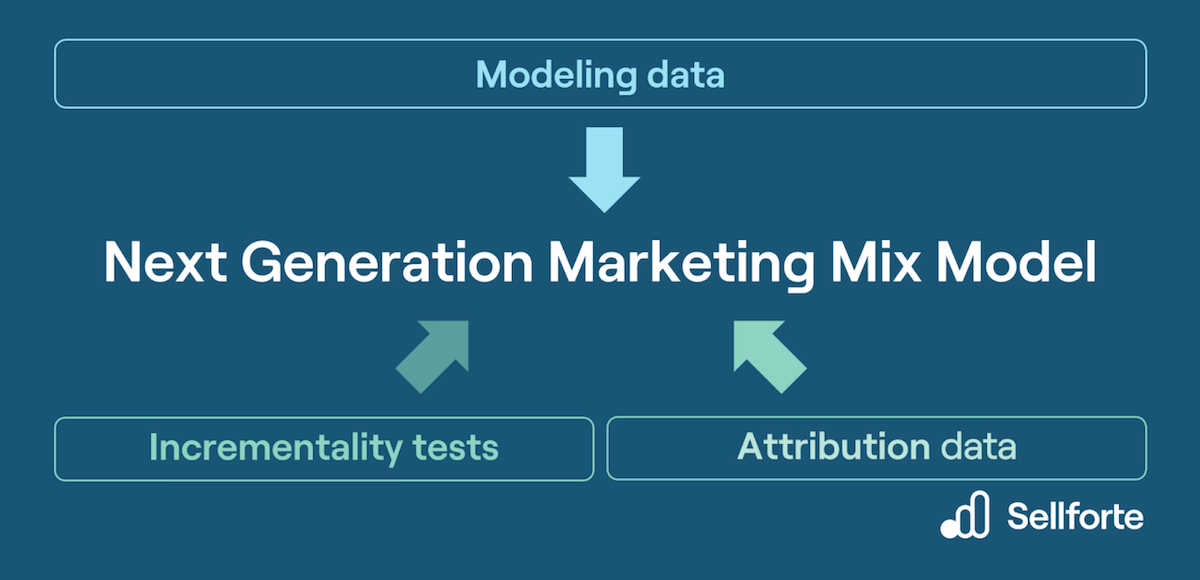
By using Conversion Lift results as evidence within the MMM, marketers can ground their ongoing measurement in causal studies without losing the broader, cross-channel view that MMM provides.
The problem is that this connection has traditionally required a lot of manual work.
A Conversion Lift study can include several reported outcomes. The MMM may be modeling revenue, purchases, leads, or another business KPI. The study also needs to be matched to the correct Meta account, campaigns, geography, and media data.
When several studies are available, teams also need to decide whether a study completed six months ago should carry the same weight as one completed last week, how to balance an uncertain result against a study with a much tighter confidence interval, and how to combine several studies covering similar Meta activity.
Without a systematic process, calibration can easily become subjective, inconsistent, and outdated.
From a one-time project to continuous calibration
With Sellforte, calibrating MMM with Meta Conversion Lift studies becomes a continuous process.
Sellforte retrieves both historical and ongoing Meta Conversion Lift studies through the native Meta connector. It identifies the relevant study outcomes, matches the studies to the corresponding MMM data, and converts the available evidence into model priors.
When several studies apply, Sellforte does not simply copy the latest point estimate into the model or calculate a basic average.
The studies are weighted based on factors including recency and statistical confidence. Newer studies and studies with stronger evidence receive more influence, while older or less precise results are treated accordingly.
The resulting priors are then included in Sellforte's daily model run.
This allows the MMM calibration to evolve as new causal evidence becomes available, without requiring teams to wait for another manual calibration project before a recently completed study can influence the model.
Once the Meta connection is in place, the workflow becomes what our CEO Juha Nuutinen described as "connect and forget."
How MMM Calibration with Meta Conversion Lift Studies works
The initial setup is simple.
To get started, you need to have the Meta Pixel installed, have completed at least one Meta Conversion Lift study, and connect Meta to Sellforte through the native connector.
The connection itself takes around 10 minutes. After that, the recurring calibration process happens automatically.
Step 1: Meta Conversion Lift studies flow into Sellforte
Every day, Sellforte retrieves Meta Conversion Lift studies through the native Meta connector.
This includes studies completed in the past as well as studies that are currently running. As new results become available, Sellforte updates the corresponding studies in the Experiments Hub.
Instead of maintaining a separate spreadsheet or manually uploading study results, marketers have one continuously updated library of their Meta Conversion Lift evidence.
The Experiments Hub shows the study name, type, status, dates, media spend, test iROAS, confidence, and other relevant results.
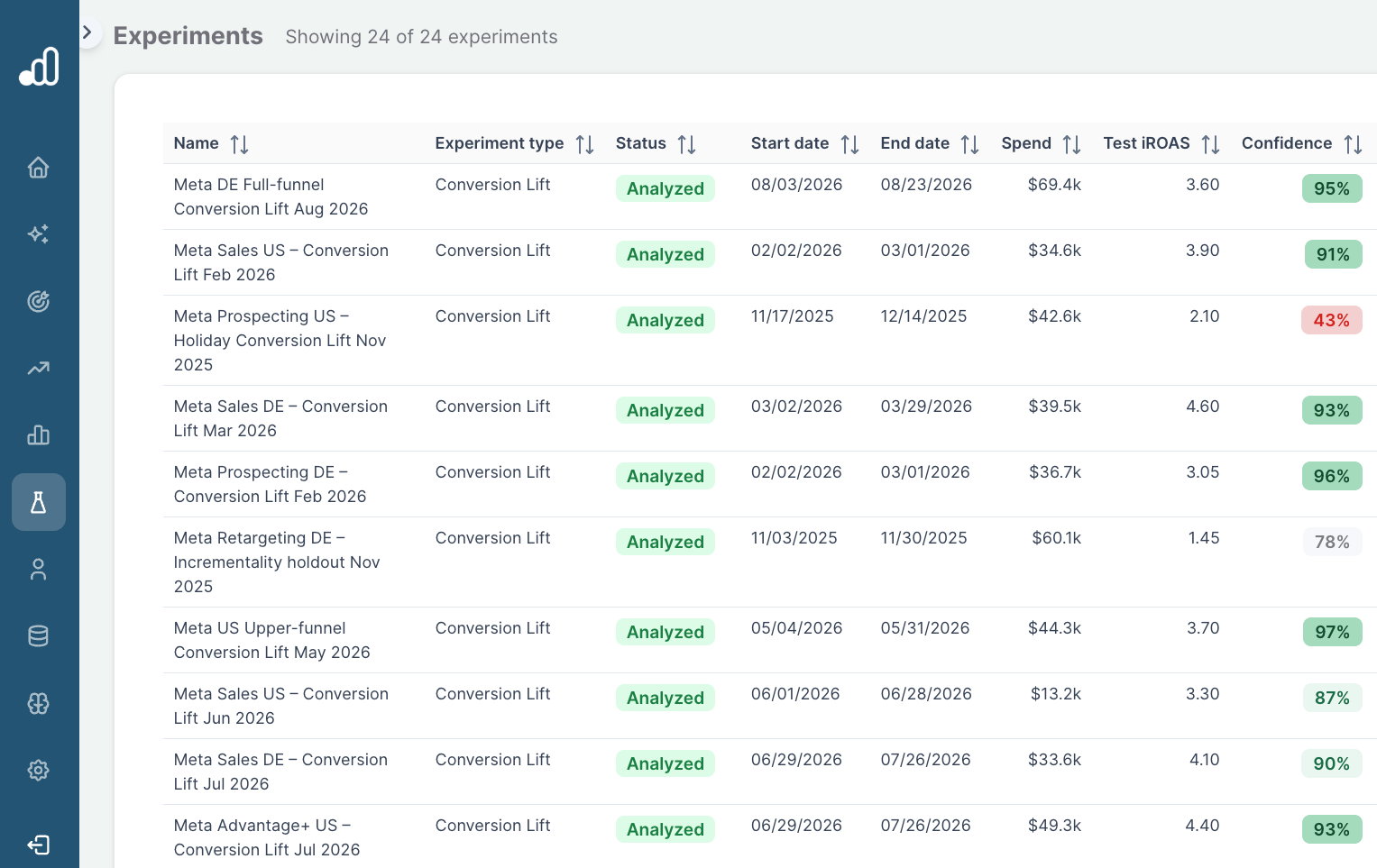
Completed and ongoing Meta Conversion Lift studies are automatically imported into the Sellforte Experiments Hub.
Step 2: Sellforte processes the relevant study results
A single Conversion Lift study may report several different outcomes. Sellforte identifies the result that corresponds with the KPI being modeled in MMM.
For example, if the MMM is modeling sales, Sellforte uses the relevant sales outcome from the study. If the model is focused on leads or customer acquisition, it can use the corresponding conversion result.
Sellforte also matches the study with the appropriate Meta media data, including the relevant advertising account, campaigns, market, and time period.
This removes the need to manually reconcile study objectives, campaign identifiers, countries, and MMM features each time a new study is completed.
Open an individual study in the Experiments Hub and you can review the evidence behind it, including incremental sales or conversions, test iROAS or iCPA, confidence intervals, and the overall confidence of the result.
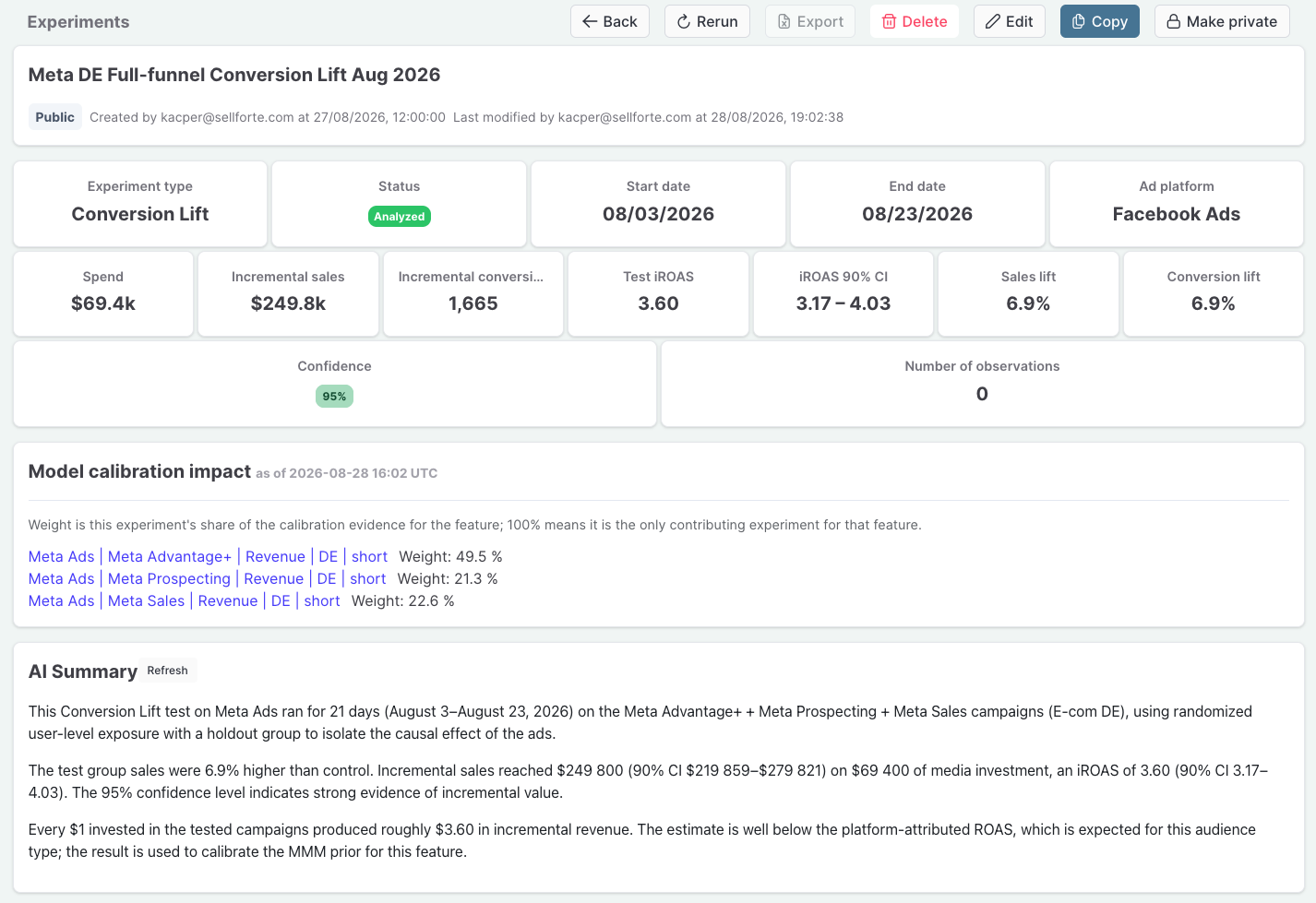
Each study includes its incremental results, test iROAS or iCPA, confidence interval, and confidence level.
Step 3: Multiple studies are weighted intelligently
When several Meta Conversion Lift studies are relevant to the same area of the model, Sellforte combines the evidence.
However, not every study is treated equally.
More recent studies are generally more representative of current performance than older studies, while studies with tighter confidence intervals provide stronger evidence than highly uncertain results.
Sellforte accounts for these differences when deciding how much weight each study should receive.
This is particularly important for larger advertisers that have accumulated many Conversion Lift studies over time. Rather than selecting one study, ignoring older evidence, or calculating an unweighted average, Sellforte creates a combined view based on the relative strength of the available results.
The resulting study evidence appears in Model Calibration alongside the other inputs used to establish the model prior. In many cases, the Meta Conversion Lift results show materially higher incremental ROI than GA4-based priors, and because they provide direct causal evidence, they receive the greatest weight in the calibration.
Teams with access to the Model Calibration view can see the experiment-based prior, the final prior used by the model, and how many studies contributed to the calculation.
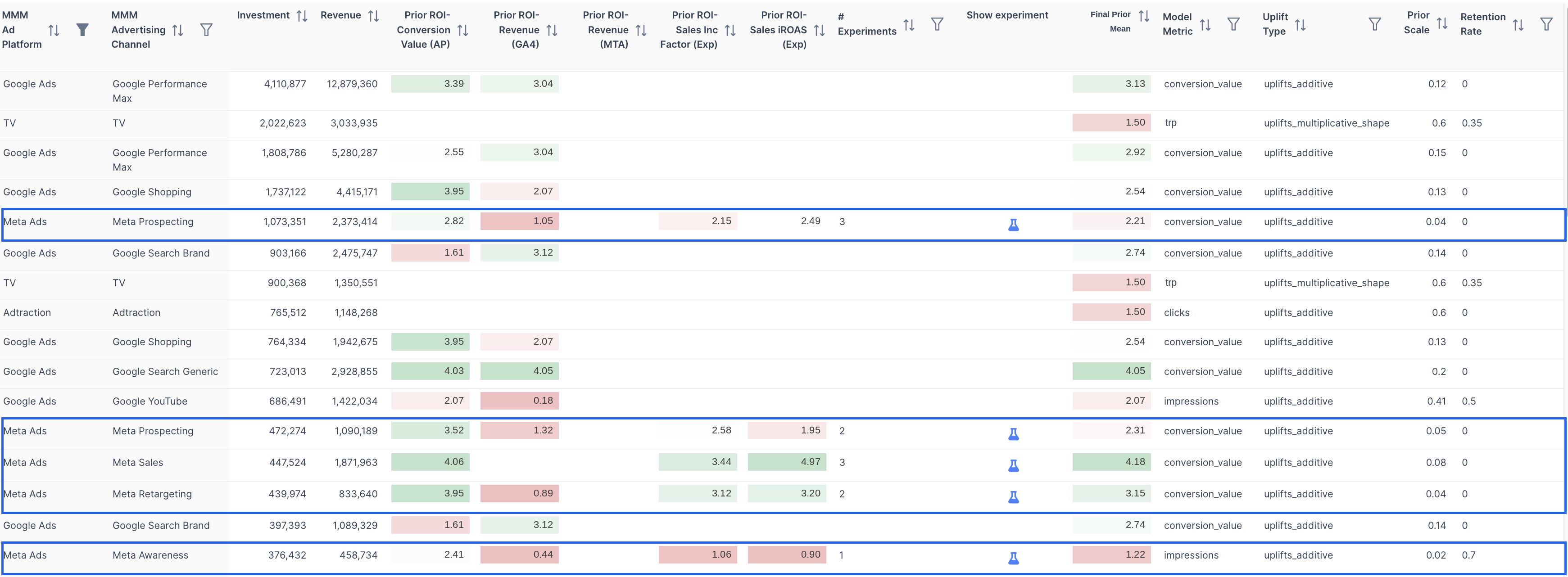
Meta Conversion Lift evidence is automatically included in Model Calibration alongside the other inputs used to calculate the final prior.
Step 4: The model priors update automatically
After the studies have been processed and weighted, Sellforte updates the relevant Bayesian priors.
These priors provide evidence about the range of results the MMM should consider plausible before estimating performance from the complete business and marketing dataset.
The updated priors are included in the daily model run, allowing a new Meta Conversion Lift result to begin influencing the MMM without someone manually reconfiguring the model.
The process also continues after the first calibration.
Sellforte keeps retrieving study data and recalculating the calibration as new studies are completed, ongoing studies develop, or the available evidence changes.
This turns calibration from a periodic modeling task into an always-on measurement capability.
Step 5: The calibration remains traceable
For teams with access to Model Calibration, the evidence behind the process remains visible.
From Model Calibration, users can open the list of contributing studies and see the name of each Conversion Lift study, the weight it received, its test iROAS, its confidence level, and the study dates.
This makes it possible to understand which studies influenced the model and how much each one contributed.
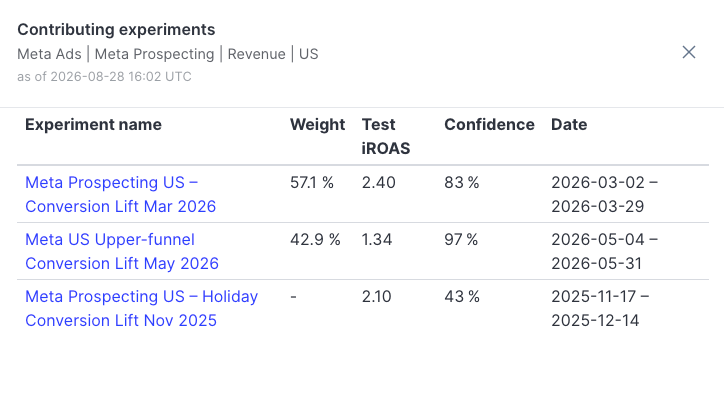
Open the contributing studies panel to see the weight, test iROAS, confidence, and date of every study included in the calibration.
The connection also works in the opposite direction.
Open a Conversion Lift study in the Experiments Hub and the Model Calibration Impact section shows whether the study contributed to the current model calibration and the weight it received.

The Model Calibration Impact section shows how an individual Meta Conversion Lift study contributes to the MMM.
This gives measurement teams a transparent link between the original causal study and the model that uses its results.
Why this matters most at scale
Any advertiser that has run a Meta Conversion Lift study can benefit from using that evidence to calibrate its MMM.
The biggest operational benefit, however, comes to advertisers that have already run tens or hundreds of studies.
For these teams, the difficulty is not generating enough evidence. It is processing and making consistent use of the volume of evidence they already have.
Studies may have been run in different countries, at different times, with different objectives, and with very different levels of statistical confidence. Results can end up distributed across Meta, spreadsheets, presentation decks, and internal documentation.
Even when a business has invested significantly in incrementality testing, only a small part of that evidence may ultimately make it into the MMM.
Sellforte MMM Calibration with Meta Conversion Lift Studies gives those businesses a systematic way to use their complete library of Conversion Lift evidence.
Each relevant study can contribute to the calibration, with newer evidence receiving the appropriate influence as it becomes available and older evidence remaining part of the picture without being treated as equally representative of current performance.
The result is a model that remains connected to the advertiser's latest causal evidence without creating an ongoing manual workload for the marketing or analytics team.
The new industry standard for MMM calibration
The old standard for bringing incrementality studies into MMM has been a manual calibration exercise in which teams export the results, match the data, select the relevant studies, decide how much confidence to place in each one, enter the priors, and repeat the process as new evidence accumulates.
That approach does not scale with the volume of experimentation now being run by sophisticated advertisers.
The new industry standard is continuous calibration that uses all relevant studies, accounts for the recency and statistical strength of the available evidence, updates as new results arrive, and keeps the relationship between the original studies and the resulting model priors transparent.
Sellforte MMM Calibration with Meta Conversion Lift Studies establishes this new standard by replacing a recurring manual project with a direct, continuously updated connection between causal studies and ongoing marketing measurement.
Running an incrementality study should not create another isolated measurement result. Each new study should strengthen the business's ongoing understanding of Meta performance.
With Sellforte, Meta Conversion Lift results become part of the MMM automatically, helping keep the model grounded in the latest available causal evidence rather than leaving valuable study results in a separate reporting workflow.
Meta Conversion Lift studies are the first source supported by Sellforte MMM Calibration. The broader direction is to make it easier for every relevant piece of causal evidence to strengthen the MMM without requiring another manual calibration project.
See MMM Calibration with Meta Conversion Lift Studies in action
Sellforte MMM Calibration with Meta Conversion Lift Studies is rolling out to Sellforte customers from today onwards.
To use the capability, customers need to connect Meta through Sellforte's native connector, have the Meta Pixel installed, and have completed at least one Meta Conversion Lift study.
Once connected, Sellforte can automatically retrieve the studies and begin incorporating the relevant evidence into the daily MMM calibration.
👉 Book a demo to see MMM Calibration with Meta Conversion Lift Studies in action
MMM Calibration Explained: What It Is, Why It Matters, and How to Do It
Calibrating Marketing Mix Models with Experiments and Attribution data