

The short answer
No. A generic AI cannot reliably optimize media spend from raw marketing data alone. Attributed sales do not establish incrementality, and past returns do not show how much more a channel can absorb. Reliable recommendations need a validated model of incremental impact and saturation, supported by experiments. AI can help you use that model.
Here's a summary video from Sellforte CEO, Juha Nuutinen:
This article is part of Asked by Marketers, a series answering real questions from marketing leaders.
Sellforte's team holds more than 1,450 meetings each year with marketing leaders in Ecommerce and Retail about Marketing Mix Modeling and incrementality testing. Each week, we anonymize at least one question from those conversations and answer it in depth, based on what marketers are actually struggling with, not what keyword tools suggest. About the series
Why marketers ask this
You already have sales data, campaign spend, and reports from your advertising platforms. Giving those files to an AI and asking where to invest next seems like a reasonable shortcut. If it can explain last month's performance, why shouldn't it be able to recommend next month's budget?
The difficulty is that a spending recommendation requires an estimate of what will change when you change the budget. A report of purchases credited to each channel does not answer that question. The AI needs a sound measurement and optimization process behind its answer.
Why can raw marketing data lead to the wrong recommendation?
An AI that treats attributed revenue as the revenue caused by advertising can recommend scaling channels that mostly capture existing demand. Meta retargeting, Google Search brand, and email marketing are familiar examples: each can receive credit for purchases from people who were already likely to buy.
Consider someone who has decided to buy from you, searches for your brand, and clicks a paid search ad. The purchase appears in the campaign report. That record does not tell you whether the person would have bought through an organic result if the ad had been absent. The same question applies when a returning shopper clicks a retargeting ad or an email.
These channels can generate incremental sales. The problem is assuming that every attributed sale is incremental, or that the channel with the highest attributed ROAS deserves the next dollar. Advertising earlier in the purchase journey may contribute to demand while receiving little credit in a click-based report.
Sales and spend data also contain overlapping influences. A promotion can raise sales during a week when advertising spend increases. Seasonal demand can lift both branded searches and purchases. Simply identifying that spend and sales moved together does not separate these effects.
Why isn't knowing incrementality enough to decide where to spend more?
You also need to estimate how returns change at different spending levels. A channel can have generated substantial incremental revenue so far and still have little room to absorb more budget efficiently.
This is saturation. As investment increases, additional spend can produce progressively less additional revenue. The average return on the budget already spent can remain attractive even when the next dollar has a weak return.
Advertising response curves estimate the relationship between spend and incremental sales. Their slope at the current spending level describes the marginal incremental return. For a larger budget change, compare the expected sales at the starting and proposed spending levels.
Practical capacity matters too. More budget cannot create unlimited branded searches or expand an email audience overnight. A useful optimization needs constraints that reflect what the team can change. Otherwise, even a model-based scenario can recommend a budget the channel cannot spend as intended.
What should sit behind an AI's media spend recommendation?
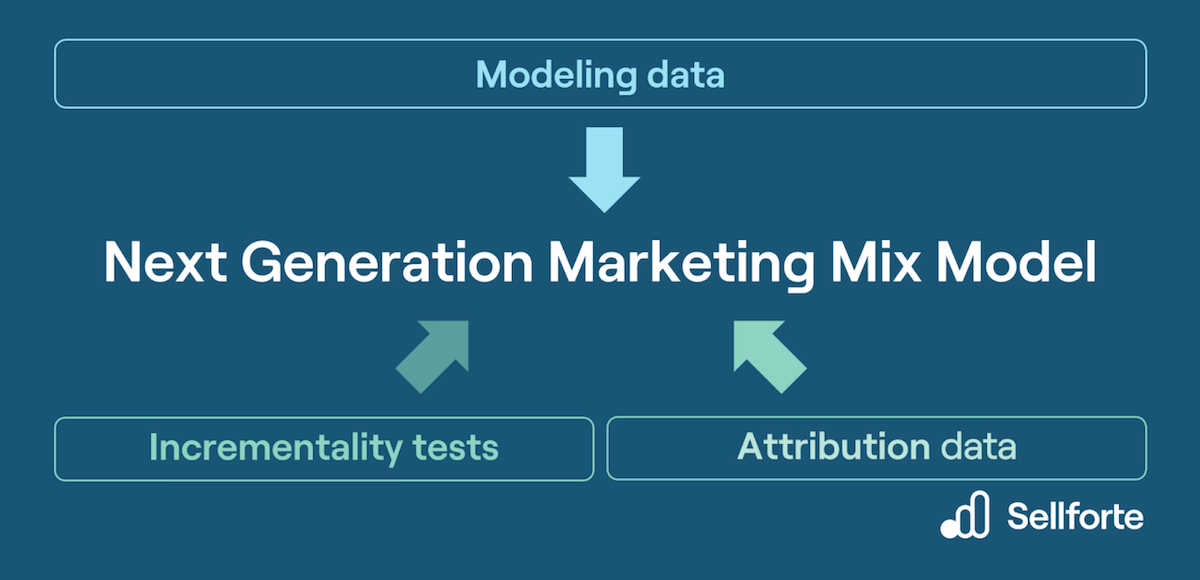
A validated marketing model should estimate incremental effects, account for saturation, and support scenarios for the budget decision you need to make. Marketing Mix Modeling uses historical sales and marketing data, together with other sales drivers, to estimate how marketing contributes to business outcomes.
Sellforte uses its own Bayesian MMM. The model accounts for channel response and saturation, with relevant controls such as seasonality and promotions. Bayesian modeling also allows prior evidence to inform the estimates, including evidence from incrementality experiments.
Incrementality tests, such as conversion-lift or geo-lift studies, estimate what changes when advertising is withheld or changed. Calibrating the MMM with credible, relevant tests helps ground its estimates in experimental evidence. The test and model need compatible campaign coverage, sales definitions, and measurement periods. One test at one spending level does not establish the entire response curve.
The Bayesian label alone does not make the recommendation reliable. The data, model assumptions, calibration, and validation all need scrutiny. A forecast should retain the uncertainty in those estimates, particularly when a proposed budget moves beyond the spending levels you have observed.
How can AI help once that model is in place?
AI can make the model and its optimization tools easier to use. It can retrieve results, create scenarios from your instructions, and explain the calculated differences between plans.
You might ask: “Keep our total budget unchanged next month, hold branded search and email fixed, and compare the current allocation with a plan that maximizes incremental sales.” The AI can translate that request into the optimizer's settings and summarize its output. The channel estimates and budget calculations should be traceable to the underlying model and tools.
Review the scenario itself before acting. Check the dates, market, sales measure, and spending constraints. An assistant can misinterpret a regional request and run a national scenario, or use a different sales measure from the one you intended. A correctly calculated answer to the wrong question is still the wrong recommendation.
The same requirements apply if you use AI to help build an analysis from scratch. Generating code or fitting a model does not establish that its causal assumptions are sound. Reliable optimization still requires the modeling, experiments, and checks described above.
How this looks in practice
Consider a hypothetical ecommerce team deciding where to invest an additional $10,000. Two campaign groups each spent $50,000 in the reference period. Assume the same market, dates, and revenue definition, and that a validated, experiment-calibrated MMM provides the following estimates. All figures are illustrative.
| Measure | Campaign group A | Campaign group B |
|---|---|---|
| Attributed revenue | $400,000 | $200,000 |
| Attributed ROAS | 8.0 | 4.0 |
| Estimated incremental revenue | $150,000 | $125,000 |
| Average incremental ROAS | 3.0 | 2.5 |
| Forecast additional revenue from another $10,000 | $8,000 | $16,000 |
Ranking by attributed ROAS favors A. Even ranking by average incremental ROAS favors A. But the response curves indicate that B would generate more additional revenue from this particular budget increase. Its estimated return on the extra $10,000 is 1.6, compared with 0.8 for A.
Those are modeled returns over the proposed spending interval, not fixed rates that apply at every budget. B's higher forecast also does not establish profitability: the team needs to compare the additional revenue with margins and relevant costs, and review the uncertainty before committing.
A useful AI answer would show the model's scenario comparison, explain why the ranking changes, and retain those qualifications. A recommendation based only on the two attributed ROAS figures would miss the decision.
How Sellforte helps
Sellforte combines Bayesian MMM, incrementality-test calibration, and optimization tools to estimate channel returns and compare spending scenarios. Sellforte AI helps teams query those results and build plans through a conversational interface, with the underlying scenarios available for review. Book a demo.
Authors

Lauri Potka is the Chief Operating Officer at Sellforte and has over 15 years of experience in Marketing Mix Modeling, marketing measurement, and media spend optimization. Before joining Sellforte, he worked as a management consultant at the Boston Consulting Group, advising some of the world's largest advertisers on data-driven marketing optimization. Follow Lauri on LinkedIn, where he is one of the leading voices in MMM and marketing measurement.

How should we weight multiple incrementality tests when calibrating an MMM?

Isn’t MMM just a quarterly project?