


The short answer
Yes. MMM calibration should separate traffic, engagement, awareness, and sales campaigns because they represent distinct revenue pathways, response curves, and lag structures. Use objective-level experiments as the primary calibration signal. As secondary evidence, combine attribution data with incrementality-factor benchmarks, using last click mainly for lower-funnel objectives and considering platform data for top-of-funnel objectives.
This article is part of Asked by Marketers, a series answering real questions from marketing leaders.
Sellforte's team holds more than 1,450 meetings each year with marketing leaders in Ecommerce and Retail about Marketing Mix Modeling and incrementality testing. Each week, we anonymize at least one question from those conversations and answer it in depth, based on what marketers are actually struggling with, not what keyword tools suggest. About the series →
A note on terminology: This article uses MMM calibration to mean bringing incrementality tests, attribution benchmarks, and other prior knowledge into the MMM. It does not cover the separate downstream step of applying MMM-derived calibration factors to MTA or other attribution data to translate attributed ROAS into incremental ROAS.
Why do marketers ask this?
Paid-social advertising rarely contains one kind of marketing. The same account can hold sales campaigns optimized for purchases, traffic campaigns optimized for site visits, engagement campaigns optimized for interactions, and awareness campaigns optimized for reach or views. Those campaigns may share a platform and even budget owner, but they do different jobs.
That creates an immediate MMM question. Should the model use one paid-social feature with one calibration prior, one response curve, and one lag structure, or should it estimate and calibrate the objectives separately?
The answer matters when marketers set budgets at the objective level. A single platform result can be adequate for deciding how much to invest in paid social overall. It is much less useful when the team needs to decide whether the next euro should go to retargeting, prospecting, traffic, video engagement, or awareness.
The weekly spend mix can also change materially, as the demo view below shows. If objective shares move over time, a single paid-social feature can mistake a change in campaign composition for a change in platform effectiveness.
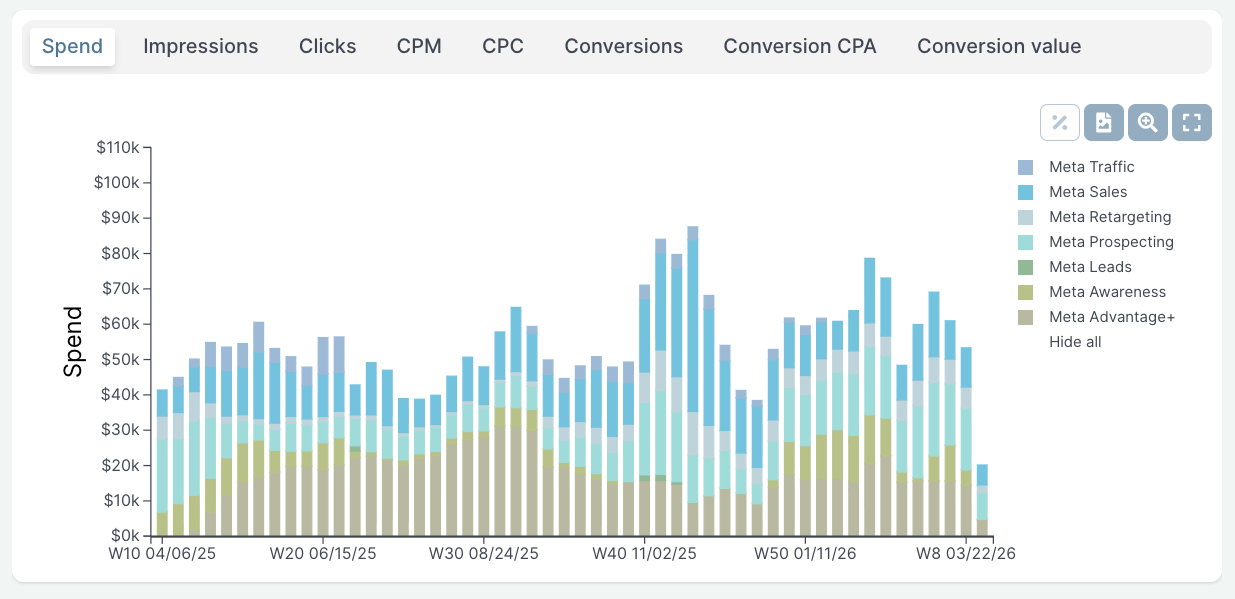
Why should MMM calibration distinguish campaign objectives?
Campaign objectives are different in four main ways.
1. They affect different stages of the customer journey. Retargeting and other demand-capture activity work close to purchase. Traffic and engagement campaigns may create visits or consideration that convert later. Awareness campaigns are designed to build reach, memory, and future demand. One calibration prior cannot represent these pathways equally well.
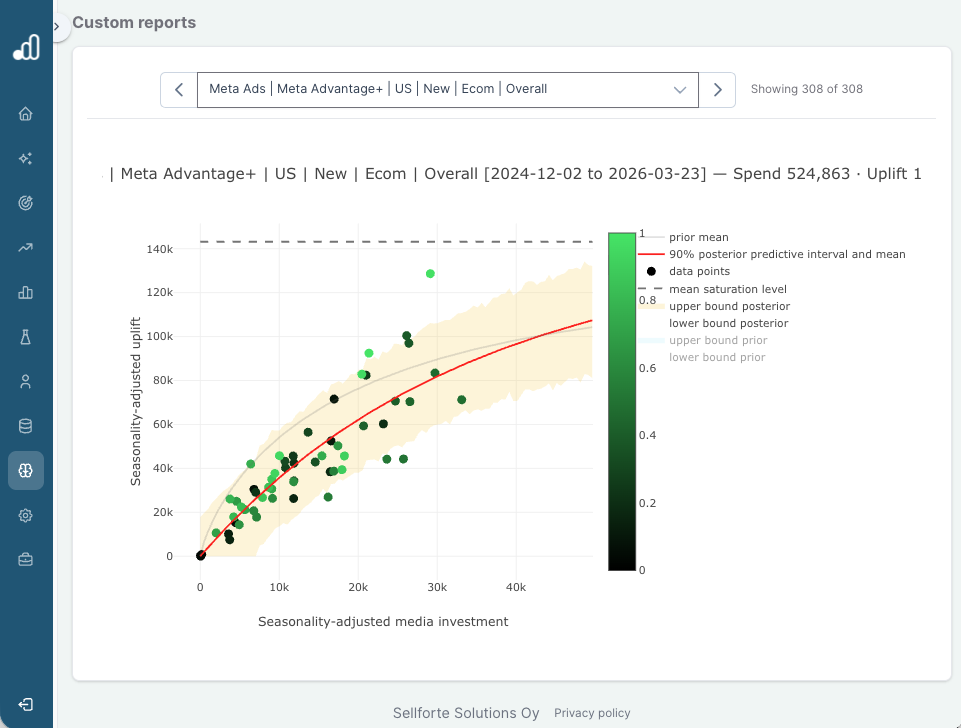
2. They can have different response curves. A small retargeting pool may saturate quickly because the number of high-intent users is limited. Prospecting or awareness can have a larger scalable audience, but its marginal return may develop differently as reach and frequency increase. If objectives are combined, the model estimates an average curve that may not describe any of them accurately. Below is an example of a Meta Advantage+ response curve (demo data). The response curve for awareness can be very different for the same business.
3. They can have different lag structures and value horizons. Sales campaigns often produce a larger share of their observable revenue soon after exposure. Mid-funnel and top-of-funnel activity may influence purchases weeks or months later. If those campaigns acquire new customers, measuring their full incremental ROAS may also require later repeat purchases or a defensible customer lifetime value estimate. For omnichannel retailers, it may require offline sales too.
4. They have different measurement visibility. Last-click attribution can observe a retargeting click immediately before purchase. It sees much less of a reach or video-view campaign that influenced the customer earlier. Ad-platform reporting may retain more view-through signal, but it introduces its own attribution assumptions.
If the objectives are different, why is objective-level calibration difficult?
The main challenge is not the rationale for separating objectives. It is building data and calibration evidence at the same level.
Campaigns must be classified consistently. Objective fields are not always present in the historical dataset, naming conventions change, and one campaign name may encode audience, funnel role, country, product, and optimization event. The taxonomy must connect platform delivery data, experiment cells, sales outcomes, and the MMM feature definition across the full model history.
Calibration evidence must exist at the same level. A platform-wide lift study can show that paid social was incremental without telling the model how much of the result came from traffic, engagement, awareness, or sales campaigns. Objective-specific test cells are cleaner. Mixed cells require a defensible allocation key, and the remaining limitation should widen the calibration range. The fallback should not be one universal prior for every objective and market merely because direct evidence is missing.
Spend and variation are rarely balanced. Sales campaigns may run every week with substantial spend, while awareness appears in short bursts. Another account may have the opposite mix. A feature with little spend, few active weeks, or almost no independent variation will have a weaker statistical signal, even if its business role is distinct.
Objectives often move together. A brand campaign may launch at the same time as prospecting, promotions, and seasonal demand. When features are highly correlated, the model has limited information for separating their effects. Calibration can stabilize the estimates, but it cannot create identification that is absent from the data.
The outcome and time horizon must match the objective. A model of immediate ecommerce revenue cannot fully calibrate an awareness feature against a claim about long-term customer value or store sales. The target KPI, lag window, returns treatment, offline sales, and customer lifetime value assumptions need to be explicit.
The practical rule is to use the most decision-useful granularity the data and evidence can support. Separate objectives with stable definitions, material spend, and credible calibration evidence.
What calibration data should you use for each objective?
Use a hierarchy of evidence rather than one benchmark for every campaign type. Incrementality experiments are the causal anchor. MMM is the integration layer that combines those tests with attribution benchmarks and the observed time series, including for features that have not yet been tested directly.
How should incrementality tests be used?
Incrementality tests are the strongest calibration evidence because they estimate what happened because of the advertising. Use objective-specific conversion-lift or geo holdout tests when the test scope, KPI, market, and time horizon match the MMM feature.
Below is a demo conversion-lift test for Meta.
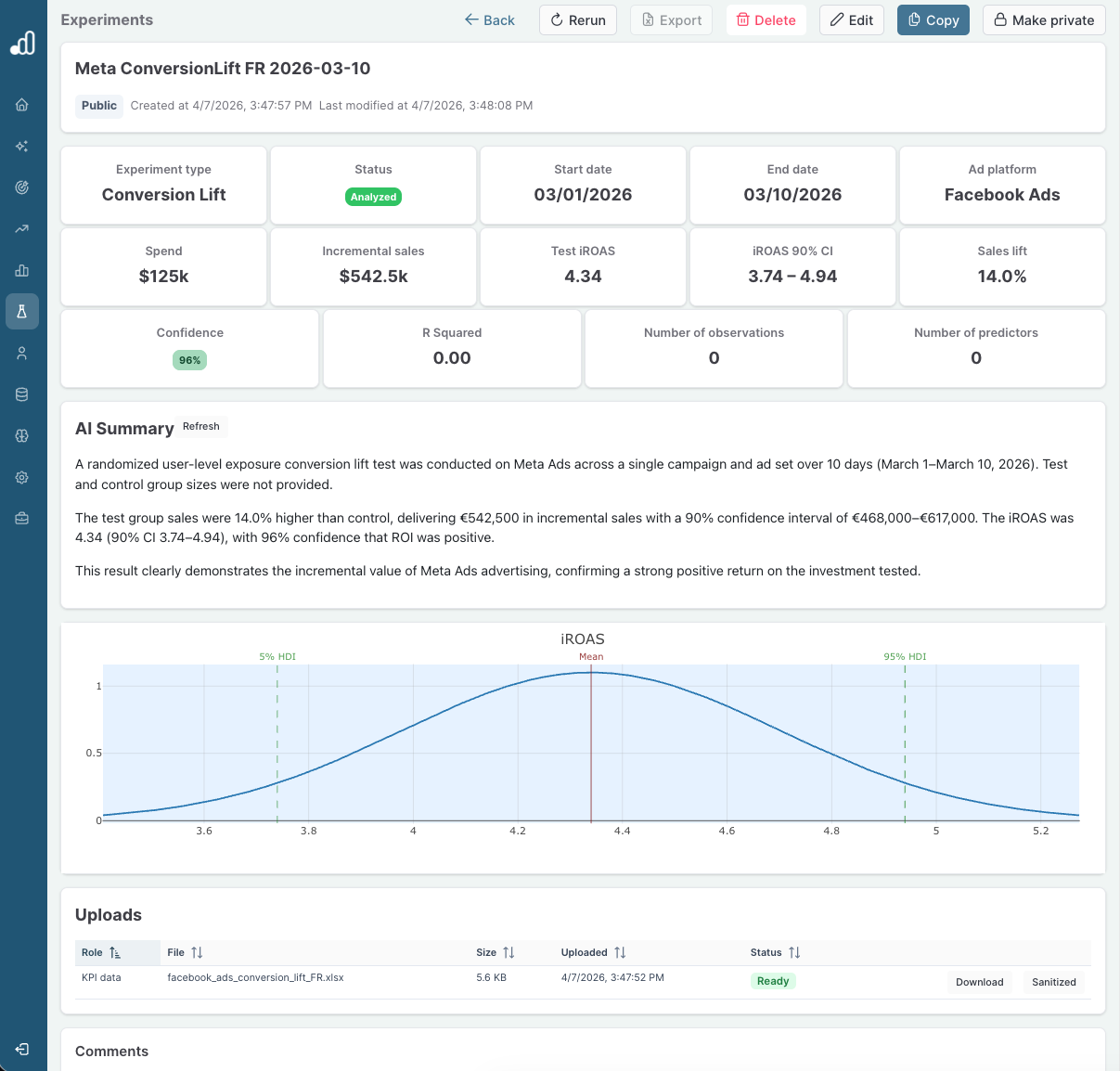
Where possible, design future test cells around one campaign objective or another clean feature definition. If a historical test mixes objectives, retain the total causal result and allocate it only when campaign-level data provides a defensible key.
When are last-click benchmarks useful?
Calibration evidence that combines last-click attribution with relevant incrementality-factor benchmarks is most useful for lower-funnel, click-led activity such as retargeting, where a click close to purchase is part of the expected revenue pathway.
Just to be clear: last click is not causal measurement but can provide a calibration signal when processed correctly.
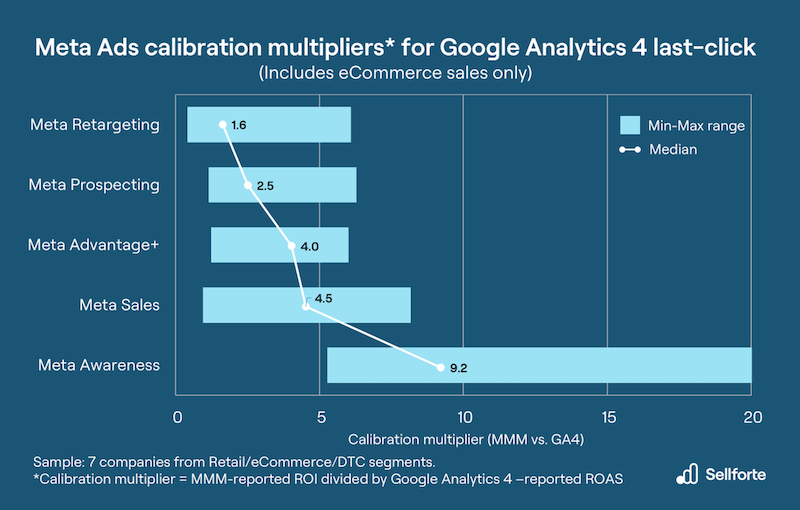
To give you an example of last-click-based calibration multipliers, we conducted research across seven retail, ecommerce, and DTC companies, comparing GA4 last-click ROAS with MMM-reported ROI. We found that the median multiplier varies from 1.6x for Meta Retargeting to 9.2x for Meta Awareness. Full research data is below:
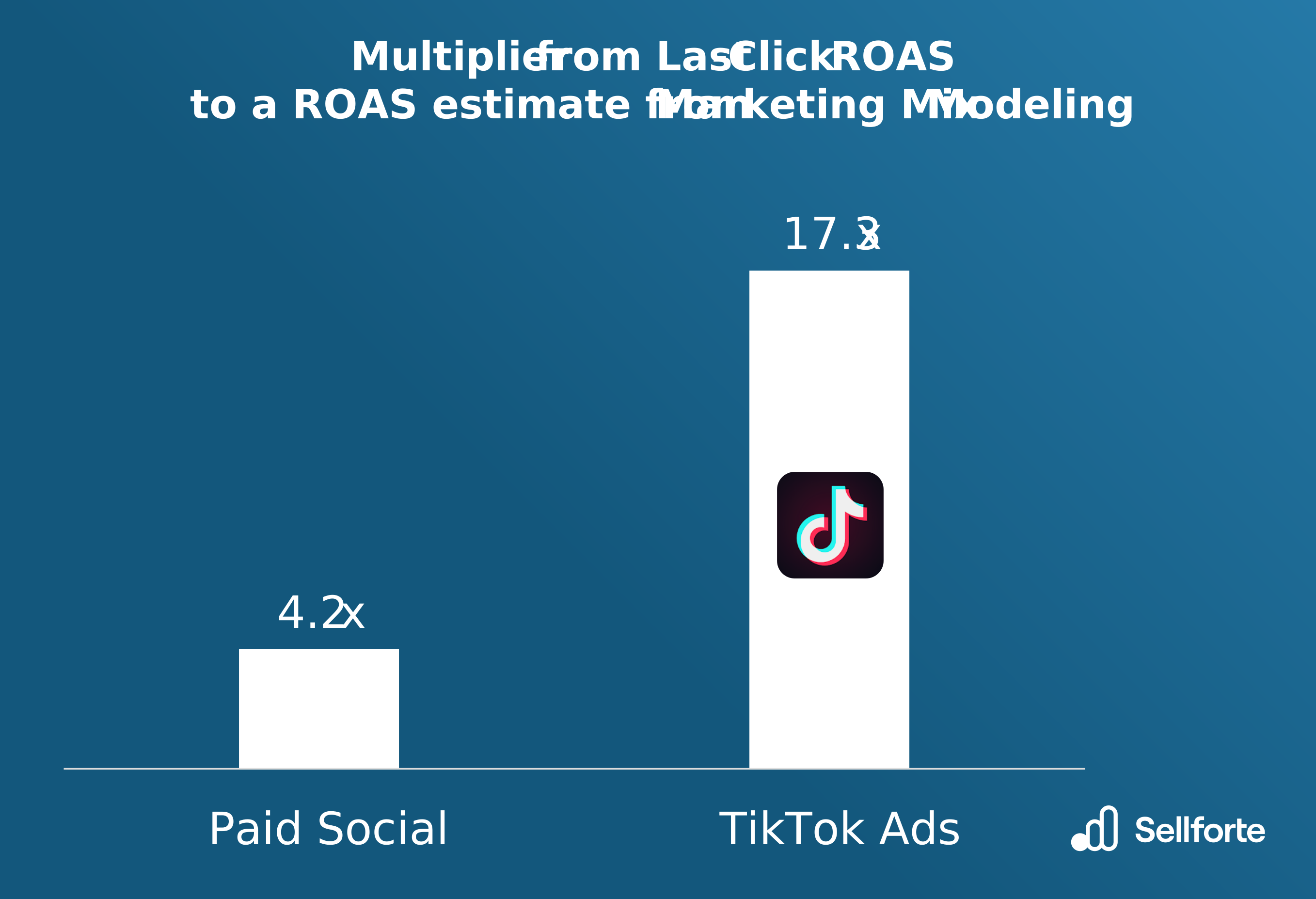
The same point appears in Sellforte's TikTok research. Across 34 ecommerce and retail businesses, the median multiplier from last-click ROAS to MMM-based ROAS was 17.3 for TikTok Ads and 4.2 for paid social overall. The study also found substantial variation between businesses, with larger multipliers where awareness represented more of the TikTok mix.
When are ad-platform benchmarks useful?
Calibration evidence that combines ad-platform attribution with relevant incrementality-factor benchmarks is more useful for top-of-funnel objectives because platform reporting includes signals that last-click tools often miss, such as view-through or engaged-view conversions.
However, ad-platform-based calibration is the trickiest because it requires an in-depth understanding of platform-specific attribution rules and access to benchmarks matched to those rules.
How this looks in practice
A practical calibration workflow would proceed in five steps.
1. Build the campaign taxonomy. Use platform objective, audience, optimization event, and naming rules to create stable MMM features. Separate Retargeting from broad Sales or Prospecting when targeting changes the revenue pathway.
2. Check whether the data can identify each feature. Review weekly spend, active periods, correlation with other objectives, and the amount of outcome variation.
3. Map the best evidence to each feature. Use objective-matched incrementality tests first. Use last-click benchmarks mainly for click-led lower-funnel features. Use ad platform benchmarks where view-led signals are more representative, while keeping wider uncertainty for indirect or sparse objectives.
4. Fit objective-specific response and lag structures. Let the model estimate separate saturation and carryover where the data supports it. For awareness or prospecting, verify that the modeled outcome includes the relevant delayed, offline, or customer-value effects before comparing iROAS with lower-funnel campaigns.
5. Validate the full chain. Inspect the raw evidence, prior vs. posterior, response curve, and lagged effects.
What are the best practices for objective-level MMM calibration?
Refresh the calibration over time. Changes in consumer behavior, ad-platform algorithms, and creative formats can alter incrementality. Objective-level calibration is a maintained evidence system, not a one-time setup.
Integrate objective-level calibration into a systematic calibration framework. The framework should adapt as new evidence emerges.
Use one platform for the full calibration workflow. The platform should connect incrementality test analysis, feature mapping, calibration configuration, model fitting, and final MMM results. Marketers should be able to trace each objective-level estimate back to the evidence that informed it. If the same platform later applies MMM-derived factors to MTA, label that as a separate downstream stage.
Related questions
Which calibration evidence should take priority?
Use a well-executed, closely matched incrementality test as the strongest causal anchor. Then use last-click or platform benchmarks where they add relevant feature-level signal. When several tests exist, weight them by relevance, recency, statistical confidence, and spend. See How should we weight multiple incrementality tests when calibrating an MMM?.
Is objective-level MMM calibration the same as applying MMM correction factors to MTA?
No. MMM calibration uses evidence to inform feature-level MMM estimates, response curves, and uncertainty. Applying MMM-derived factors to MTA is a downstream attribution workflow. The two can share a campaign taxonomy, but they answer different questions and should not be described as the same calculation.
How Sellforte helps
Sellforte connects incrementality tests, attributed and platform benchmarks, feature-level calibration, and MMM results in one auditable workflow. Teams can inspect the evidence, response curve, lag structure, and uncertainty for each campaign objective before using the model for budget decisions. Book a demo.
Authors

Lauri Potka is the Chief Operating Officer at Sellforte and has over 15 years of experience in Marketing Mix Modeling, marketing measurement, and media spend optimization. Before joining Sellforte, he worked as a management consultant at the Boston Consulting Group, advising some of the world's largest advertisers on data-driven marketing optimization. Follow Lauri on LinkedIn, where he is one of the leading voices in MMM and marketing measurement.

Why can a calibrated MMM show a different incremental ROAS than a conversion-lift study?

Can you trust a generic AI to do reliable media spend optimization with raw marketing data?