


The short answer
Yes. Use incrementality evidence from one country as an informative prior for the same channel in a structurally comparable market, not simply as a copy-pasted incremental ROAS. Adjust for local economics and media conditions, retain wider uncertainty, and replace the borrowed evidence with local experiments as they become available.
This article is part of Asked by Marketers, a series answering real questions from marketing leaders.
Sellforte's team holds more than 1,450 meetings each year with marketing leaders in Ecommerce and Retail about Marketing Mix Modeling and incrementality testing. Each week, we anonymize at least one question from those conversations and answer it in depth, based on what marketers are actually struggling with, not what keyword tools suggest. About the series →
Why do marketers ask this?
A multinational marketer's experiment roadmap fills up quickly. Once the team crosses countries with channels and campaign types, it may face dozens or hundreds of possible tests. Some markets have years of experiment history, while a newly modeled country may have no local lift study for an important channel.
That creates a practical choice. The MMM can ignore relevant evidence from other markets, use a generic benchmark, or borrow from a comparable country. Borrowing is often the most informative option, but only if the method preserves what is local.
The difficulty is that countries differ in average order value, media prices, brand strength, promotion intensity, customer behavior, channel mix, and the amount already being spent. Even two neighboring markets can sit at different points on a response curve. A return measured in one country therefore cannot simply become the expected return in another.
What should transfer across countries, and what should stay local?
Start with evidence that can credibly inform another market. In most cases, that is a relationship between causal and attributed performance rather than iROAS itself.
The clearest example is an incrementality factor. Suppose a lift study reports an incremental ROAS of 5.0 for a digital channel, while matched attribution for the same campaigns and dates reports a ROAS of 10.0. The resulting factor is 0.50. It says that, in this test, incremental revenue was 50% of the matched attributed revenue.
If a comparable destination market has attributed ROAS of 8.0, applying the 0.50 factor gives a starting calibration value of 4.0. Copying the source country's 5.0 would ignore the destination market's lower observed return. The factor does not prove incrementality in the new market. It gives the MMM a starting point that still reflects local attributed performance.
The destination country's MMM still estimates performance from its own data. Keep these elements local:
- Sales, margin, prices, returns, and average order value
- Media spend, delivery, and attribution data
- Seasonality, promotions, holidays, and other demand drivers
- Response curves, saturation, and lag structures
- Offline outcomes and channel interactions
Enter the borrowed evidence as a prior distribution or calibration range with explicit uncertainty. Local data then updates that starting point.
When are two countries comparable enough?
Two countries are comparable enough when the channel operates through a similar mechanism and the remaining differences can be represented by local model inputs. Geographic proximity alone is weak evidence.
Assess comparability at the level of the channel and campaign type, not for the country as a whole. One pair of markets may be comparable for a global paid-social prospecting product but unsuitable for print, promotions, or locally targeted search.
| Comparability check | What to compare | Warning sign |
|---|---|---|
| Channel and objective | Advertising platform, Campaign objective | A prospecting test is being used for retargeting or awareness |
| Outcome definition | Revenue basis, attribution scope, offline sales, returns, and time window | One market measures gross ecommerce revenue and the other measures net omnichannel sales |
| Media conditions | Spend level, reach, frequency, media cost, and saturation | The destination market operates far outside the tested spend range |
| Demand context | Brand maturity, customer mix, promotion intensity, seasonality, and category behavior | Promotions or baseline demand dominate one market but not the other |
| Evidence quality | Test design, confidence interval, recency, campaign mapping, and data quality | The source test is imprecise, outdated, or poorly matched |
A good diagnostic is a country by channel matrix of experiment-derived incrementality factors. Consistent values across comparable cells support transferability of evidence. A clear outlier is a reason to inspect campaign mapping, test quality, market conditions, and objective mix.
How should cross-country evidence enter MMM calibration?
Use an evidence ladder that makes the origin and confidence of every prior visible. A practical order is:
- A direct experiment for the same channel in the same country
- A closely related channel experiment in the same country
- The same channel in a structurally comparable country
- A relevant industry benchmark
- A weak or uninformative prior
The ranking matters because evidence becomes less direct as you move down the list. A borrowed factor from a comparable market should normally receive a wider prior range than a precise local experiment. An industry benchmark should be wider still.
A Bayesian MMM can encode the same rule directly. Set a tighter prior when the source experiment closely matches the destination market and a wider one when the comparison is weaker. The local time series then updates the prior. This setup does not prove that the markets are comparable, so the evidence source and the business rationale still need review.
Run at least two sensitivity checks. First, compare the model with and without the borrowed evidence. Second, widen or weaken the cross-country prior. If a material budget decision changes under reasonable alternatives, the uncertainty belongs in the decision and the country-channel combination becomes a strong candidate for a local test.
When should you avoid transferring incrementality evidence?
Avoid transfer when the causal mechanism is mainly local or the source and destination cells are not genuinely comparable.
Print and promotions are common examples. Distribution, customer selection, offer design, local pricing, and promotion calendars can differ enough that direct country-level evidence is more credible. The same caution applies to local media, market-specific partnerships, and channels whose effectiveness depends heavily on local brand maturity or retail coverage.
Do not transfer when the campaign objective, KPI, measurement window, or spend range differs materially. Awareness, prospecting, retargeting, and sales campaigns can have different incrementality even when they sit in the same advertising account.
Conflicting source-market results should also stop an automatic transfer. A mid-funnel social category can produce sharply inconsistent factors across countries. Treat that disagreement as an open research question and a reason for targeted testing. Averaging the factors would hide the problem.
How this looks in practice
Consider a retailer launching MMM in Market B without a local lift test for paid-social prospecting. Market A has a recent, well-executed experiment for the same objective and a similar audience strategy. The figures below are hypothetical.
| Step | Market A evidence | Market B calibration |
|---|---|---|
| Match the evidence | Experiment and attribution cover the same campaigns, dates, and revenue definition | Campaign objective and KPI are confirmed comparable |
| Calculate the factor | Test iROAS 5.0 ÷ attributed ROAS 10.0 = 0.50 | The 0.50 factor is used as borrowed evidence |
| Localize the return | The source iROAS stays in Market A | Local attributed ROAS 8.0 × 0.50 = prior center of 4.0 |
| Fit the local MMM | No value is copied into Market B | Local spend, sales, demand drivers, response curve, and lag update the prior |
| Replace the assumption | Market A remains one supporting source | A later Market B experiment receives more weight than the borrowed factor |
Reviewers should be able to see which market supplied the evidence, why the cells were considered comparable, how much uncertainty was added, and which local test would most improve the decision. Hiding one cross-country factor inside the model is not enough.
How should the borrowed evidence be maintained over time?
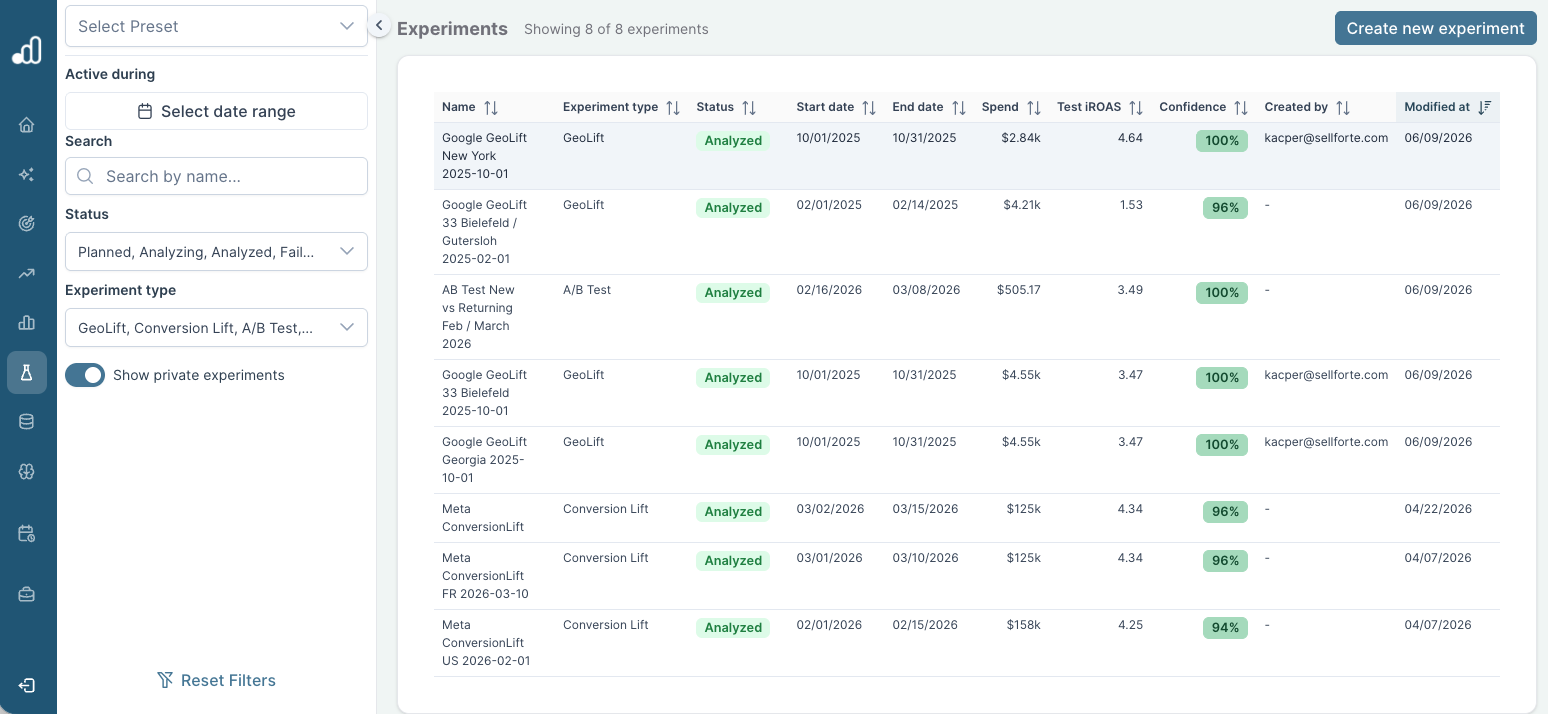
Maintain a country by channel evidence matrix alongside the experiment library. For each cell, record the current evidence tier, source market, factor or prior range, test date, campaign objective, KPI, spend coverage, and confidence.
Refresh the matrix when a new experiment arrives or when channel conditions change. A borrowed factor can become less relevant after a major platform change, new optimization objective, different audience strategy, or structural shift in local media costs.
Use the same matrix to plan tests. High spend, low confidence, and a realistic chance that better evidence would change the budget decision make a strong testing candidate. Once a credible local test improves the cell, its priority falls and the roadmap moves to the next important uncertainty.
Related questions
Can we copy incremental ROAS from one country to another?
No. Incremental ROAS includes local revenue and media economics, so copying it assumes the countries have the same value per sale, media cost, spend response, and demand context. Transfer a defensible relationship or prior, then let the destination country's data determine its return.
What should we do when country-level experiments disagree?
Check the campaign mapping, objective, KPI, test dates, spend range, confidence interval, and market conditions before combining the results. If the disagreement remains, retain separate estimates or use a wider pooled prior. The conflict is evidence that a local test may be valuable.
How should several cross-country tests be weighted?
Weight them by market and channel relevance, recency, statistical confidence, and spend. A precise test from a comparable market should usually influence the prior more than a weak test from a structurally different one. See How should we weight multiple incrementality tests when calibrating an MMM?.
Why can the local MMM still differ from the borrowed experiment?
The experiment measured one setup in one country, while the MMM uses local history, spend, response curves, demand drivers, and other evidence. A difference is not automatically an error, but it should be explainable through the mapping, prior, KPI, and uncertainty. See Why can a calibrated MMM show a different incremental ROAS than a conversion-lift study?.
How Sellforte helps
Sellforte connects incrementality tests, country by channel evidence, calibration priors, and MMM results in one auditable workflow. Teams can see what was measured locally, what was borrowed, how strongly it influenced the model, and which experiment would most improve the next budget decision. Book a demo.
Authors

Lauri Potka is the Chief Operating Officer at Sellforte and has over 15 years of experience in Marketing Mix Modeling, marketing measurement, and media spend optimization. Before joining Sellforte, he worked as a management consultant at the Boston Consulting Group, advising some of the world's largest advertisers on data-driven marketing optimization. Follow Lauri on LinkedIn, where he is one of the leading voices in MMM and marketing measurement.

Why can a calibrated MMM show a different incremental ROAS than a conversion-lift study?

How should we weight multiple incrementality tests when calibrating an MMM?