


The short answer
Yes. A properly powered Meta Conversion Lift test is credible causal evidence for the audience, campaigns, conversion definition, and period it measured. Its randomized holdout design is sound, but advertisers cannot independently audit assignment. Check setup and uncertainty, repeat tests, and validate the program with occasional matched geo-lift studies before using results to calibrate MMM.
Here's a summary video from Sellforte CEO, Juha Nuutinen:
This article is part of Asked by Marketers, a series answering real questions from marketing leaders.
Sellforte's team holds more than 1,450 meetings each year with marketing leaders in Ecommerce and Retail about Marketing Mix Modeling and incrementality testing. Each week, we anonymize at least one question from those conversations and answer it in depth, based on what marketers are actually struggling with, not what keyword tools suggest. About the series →
Why are marketers asking if they can trust Meta Conversion Lift tests?
There's three primary reasons that why marketers are asking if they can trust Meta Conversion Lift tests.
Conflicting incentives. Meta sits on both sides of the table. It sells the advertising and runs the experiment that measures whether the advertising worked.
Limited transparency. The advertiser does not choose who enters the test and control groups, and the standard output does not let an outside analyst reproduce the assignment. Even when the design is randomized, that lack of visibility can make the result feel like a black box. Platforms tests have also been criticized for divergent delivery.
Narratives popularized by Incrementality testing vendors. Vendors that sell geo-lift or other independent incrementality testing products have an incentive to spread narratives that make advertisers distrust platform studies.
What does a Meta Conversion Lift test actually prove?
A Meta Conversion Lift test estimates the causal effect of the included campaigns on a defined conversion outcome for the eligible audience during the study period. It does this by randomly assigning eligible people to treatment and control, then comparing conversion rates after accounting for the different group sizes.
That is fundamentally stronger than comparing people who happened to see an ad with people who did not. Exposure is affected by the auction, campaign optimization, user behavior, and advertiser targeting. Random eligibility protects the causal comparison even though not every person assigned to treatment will actually receive an impression. In experimental terms, the result is an intent-to-treat estimate.
The scope of the conclusion is narrower than many dashboard conversations suggest:
| The test supports a causal conclusion about | The test does not establish by itself |
|---|---|
| The eligible audience and included campaigns | Meta's effect on people or campaigns outside the test |
| The chosen Pixel, CAPI, app, or offline conversion definition | Total net omnichannel sales when those outcomes were not supplied |
| The tested dates, spend level, and campaign setup | The same return at every future spend level or campaign mix |
| Conversions observed within the study's measurement window | Every delayed or cross-channel effect beyond that window |
A credible test can still answer a narrower question than the marketer cares about. That is a scope problem, not evidence that the randomization failed.
Sellforte experience: Why are Meta Conversion Lift results credible?
Our strongest real-world check is what happens when a different method measures similar activity. Across Sellforte customers, we have compared Meta Conversion Lift results with geo-lift results. We have not seen a systematic pattern in which the Meta result is always higher. The methods tend to tell the same broad story once campaign scope, KPI, dates, and uncertainty are aligned.
The second real-world check are bad results. We have seen Meta Conversion Lift tests fail, in terms of producing weak and statistically inconclusive results, but also in terms of revealing low incrementality ratios for some Meta channels for some customers.
These two combined significantly dilute the theory that Meta simply suppresses unfavorable results.
What can still go wrong in a Meta Conversion Lift test?
Sound randomization cannot repair a bad outcome definition, weak statistical power, or faulty implementation. In practice, many failures happen around the experiment rather than in the causal logic.
Start with tracking. Pixel, CAPI, app, and offline events can be incomplete, duplicated, delayed, or mapped to the wrong revenue definition. Returns, taxes, currency conversion, deduplication, and cross-device matching can all create a gap between platform-observed revenue and the KPI used by finance or MMM. A randomized test can estimate the causal effect on a badly defined event with perfect internal validity.
Statistical power needs a separate check. Low conversion volume, low reach, small holdouts, or too many test cells can leave the estimate with a wide interval. Meta's published methodology shows that multi-cell comparisons require materially larger samples than a single treatment-versus-control study. A positive point estimate with a wide interval is not a confident positive result, and a non-significant result is not proof of zero incrementality.
Campaign mapping and timing create another set of problems. The study may include the wrong campaigns, combine objectives that behave differently, overlap with another experiment, or run during an unusual promotion. Post-test conversions may also arrive after the primary reporting window. These issues change what the estimate represents even if assignment remains random.
Software can fail as well. Meta disclosed a conversion-lift reporting issue in 2020 that had affected some studies for about a year by undercounting reached conversions. The incident does not discredit randomized experiments, but it does show why no platform measurement system should be treated as infallible.
Finally, one lift study observes one part of a response curve. It does not tell you what would happen if spend doubled, halved, or shifted to a different audience. Extrapolation requires other tests, model structure, or both.
How should you validate Meta Conversion Lift in practice?
Trust should come from a measurement process, not from one attractive point estimate. Use the following checks before a result influences a major budget decision or MMM calibration.
- Define the decision before the test. Record the campaigns, eligible audience, primary outcome, dates, expected effect, holdout design, and the decision the result will inform.
- Audit the conversion data. Reconcile Pixel, CAPI, app, or offline events with backend totals. Check deduplication, returns, taxes, currency, conversion windows, and the sales channels included.
- Read the full uncertainty interval. Keep the point estimate, interval, confidence level, spend, and conversion count together. Do not turn a noisy estimate into an exact channel rule.
- Repeat the test under different conditions. Build evidence across normal and promotional periods, spend levels, campaign objectives, and audiences. Preserve weak and unfavorable results instead of selecting only the tests that support the current plan.
- Run a matched geo-lift validation. Use the same campaigns, dates, business KPI, and effect window as far as the designs allow. Compare the direction and uncertainty ranges rather than demanding identical point estimates.
- Investigate disagreement. Check scope and KPI first, followed by tracking, power, spillover, campaign mapping, and concurrent changes. If the disagreement remains, keep wider uncertainty and design the next test around the unresolved cause.
One or two geo-lift studies can reveal whether a Conversion Lift program appears systematically optimistic for a particular advertiser. They cannot certify every past and future Meta test. Validation becomes stronger as comparable pairs accumulate and the distribution of differences remains visible.
Geo-lift is not a perfect referee. Geographic tests have their own problems with spillover, regional comparability, minimum detectable effects, and concurrent local changes. The useful question is whether two different designs, with different weaknesses, support a coherent conclusion.
How should Meta Conversion Lift tests be used for MMM calibration?
Use each test as scoped causal evidence for the Marketing Mix Model feature it actually measured. Map the result to the market, campaigns, objective, dates, spend, KPI, and sales channels before it enters the model. A study of Meta sales campaigns should not silently become a precise prior for all paid social.
When seasonal demand makes a test-period iROAS hard to transfer directly, calculate an incrementality factor for the matched scope:
incrementality factor = experiment iROAS / attributed ROAS for the same campaigns and dates
The factor estimates how much of the attributed result was incremental in that test. It can then adjust a compatible attributed signal used to form the MMM prior. The experiment's interval should become uncertainty around the prior, not disappear when the factor is calculated.
Several relevant studies should inform a distribution rather than compete for the title of "correct result." Weight them by scope match, recency, spend, statistical precision, and execution quality. Keep valid disagreements visible. A calibrated MMM should be coherent with the evidence library as a whole, not forced to copy the latest study's point estimate.
A matched geo-lift result can then serve as a broader validation or constraint, especially when it measures the exact business KPI used by MMM. When both experiments cover the same intervention, do not count them as two fully independent observations. The detailed integration approach is covered in How should geo-lift and conversion-lift studies be combined when calibrating MMM?.
What do Meta Conversion Lift tests look like in practice?
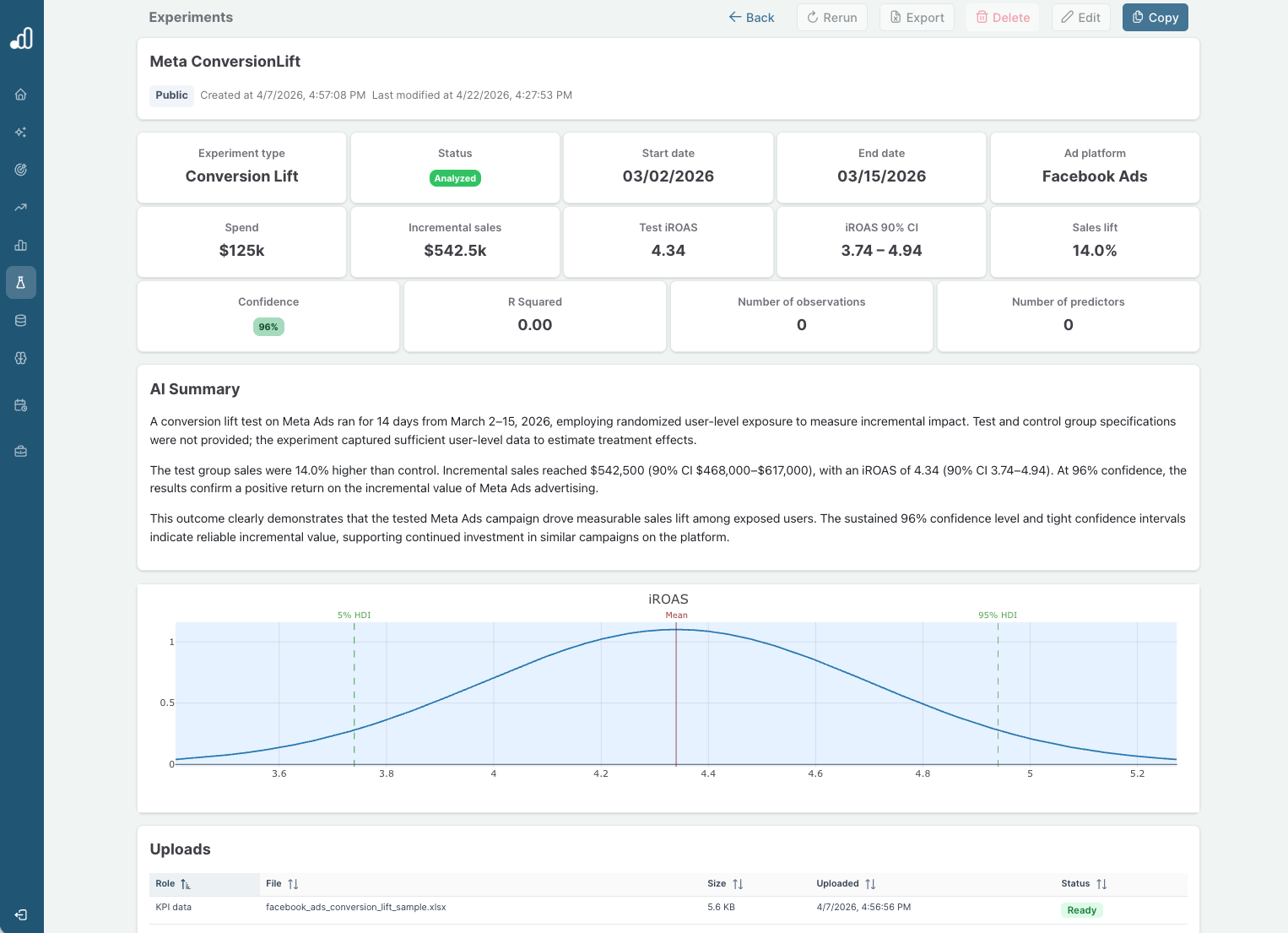
Meta Conversion Lift tests can be automatically ingested from Meta to a Marketing Mix Modeling or incrementality testing tool. A typical report shows dates, spend, iROAS, Confidence interval and other statistics.
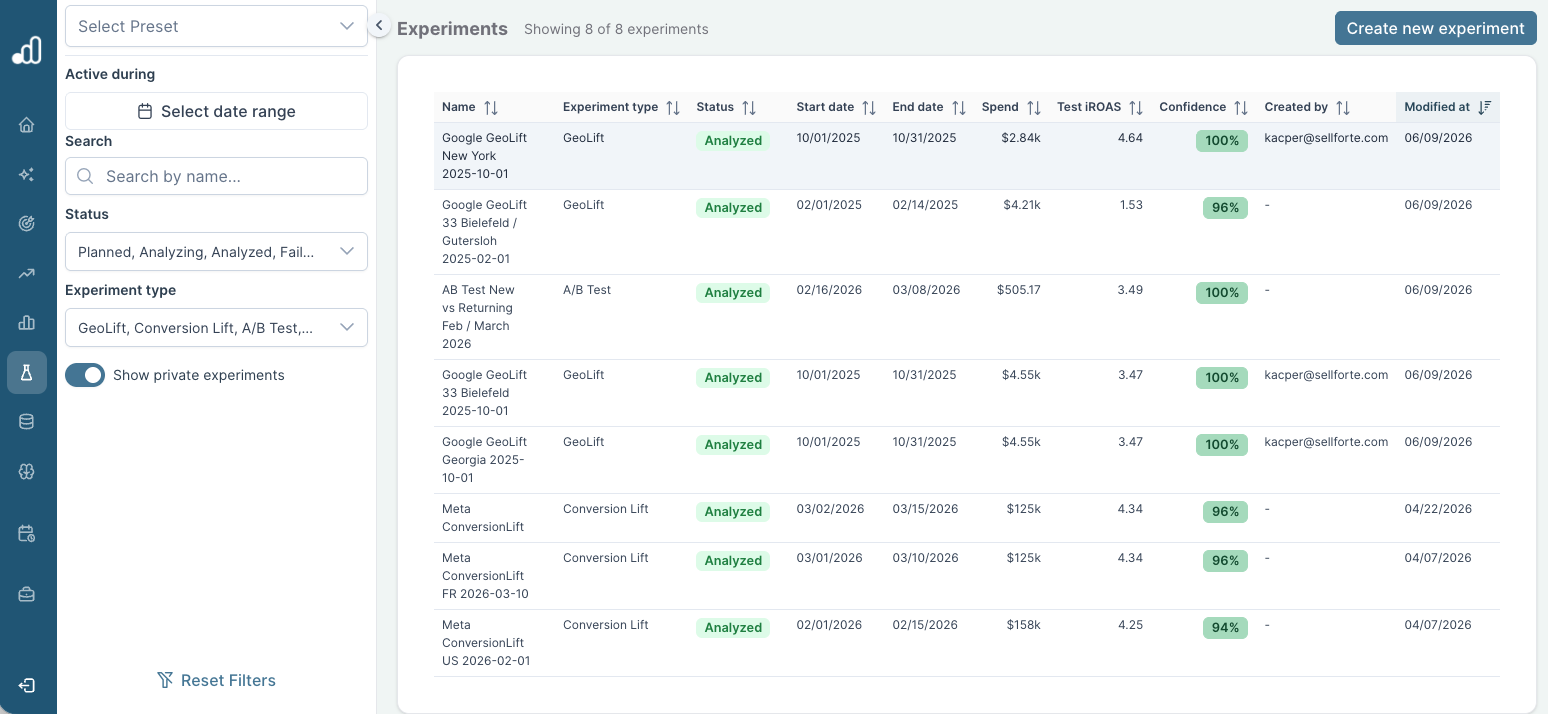
Experiment library collects all Incrementality tests, including Conversion Lift tests and Geo tests into a single view with filters.
Related questions
Does a high Meta ROAS mean its Conversion Lift test is biased?
No. Platform-attributed ROAS and randomized incremental ROAS use different comparisons. Attribution can credit conversions that would have happened anyway, while Conversion Lift compares randomized groups. See Why do platform-reported ROAS and incremental ROAS tell such different stories?.
Is geo-lift more trustworthy than Meta Conversion Lift?
Not automatically. Geo-lift offers greater independence from platform assignment and can use a business-level KPI, but it can suffer from low power, spillover, and poor regional matches. The better evidence is the well-executed study that matches the decision, with uncertainty retained.
Can one geo test validate Meta Conversion Lift?
One well-matched geo study is a useful check, especially when it covers the same campaigns, dates, spend, and KPI. It cannot validate every historical or future Meta study. Repeated matched comparisons provide stronger evidence about whether either method is systematically higher.
Can one Meta Conversion Lift test calibrate all paid social?
Usually not. Apply the result to the campaigns, objectives, market, KPI, and spend range it measured. Broader use requires an explicit pooling assumption and wider uncertainty. See Why can a calibrated MMM show a different incremental ROAS than a conversion-lift study?.
How Sellforte helps
Sellforte brings Meta Conversion Lift, geo-lift, and other experimental evidence into one library and connects each result to the MMM features it can inform. Teams can inspect scope, uncertainty, exclusions, and agreement across methods before using calibrated results for budget decisions. Book a demo.
Authors

Lauri Potka is the Chief Operating Officer at Sellforte and has over 15 years of experience in Marketing Mix Modeling, marketing measurement, and media spend optimization. Before joining Sellforte, he worked as a management consultant at the Boston Consulting Group, advising some of the world's largest advertisers on data-driven marketing optimization. Follow Lauri on LinkedIn, where he is one of the leading voices in MMM and marketing measurement.

Why can a calibrated MMM show a different incremental ROAS than a conversion-lift study?

What is the best incrementality test?