


The short answer
Use all three as one connected system. Incrementality tests provide causal ground truth for a channel at a defined point in time and calibrate MMM. MMM integrates tests, attribution, offline sales, and untestable channels into the primary business-wide planning view of media's incremental sales impact. MTA supplies MMM with granular data for campaign and ad-set optimization.
This article is part of Asked by Marketers, a series answering real questions from marketing leaders.
Sellforte's team holds more than 1,450 meetings each year with marketing leaders in Ecommerce and Retail about Marketing Mix Modeling and incrementality testing. Each week, we anonymize at least one question from those conversations and answer it in depth, based on what marketers are actually struggling with, not what keyword tools suggest. About the series →
Why do marketers ask this?
Measurement tools are too often bought one at a time. The ecommerce team has web analytics and platform reporting. Performance marketing may have an MTA model. The insights team runs MMM. Individual channels occasionally provide conversion-lift studies, while the analytics team designs geo tests when a bigger decision needs causal evidence.
When these methods operate separately, they can give three different answers for the same channel. An attribution model may report a ROAS of 10, an MMM may estimate 3, and an experiment may find 5. The problem is not that the retailer has too many methods. The problem is that the evidence has not been connected.
That distinction becomes unavoidable in omnichannel retail. A customer may research online and buy in a store. Loyalty and first-party data can connect some of that journey, but many ad exposures and store visits remain unlinked. The retailer still has to set an annual budget, decide whether a channel is incremental, and adjust individual campaigns this week.
So the retailer should not ask which method wins. Incrementality testing, MMM, and MTA have different jobs in the same system: find causal truth, integrate it across the business, and turn it into campaign-level action.
When should an omnichannel retailer use incrementality testing?
Use incrementality testing to establish causal iROAS for a defined channel, market, setup, KPI, and period. Its main role in the measurement system is to give MMM a ground-truth calibration point. Tests are especially valuable when existing measurement is uncertain, a large budget decision is approaching, or a platform-reported result looks too good or too weak to trust.
There are three main test types:
- Conversion-lift tests are specific to an ad platform. They split users into exposed and control groups to measure iROAS.
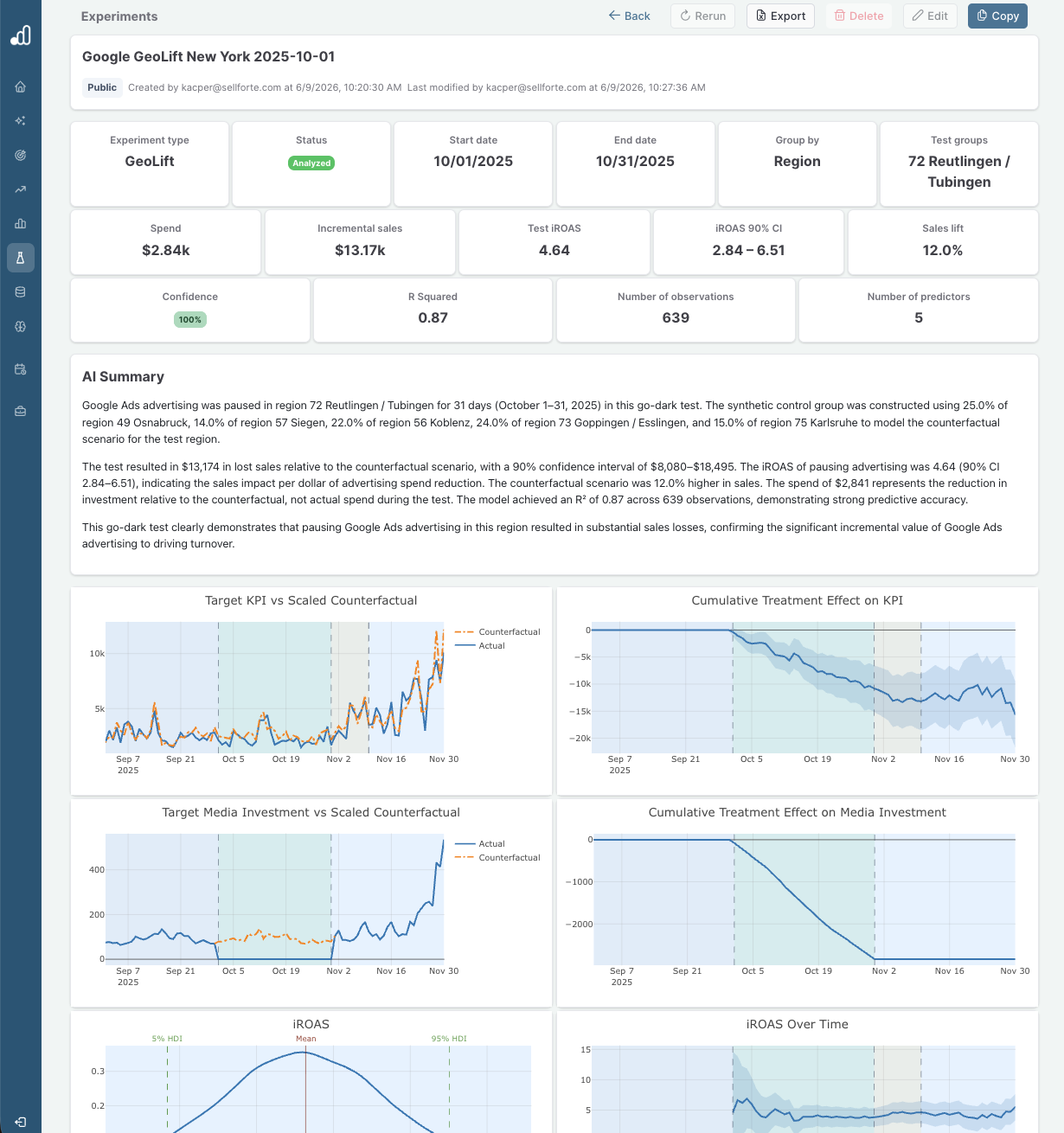
- Geo-lift tests work when spend can be changed across comparable regions and total sales can be measured consistently. For a retailer, this can include ecommerce and store sales.
- Customer or audience holdouts work for addressable activity such as email, direct mail, loyalty offers, or other owned channels.
Experiments have limits. A test answers a specific question about a particular setup, period, market, audience, and outcome. Its iROAS is ground truth for that scope and point in time, with the uncertainty reported by the test. It does not automatically tell you the return in every country or the best allocation across the entire media plan. Small channels may not create enough signal, and testing every channel in every market each year is neither practical nor necessary.
That is why each experiment should become a reusable calibration input. Store the result with its scope, confidence interval, dates, spend level, and post-treatment window. Feed it into MMM, map it to the model feature it actually measured, and update the calibration when later tests provide new evidence.
The experiment view below shows a typical output from an incrementality test.
When should an omnichannel retailer use MMM?
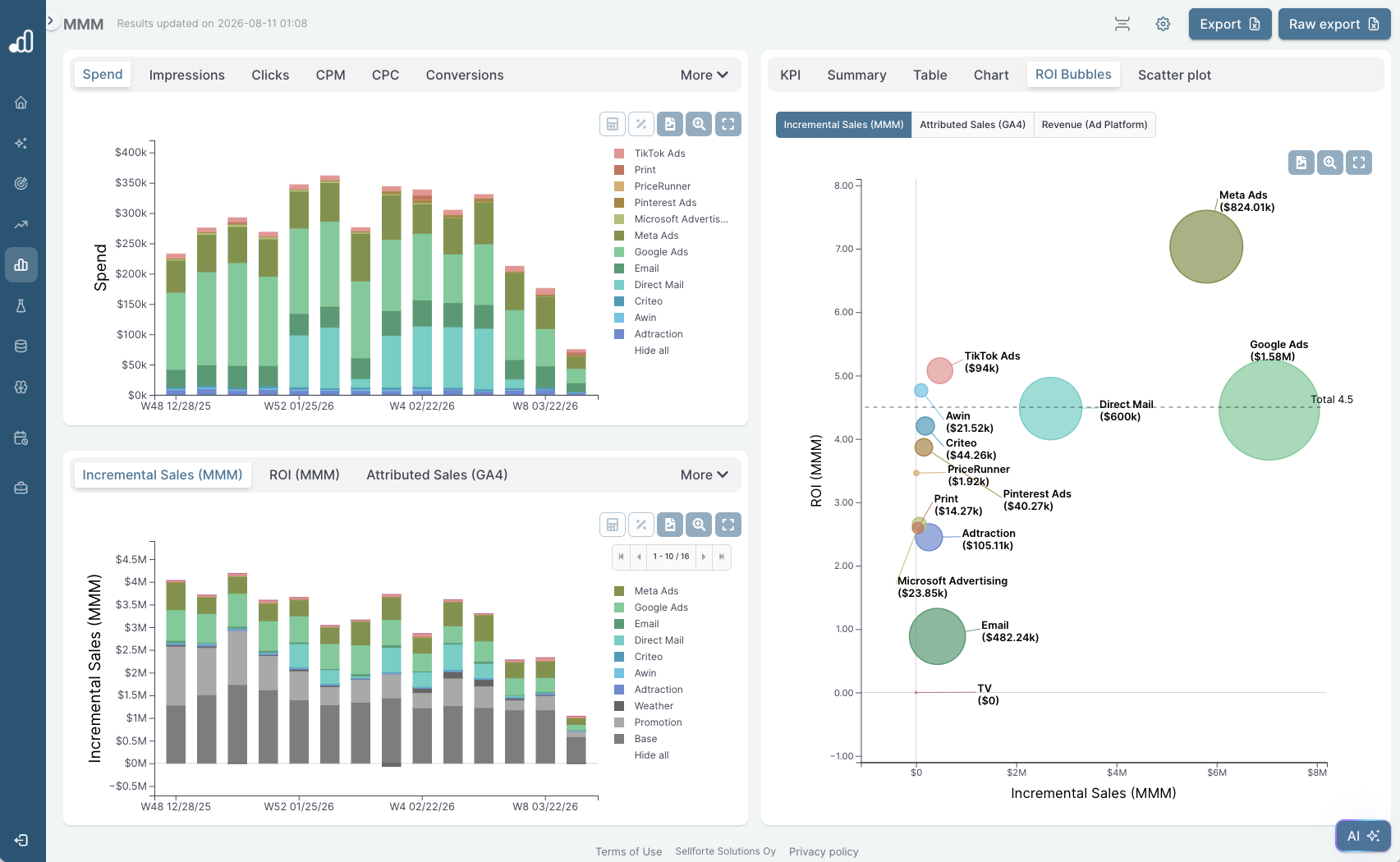
Use Marketing Mix Modeling as the integration layer and primary cross-channel planning view. MMM combines incrementality tests, attribution data, historical spend and outcomes, and other business drivers. It estimates iROAS across the full media plan, including markets and channels that cannot be tested directly.
For an omnichannel retailer, the outcome variable matters as much as the method. If digital advertising can influence both ecommerce and physical-store sales, a model trained only on online revenue answers a smaller question. Model the relevant sales channels separately, then combine them for the budget decision. The same principle applies to categories, customer types, and private-label brands when the data and decision justify the split.
MMM also separates media from other forces that move retail sales, including promotions, pricing, weather, holidays, store footprint, assortment, and underlying demand. An MTA path cannot reliably make those distinctions because most of those factors do not appear as touchpoints. MMM can then estimate both average iROAS and the marginal return on the next euro, which is the number a budget optimizer needs.
A Bayesian MMM can use incrementality results as informative priors. Where a strong experiment exists, the model should align with that evidence within the scope and uncertainty the test measured. Where no test exists, the model can use historical variation, attribution data, and cautious evidence from comparable markets while keeping the uncertainty visible.
MMM still does not remove the need for judgment. The model is only useful if the inputs match the commercial decision and the team can trace how the result was produced.
The MMM dashboard below covers spend, sales decomposition, and iROAS analyses.
When should an omnichannel retailer use MTA?
Use Multi-Touch Attribution and other attribution models as granular data sources and execution layers for MMM. Attribution supplies campaign, ad-set, keyword, creative, and audience-level signals that a channel-level MMM may not contain. MMM then sends calibrated incrementality factors back to that detail for daily optimization.
This two-way flow makes MTA useful for daily steering. A performance marketer deciding which of ten Google Performance Max campaigns should receive the next budget increase needs more detail than a channel recommendation. Attribution shows where conversions are appearing. The MMM calibration corrects the value of those conversions before the team changes budgets, bids, or target ROAS.
MTA should not be mistaken for a causal measurement system. It allocates credit among recorded touchpoints, but it cannot directly observe what would have happened without the advertising. Branded search, retargeting, and other lower-funnel activity can receive credit for demand that already existed. Upper-funnel activity can be missed when it creates no trackable click. For more background, see Why Attribution Alone Falls Short for Ecommerce Marketing Measurement.
The omnichannel limitation is larger. Even with strong first-party data, a retailer rarely observes every exposure and every store visit. MTA remains valuable because it gives MMM and performance teams granular digital evidence. It should not be treated as an independent source of incremental truth or as the basis for cross-channel or online-versus-store budget decisions.
The performance recommendations below show how MMM and attribution together can support campaign- and ad-set-level bidding decisions.

How should MMM, MTA, and incrementality testing work together?
Connect the methods in one continuous measurement loop. Experiments find causal truth. MMM integrates that truth with attribution and the rest of the business. Attribution executes the calibrated insight at scale.
A practical operating cycle looks like this:
- Find causal truth with experiments. Test a valuable uncertainty and estimate iROAS for the channel, market, KPI, and period the experiment covers.
- Integrate the evidence in MMM. Feed the experiment and granular attribution data into MMM. Use the test to calibrate the relevant model feature, then estimate iROAS and marginal returns for the full business, including offline outcomes and untested channels.
- Execute through attribution. Translate the MMM result into campaign-level calibration factors and apply them to MTA, GA4, or platform data. Use the calibrated values to change budgets, bids, and targets.
- Monitor and repeat. Check whether those changes produce the forecast outcome. Keep what works, revert what does not, and use new tests to refresh the next MMM calibration.
This setup gives each number a defined job. Finance and marketing plan from the same integrated MMM view. Analytics can see the calibration evidence and uncertainty. Performance teams retain the campaign detail they need without treating raw attribution as incremental truth.
How does this align with Google's modern measurement playbook?
The approach described in this article is aligned with Google's modern measurement approach. Google recommends using incrementality experiments, MMM, and attribution together so each method improves the others instead of operating in separate silos.
In Google's framework, experiments calibrate and validate MMM and inform how attributed values are used. Attribution provides fast, granular signals for optimization and MMM deep dives. MMM adds cross-channel planning insight and can calibrate attribution outputs. The Google Modern Measurement Playbook presents this as a continuous learning loop.

Google also makes an important distinction: the goal is not to force the three methods to produce one universal answer. Each method has a different scope and strength. The aligned operating model is scoped authority: experiments for causal truth within the tested scope, MMM as the primary cross-channel planning and integration view, and attribution for day-to-day execution.
How did bonprix put this into practice?
bonprix's measurement transformation shows how the connected system works in a complex ecommerce business. In the Sellforte webinar, Anika Kreißl, Teamlead Display, Retargeting & Affiliate at bonprix, described a strong in-house attribution model that worked well for lower-funnel optimization. But it could not show the true value of mid- and upper-funnel activity or answer whether the next euro should go to lower-funnel marketing in Germany or upper-funnel marketing in France. That decision had to be made across 16 markets.
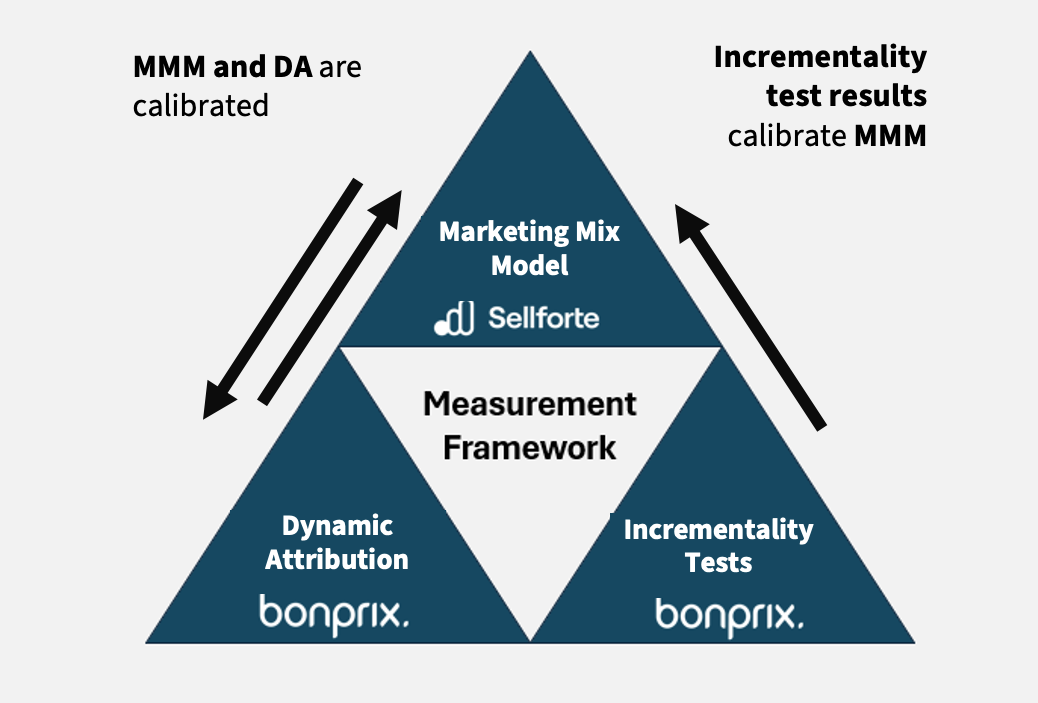
bonprix kept its attribution model and added MMM as the full-funnel integration and planning layer. Attribution data enters the MMM, incrementality test results calibrate the MMM, and MMM calibration factors flow back into dynamic attribution.
For Anika, the operational test was simple: "The best model is useless if it doesn't change decisions." bonprix is embedding the results into planning, budgeting, steering, and reporting. It is also calibrating dynamic attribution with Sellforte factors, which changes daily campaign steering and budget shifting across departments. Every new incrementality test is fed back into the MMM. In the webinar, Anika illustrated bonprix's measurement framework as follows:
The organizational setup matters as much as the model. bonprix made measurement a senior business priority, aligned the work with Finance, and brought data science, data engineering, IT, customer and sales teams, and marketing operations into one cross-functional project. The team started with an MVP at 90% certainty, aligned it with the board, and iterated instead of waiting for perfection.
Related questions
Can MTA measure offline store sales?
Typically not, although it is possible in some cases. MTA can include store purchases when reliable customer identifiers connect an ad interaction to a transaction. That linkage will still be incomplete for many retailers and does not by itself establish causality. Use the matched data as useful journey evidence, then validate total store impact with geo tests or MMM.
Why should an omnichannel retailer not rely on MMM alone?
MMM can be the primary business-wide planning view, but it may not provide the campaign, ad-set, keyword, or creative detail needed for daily execution. Granular attribution supplies that detail and helps performance teams act on the model's direction. Experiments are still needed to calibrate MMM with causal evidence at defined points in time.
Should incrementality tests replace MMM?
No. Tests provide ground-truth iROAS for the setup and period they measure, but a retailer cannot test every channel, market, and period. MMM integrates those results with attribution and historical business data, estimates the untested parts of the plan, and creates one view for decisions across the whole business.
How should a retailer calibrate its MTA?
Compare attributed ROAS with the iROAS from the calibrated MMM at the most decision-useful level supported by the data. Divide MMM iROAS by attributed ROAS to calculate a correction factor for campaign-level attribution. The factor should reflect the channel, market, campaign objective, KPI, and period covered by the evidence. Pool sparse areas conservatively rather than creating precise-looking factors from weak tests.
How Sellforte helps
Sellforte connects Marketing Mix Modeling, incrementality experiments, and existing attribution sources in one measurement workflow. Retailers can include ecommerce and store sales, calibrate models with causal evidence, compare attributed and incremental results, and translate channel insights into campaign-level recommendations. Book a demo.
Authors

Lauri Potka is the Chief Operating Officer at Sellforte and has over 15 years of experience in Marketing Mix Modeling, marketing measurement, and media spend optimization. Before joining Sellforte, he worked as a management consultant at the Boston Consulting Group, advising some of the world's largest advertisers on data-driven marketing optimization. Follow Lauri on LinkedIn, where he is one of the leading voices in MMM and marketing measurement.

Is attribution enough on its own? Why MMM and incrementality testing are required

What changes when an ecommerce or retail company adopts incrementality?