

The short answer
Platform ROAS credits sales observed after an ad interaction, while incremental ROAS estimates sales that would not have happened without the advertising. The gap is expected because the two metrics use different counterfactuals, attribution windows, conversion scopes, and time horizons. Use platform ROAS to steer activity within a platform, and incremental ROAS to compare investments and set budgets.
This article is part of Asked by Marketers, a series answering real questions from marketing leaders.
Sellforte's team holds more than 1,450 meetings each year with marketing leaders in Ecommerce and Retail about Marketing Mix Modeling and incrementality testing. Each week, we anonymize at least one question from those conversations and answer it in depth, based on what marketers are actually struggling with, not what keyword tools suggest. About the series →
Why do marketers ask this?
The disagreement becomes visible as soon as a marketing team puts its reports on one screen. A platform may show a strong return, web analytics may credit far less revenue to the same activity, and a conversion-lift study or calibrated MMM may land somewhere else entirely. The gap can be large enough to reverse the channel ranking.
That creates an awkward stakeholder discussion. Performance teams have made thousands of decisions using the platform number. Finance wants a return that can be compared across channels. Analytics knows that neither a click path nor a platform pixel reveals what customers would have done without the advertising.
The useful response is not to choose the highest or lowest number. First identify the question behind each metric. Platform ROAS describes conversions that the platform can associate with ads. Incremental ROAS estimates the additional outcome caused by the investment. Once those roles are explicit, disagreement becomes diagnostic evidence rather than a reporting failure.
What does platform ROAS actually measure?
Platform ROAS measures conversion value that an ad platform attributes to its advertising, divided by spend on that platform. The platform applies its own identity matching, attribution window, click and view rules, and conversion definitions. The result is designed to help its delivery system and advertisers compare activity inside the platform.
That makes platform ROAS useful for questions such as which ad set, audience, keyword, or creative is producing more attributed value under the same measurement rules. It is granular, updates quickly, and stays close to the controls a performance team can change.
It does not establish that the advertising caused every credited sale. A customer may have bought anyway. Branded search can capture demand created elsewhere. Retargeting reaches people who already visited the site. Two platforms can each claim the same purchase after appearing in the same journey. Those are expected properties of attribution, not evidence that the platform report is fabricated.
What does incremental ROAS measure instead?
Incremental ROAS (iROAS) estimates the additional sales caused by advertising, divided by advertising spend.
It asks a causal question: how much of the observed sales would not have happened without the media? Sales expected without the advertising are excluded.
Why can the gap point in either direction?
Platform ROAS is often higher than incremental ROAS for lower-funnel activity. Platform attribution can credit conversions from people who already had high purchase intent, include view-through or long lookback windows, and overlap with credit claimed by other channels. Incremental measurement removes the demand expected without the advertising, so the remaining return can be much lower.
The reverse can also happen. A platform may miss store sales, cross-device behavior, delayed purchases outside its attribution window, or demand that appears without a trackable click. Upper-funnel video and reach campaigns are especially likely to create effects outside the path the platform can observe. In those cases, an experiment or MMM that measures the full outcome can estimate a higher incremental return than the platform reports.
Web analytics adds a third perspective. It may use stricter click-based rules and a different cross-channel attribution model, which can make its ROAS lower than both the platform and the incremental estimate. The direction of the gap therefore depends on the channel, campaign objective, KPI, market, time horizon, and measurement rules. A universal correction factor is rarely defensible.
How should marketers reconcile the numbers?
Reconcile the numbers by connecting them, not averaging them. Keep platform and web-analytics ROAS visible as attributed signals, use experiments to estimate causality where the decision matters most, and use MMM to apply that evidence across the broader media plan.
A practical review has five steps:
- Align the scope. Compare the same spend, dates, market, campaigns, KPI, returns treatment, and conversion window before interpreting the gap.
- Inspect the attribution rules. Record whether the platform includes clicks, views, modeled conversions, cross-device matching, or conversions that another platform may also claim.
- Add causal evidence. Use a conversion-lift, geo-lift, or customer-holdout test for a material uncertainty, and preserve the result's confidence interval and exact test scope.
- Calibrate at a useful level. Map the experiment to the channel, country, and campaign objective it measured. Pool sparse evidence conservatively instead of applying one platform-wide multiplier.
- Assign each metric a job. Use incremental ROAS and marginal returns for cross-channel allocation. Use calibrated platform or attribution signals for frequent decisions within a channel.
This process will not force every dashboard to show the same number. It creates a traceable explanation for why the numbers differ and a consistent rule for which one supports each decision.
How this looks in practice
Consider a hypothetical ecommerce company comparing channel performance in MMM with ad-platform reporting. In Sellforte demo data, the comparison looks like this:
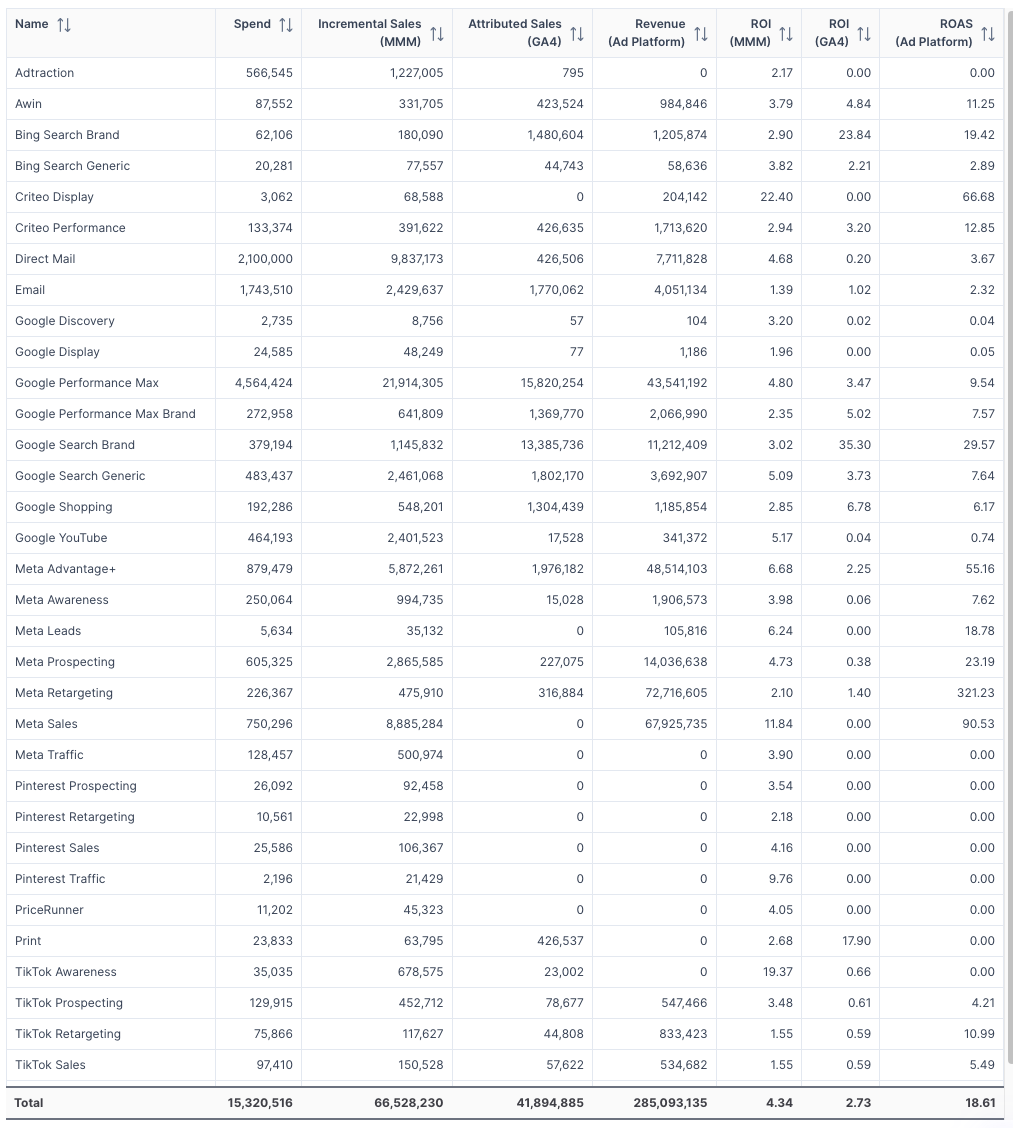
The comparison immediately changes the discussion. Google Search Brand has an ad-platform ROAS of 29.57, compared with an iROAS of 3.02 in the MMM.
Google YouTube shows the opposite pattern. The platform reports a ROAS of 0.74 because much of the response happens without a trackable conversion inside its window. The calibrated MMM includes those broader effects and estimates an incremental ROAS of 5.17. The budget decision should not penalize the campaign for conversions the platform cannot observe.
The point is not that incremental ROAS is always lower or that MMM automatically wins every disagreement. The side-by-side view reveals where attribution is likely capturing existing demand, where trackable conversions are incomplete, and where another experiment would materially improve the decision.
Related questions
Is platform ROAS wrong?
No. Platform ROAS is an attributed performance metric, and it can be useful for optimizing activity under one platform's rules. The mistake is treating it as a causal estimate or comparing it directly with another platform whose identity matching, attribution window, and conversion scope differ.
What is an incrementality factor?
An incrementality factor is a ratio used to translate an attributed result into an estimated incremental result for a defined scope. It should be based on relevant experimental or calibrated MMM evidence and retain the channel, market, objective, KPI, period, and uncertainty behind that evidence. There is no universal factor for an entire platform.
Should marketers turn off branded search when its incremental ROAS is lower?
Not automatically. The decision depends on marginal incremental return, budget constraints, auction dynamics, and what happens when spend changes. A lower incremental ROAS means attributed demand should not all be credited to the ads; it does not prove that the next dollar has no value.
How often should attributed ROAS be recalibrated?
MMM can provide an ongoing incrementality factor for each attributed ROAS source, such as the ad platform or GA4. The factor may change little from one day to the next but can move materially over weeks or months as the response pattern and evidence change.
How Sellforte helps
Sellforte places platform, web-analytics, and incremental ROAS side by side, then uses experiment-calibrated MMM to explain the difference and support budget decisions. Teams can keep granular attribution for execution while using a consistent incremental view across channels, markets, and outcomes. Book a demo.
Authors

Lauri Potka is the Chief Operating Officer at Sellforte and has over 15 years of experience in Marketing Mix Modeling, marketing measurement, and media spend optimization. Before joining Sellforte, he worked as a management consultant at the Boston Consulting Group, advising some of the world's largest advertisers on data-driven marketing optimization. Follow Lauri on LinkedIn, where he is one of the leading voices in MMM and marketing measurement.

Attribution says ROAS is 8, experiments say 4. Which should I trust?
How to Set a Target ROAS That Reflects True Incrementality