


The short answer
Adopting incrementality changes the company's decision language. Marketing stops defending credited conversions and starts discussing incremental sales, incremental ROAS, marginal returns, and confidence with finance. Budget plans become causal forecasts rather than collections of platform reports, while attribution remains in place for daily campaign execution after it has been calibrated to incremental outcomes.
Sellforte CEO and co-founder Juha Nuutinen explains the most immediate change in this short video:
This article is part of Asked by Marketers, a series answering real questions from marketing leaders.
Sellforte's team holds more than 1,450 meetings each year with marketing leaders in Ecommerce and Retail about Marketing Mix Modeling and incrementality testing. Each week, we anonymize at least one question from those conversations and answer it in depth, based on what marketers are actually struggling with, not what keyword tools suggest. About the series →
Why do marketers ask this?
Many ecommerce and retail teams already have plenty of performance data. Google, Meta, GA4, and an internal attribution model can each report revenue and ROAS by channel or campaign. The difficulty starts when those numbers enter an annual budget discussion. Several systems may claim the same sale, and none of them directly shows what would have happened without the advertising.
Finance sees the mismatch. An attribution ROAS of 15 may be useful inside a channel's own steering system, but it is hard to treat as an economic return when the company's total sales would not collapse by the amount implied if media stopped. The marketing team then spends the meeting explaining the metric instead of discussing the investment decision.
This is where incrementality testing changes the conversation. A conversion-lift study, geo-lift test, or customer holdout estimates the sales caused by a defined marketing activity by comparing it with a credible counterfactual. The result is usually less flattering than attributed revenue, but it is tied to a question finance recognizes: what would the business lose if this investment went away?
Running one test is not the same as adopting incrementality. Adoption happens when causal evidence changes the reported KPIs, budget rules, planning process, and decisions made by channel teams.
What changes in conversations with finance?
The discussion moves from defending marketing credit to evaluating an investment. Instead of saying that a platform reports a ROAS of 15, marketing can say that the best current estimate of incremental ROAS is 5, show the evidence and uncertainty behind it, and explain which budget changes follow from that number.
The smaller number can carry more weight because its meaning is clearer. An incremental ROAS of 5 says that each euro of spend caused an estimated five euros of additional revenue for the measured scope. Finance can connect that estimate to gross margin, variable costs, payback requirements, and the company's growth target. The number can enter a plan because the assumptions can be challenged and reconciled.
Credibility does not come from calling a metric incremental. Marketing still needs to state the KPI, test or model scope, time horizon, confidence interval, treatment of returns and discounts, and whether store sales or later customer value are included. A precise figure with hidden assumptions will recreate the same trust problem under a new label.
The relationship also becomes two-way. Finance defines the economic threshold and business constraints. Marketing supplies a causal estimate of what different investments produce. The useful question is no longer, "Whose ROAS is correct?" It is, "Which feasible plan produces the best incremental sales or profit at the return we require?"
What changes in marketing reporting?
The company stops asking one ROAS figure to do every job. Attribution, average incremental ROAS, and marginal incremental ROAS answer different questions.
The reporting hierarchy changes with those jobs. The executive view leads with incremental sales, iROAS, profit contribution where available, and uncertainty. Channel teams can retain campaign and ad-set detail, but the attributed figures are calibrated so that their total is consistent with causal evidence. The performance team does not have to give up the detail it needs just because finance needs a defensible total.
Marketing Mix Modeling is often the integration layer. Experiments provide strong evidence for selected channels, markets, and periods. MMM combines those results with sales, spend, promotions, seasonality, pricing, and other demand drivers to estimate a comparable incremental view across the wider plan. Attribution then carries the calibrated direction back to daily execution.
This division of labor is also the basis of Google's modern measurement playbook, which combines incrementality experiments, MMM, and attribution instead of treating any one method as the complete answer.
What changes in budget decisions?
Budget allocation becomes a forward-looking comparison of incremental opportunities. A high attributed ROAS is no longer enough to justify more spend, and a low attributed ROAS is no longer enough to cut a channel. The team asks what additional sales or profit the next budget change is expected to cause.
This often changes the apparent ranking of channels. Branded search and retargeting may lose some of the credit they received for existing demand. Paid social prospecting, video, TV, radio, out of home, or print may gain value when their effect on later ecommerce and store sales becomes visible. That does not guarantee that upper-funnel activity wins. It means every investment is compared on a more consistent causal basis.
Advertising response curves add the next step. Average iROAS describes what the existing investment produced. A response curve estimates how incremental sales change as spend moves, making saturation and marginal return visible. This is what allows the team to forecast a reallocation, a budget increase, or a cut before changing the plan.
The plan also becomes easier to audit. Each recommendation should connect to a current spend level, a marginal return estimate, a financial threshold, and explicit constraints such as minimum market presence, peak trading weeks, commitments, or new-customer targets. Finance can disagree with an assumption without rejecting the whole measurement system.
What changes in the marketing team's operating rhythm?
Incrementality becomes a learning system rather than a sequence of isolated studies. Teams keep a record of every experiment, including its campaigns, market, dates, KPI, spend level, result, and uncertainty. Tests are prioritized where the spend is material and the current evidence could change a decision.
In practice, the work settles into a recurring five-step cycle:
- Measure the important uncertainty. Run a lift study or use a strong natural experiment where the current estimate is weak or disputed.
- Update the common view. Calibrate MMM and reporting with the result at the level the test actually measured.
- Plan the decision. Compare feasible budget scenarios using marginal incremental returns and agreed financial constraints.
- Execute with granular signals. Translate the channel direction into campaign budgets, bids, and target ROAS settings.
- Check what happened. Compare the realized outcome with the forecast and use the learning in the next cycle.
Ownership becomes clearer as well. Analytics maintains the evidence and its limitations. Marketing decides where to act. Finance defines the economic hurdle and validates the connection to the plan. Channel owners execute and report whether the intended changes were made. Without those roles, an iROAS dashboard can become one more report that nobody uses.
How this looks in practice
Consider an illustrative ecommerce team reviewing two channels. The platform view says Google Search Brand is the obvious winner, while YouTube appears unprofitable. The experiment-calibrated view reverses that ranking.
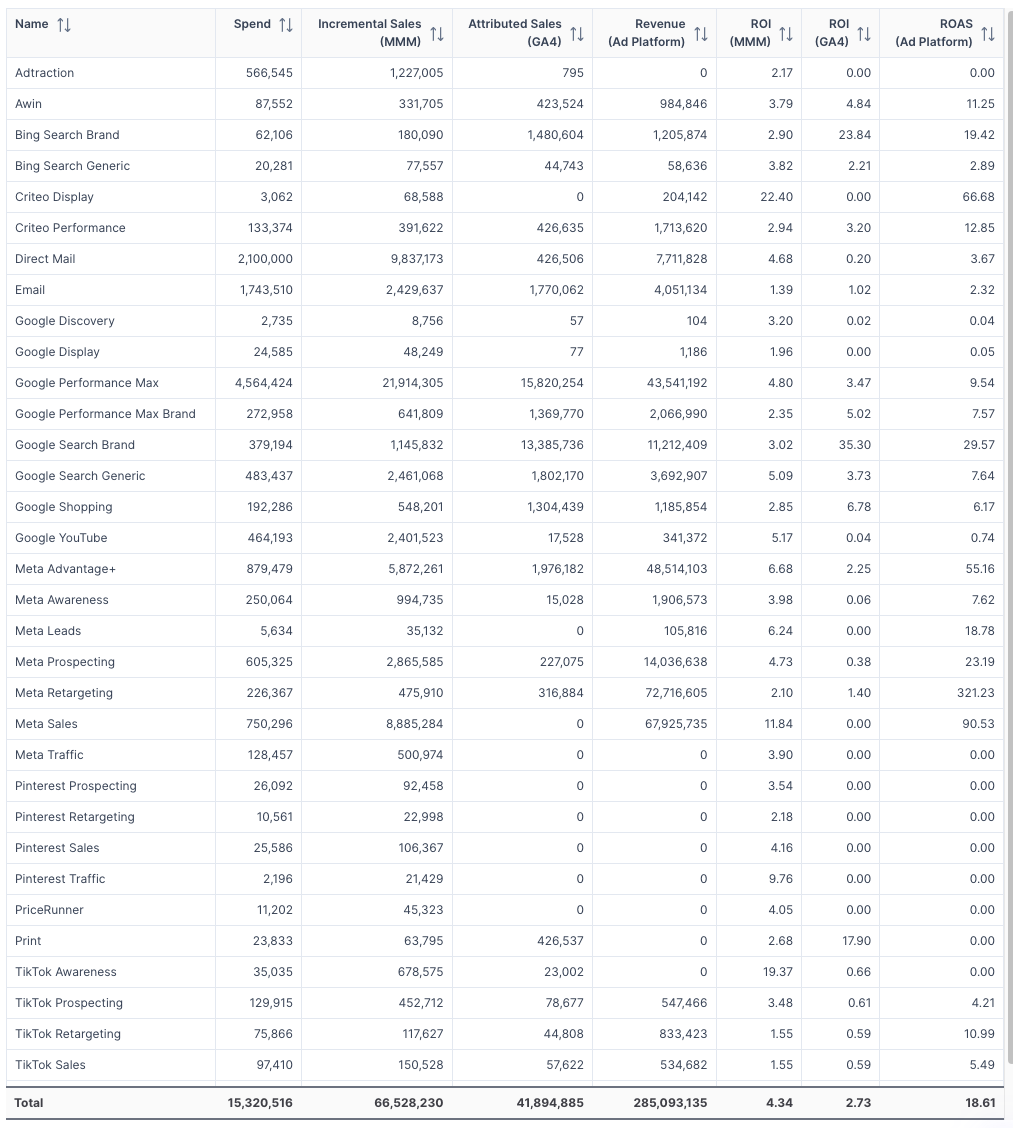
The adoption change is not simply replacing 29.57 with 3.02 in a dashboard. The team uses the calibrated iROAS to establish a credible historical view, then uses marginal return to decide how much each channel can absorb. The budget recommendation may reduce brand search, increase YouTube, or leave both unchanged, depending on their current spend, response curves, uncertainty, and business constraints.
bonprix has described this operating model publicly. The company connected incrementality tests, MMM, and its existing dynamic attribution system across 16 markets. Experiments establish causal evidence, MMM extends it across the plan, and calibration factors flow back into daily bidding. Finance, marketing, and the execution systems work from the same economic view without discarding the attribution infrastructure already in place.
Related questions
Does adopting incrementality mean replacing attribution?
No. Attribution remains useful a granular data source on the campaign and ad-set level. The change is that attribution no longer defines causal truth by itself; experiments and MMM calibrate it to a comparable incremental outcome. See when an omnichannel retailer should use MMM, MTA, or incrementality testing.
Why is incremental ROAS often lower than platform ROAS?
Platform attribution can credit sales from customers who would have purchased anyway, and several platforms can claim the same conversion. Incremental ROAS removes the counterfactual sales expected without the advertising. The gap can also run in the other direction when a channel creates demand that the platform cannot observe. See Why do platform ROAS and incremental ROAS tell such different stories?.
Should finance use average iROAS for every budget decision?
No. Average iROAS is useful for evaluating the return produced by an existing investment, but a budget change happens at the margin. Use marginal iROAS, response curves, and financial constraints to estimate what the next euro added or removed is likely to produce.
Which incrementality test should a company run first?
Start where the potential decision value is highest: material spend, weak current evidence, and a feasible design with enough statistical power. Do not begin with the easiest channel if the result cannot change a meaningful decision. See How should we prioritize incrementality tests across markets and channels?.
How Sellforte helps
Sellforte connects incrementality experiments, always-on MMM, attribution calibration, and budget planning in one workflow. Teams can move from causal evidence to a finance-ready plan, then translate the decision into campaign and ad-set recommendations without losing operational detail. Book a demo.
Authors

Lauri Potka is the Chief Operating Officer at Sellforte and has over 15 years of experience in Marketing Mix Modeling, marketing measurement, and media spend optimization. Before joining Sellforte, he worked as a management consultant at the Boston Consulting Group, advising some of the world's largest advertisers on data-driven marketing optimization. Follow Lauri on LinkedIn, where he is one of the leading voices in MMM and marketing measurement.

Is attribution enough on its own? Why MMM and incrementality testing are required

When should an omnichannel retailer use MMM, MTA, or incrementality testing?