

Branded search advertising is paid search advertising on keywords that contain an advertiser's own brand or product names, such as "Nike shoes". The ads appear when people search for the company directly. Because many of these searchers would reach the site through the organic result anyway, branded search usually has much lower incrementality than its attributed results suggest.
Branded search advertising is also called branded keyword advertising, branded PPC (pay-per-click) or brand keyword campaigns.
How branded search advertising works
Branded search is a subset of search engine marketing (SEM). When someone searches for terms like "Nike shoes", "Apple iPhone" or "Coca-Cola", the brand's ad can appear above the organic results, even if competitors are also bidding on the brand's terms. The ads can include sitelinks, prices and promotions. Below is an example of a branded search ad by Nike:

Key characteristics of branded search
- High intent: People searching for a brand already know it and are often close to purchase.
- Demand capture: Much of the traffic is existing demand or demand created by other channels, such as TV, social or word of mouth. In Sellforte's MMM results, typically only 10–20% of the conversions attributed to branded search are incremental.
- Defensive role: Advertisers bid on their own brand to stop competitors from capturing those clicks.
- Depends on brand awareness: The number of brand searches rises and falls with awareness, which is why share of search is used as a brand metric.
- Cost and click-through rate: Lower CPC and higher CTR than non-branded search.
Why branded search incrementality is low: the evidence
The best-known study is a large field experiment at eBay. When eBay switched off its brand keyword ads, almost all of the lost paid traffic came back through the organic search result, and the authors found no measurable short-term benefit from brand ads (Blake, Nosko & Tadelis, 2015).
Later studies show that the answer depends on the brand and its competitive situation:
- Competition on the brand's name. A field experiment on Bing covering frequently searched brands found that paid brand ads do bring incremental traffic, but that they also crowd out a large share of the brand's organic clicks. For brands that faced competitor ads on their name but did not advertise themselves, competitors captured 18–42% of the clicks (Simonov, Nosko & Rao, 2018).
- Brand strength. At Edmunds.com, a less dominant brand than eBay, switching paid search off lost more than half of the paid traffic, with larger losses in markets where branded ads had a high share of traffic (Coviello, Gneezy & Goette, 2017).
- Organic rank. Google's meta-analysis of search ads pause studies found that ad clicks are far less incremental when the advertiser's organic result already ranks first than when there is no organic result. These studies measure clicks, not sales (Kumar, Ma & Koehler, 2012).
The evidence supports measuring incrementality brand by brand rather than either assuming that branded search is worthless or trusting its attributed ROAS.
Measuring the iROAS of branded search
Branded search has traditionally been judged on ROAS from last-click attribution or the ad platform's own attribution. That approach overstates its value, because branded search is usually the last click before a purchase that other channels or existing demand created. Incremental ROAS (iROAS), based on incrementality, is a better basis for decisions. In Sellforte's MMM results, typically only 10–20% of the conversions that ad platforms report for branded search are incremental.
A tool for measuring branded search should provide:
- Incremental sales from branded search in all sales channels: ecommerce, stores and marketplaces
- Continuous iROAS tracking
- Campaign-level iROAS for every branded search campaign
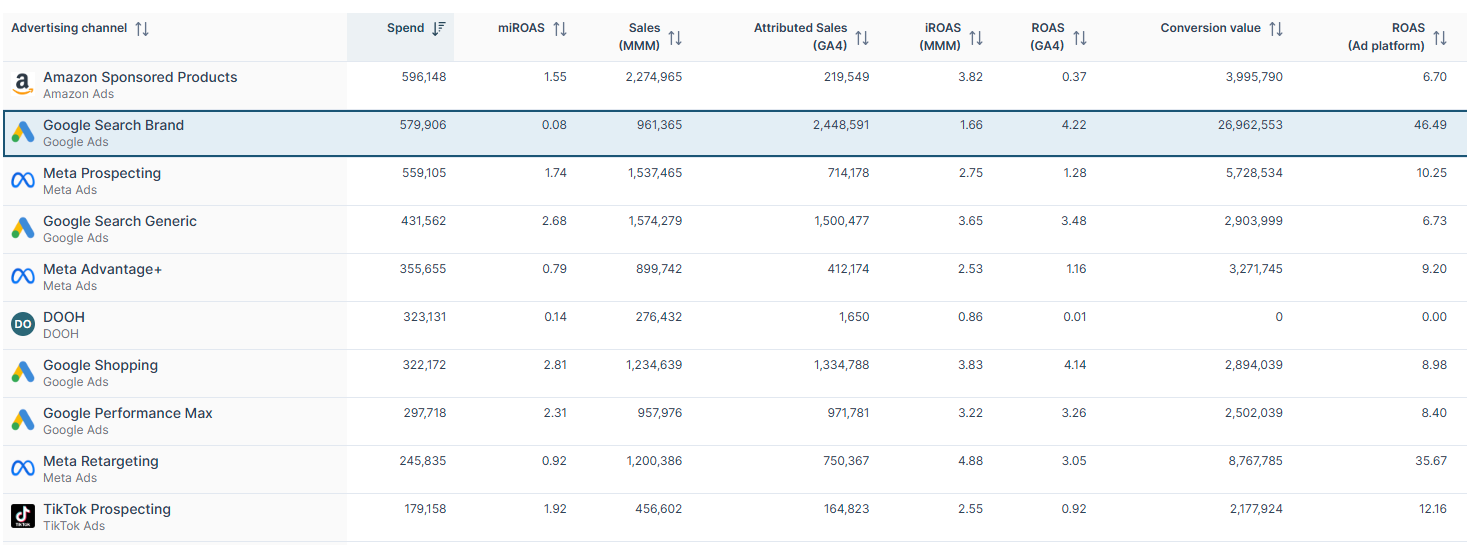
This requires combining marketing mix modeling, incrementality tests and attribution data. Sellforte is one such tool. Below is a channel-level analysis from the Sellforte demo with Google Search Brand highlighted.
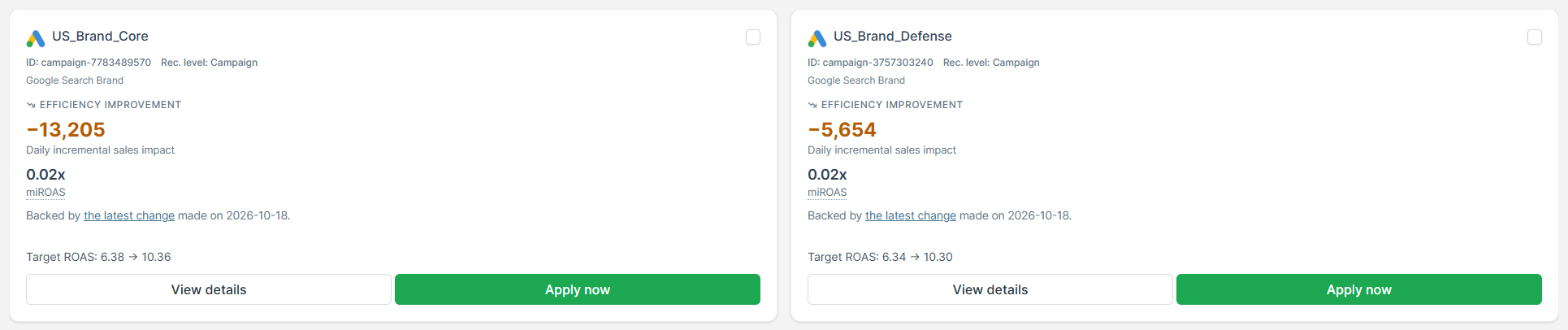
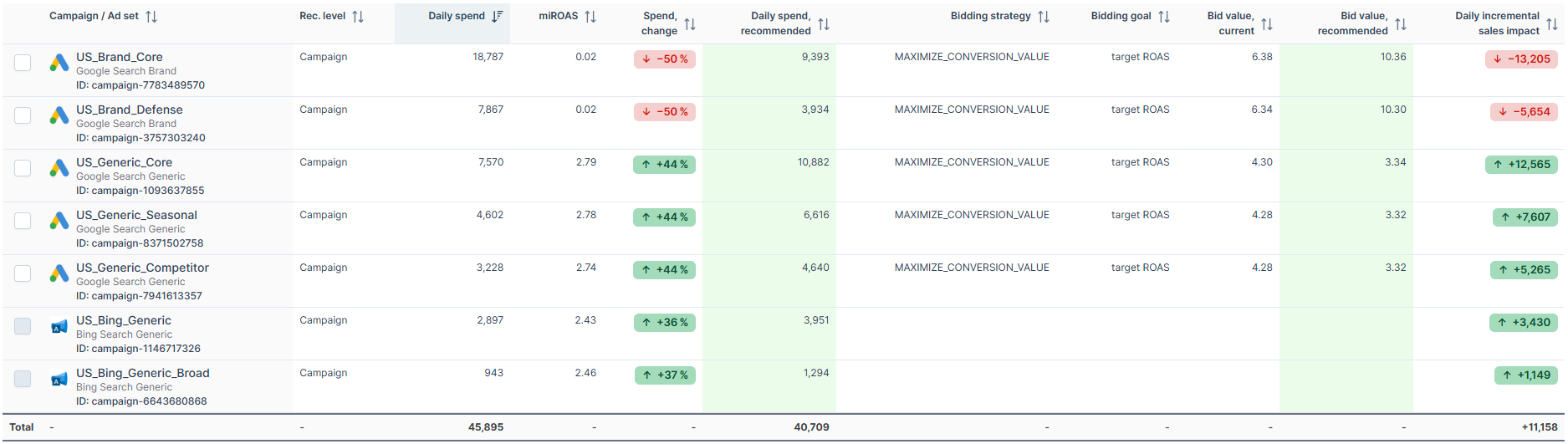
As another example from the Sellforte demo, the view below shows campaign-level recommendations for branded search, based on marginal iROAS (miROAS).
Measuring branded search with media metrics
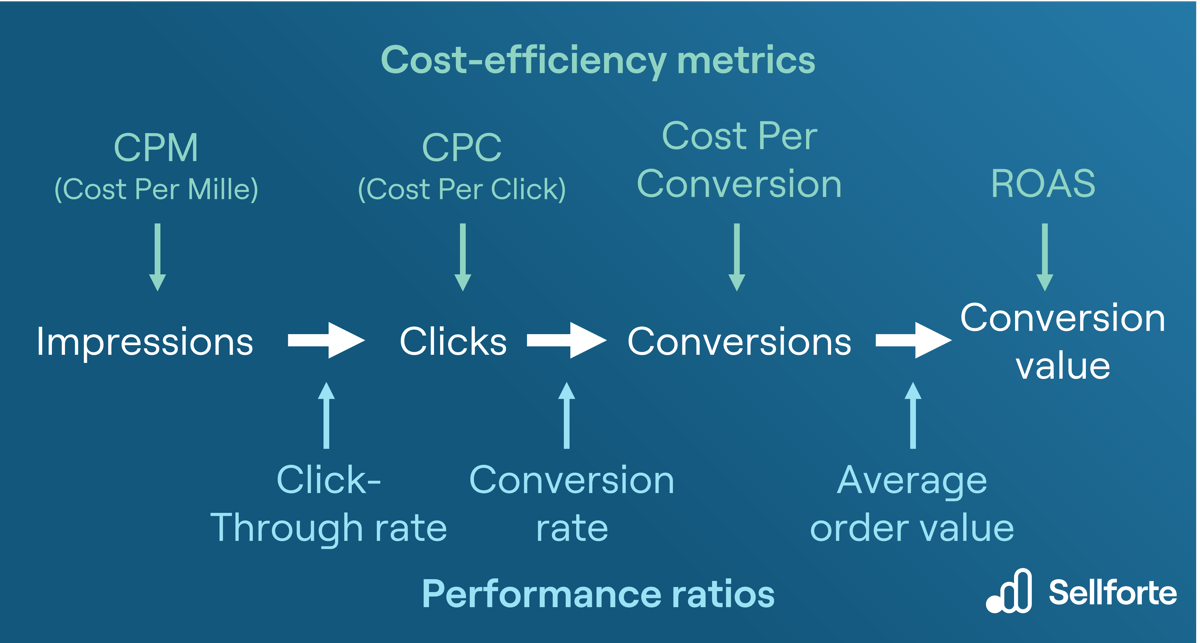
Platform metrics such as impressions, CTR, CPC, conversion rate and average order value do not measure incrementality, but they help explain why iROAS changes. For example, a rise in iROAS could come from a higher average order value. See why to combine media metrics with MMM insights.
Optimizing branded search spend
Optimize branded search on three levels:
- Channel budget: how much to spend on branded search compared with other channels, such as non-branded search or paid social
- Budget over time: the optimal weekly budget
- Campaign spend: the optimal allocation to each branded search campaign
Each level relies on response curves, which capture diminishing returns and show whether a channel has room to scale:
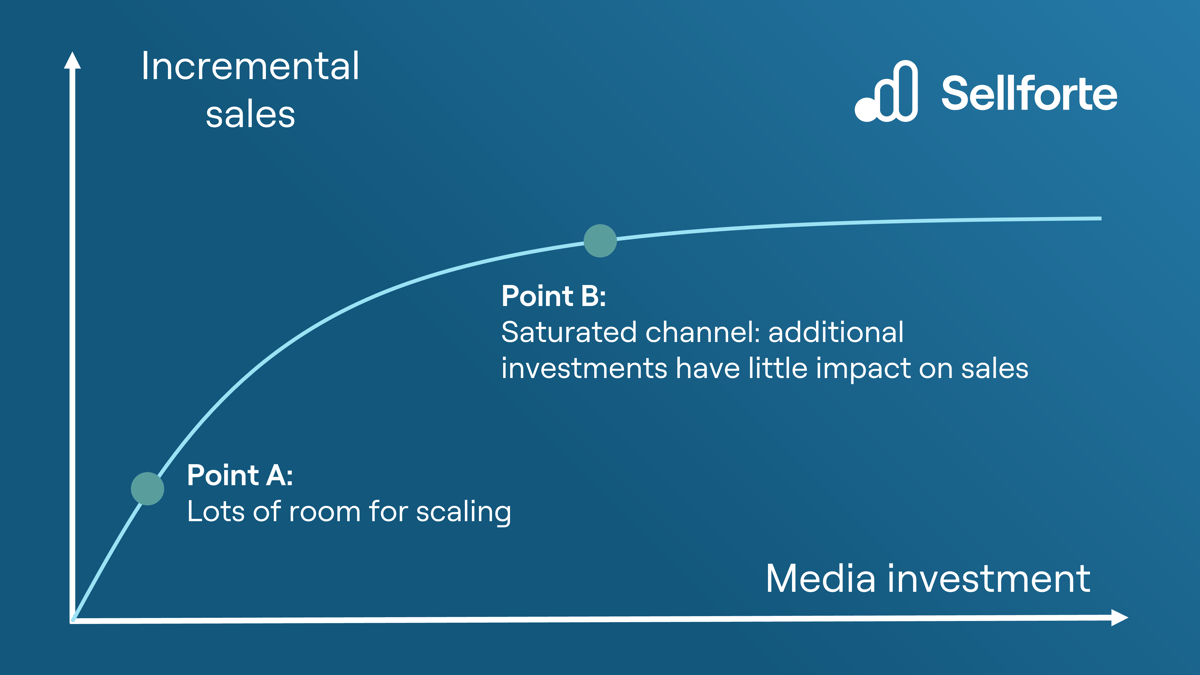
For branded search, the curves change from week to week with the volume of brand searches, which makes manual optimization impractical. Below are examples of optimization views from the Sellforte demo.
1. Channel-level budget optimization scenarios:

2. Optimal spend allocation by week:

3. Recommended budget changes by campaign:
Criticisms of branded search advertising
- Limited incrementality: Many people searching for a brand would buy without the ad. Field experiments such as Blake et al. (2015) found little or no short-term effect for a well-known brand.
- Over-attribution: Attribution models give branded search credit for conversions that other channels created, which inflates ROAS and misdirects budgets.
- Organic cannibalization: Paid brand ads can take clicks the organic listing would have received, adding cost without adding visits.
- Brand dependency: Heavy reliance on branded search can mask under-investment in the brand building that creates brand searches in the first place.
Branded search vs. non-branded search
The incrementality factors in the table below are Sellforte's typical MMM results, not universal benchmarks.
| Aspect | Branded Search | Non-Branded Search |
| Intent | High (users know your brand) | Variable (users exploring options) |
| Search Volume | Low - Limited number of people search for the brand | High - Many keywords available |
| Keyword competition | Low (fewer advertisers bidding) | High (many competitors bidding) |
| Typical incrementality factor in Sellforte's MMM results (% of attributed conversions that are incremental) | 10-20% | Larger variance, but often around 50-60% |
| Cost-Per-Click (CPC) | Lower CPC | Higher CPC |
| Click-through-Rate (CTR) | Higher CTR | Lower CTR |
Practical guidelines for branded search campaigns
- Separate campaigns: Keep branded terms in their own campaigns so that budgets, bids and measurement stay separate from non-branded search.
- Test incrementality: Use geo holdouts or MMM to estimate how many branded conversions you would keep without the ads, and repeat the test as competition changes.
- Watch competitors: Monitor who bids on your brand terms. The research above suggests that defensive spend matters most when competitors bid on your brand.
- Judge on total brand traffic: Look at paid and organic brand clicks together, not paid metrics alone.
Key takeaways
- Branded search captures existing demand; its attributed ROAS greatly overstates its incremental effect.
- Incrementality depends on brand strength, organic rank and competitor bidding, so it must be measured for each brand.
- Optimize branded search on iROAS and response curves, together with the channels that create brand searches.
Related terms
- Search engine marketing (SEM)
- Incrementality
- Share of search
- Return on advertising spend (ROAS)
- Organic visibility
Further reading on Sellforte
- Should you include branded keyword paid search spend in MMM?
- The spillover effect: how TV affects search engine marketing
- How to set a target ROAS that takes incrementality into account
References
- Blake, T., Nosko, C., & Tadelis, S. (2015). Consumer heterogeneity and paid search effectiveness: A large-scale field experiment. Econometrica, 83(1), 155–174. https://doi.org/10.3982/ECTA12423
- Simonov, A., Nosko, C., & Rao, J. M. (2018). Competition and crowd-out for brand keywords in sponsored search. Marketing Science, 37(2), 200–215. https://doi.org/10.1287/mksc.2017.1065
- Coviello, L., Gneezy, U., & Goette, L. (2017). A large-scale field experiment to evaluate the effectiveness of paid search advertising (CEPR Discussion Paper No. 12333). Centre for Economic Policy Research. https://cepr.org/publications/dp12333
- Kumar, D., Ma, S., & Koehler, J. (2012). Impact of ranking of organic search results on the incrementality of search ads. Google Inc. https://research.google/pubs/impact-of-ranking-of-organic-search-results-on-the-incrementality-of-search-ads/
Authors

Lauri Potka is the Chief Operating Officer at Sellforte, with over 15 years of experience in Marketing Mix Modeling, marketing measurement, and media spend optimization. Before joining Sellforte, he worked as a management consultant at the Boston Consulting Group, advising some of the world’s largest advertisers on data-driven marketing optimization. Follow Lauri in LinkedIn, where he is one of the leading voices in MMM and marketing measurement.


