


Search engine marketing (SEM) is paid advertising on search engine results pages. Advertisers bid in an auction on keywords so that their ads appear when people search for related terms. Also called paid search or pay-per-click (PPC) search advertising, SEM reaches people who are actively looking for a product, brand or service.
Some practitioners use SEM as an umbrella term for both paid search and search engine optimization (SEO). On this page, SEM means paid search; for the unpaid side, see organic visibility.
How search engine marketing works
SEM runs on keyword auctions. Advertisers choose keywords, write ads and set bids or automated bidding goals. When someone searches, every eligible ad enters an auction that decides whether it shows and in which position. The largest platforms are Google Ads and Microsoft Advertising (Bing).
In Google Ads, the outcome depends on Ad Rank. Google calculates Ad Rank from the bid, the auction-time quality of the ad and landing page, Ad Rank thresholds and the competitiveness of the auction (Google Ads Help, About Ad Rank). Auction-time quality includes expected click-through rate, ad relevance and landing page experience.
Key components of search engine marketing
Keywords are the search terms an advertiser bids on. Match types control how closely a search query must match a keyword for the ad to be eligible, and negative keywords exclude irrelevant queries.
Ads consist of headlines, descriptions and a display URL, often extended with assets such as sitelinks or prices.
Landing pages are the pages people reach after clicking. Their relevance to the query affects both conversion and the ad's quality assessment.
Quality Score is a 1–10 keyword-level diagnostic in Google Ads, based on expected click-through rate, ad relevance and landing page experience. Google states that Quality Score is not itself an input in the ad auction; it is a summary of how well the ads have performed in past auctions (Google Ads Help, About Quality Score).
Types of search ads
- Text ads: headline and description ads shown above or below the organic results and labeled as sponsored.
- Shopping ads: product listings with image, price and merchant, fed from a product catalog. These are most relevant for ecommerce.
- Local ads: ads for searches with local intent, typically with address, map and phone information.
- Dynamic search ads: ads whose headlines and landing pages are generated from the advertiser's website content.
Brand vs. non-brand search: why incrementality differs
The most important distinction for measurement is between branded search (queries containing the advertiser's brand) and non-brand or generic search (category queries such as "running shoes"). Both look strong in attribution because search is one of the last clicks before a purchase. Their incrementality, the share of sales that would not have happened without the ads, is very different.
The best-known evidence comes from a large field experiment at eBay. When eBay switched off brand keyword ads, nearly all of the lost paid traffic came back through the organic link, and the authors found no measurable short-term benefit from brand ads. For non-brand keywords, ads did affect new and infrequent users, but most spend went to frequent users who would have bought anyway, so the average return was negative (Blake, Nosko & Tadelis, 2015).
The eBay result does not transfer to every advertiser. In a similar geo experiment at Edmunds.com, more than half of the paid traffic was lost when paid search was switched off (Coviello, Gneezy & Goette, 2017). For brand keywords, competition matters: in a field experiment on Bing, paid brand ads brought incremental traffic but also crowded out organic clicks, and competitors bidding on a brand's name captured a share of its clicks when the brand itself did not advertise (Simonov, Nosko & Rao, 2018). Google's own "search ads pause" studies, which measure clicks rather than sales, report that most paid clicks are incremental overall, but far fewer when the advertiser already ranks first organically (Kumar, Ma & Koehler, 2012).
The practical conclusion: brand and non-brand search need separate incrementality estimates, and those estimates are specific to the brand, market and competitive situation. They should be measured, not assumed.
How to measure the iROAS of search engine marketing
Attribution, whether last-click or platform-reported, tends to overstate paid search, and branded search in particular. Search is often the last touchpoint, so it receives credit for conversions driven by other channels (for example TV or social, which raise search volume) and for conversions that would have happened without any ad.
Incrementality-based measurement combines marketing mix modeling (MMM), experiments such as geo holdouts, and attribution data. For SEM it allows marketers to:
- Estimate incremental ROAS (iROAS): the sales SEM actually causes, separately for brand and non-brand campaigns.
- Measure offline sales impact: for omnichannel retailers, cover both ecommerce and store sales.
- Assess saturation: use response curves to see whether additional spend still pays back.
- Optimize within SEM: find the right split between brand and generic and the right spend level per campaign.
Below are example measurement views for SEM from the Sellforte demo.
Branded and generic search on Google, and generic search on Bing:

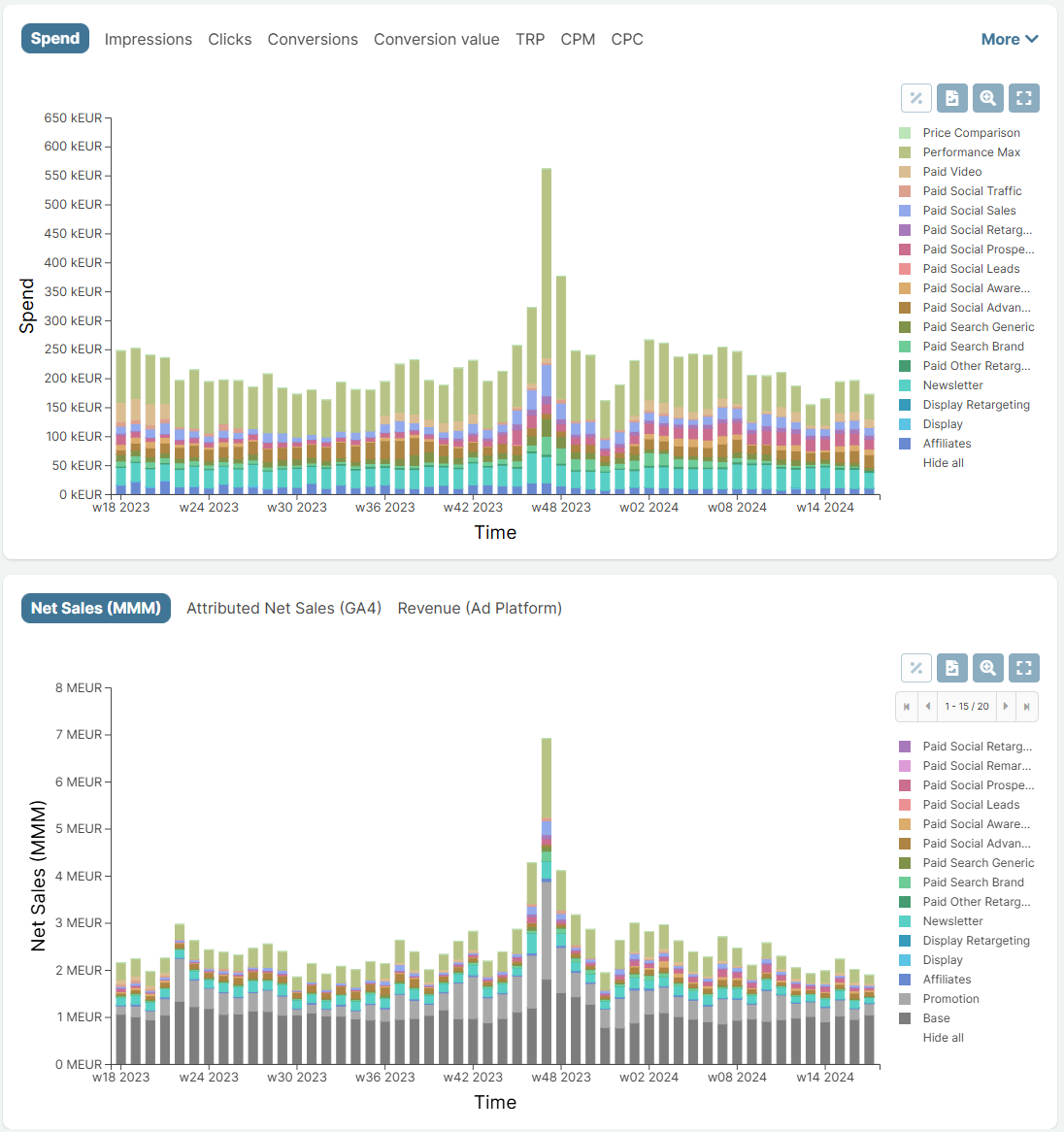
Spend and incremental sales by channel, including Paid Search Generic and Paid Search Brand:
Media metrics for search advertising
Platform metrics such as CTR, CPC, conversion rate, impression share and ROAS explain what drives search performance, but none of them measures incrementality. Platform ROAS is attribution-based and should be read alongside iROAS; see why to combine media metrics with MMM insights.
Paid and organic search interact
Paid and organic listings for the same query affect each other. Paid ads can take clicks that the organic result would have received (cannibalization), and studies have also found positive spillovers between the two (Yang & Ghose, 2010). This is one reason to evaluate SEM on total search outcomes rather than paid clicks alone.
Key takeaways
- SEM is an auction-based channel; in Google Ads, position depends on Ad Rank, not on Quality Score directly.
- Attribution overstates paid search, and branded search most of all. Field experiments show that incrementality varies widely between advertisers.
- Measure brand and non-brand search separately with MMM and experiments, and optimize spend on iROAS.
Related terms
- Branded search advertising
- Incrementality
- Impression share
- Cost per click (CPC)
- Share of search
- Organic visibility
Further reading on Sellforte
- Should you include branded keyword paid search spend in MMM?
- The spillover effect: how TV affects search engine marketing
- How to set a target ROAS that takes incrementality into account
- ROAS, iROAS and miROAS
References
- Blake, T., Nosko, C., & Tadelis, S. (2015). Consumer heterogeneity and paid search effectiveness: A large-scale field experiment. Econometrica, 83(1), 155–174. https://doi.org/10.3982/ECTA12423
- Coviello, L., Gneezy, U., & Goette, L. (2017). A large-scale field experiment to evaluate the effectiveness of paid search advertising (CEPR Discussion Paper No. 12333). Centre for Economic Policy Research. https://cepr.org/publications/dp12333
- Simonov, A., Nosko, C., & Rao, J. M. (2018). Competition and crowd-out for brand keywords in sponsored search. Marketing Science, 37(2), 200–215. https://doi.org/10.1287/mksc.2017.1065
- Kumar, D., Ma, S., & Koehler, J. (2012). Impact of ranking of organic search results on the incrementality of search ads. Google Inc. https://research.google/pubs/impact-of-ranking-of-organic-search-results-on-the-incrementality-of-search-ads/
- Yang, S., & Ghose, A. (2010). Analyzing the relationship between organic and sponsored search advertising: Positive, negative, or zero interdependence? Marketing Science, 29(4), 602–623. https://doi.org/10.1287/mksc.1090.0552
- Google. (n.d.). About Ad Rank. Google Ads Help. Retrieved 2026-10-30, from https://support.google.com/google-ads/answer/1722122
- Google. (n.d.). About Quality Score for Search campaigns. Google Ads Help. Retrieved 2026-10-30, from https://support.google.com/google-ads/answer/6167118
Authors

Lauri Potka is the Chief Operating Officer at Sellforte, with over 15 years of experience in Marketing Mix Modeling, marketing measurement, and media spend optimization. Before joining Sellforte, he worked as a management consultant at the Boston Consulting Group, advising some of the world’s largest advertisers on data-driven marketing optimization. Follow Lauri in LinkedIn, where he is one of the leading voices in MMM and marketing measurement.


