


Regional measurement gets complicated fast.
Google, Meta, TikTok, analytics platforms, and first-party business data do not always describe geography in the same way. A market represented one way in one platform may use a different definition, identifier, or boundary somewhere else.
That creates unnecessary work when teams want to run geo experiments, compare regional performance, or build more granular MMM.
Today, we're introducing Sellforte Market Areas, a standardized geographic layer that brings those different definitions into one consistent structure inside Sellforte.
The idea is to create a geographic foundation that can be used consistently across regional MMM, experiments, and reporting, rather than treating each of those as a separate geo problem.
Going beyond country-level measurement
For brands operating across the US, national-level results are often only part of the picture.
Marketing teams may plan budgets around DMAs, internal sales regions, store footprints, or other geographic structures. They may also want to understand whether incremental performance differs between those areas or use them as treatment and control regions in a geo experiment.
Both require reliable regional data.
The challenge is not deciding whether regional measurement matters. It is getting the underlying data into a consistent enough structure to actually do it.
Sellforte Market Areas provide that common structure, so the same underlying geography can support regional measurement, experiments, and reporting.
The geo data problem
In the US, regional media has traditionally been organized around Designated Market Areas, or DMAs. Nielsen currently defines 210 DMA regions across the US.
But the advertising platforms do not all represent those markets in exactly the same way.
Google uses its own Metro geography, while Meta has introduced Comscore Markets alongside its existing geographic reporting. Other platforms expose their own combinations of regions, cities, ZIP codes, and geographic identifiers.
That means the same underlying market can arrive in slightly different forms depending on the source.
Before you can compare media delivery with sales, build a regional model, or set up a geo experiment, those differences need to be reconciled. And when a platform changes how it represents geography, the mapping needs to keep up.
Sellforte handles that underneath the measurement.
So while the platforms can change their geography, your measurement doesn't have to.
One consistent geographic layer
Sellforte Market Areas sit between the geography provided by individual data sources and the geography used for measurement inside Sellforte.
In the US, Sellforte harmonizes different source definitions into a consistent structure closely aligned with familiar DMA-level markets.
One platform might report a Metro. Another might use a Comscore Market. First-party business data might start from ZIP codes, stores, or another regional structure.
Sellforte maps those sources into a common geographic foundation that can then be used across measurement.
The result is not simply another geo dimension in a dataset. It is a way to keep the geography used across MMM, experiments, and reporting consistent even when the underlying sources are not.
Measure the regions your business actually uses
The 210 US DMAs provide a useful starting point, but they do not have to dictate how measurement is structured.
Many businesses already plan and report using their own regional setup, whether that is based on sales territories, store trade areas, franchise regions, retail catchments, or a broader internal grouping of DMAs.
Sellforte Market Areas can be used as the building blocks for that structure.
A customer might start with DMA-level geography in the US, then combine those areas into the regions they already use to allocate budgets and review performance. Sellforte can measure at that level while keeping the underlying geographic structure consistent across the data.
So Market Areas are a default template, not a constraint.
The goal is not to make measurement as granular as possible. It is to use the level of geography that makes sense for the business and the question being asked.
See how performance differs between markets
Once the geography is in place, regional MMM can reveal differences that are difficult to see in a national result.
In the example below, modeled ROI ranges from around 0.9x in Dallas to 7.0x in Los Angeles, showing just how differently the same marketing channel can perform across markets.
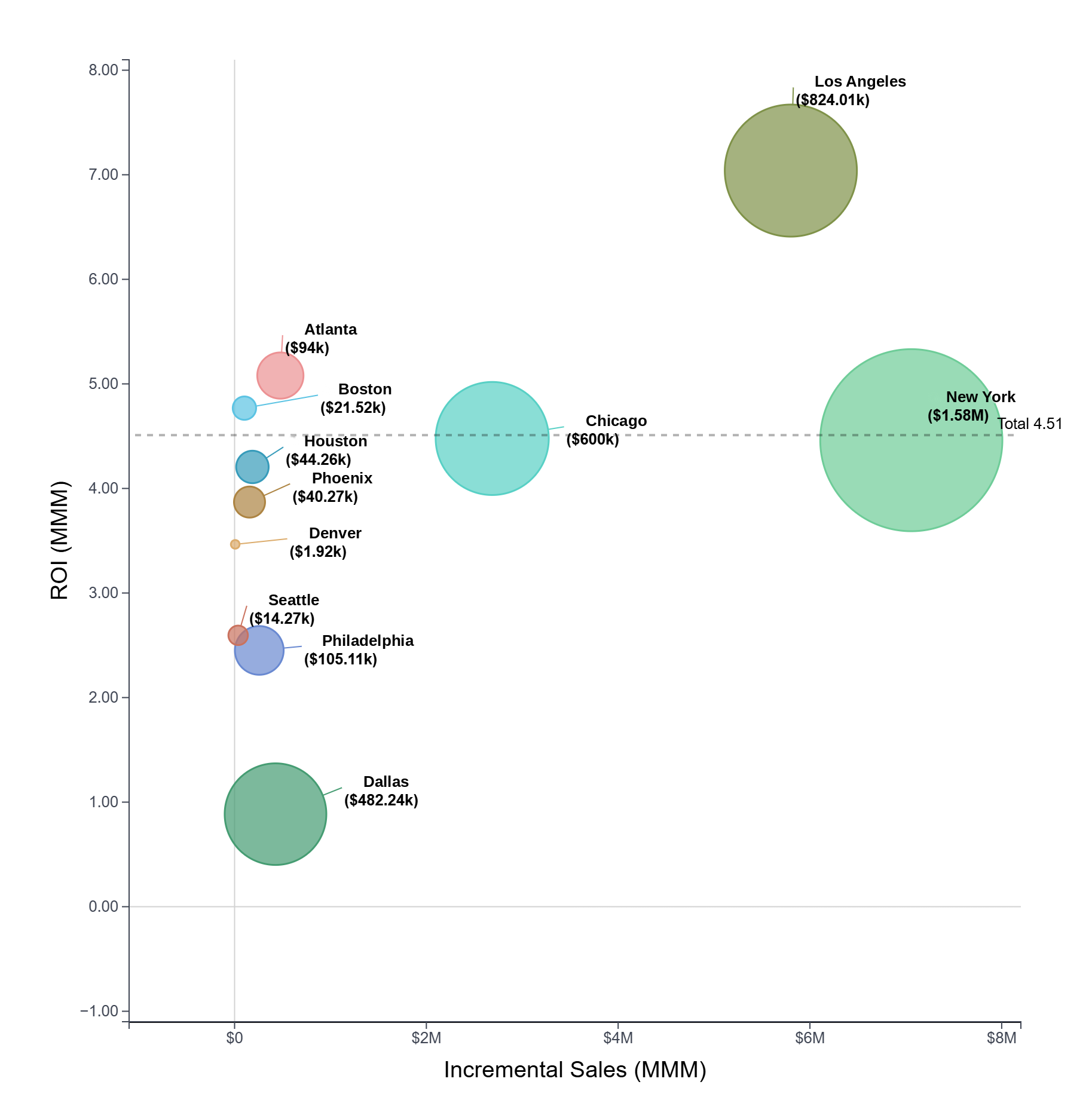
Regional MMM can reveal large differences in incremental sales and ROI between markets.
That spread is exactly why regional measurement can be so useful. But the goal is not to split every business into 210 separate models.
More granularity only helps when there is enough data to support it, and when the regions reflect how the business actually operates. Splitting too far can leave each model with too little signal, so the right level will vary from one business to another.
Sellforte Market Areas gives teams the flexibility to find that level, whether that means individual markets or larger regional groupings.
Because sometimes the right question isn't simply:
How well is our marketing performing in the US?
It's:
Where in the US is our marketing actually working?
Use the same geography for geo experiments
The same Market Area structure can also be used for geo incrementality testing.
A geo experiment might increase media investment in one set of markets, hold back spend in another, or launch a campaign only in selected areas. In each case, the media data and the business outcome need to line up geographically.
With Sellforte Market Areas, that regional structure can already be in place.
Rather than creating a new set of geographic definitions for every experiment, teams can use the same foundation they already use for regional measurement.
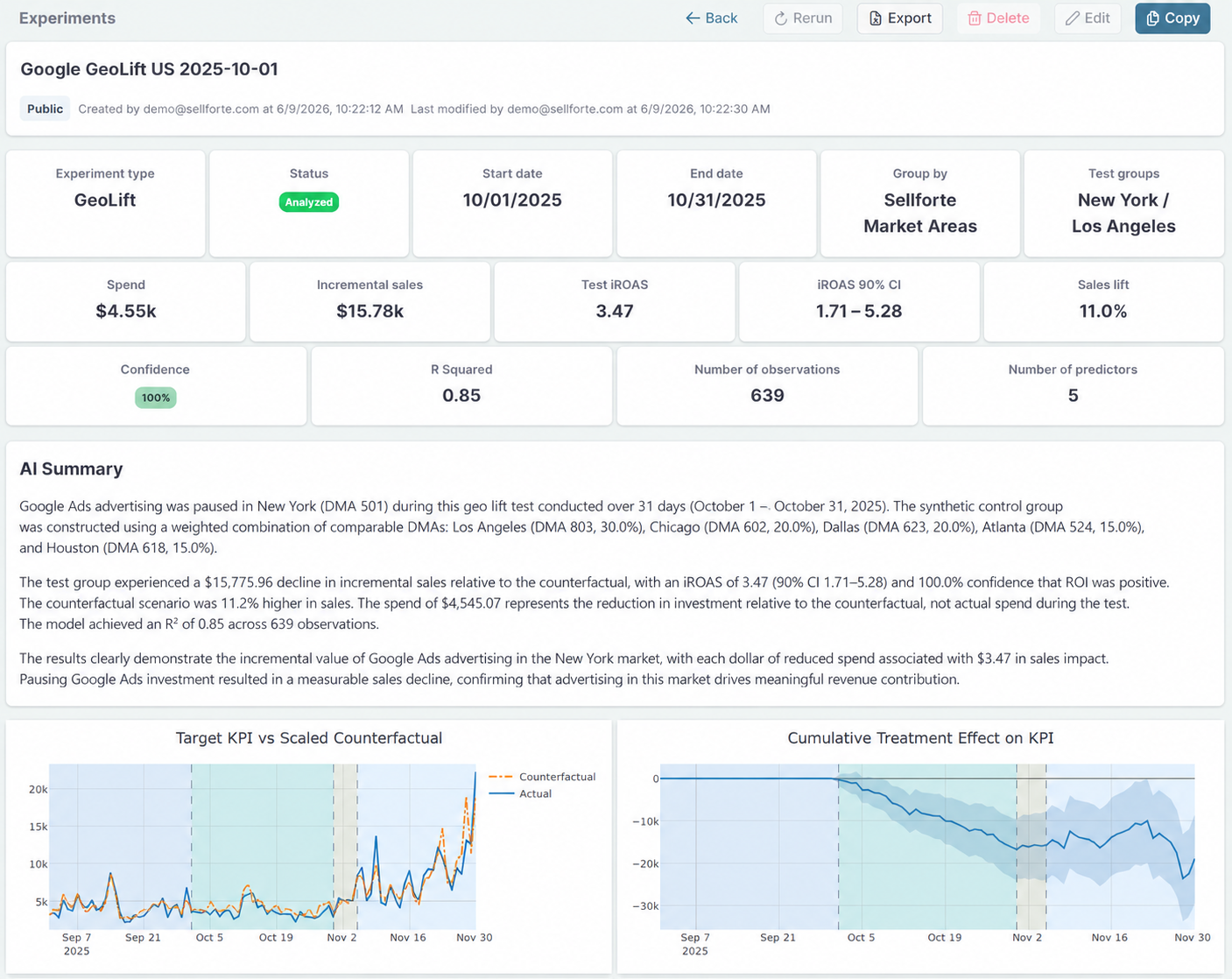
Sellforte Market Areas can be used directly as the geographic dimension for geo lift experiments.
That means the geography used to define treatment and control markets can also be used when analyzing the result in Sellforte Experiments and when looking at broader regional MMM performance.
This is where the wider value of Market Areas becomes clearer. They are not just there to help design a geo test. They provide a common geographic foundation across models, experiments, and reporting.
Designed to work beyond the US
The immediate need for Sellforte Market Areas has been particularly clear in the US, but DMA is a US-specific concept.
The same framework can support different geographic definitions in different countries while keeping the structure inside Sellforte consistent.
Outside the US, the current approach is to use administrative regions where they provide the right level of granularity, including markets such as Germany, France, and Italy. Great Britain is a separate case, where ITV regions can provide a more useful regional structure.
Those definitions are still a starting point rather than a hard limit.
If a customer's business is organized around a different geography, the Market Areas can be adapted or grouped to match the way that business plans and measures marketing.
That is the reason for using Sellforte Market Areas as the common layer rather than trying to extend a US-specific DMA structure everywhere.
Bringing regional measurement together
We recently introduced Sellforte Incrementality Testing and Incremental Attribution to give performance teams a more practical way to measure what their marketing actually causes.
Sellforte Market Areas add the geographic foundation underneath that measurement.
The same regional structure can support MMM, geo incrementality tests, regional performance analysis, and the customer-specific regions a business already uses internally.
Instead of treating each of those as a separate geography problem, they can work from the same underlying structure.
One geography for your models, your tests, and your reporting.
See Sellforte Market Areas in action
Sellforte Market Areas are bringing more granular geographic measurement into Sellforte.
If you want to understand how marketing effectiveness differs between markets, run geo experiments using the same regional structure as your wider measurement, or build MMM around the way your business actually operates, book a demo and we'll show you how Sellforte Market Areas work.
👉 Book a demo to see Sellforte Market Areas in action