


The short answer
To assess whether MMM will pay for itself, compare the additional contribution profit from decisions it changes with the full cost of the program. Agree on a baseline and payback period with finance, allow time to implement recommendations, and track realized results separately from the model's forecast. Test a conservative case before committing.
This article is part of Asked by Marketers, a series answering real questions from marketing leaders.
Sellforte's team holds more than 1,450 meetings each year with marketing leaders in Ecommerce and Retail about Marketing Mix Modeling and incrementality testing. Each week, we anonymize at least one question from those conversations and answer it in depth, based on what marketers are actually struggling with, not what keyword tools suggest. About the series →
Why marketers ask this
A marketing leader can see the appeal of better measurement and still struggle to justify another subscription. Finance needs to know what will change, how much that change could be worth, and when the benefit will arrive. That question is especially reasonable when the team already has strong performance marketing measurement. The business case should reflect the decisions that remain difficult, without assuming that every part of the current plan needs fixing.
Which decisions could make MMM worth the cost?
Start with decisions the team can act on. Marketing Mix Modeling can inform allocation across channels, campaigns, or markets, as well as the timing and overall level of spend. The financial opportunity depends on how those decisions would differ from the plan you would otherwise follow.
Write down that current plan before reviewing an optimized alternative. Use the same planning period, sales definition, and business assumptions for both. Then record the practical limits: committed media spend, minimum channel budgets, and who can approve a change. An attractive recommendation has little near-term value if the team cannot implement it.
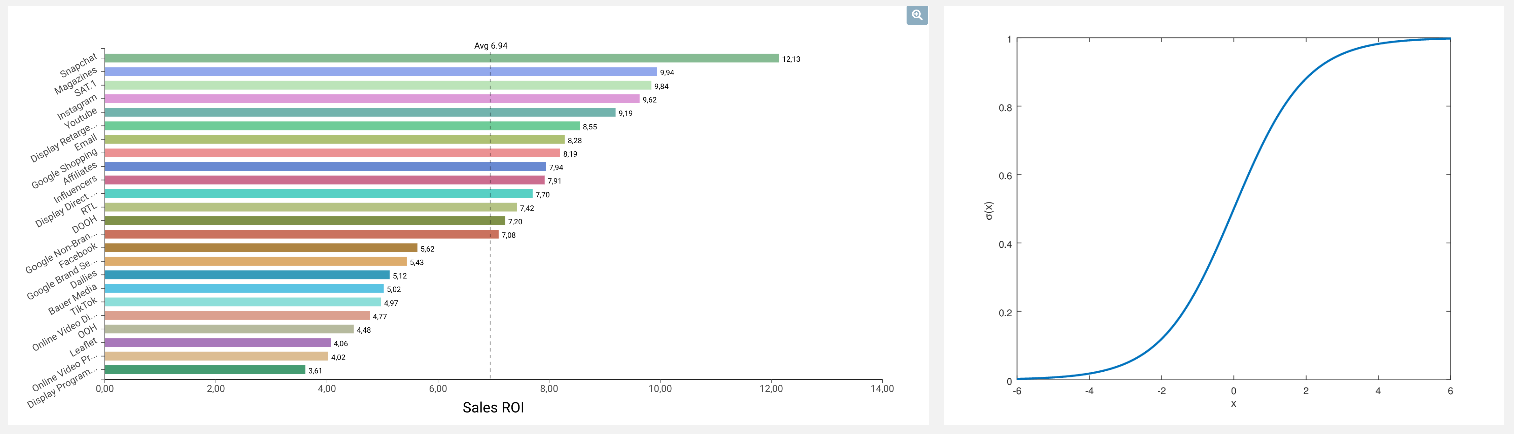
Channel comparisons can help identify where to investigate. The illustration below shows how estimated sales return varies across channels. To decide where the next euro should go, also examine response curves, which describe how the expected return changes with spend. A channel's strong historical average does not mean it can absorb unlimited budget at the same return.
Ask for customer evidence that resembles your starting point. A business with limited measurement may have different opportunities from one that already optimizes its main channels well. Use a provider's benchmark to inform an assumption, with its scope and limitations stated. Do not present it as an uplift your business has already achieved.
How should we calculate the return?
Calculate the change in contribution profit after media spend, then subtract the cost of running MMM over the same period. Agree with finance on which variable costs belong in the contribution margin so that revenue and profit do not get mixed together.
For a simple case with a consistent contribution margin, use:
Benefit before MMM costs = additional revenue versus the current plan × contribution margin before media − additional media spend
Net benefit = benefit before MMM costs − total MMM program cost
MMM return on investment = net benefit ÷ total MMM program cost
Here, contribution margin before media means the share of revenue left after the agreed variable costs, before subtracting media or MMM costs. If margins differ across products or sales channels, calculate the contribution change for each part and add them together.
Keep the spending comparison explicit. If both plans use the same media budget, additional media spend is zero. If the proposed plan spends more, deduct the increase. If it spends less, count the saving alongside any change in contribution from sales. Do not count a reallocated euro as both a cash saving and money still available to spend.
The MMM program cost should include the quoted implementation and subscription fees, plus the internal work and any additional analysis or testing required for the plan. Record staff time even when it does not create a new invoice. Show possible reporting-time savings separately until you can explain how they reduce a cost or free capacity for a defined task.
When should we expect MMM to pay back?
Build a monthly schedule that starts with implementation and ends when the cumulative benefit covers the cumulative program cost. First results, the first budget change, and financial payback are different milestones.
Allow time for data preparation, model review, and approval of spending changes. The MMM implementation process is one part of that schedule. A team preparing during a quiet trading period may only be able to act meaningfully in its next planning cycle. A first-year business case must include that delay.
For subscription or repeat-purchase businesses, agree on the customer lifetime value window and the margin applied to it. A forecast that includes future customer purchases can support a long-term investment decision, but it does not establish that the cash will arrive in the first year. Keep projected lifetime contribution separate from the contribution expected within the payback period.
How do we check whether the value was realized?
Review the agreed business case each month, alongside the decisions actually implemented and the evidence available to evaluate them. An optimizer's forecast is the starting hypothesis for that review.
Keep a record of the original plan, each approved change, the date it took effect, and the outcome it was expected to improve. Compare performance with that baseline using a consistent sales definition and account for changes such as promotions, prices, or availability. A rise in total sales alone does not establish the value created by adopting MMM.
For a material budget change, use incrementality testing where a suitable experiment is feasible. A test can assess the effect of the spending intervention; the financial review still needs to deduct the relevant costs. Where the estimate relies on MMM, label it as model-estimated and explain the uncertainty. Keep forecast benefits, implemented decisions, and measured outcomes separate in the review.
If the benefit is below plan, examine whether recommendations were implemented, whether the expected sales response occurred, and whether margins or timing changed.
How this looks in practice
Consider a hypothetical business evaluating MMM over its first 12 months. Its planned media budget is unchanged. Assume a total MMM program cost of €80,000: €50,000 for the subscription, €10,000 for implementation, and €20,000 for internal work and other required support. These are invented assumptions for the calculation, not Sellforte prices or customer results.
The business uses a 30% contribution margin before media. It expects to start changing budgets after the first three months, so the revenue assumptions below cover the remaining nine months of the first year. They represent additional revenue versus the original plan.
| Calculation | Lower-return case | Planning case |
|---|---|---|
| Additional revenue | €200,000 | €400,000 |
| Contribution at 30% | €60,000 | €120,000 |
| Additional media spend | €0 | €0 |
| Total MMM program cost | €80,000 | €80,000 |
| Net benefit after MMM costs | −€20,000 | €40,000 |
| MMM return on investment | −25% | 50% |
At this margin, the first-year break-even point is about €266,667 in additional revenue: €80,000 ÷ 30%. The planning case clears that threshold; the lower-return case does not. The decision now depends on whether the revenue assumptions are credible and achievable within the nine months available, and whether the business can accept the downside.
A second illustration shows why the media budget comparison matters. The chart below compares €2 million of media spend with €2.5 million, with illustrative incremental media-driven sales of €9.94 million and €12.14 million respectively. Both figures describe the sales attributed to media in the scenarios. They are not the additional sales created by buying an MMM subscription.
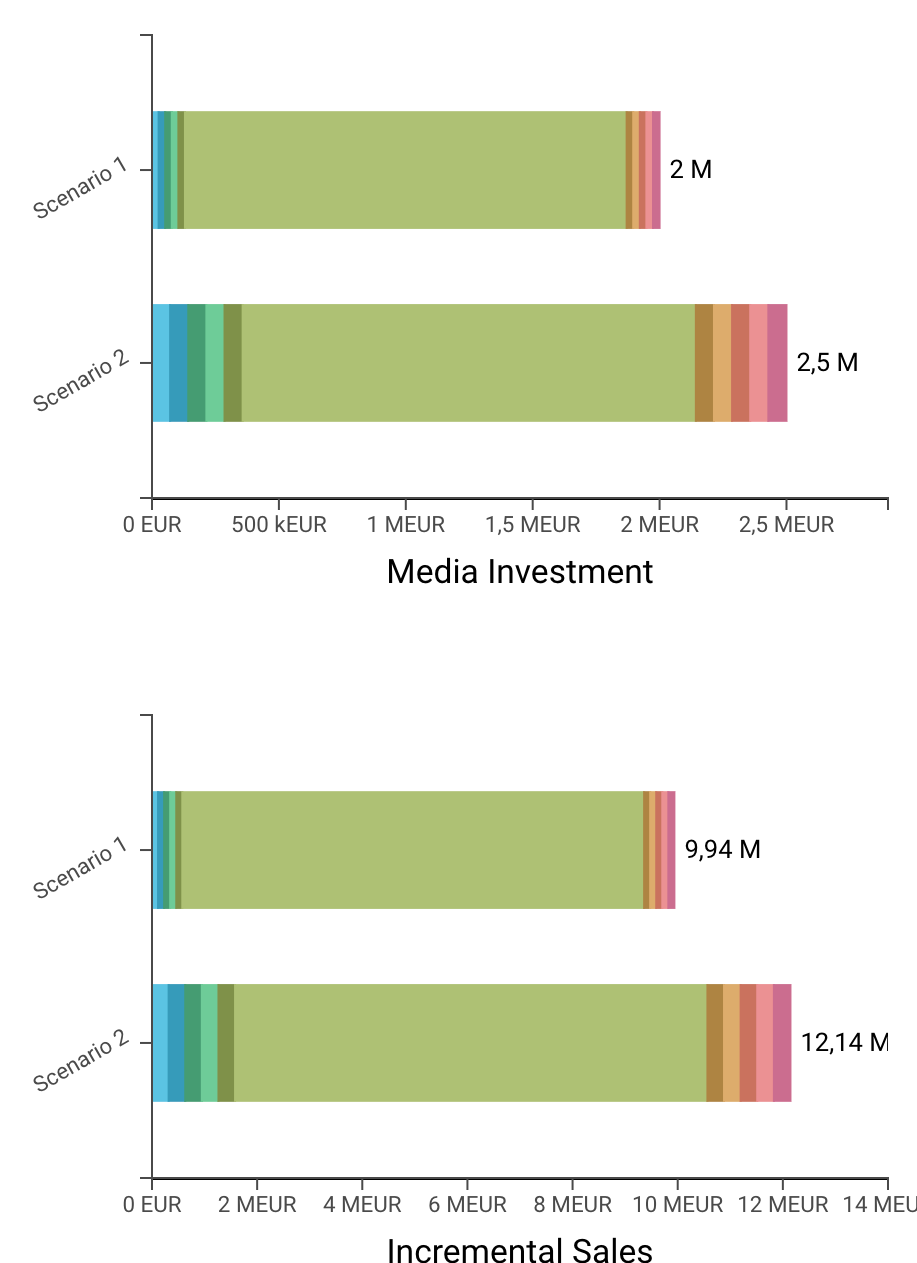
The difference is €2.2 million in sales for €500,000 more media spend. Applying a hypothetical 30% contribution margin gives €660,000 of additional contribution before media, or €160,000 after the extra media cost and before MMM costs. That calculation evaluates the spending change. To assess MMM itself, compare the decision the team would have made without it with the decision it actually enabled.
How Sellforte helps
Sellforte helps teams compare media plans, examine response curves, and translate recommendations into budget decisions. A business-case review can connect those decisions to agreed contribution margins, costs, and a payback schedule.
Explore the Sellforte demo or book a demo to discuss the decisions your business needs to improve.
Authors


Can MMM help us set a budget for a channel we've never used?

How should we calculate CRM ROI in MMM when most costs are fixed?