MMM Use Case

To calculate an incrementality factor in Sellforte, divide iROAS (MMM) by ROAS (Ad Platform) for the same channel and period. The result tells you how much of the platform-reported return is incremental according to MMM. You can use this factor to adjust platform ROAS or attributed revenue to reflect the model's estimate of incremental impact.
This walkthrough uses the public Sellforte demo, with US selected and the displayed period W27 August 2–W40 November 1, 2026. Screenshots and figures use simulated demo data captured on November 15, 2026.
Before you start: You need MMM results and platform-attributed revenue for the same channel, period and market, using a consistent sales definition and spend basis.
What you will calculate: A channel-specific incrementality factor, including the percentage of branded-search platform ROAS that MMM estimates is incremental.
1. Find the MMM and platform metrics for the same channel
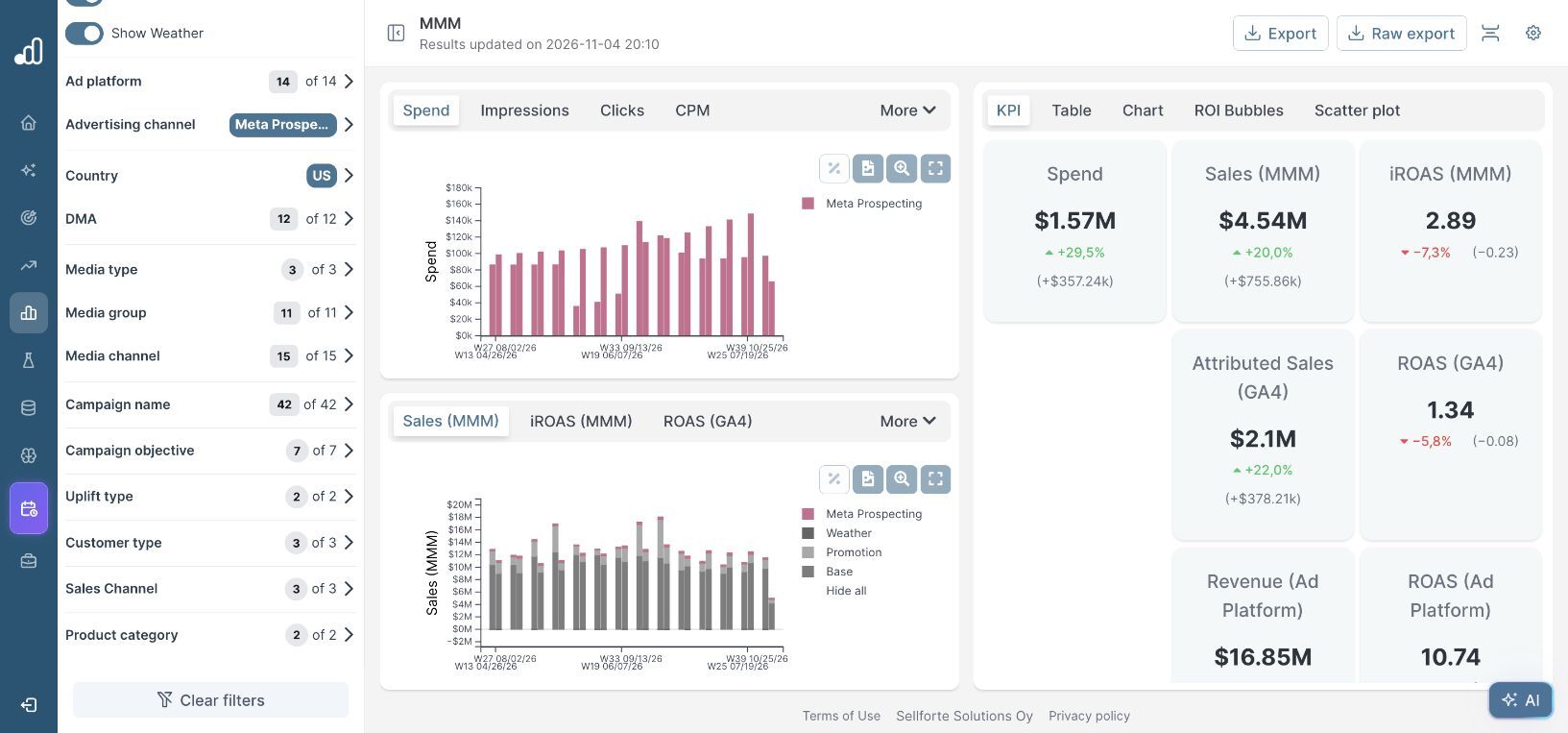
Open Dashboards → MMM, set the period and market, and choose Advertising channel under Primary group by. Keep the other filters fixed while comparing the metrics.
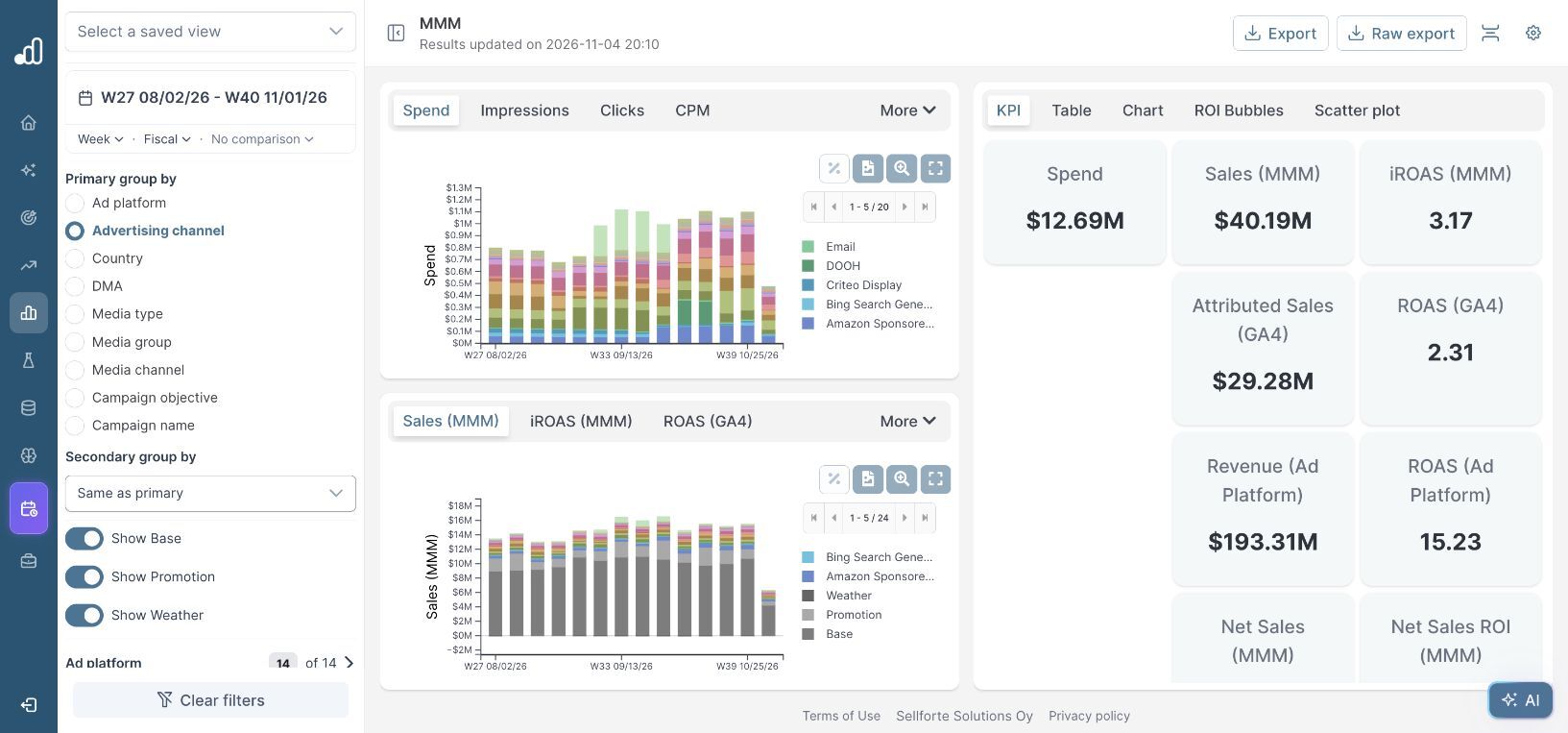
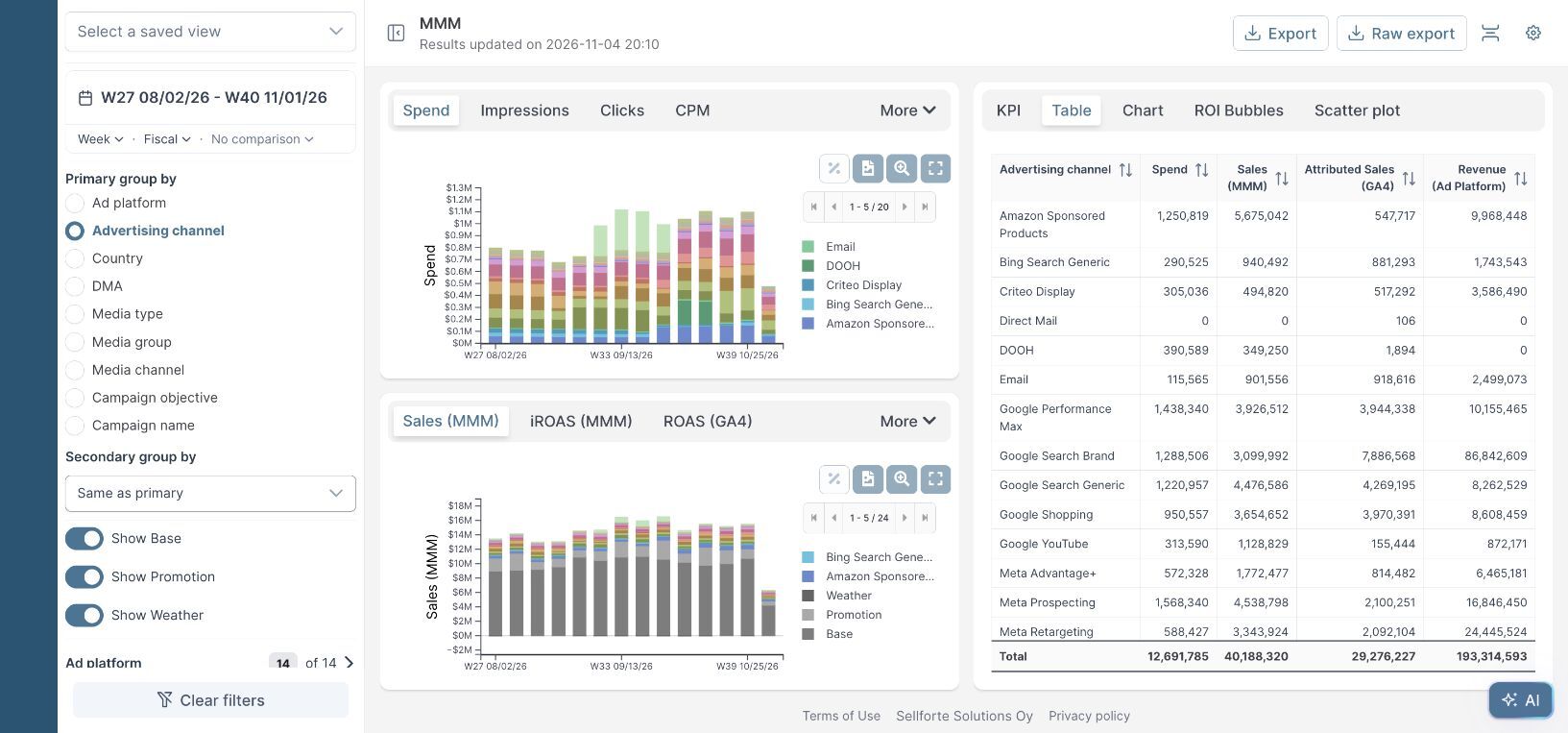
Switch to Table and find the channel row. Read iROAS (MMM) and ROAS (Ad Platform); scroll horizontally to reach the return columns. MMM estimates incremental sales generated by advertising, while platform ROAS uses the revenue credited by the platform's attribution settings.
Use comparable revenue definitions and the same spend denominator. For example, a factor calculated from gross sales should be applied to gross-sales reporting. Keep the attribution window consistent when using the factor.
2. Calculate the branded-search incrementality factor
The Google Search Brand row shows 2.41 iROAS (MMM) and 67.40 ROAS (Ad Platform). Divide the incremental return by the platform-reported return:
Incrementality factor = iROAS (MMM) ÷ ROAS (Ad Platform)
2.41 ÷ 67.40 ≈ 0.0358 ≈ 3.6%
For this channel and period, MMM estimates that approximately 3.6% of the platform-reported branded-search ROAS is incremental. Each $1 of ad spend receives $67.40 of revenue credit in the platform, while MMM estimates about $2.41 in incremental sales.
You can calculate the same factor from revenue: Sales (MMM) ÷ Revenue (Ad Platform). The branded-search row shows $3,099,992 and $86,842,609, respectively, which also gives approximately 3.6%. Use the unrounded revenue figures when you need a precise factor; the displayed ROAS values are rounded.
3. Calculate a separate factor for each channel and attribution source
Repeat the calculation for the other channels. The demo produces very different factors for branded search, prospecting and video:
| Channel | iROAS (MMM) | ROAS (Ad Platform) | Incrementality factor |
|---|---|---|---|
| Google Search Brand | 2.41 | 67.40 | 3.6% |
| Meta Prospecting | 2.89 | 10.74 | 26.9% |
| Google YouTube | 3.60 | 2.78 | 129.5% |
A factor can exceed 100%. Here, MMM estimates more incremental revenue for YouTube than the platform attributes to it, so the factor scales the platform figure upward. The percentage expresses the ratio between the revenue estimates; it is not a percentage of individual customers.
Calculate a separate factor for GA4 if you want to adjust GA4 reporting. Google Search Brand has a GA4 ROAS of 6.12, so its GA4-based factor is 2.41 ÷ 6.12 ≈ 39.4% using the displayed values. The platform-based 3.6% factor applies to the platform figure; the GA4-based 39.4% factor applies to GA4.
4. Apply the factor to platform reporting
Multiply platform ROAS by the factor to express the return in incremental terms:
Incrementality-adjusted ROAS = platform ROAS × incrementality factor
For branded search, 67.40 × 0.0358 ≈ 2.41. The same multiplier can be applied to platform-attributed revenue. This is the calculation behind incrementality-corrected attribution.
Use the factor for the channel and attribution setup it was calculated from. Refresh it as MMM results or the campaign mix change. Applying a channel factor to individual campaigns assumes they share that channel's incrementality; campaign-level factors need evidence at that level.
Further Reading and Resources
Calculate and apply incrementality factors
Plan the next budget decision
About the author

Lauri Potka is the Chief Operating Officer at Sellforte, with over 15 years of experience in Marketing Mix Modeling, marketing measurement and media spend optimization. Before joining Sellforte, he worked as a management consultant at the Boston Consulting Group, advising some of the world’s largest advertisers on marketing optimization. Follow Lauri on LinkedIn.
How to See Which Channels Drive Incremental Sales
How to Understand Why a Channel’s Performance Changed