


Media mix optimization is the process of allocating a marketing budget across channels, campaigns and time periods to maximize a business outcome, such as incremental revenue or contribution profit, within the budget and other constraints. It usually relies on response curves from a marketing mix model (MMM) and moves spend until marginal returns are equal across channels.
How media mix optimization works
An optimizer needs four inputs:
- Response curves: one per channel, campaign or market, showing how incremental revenue changes as spend rises or falls. In practice these come from a marketing mix model (see response curve).
- An objective: usually incremental revenue, incremental conversions or contribution profit over a planning period.
- A budget rule: either a fixed total budget, or a flexible budget that grows as long as a return target is met.
- Constraints: minimum and maximum spend per channel, limits on how far spend may move from the current plan, and commitments the model cannot see.
The output is a recommended spend by channel and period, with the forecast incremental revenue and incremental ROAS (iROAS) of the plan.
The optimization problem
For a fixed budget, the problem can be written as:
Maximize Σi fi(xi) subject to Σi xi = B and Li ≤ xi ≤ Ui
- fi(xi): the incremental revenue of channel i at spend xi, read from its response curve.
- B: the total budget for the planning period.
- Li and Ui: the lower and upper spend bounds for channel i.
Because response curves show diminishing returns, the solution has a simple property: every channel that is not held at a bound ends up with the same marginal iROAS, which is the slope of its curve at the chosen spend. If the next euro returned more in one channel than in another, moving a euro between them would raise the total (see marginal iROAS).
If the objective is contribution profit instead of revenue, the budget itself becomes a decision. With a contribution margin m, spend in each channel should rise until its marginal iROAS reaches 1 / m. At a 50% margin, the break-even marginal iROAS is 2.0. Setting advertising where the return on the last unit covers its cost goes back to the classic analysis of optimal advertising by Dorfman and Steiner (1954).
Example: reallocating a fixed budget
An online retailer spends 300 000 EUR a month on three channels. Its MMM gives a concave response curve for each (illustrative numbers):
| Channel | Current spend (EUR) | iROAS | Marginal iROAS | Optimized spend (EUR) | iROAS | Marginal iROAS |
| Paid search | 160 000 | 4.17 | 1.39 | 117 000 | 5.08 | 2.06 |
| Paid social | 90 000 | 3.75 | 2.34 | 105 000 | 3.53 | 2.08 |
| Online video | 50 000 | 3.20 | 2.56 | 78 000 | 2.88 | 2.07 |
| Total | 300 000 | 3.88 | – | 300 000 | 3.96 | – |
The optimizer cuts paid search, the channel with the highest iROAS, because its next euro returns only 1.39 EUR, and moves the budget to paid social and online video, where the next euro returns 2.34 and 2.56 EUR. After the move, marginal iROAS is about 2.07 in every channel, and incremental revenue rises from 1 164 200 EUR to 1 189 000 EUR: roughly 24 800 EUR more per month for the same spend.
Average iROAS points the wrong way: paid search's iROAS rises from 4.17 to 5.08 as it is cut. At a 50% contribution margin, break-even marginal iROAS is 2.0, so the optimized plan (2.07) could still grow slightly; with these curves, a flexible budget would stop at about 313 000 EUR.
Why allocation matters
Mantrala, Sinha and Zoltners (1992) showed that aggregate sales and profit are usually more sensitive to improvements in allocation rules than to increases in investment levels. Fischer et al. (2011) built a dynamic budget allocation model across countries, products and marketing activities, implemented it at Bayer and report a profit improvement potential of more than 50%. In Sellforte's analysis of 27 ecommerce and DTC advertisers, moving to the MMM-recommended allocation at the same total media spend was estimated to improve sales by 6.5%.
Fixed-budget and target scenarios
Most optimizers offer two kinds of scenario. Google's open-source MMM Meridian has a fixed-budget scenario that finds the best split of a given budget, and flexible-budget scenarios that maximize the incremental outcome while meeting either a target ROI for total marketing or a minimum marginal ROI (mROI) for each channel, in Meridian's terms (Google, n.d.). Meta's open-source Robyn has a "max_response" scenario, which maximizes response for a total budget, and a "target_efficiency" scenario, which finds the spend that reaches a target ROAS or cost per acquisition, in Robyn's terms (Runge et al., 2024).
Constraints and guardrails
An unconstrained optimizer often moves large shares of budget, sometimes beyond the spend levels the model has observed. Meridian's documentation describes channel-level spend constraints as a way to prevent unreasonable outcomes, such as putting all spend into a single channel (Google, n.d.). Common constraints are:
- Change limits from the current plan per planning cycle. A practical starting point is 10% to 20% per channel, widening the limits as results confirm the forecast.
- Minimum and maximum spend, reflecting minimum viable budgets, platform learning periods and audience or inventory limits.
- Commitments such as TV upfronts, retail media agreements or brand campaigns with a strategic role the model does not capture.
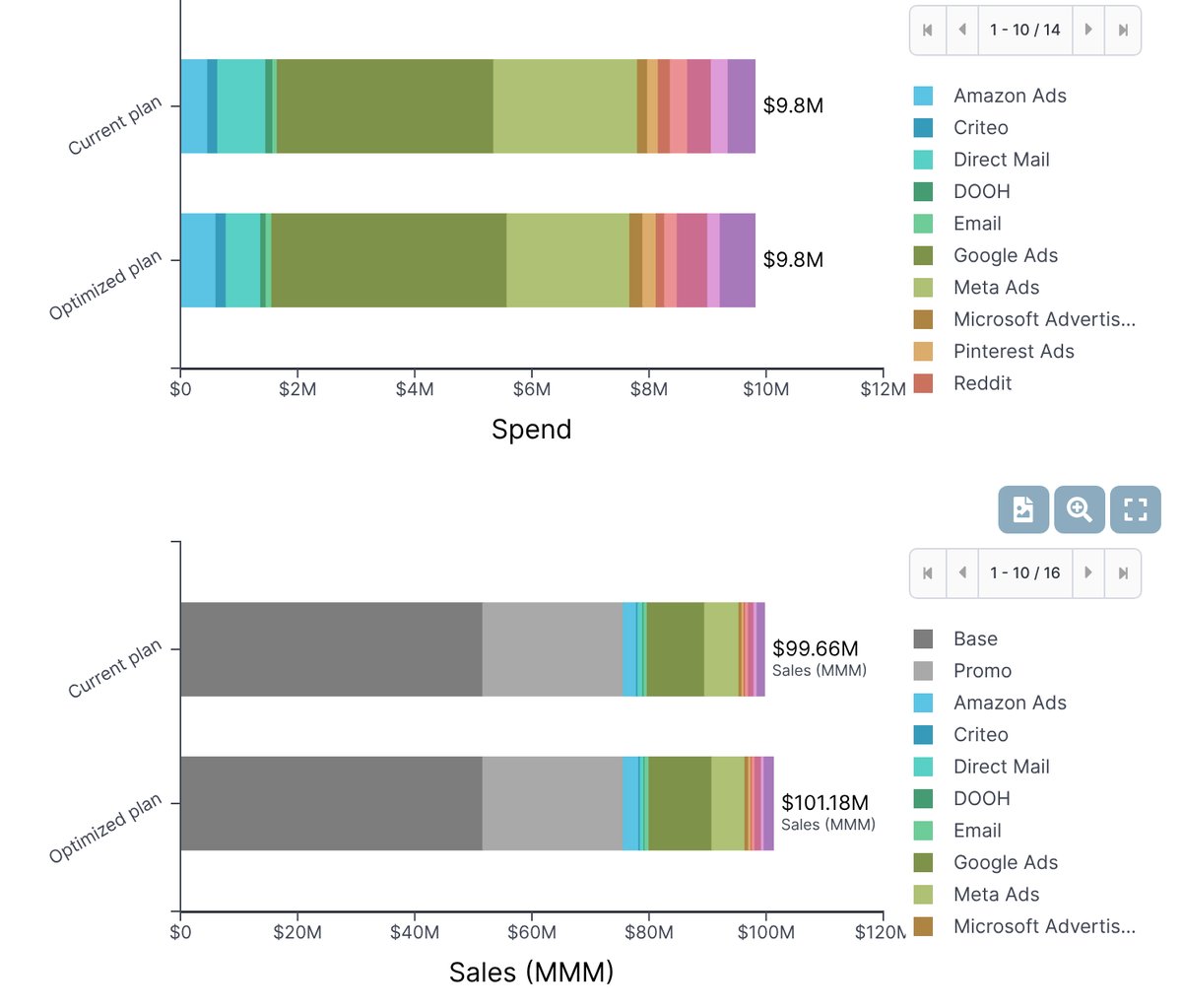
The charts below from the Sellforte demo (demo data, USD) compare the current allocation with an optimized plan for the same four weeks, with each channel and market allowed to move up to 30%. Spend stays at 9.8 million USD, while MMM-estimated sales rise from 99.66 to 101.18 million USD.
Media mix optimization in marketing mix modeling
An optimizer is only as good as the response curves behind it. Three issues matter most:
- Uncertainty. Jin et al. (2017) found that the optimal media mix from their Bayesian MMM had a large variance because of the variance of the parameter estimates. An optimizer favors the curves that look best, including those that look best by chance. Smith and Winkler (2006) call this the optimizer's curse: choosing the option with the highest estimated value leads to expected disappointment even when the estimates are unbiased, and they recommend Bayesian adjustment of the estimates. Informative priors, experiment calibration and change limits all reduce the risk.
- Time. Because of adstock, spend in one week drives sales in later weeks, and curves shift with seasonality. Optimizers therefore allocate spend week by week within the planning period instead of using one annual curve.
- Validation. Experiments calibrate the curves, and a heavy-up geo lift test in a channel the optimizer wants to scale checks the recommendation before the full budget moves.
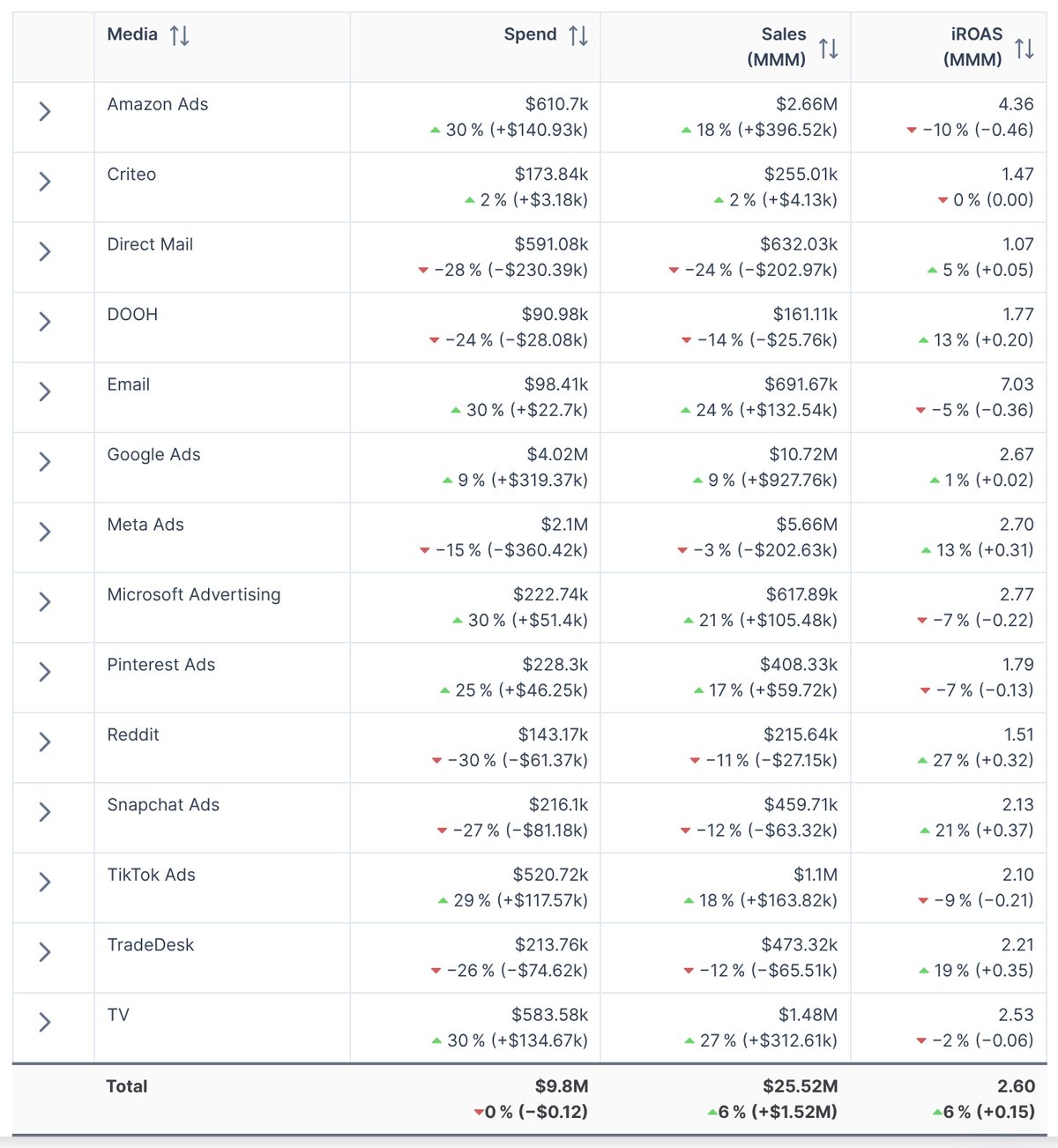
The result table for the same Sellforte demo run (demo data, USD) shows the change by ad platform. Platforms that gain budget, such as Amazon Ads (+30% spend), see their iROAS fall, while cut platforms such as Reddit (−30%) see it rise: diminishing returns at work. Several platforms end at the 30% limit, so the constraint binds. Media-driven sales rise by 6% (+1.52 million USD) and iROAS from 2.45 to 2.60 at unchanged spend.
Key takeaways
- Media mix optimization allocates a budget across channels, campaigns and weeks to maximize incremental revenue or profit within constraints.
- The optimum equalizes marginal iROAS across channels, so the channel with the highest average iROAS can still lose budget.
- For a profit-maximizing total budget, add spend until marginal iROAS reaches 1 divided by the contribution margin.
- Treat the output as a forecast: limit changes, account for model uncertainty and validate large moves with experiments.
Related terms
- Response curve
- Marginal iROAS (miROAS)
- Hill function
- Adstock
- Incrementality
- Measurement triangulation
- Google Meridian
Further reading on Sellforte
- How much should we let an MMM optimizer change the media mix at once?
- How does marketing mix modeling improve annual budget planning?
- How does marketing mix modeling optimize monthly and campaign budgets?
- ROAS, iROAS, miROAS: Choosing the right KPI for optimizing media spend
References
- Dorfman, R., & Steiner, P. O. (1954). Optimal advertising and optimal quality. The American Economic Review, 44(5), 826–836. https://www.jstor.org/stable/1807704
- Fischer, M., Albers, S., Wagner, N., & Frie, M. (2011). Practice prize winner—Dynamic marketing budget allocation across countries, products, and marketing activities. Marketing Science, 30(4), 568–585. https://doi.org/10.1287/mksc.1100.0627
- Google. (n.d.). Budget optimization scenarios. Meridian documentation. Retrieved 2026-11-28, from https://developers.google.com/meridian/docs/user-guide/budget-optimization-scenarios
- Jin, Y., Wang, Y., Sun, Y., Chan, D., & Koehler, J. (2017). Bayesian methods for media mix modeling with carryover and shape effects. Google Inc. https://research.google/pubs/bayesian-methods-for-media-mix-modeling-with-carryover-and-shape-effects/
- Mantrala, M. K., Sinha, P., & Zoltners, A. A. (1992). Impact of resource allocation rules on marketing investment-level decisions and profitability. Journal of Marketing Research, 29(2), 162–175. https://www.kellogg.northwestern.edu/academics-research/research/detail/1992/impact-of-resource-allocation-rules-on-marketing-investment-level/
- Runge, J., Skokan, I., Zhou, G., & Pauwels, K. (2024). Packaging up media mix modeling: An introduction to Robyn's open-source approach (arXiv:2403.14674). arXiv. https://doi.org/10.48550/arXiv.2403.14674
- Smith, J. E., & Winkler, R. L. (2006). The optimizer's curse: Skepticism and postdecision surprise in decision analysis. Management Science, 52(3), 311–322. https://doi.org/10.1287/mnsc.1050.0451
Authors

Lauri Potka is the Chief Operating Officer at Sellforte, with over 15 years of experience in Marketing Mix Modeling, marketing measurement, and media spend optimization. Before joining Sellforte, he worked as a management consultant at the Boston Consulting Group, advising some of the world’s largest advertisers on data-driven marketing optimization. Follow Lauri in LinkedIn, where he is one of the leading voices in MMM and marketing measurement.


