


The short answer
Start with 10% to 20% spend changes per channel, then move farther only where the team can execute and the evidence remains credible. Keep an unconstrained scenario for direction, not as the immediate plan. Check performance after each move and widen the limits deliberately.
This article is part of Asked by Marketers, a series answering real questions from marketing leaders.
Sellforte's team holds more than 1,450 meetings each year with marketing leaders in Ecommerce and Retail about Marketing Mix Modeling and incrementality testing. Each week, we anonymize at least one question from those conversations and answer it in depth, based on what marketers are actually struggling with, not what keyword tools suggest. About the series →
Why do marketers ask this?
MMM optimizer tools help marketers find budget scenarios based on the underlying Marketing Mix Model and constraints supplied by the user. One important constraint controls how far spend may move for each channel. In the Sellforte Optimizer screenshot below, the channel-specific budget controls appear as sliders on the left.
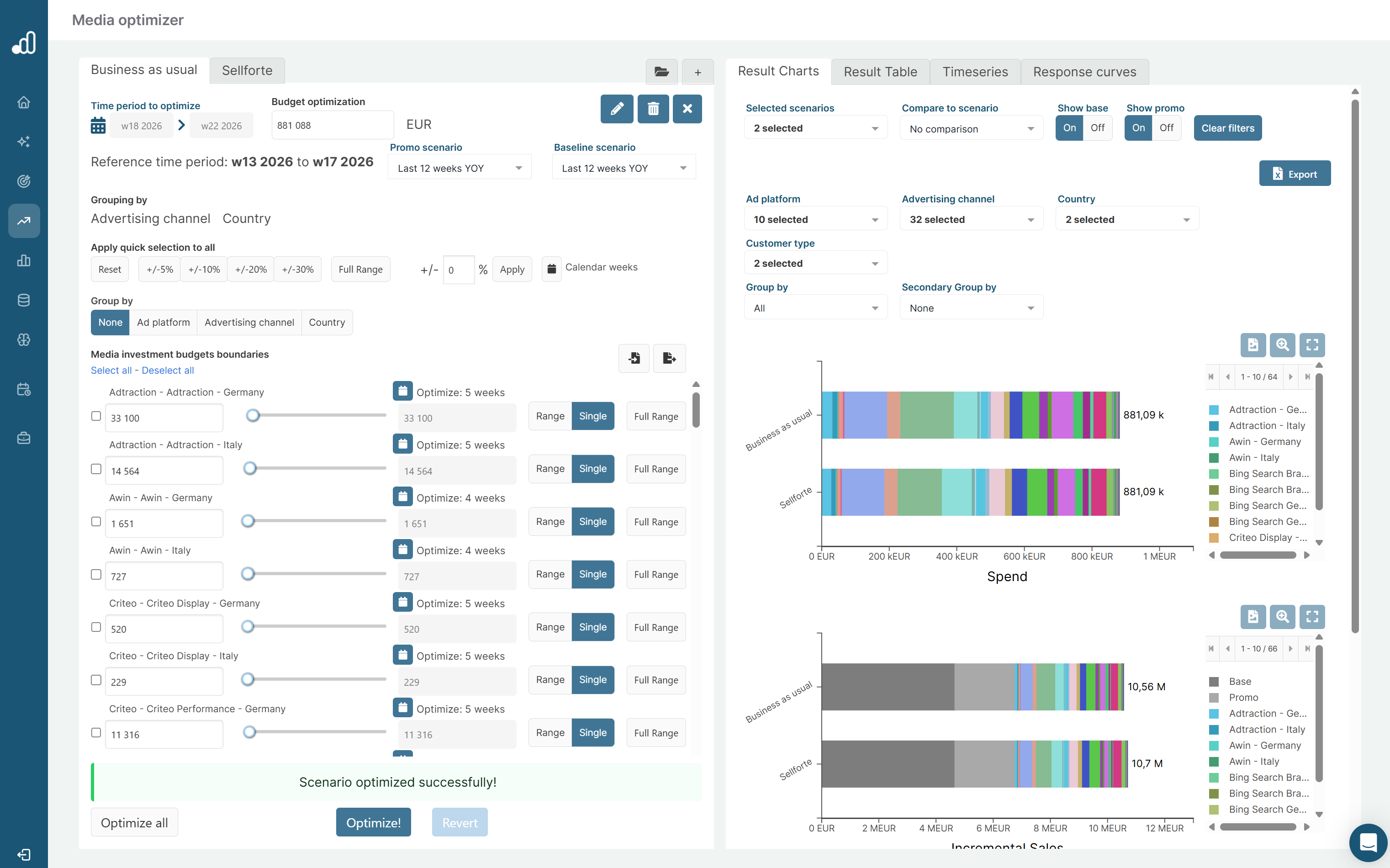
In practice, the user chooses between an unconstrained scenario, where the optimizer has full freedom, and a constrained scenario such as allowing each channel to move from 20% below to 20% above its reference spend.
Why not implement the unconstrained optimum immediately?
An unconstrained scenario answers an important question: where would the model move the budget if it only had to maximize the chosen outcome? It exposes the direction of travel and the potential value of correcting the current mix.
The calculation combines Marketing Mix Modeling results across investment pockets. Advertising response curves estimate how incremental sales change as spend rises or falls, and the optimizer reallocates budget toward stronger marginal returns until it reaches the best modeled allocation subject to the constraints it has been given.
That result is still a forecast. Large reallocations can push a channel beyond the spend levels that have been observed often enough to estimate confidently. They can also run into minimum viable budgets, buying commitments, audience limits, platform learning periods, creative capacity, or strategic roles that the objective function does not capture. If several channels change at once, it also becomes harder to explain why actual performance differed from the forecast.
Keep the full-range result in the scenario set because it shows what is at stake. Sellforte's analysis of 27 ecommerce and DTC advertisers estimated a 6.5% sales improvement from moving to the modeled MMM allocation at the same total media spend. That is the estimated full opportunity across the sample, not evidence that every company should make the whole move in one month.
What change limit should you start with?
A 10% to 20% limit per channel is a defensible starting point for a monthly planning cycle. It is wide enough for the optimizer to make a meaningful reallocation, but usually narrow enough for channel teams to implement without rebuilding the plan from scratch. Treat it as a governance default, not a statistical law.
The right starting range should tighten or widen with the situation:
If the reference budget for a channel is $100,000, a 20% relative limit gives the optimizer a range of $80,000 to $120,000. Apply the limit to each channel or investment pocket while keeping the total scenario budget fixed. The optimizer can then decide which channels use the available room.
Remember that repeated changes compound. Raising a channel by 20% in three consecutive monthly cycles would take it from 100 to about 173 if each new plan becomes the next reference. A cautious monthly limit is not a permanent brake on change. It is a way to reach a larger destination through observable steps.
Should every channel use the same change limit?
No. A common percentage is a useful first pass, but the final bounds should reflect what is known and executable for each channel. Ten percent of a large search budget can be a much bigger operational move than 30% of a small test channel.
Set channel-specific bounds from explicit reasons:
Old round-number caps deserve particular scrutiny. Every floor or ceiling should have an owner, a reason, and a date for review. Otherwise the constraint quietly becomes part of the model's answer even though it came from a decision nobody can explain.
When should you widen the change limits?
Widen the limits when the recommendation has survived contact with both the data and the operating plan. One good-looking scenario is not enough.
Before moving from 10% to 20%, or from 20% to 30%, check four things:
- Direction: The same channels remain candidates for increases and decreases across recent model runs and reasonable reference periods.
- Support: The proposed spend remains within a credible part of each response curve, or there is other evidence for moving beyond the historical range.
- Execution: The team made the prior change close to plan. If the planned mix never reached the market, there is nothing useful to validate.
- Attainment: Actual spend and the agreed outcome metrics are compared with the scenario forecast, with major gaps investigated before another step.
Do not widen every channel automatically. One channel may earn more room while another stays locked. If the full-range scenario keeps recommending a dramatic move that the constrained plans never approach, the answer may be a focused learning plan rather than a larger blind reallocation.
How this looks in practice
Consider a hypothetical ecommerce company with a $1 million monthly media budget. The optimizer is asked to maximize incremental sales while holding total spend constant. The team runs the same model and reference period with four different constraint settings.
All figures are illustrative forecasts, not observed results. The 20% scenario captures two-thirds of the full-range modeled sales gain while avoiding a 68% single-channel move. Within that scenario, paid social rises from $300,000 to $360,000, nonbrand search rises from $250,000 to $280,000, and three other channels each fall by 20%. The reallocations still sum to $1 million.
The team chooses the 20% scenario for the first month. It translates the channel plan into weekly pacing, records the expected incremental sales, and checks whether the intended changes were actually executed. If the recommendation remains stable and attainment is credible, the next scenario can allow a wider move where needed. If not, the team investigates before taking another step.
Related questions
Is the unconstrained optimum useless?
No. It is the clearest view of the model's preferred direction and the maximum modeled value at stake. Use it to identify persistent allocation gaps, then decide how quickly the organization should move toward them.
Should we set the same change limit for every channel?
Use one percentage value as the first pass, then add channel-specific floors and ceilings for evidence, commitments, capacity, and strategic role. Record why each exception exists and when it will be reviewed.
How often should we rerun the optimizer?
Rerun it whenever the planning assumptions or material evidence change, and at least on the cadence at which the team makes allocation decisions. The underlying model should also be current. See how often to retrain your Marketing Mix Model.
What if the total media budget is being cut?
Use the same constrained scenario logic, but remove spend first where the marginal incremental return is weakest rather than cutting every channel equally. Protect real business constraints and compare the forecast sales loss across feasible options. See how to cut a marketing budget while protecting growth.
How Sellforte helps
Sellforte Optimizer lets teams compare reference, constrained, and full-range media plans using MMM response curves and explicit channel-level limits. Teams can see the forecast outcome and budget allocation for each scenario before selecting an executable step. Book a demo.
Authors

Lauri Potka is the Chief Operating Officer at Sellforte and has over 15 years of experience in Marketing Mix Modeling, marketing measurement, and media spend optimization. Before joining Sellforte, he worked as a management consultant at the Boston Consulting Group, advising some of the world's largest advertisers on data-driven marketing optimization. Follow Lauri on LinkedIn, where he is one of the leading voices in MMM and marketing measurement.

Can web-only incrementality tests calibrate app sales in MMM?

What changes when an ecommerce or retail company adopts incrementality?