


Google Meridian is an open-source marketing mix modeling (MMM) framework from Google that advertisers use to build and run their own models in Python. It is based on Bayesian causal inference and can pool geo-level data in a hierarchical model to estimate how each channel drives sales or another KPI, and how to reallocate the budget.
Key facts
| Developer | Google; the GitHub repository mirrors Google's internal code and does not accept pull requests |
| License | Apache License 2.0 |
| Availability | Opened to all advertisers in January 2025; version 1.0.0 was published on PyPI on 2025-01-27 |
| Current version | 2.2.2, released 2026-11-25 |
| Computation | Python; MCMC sampling with the No-U-Turn Sampler (NUTS); JAX backend by default since version 2.0.0, TensorFlow still supported; GPU recommended |
| Data level | Geo-level data, which Google encourages when available, or national-level data |
| Predecessor | LightweightMMM, with a migration guide |
| Companion tools | Meridian GeoX for geo experiments; Meridian Scenario Planner for budget planning in Colab and Data Studio |
Sources: Google (2026a), Google (2025) and Google (2026b), as of 2026-11-27.
How the Meridian model works
Meridian regresses a KPI, such as revenue or conversions, on media and non-media variables and estimates the parameters with Bayesian statistics, so every estimate comes with a credible interval. The building blocks in version 2.2.2 (Google, 2026a) are:
- Media transformations. Each paid channel's media variable passes through adstock for carryover and the Hill function for saturation, adstock first by default. Adstock decay is geometric by default, with a binomial option, and includes up to 8 lag periods by default. Jin et al. (2017) proposed this combination of carryover and shape effects for Bayesian MMM.
- Geo hierarchy. In a geo-level model, each geo has its own media effect, drawn from a shared distribution that is log-normal by default. This is a hierarchical Bayesian model: geos with little signal are pulled toward the common effect. Sun et al. (2017) showed that such a geo-level model generally gives tighter credible intervals than a model fitted to national data alone.
- Reach and frequency. For channels with reach and frequency data, Meridian models the two separately rather than as total impressions, following Zhang et al. (2023), and it can recommend an optimal average frequency.
- Time effects. A time-varying baseline is built from knots. By default, a geo-level model has one knot per time period and a national model a single knot; an Automatic Knot Selection option chooses the number of knots from the data.
- Other variables. Control variables account for other factors that affect the KPI. Non-media treatments are marketing actions without a direct media cost that, unlike controls, the advertiser can change; they get no adstock or Hill transformation. Organic media covers unpaid activity such as newsletters, blog posts, social media or email campaigns, and does get adstock and Hill effects.
A revenue-per-KPI input converts a non-revenue KPI into money for results and optimization.
Priors and calibration
Meridian reports a channel's return as ROI: the change in expected outcome when that channel's spend is set to zero, divided by its spend. Its mROI is the change in outcome from a small increase in spend, divided by that increase. When the outcome is revenue, these are what MMM practitioners also call incremental ROAS (iROAS) and marginal iROAS.
By default, Meridian places its prior on each channel's ROI rather than on the regression coefficient, and derives the coefficient from that prior. Zhang et al. (2024) proposed this reparameterization so that the prior can be matched to experiment results or other prior knowledge, and reported in simulations that it reduces bias and uncertainty in the posterior estimates. The prior can alternatively be set on mROI, on the channel's contribution or on the coefficient itself.
The default ROI prior is LogNormal(0.2, 0.9). Results from incrementality experiments can replace it channel by channel, and the prior can be restricted to the time window that the experiment covered. Version 2.0.0 added prior calibration from incrementality experiments such as those run with Meridian GeoX, together with channel calibration recommendations (Google, 2026a).
Worked example: from an experiment result to a prior
Suppose a geo lift test estimated a channel's iROAS at 2.5 with a standard error of 0.6. Meridian's helper lognormal_dist_from_mean_std converts a mean and standard deviation into log-normal parameters:
σ = √ln(1 + sd² / mean²) μ = ln(mean) − σ² / 2
With mean = 2.5 and sd = 0.6, σ = √ln(1.0576) = 0.237 and μ = ln(2.5) − 0.028 = 0.888. The table compares this prior with the default (illustrative numbers):
| Prior | Mean | Standard deviation | Median | 90% interval | P(return < 1) |
| Default: LogNormal(0.2, 0.9) | 1.83 | 2.05 | 1.22 | 0.28–5.37 | 41% |
| From the experiment: LogNormal(0.888, 0.237) | 2.50 | 0.60 | 2.43 | 1.65–3.59 | < 0.1% |
The default prior is wide: it gives about a 41% probability that the channel returns less than it costs. The experiment-based prior is far narrower, so the posterior will stay close to 2.5 unless the sales data clearly contradict it. Two checks matter first. The experiment must measure the same quantity as the prior: a go-dark test compares current spend with zero, like Meridian's ROI, while a heavy-up test measures the return on extra spend, which is closer to mROI. And the standard error should reflect the experiment's real uncertainty, since a prior that is too tight overrides the data.
Outputs and budget optimization
After sampling, Meridian reports each channel's incremental outcome, ROI, mROI and cost per incremental KPI (CPIK), plus response curves, model fit charts and a model health review covering convergence and calibration (Google, 2026a).
The budget optimizer works in two modes. A fixed-budget scenario keeps total spend constant and, by default, allows each channel to move 30% below or above its historical spend. A flexible-budget scenario lets total spend change until the ROI or mROI of total spend reaches a target the user sets. For reach and frequency channels, the optimizer can use the model's optimal frequency.
Google Meridian in marketing mix modeling practice
Meridian provides the model; the team using it provides the rest. The README describes it as a framework for advertisers to "set up and run their own in-house models" (Google, 2026a). That means collecting KPI, spend, media and control data by geo and period, running the sampler on suitable hardware (Google reports testing on a T4 GPU with 16 GB of RAM), checking convergence and out-of-sample fit, choosing priors, refreshing the model and feeding experiment results back in. The Meridian team answers GitHub issues and discussions weekly in batches.
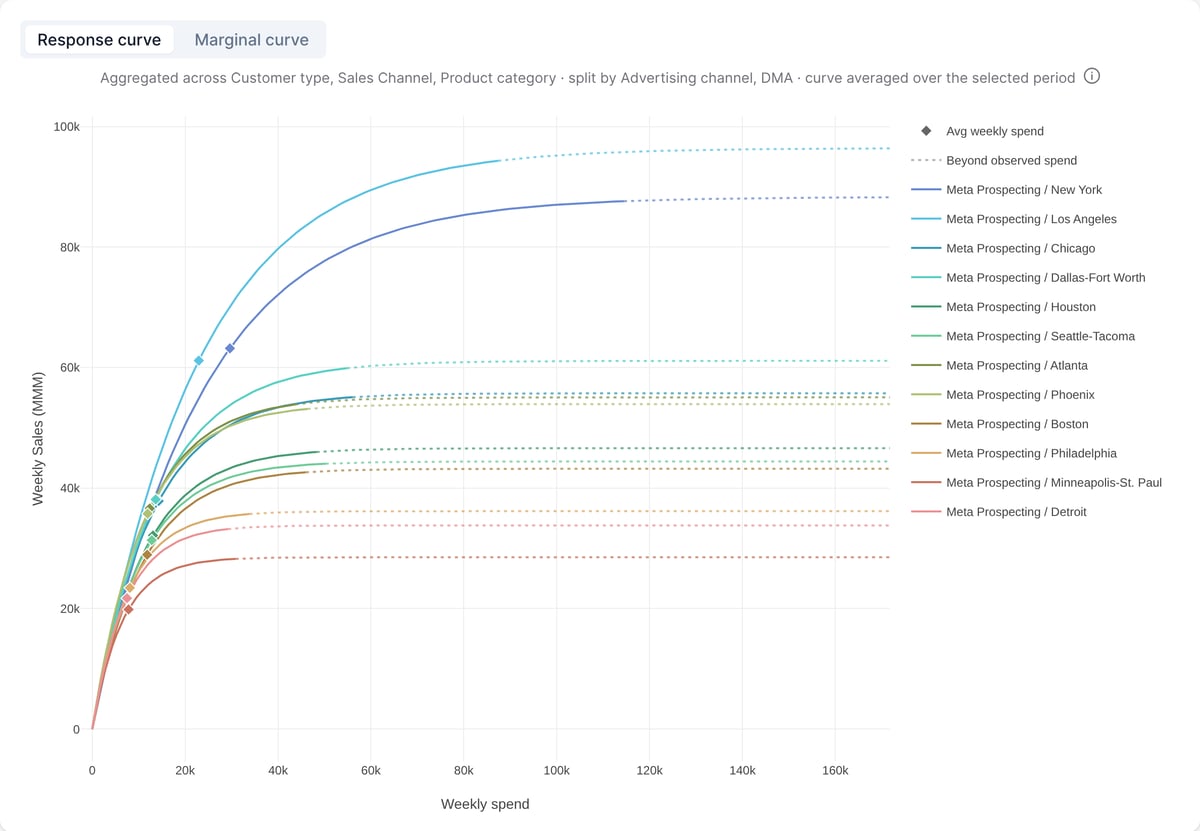
A geo-level model produces a separate response curve for each channel in each geo. The chart below from the Sellforte demo (demo data) shows Meta Prospecting response curves across 12 US designated market areas (DMAs). The curves share a shape but saturate at different levels: the geo-to-geo variation a hierarchical model estimates without fitting each geo in isolation.
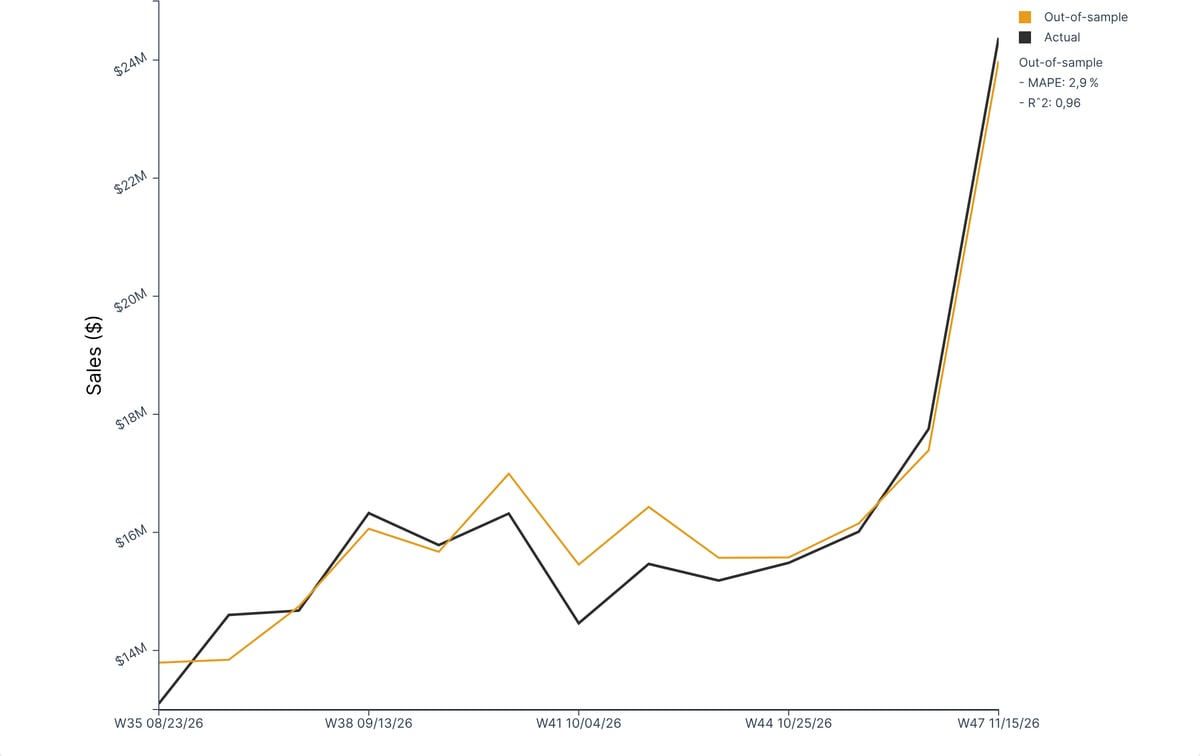
A model should also be checked on data it was not trained on; Meridian can hold out geos or time periods for this. The next chart, from the same demo (demo data), compares out-of-sample predictions with actual weekly sales over 13 weeks, with an out-of-sample MAPE of 2.9% and an R² of 0.96.
Sellforte offers MMM as a managed SaaS rather than a library. For a side-by-side look at the two approaches, see Meridian vs. Sellforte MMM SaaS.
Key takeaways
- Google Meridian is Google's open-source Bayesian MMM framework for Python, available to all since January 2025; the current version is 2.2.2.
- It combines adstock and Hill transformations with an optional geo-level hierarchy, reach and frequency modeling, controls, non-media treatments and organic media.
- Meridian sets priors on its ROI metric by default, so incrementality test results can be turned directly into channel priors; Meridian's ROI and mROI correspond to iROAS and marginal iROAS when the outcome is revenue.
- Meridian supplies the model, diagnostics and optimizer; data, compute, model review, refreshes and experiments remain the user's work.
Related terms
- Bayesian statistics
- Hierarchical Bayesian modeling
- Adstock
- Hill function
- Response curve
- Marginal iROAS (miROAS)
- Geo lift test
- Frequency
Further reading on Sellforte
- Meridian vs. Sellforte MMM SaaS: The Complete Comparison for 2026
- MMM Calibration Explained: What It Is, Why It Matters, and How to Do It
- Comparison of Robyn vs Lightweight vs Marketing Mix Modeling SaaS
- What is Marketing Mix Modeling (MMM)? A Complete Guide for Marketers
References
- Google. (2025, January 29). Meridian is now available to everyone. The Keyword. https://blog.google/products/ads-commerce/meridian-marketing-mix-model-open-to-everyone/
- Google. (2026a). Meridian (Version 2.2.2) [Computer software]. GitHub. Retrieved 2026-11-27, from https://github.com/google/meridian
- Google. (2026b). Meridian GeoX (Version 1.0.1) [Computer software]. GitHub. Retrieved 2026-11-27, from https://github.com/google/meridian-geox
- Jin, Y., Wang, Y., Sun, Y., Chan, D., & Koehler, J. (2017). Bayesian methods for media mix modeling with carryover and shape effects. Google Inc. https://research.google/pubs/bayesian-methods-for-media-mix-modeling-with-carryover-and-shape-effects/
- Sun, Y., Wang, Y., Jin, Y., Chan, D., & Koehler, J. (2017). Geo-level Bayesian hierarchical media mix modeling. Google Inc. https://research.google/pubs/geo-level-bayesian-hierarchical-media-mix-modeling/
- Zhang, Y., Wurm, M., Wakim, A., Li, E., & Liu, Y. (2023). Bayesian hierarchical media mix model incorporating reach and frequency data. Google Inc. https://research.google/pubs/bayesian-hierarchical-media-mix-model-incorporating-reach-and-frequency-data/
- Zhang, Y., Wurm, M., Li, E., Wakim, A., Kelly, J., Price, B., & Liu, Y. (2024). Media mix model calibration with Bayesian priors. Google Inc. https://research.google/pubs/media-mix-model-calibration-with-bayesian-priors/
Authors

Dr. Paavo Niskala is a Principal Engineer at Sellforte. With PhD in the field of computational plasma physics, he has over 10 years of experience in designing and building complex data-intensive systems. Paavo has especially focused on using data science in critical business applications, such as Marketing Mix Modeling, which helps businesses make better marketing decisions. Follow Paavo in LinkedIn.


