


Cost per conversion, also called cost per acquisition or cost per action (CPA), is the average media spend needed to generate one attributed conversion. It is calculated by dividing media spend by the number of conversions. A conversion is any action the advertiser chooses to track, such as a purchase, lead form submission or newsletter sign-up.
Cost per conversion (CPA) formula
Cost per conversion (CPA) = Media spend / Number of conversions
Google Ads reports this as average CPA: the total cost of conversions divided by the total number of conversions (Google Ads Help, n.d.-a). The value depends on which actions are counted as conversions, so a CPA for purchases and a CPA for sign-ups are not comparable.
Example
If your media spend is $10,000 and you receive 500 conversions, your cost per conversion is $20.00.
| Advertising spend | $10,000 |
| Number of Conversions | 500 |
| Cost Per Conversion | $20.00 |
How conversions are counted
Unlike CPC or CPM, which use counts the ad platform observes directly, CPA depends on conversion tracking and attribution rules:
- Tracking. The advertiser installs the platform's tag or pixel on the website, or sends conversions server-side, so that conversion events are reported back to the ad platform.
- Click-through conversions. A conversion is credited to an ad if the user clicked it within a set window. In Google Ads the default click-through conversion window is 30 days, and it can be set between 1 and 90 days depending on the conversion source (Google Ads Help, n.d.-b).
- View-through conversions. Conversions can also be credited after an impression without a click. Google Ads records these for display and video ads, crediting the last impression before the conversion (Google Ads Help, n.d.-c). Meta's default attribution setting is 7-day click or 1-day view, chosen at the ad set level (Meta Business Help Center, n.d.).
Longer windows and view-through credit produce more conversions and a lower CPA, without any change in what the ads actually achieve. Compare CPAs only when the conversion definition and attribution settings match.
How CPA is used
- Bidding. Target CPA bidding lets the platform set bids automatically to get as many conversions as possible at the target average cost. Sellforte has written about how to treat Google's Target CPA recommendations.
- Comparing channels and campaigns. Marketers compare CPA to see which campaigns produce conversions at the lowest cost.
- Diagnosing performance changes. CPA = CPC / conversion rate, when conversion rate is measured per click. A rising CPA can come from more expensive clicks, fewer conversions per click, or both.
Attributed CPA vs. incremental CPA
Attributed CPA counts every conversion that the platform links to an ad, including those that would have happened anyway. Incremental CPA divides spend by the conversions the ads actually caused. The two can be far apart:
- In a large field experiment at eBay, the returns to paid search were a fraction of non-experimental estimates, and brand-keyword ads showed no measurable short-term benefit (Blake, Nosko & Tadelis, 2015).
- Across 15 randomized experiments at Facebook, observational methods often failed to reproduce the experimental ad effects, even with extensive data on users (Gordon et al., 2019).
Optimizing to the lowest attributed CPA therefore tends to reward campaigns that reach people who were already about to convert. Incremental CPA comes from conversion lift studies, geo experiments or marketing mix modeling. A related metric for the whole business is customer acquisition cost (CAC), which divides all acquisition costs by the number of new customers.
How to track cost per conversion
Each ad platform reports CPA for its own campaigns, using its own attribution rules. To compare across platforms, channels and campaigns, the data needs to be consolidated and grouped consistently. Below are examples of tracking views from the Sellforte demo.
Ad platform-level cost per conversion analysis:

Advertising channel-level cost per conversion analysis:

Cost per conversion in the media metric funnel
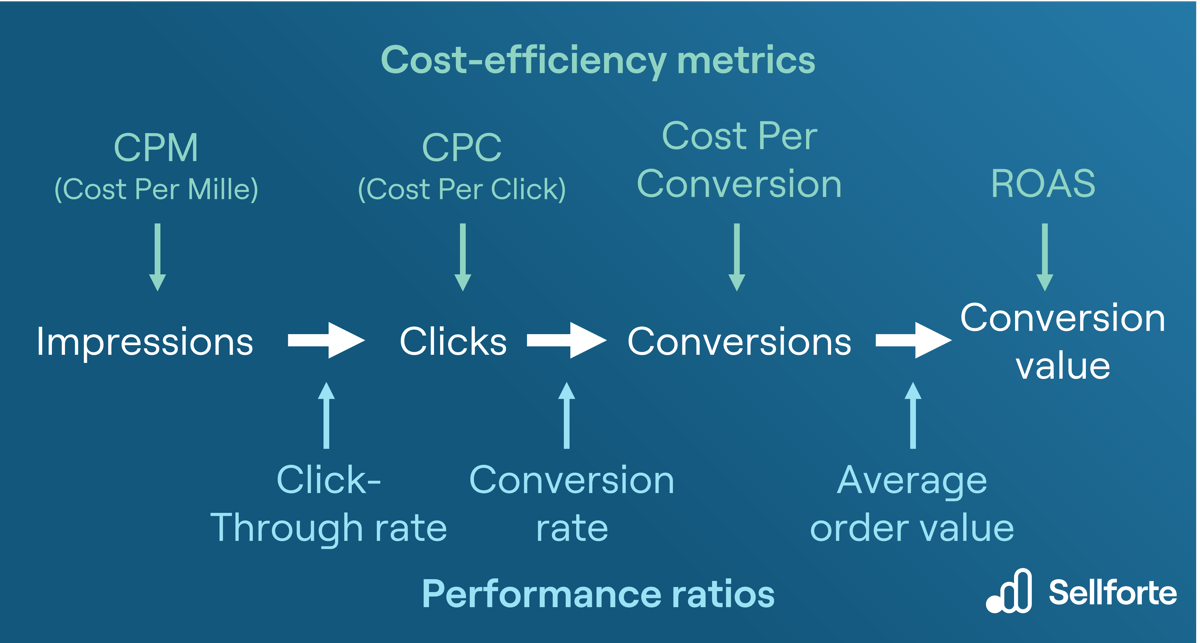
Cost per conversion is one of the cost-efficiency metrics in the media metric funnel, which follows an ad from impressions to clicks, conversions and conversion value. Conversions in the funnel are counted by attribution rules after a click or, for some ad types, after a view without a click, so the funnel describes attributed results rather than incremental ones.
Note on abbreviations
Cost per conversion is sometimes abbreviated "CPC", but in most contexts CPC means cost per click. CPA is the clearer abbreviation.
Key takeaways
- CPA = media spend / conversions, where conversions follow the advertiser's own definition.
- Attribution windows and view-through credit change CPA without changing real results.
- Incremental CPA, measured with experiments or MMM, is the basis for budget decisions.
Related terms
- Cost per click (CPC)
- Conversion rate
- Customer acquisition cost (CAC)
- Return on advertising spend (ROAS)
- Incrementality
Further reading on Sellforte
- Google Ads Target CPA recommendations
- Platform ROAS vs. incremental ROAS
- What is incrementality testing?
References
- Blake, T., Nosko, C., & Tadelis, S. (2015). Consumer heterogeneity and paid search effectiveness: A large-scale field experiment. Econometrica, 83(1), 155–174. https://doi.org/10.3982/ECTA12423
- Google Ads Help. (n.d.-a). Average CPA: Definition. Retrieved 2026-10-30, from https://support.google.com/google-ads/answer/6396841
- Google Ads Help. (n.d.-b). About conversion windows. Retrieved 2026-10-30, from https://support.google.com/google-ads/answer/3123169
- Google Ads Help. (n.d.-c). About view-through conversions. Retrieved 2026-10-30, from https://support.google.com/google-ads/answer/16542520
- Gordon, B. R., Zettelmeyer, F., Bhargava, N., & Chapsky, D. (2019). A comparison of approaches to advertising measurement: Evidence from big field experiments at Facebook. Marketing Science, 38(2), 193–225. https://doi.org/10.1287/mksc.2018.1135
- Meta Business Help Center. (n.d.). About the attribution setting. Retrieved 2026-10-30, from https://www.facebook.com/business/help/460276478298895
Authors

Lauri Potka is the Chief Operating Officer at Sellforte, with over 15 years of experience in Marketing Mix Modeling, marketing measurement, and media spend optimization. Before joining Sellforte, he worked as a management consultant at the Boston Consulting Group, advising some of the world’s largest advertisers on data-driven marketing optimization. Follow Lauri in LinkedIn, where he is one of the leading voices in MMM and marketing measurement.


