


Average order value (AOV) is the average amount a customer spends per order. For a whole business, it is total revenue divided by the number of orders. For a channel or campaign, it is the conversion value attributed to it divided by the conversions attributed to it. AOV, together with conversion volume, determines how much revenue advertising is credited with.
Average order value formula
Total average order value = Total revenue / Number of orders
Average order value of a campaign = Conversion value attributed to the campaign / Number of conversions attributed to the campaign
Definitions of "revenue" vary between systems: gross or net of discounts, with or without tax, shipping and returns. For example, Shopify changed its AOV definition in January 2023 to gross sales minus discounts, excluding adjustments made after the order was created (Shopify, 2023). Ad platforms use whatever conversion value the advertiser sends with the conversion tag. Check that both figures use the same revenue definition before comparing AOV between an ad platform and the store's own reporting.
Example calculation for average order value
If $50,000 of conversion value can be attributed to a campaign, consisting of 500 conversions, AOV for the campaign is $100.
| Conversion value attributed to the campaign | $50,000 |
| Number of conversions attributed to the campaign | 500 |
| Average Order Value | $100 |
How is average order value tracked?
Total AOV is available from the eCommerce platform or the order system. Channel- and campaign-level AOV requires conversion tracking that sends both the conversion and its value to the ad platform. To compare AOV across platforms and channels, the data needs to be consolidated in one place. Below is an example of an advertising channel-level view for AOV from the Sellforte demo.

How are attributed conversions measured?
Campaign-level AOV inherits the assumptions of attribution. Conversion events and their values are reported to the ad platform by its tag or pixel, or server-side, and credited to campaigns by attribution rules. In Google Ads, for example, the default click-through conversion window is 30 days, adjustable between 1 and 90 days depending on the conversion source (Google Ads Help, n.d.). Platforms can also credit conversions after a view without a click. Different windows or models credit different orders, and therefore produce different AOVs for the same campaign.
How is average order value used?
- Comparing the value of traffic. Marketers compare AOV across channels and campaigns to see which ones bring customers who buy more per order. A low AOV can point to audiences or offers that attract smaller baskets, such as discount-driven traffic.
- Diagnosing return on spend. When a channel's return changes, AOV is one of the factors to check, alongside CPC and conversion rate.
- Setting targets. AOV and margin determine how much a business can afford to pay for an order, which links AOV to CPA and ROAS targets.
How AOV affects ROAS and iROAS
Attributed revenue is conversions multiplied by AOV, so ROAS can be broken into its funnel components:
ROAS = Conversion value / Media spend = (Conversion rate × AOV) / CPC
where conversion rate is measured per click. For example, a campaign with a 2% conversion rate, a $100 AOV and a $0.50 CPC has a ROAS of 4.0. If AOV falls to $80 with everything else unchanged, ROAS falls to 3.2.
The same logic applies to incremental ROAS (iROAS), with one difference: what matters is the value of the orders the advertising caused, not of all orders it is credited with. Attributed AOV is the average over every credited order, including orders that would have happened anyway. The incremental orders can have a different average value, for example when a promotion-led campaign brings in smaller first-time baskets while the higher-value orders credited to it come from existing customers who would have bought anyway. Experiments and marketing mix modeling estimate incremental revenue directly, so they capture both the number and the value of the orders that advertising adds.
Average order value in the media metric funnel
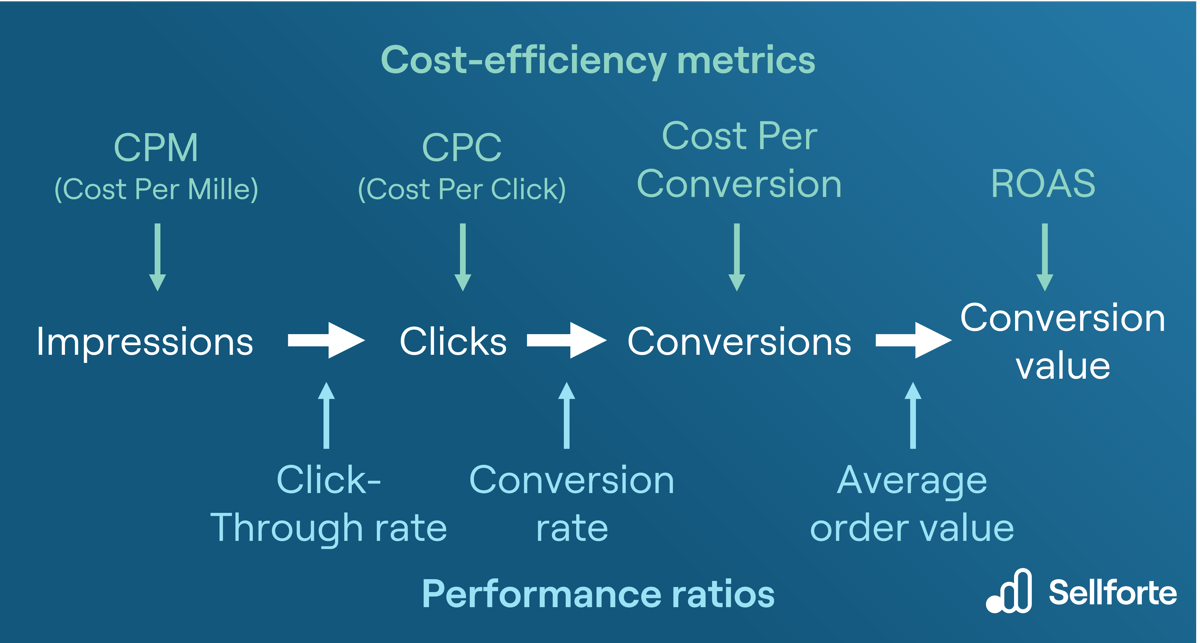
Average order value is one of the performance ratios in the media metric funnel, which follows an ad from impressions to clicks, conversions and conversion value. Conversions in the funnel are counted by attribution rules after a click or, for some ad types, after a view without a click, so the funnel describes attributed results rather than incremental ones.
Key takeaways
- AOV = revenue / orders. Check which revenue definition each system uses.
- ROAS = (conversion rate × AOV) / CPC, so a change in AOV moves ROAS directly.
- Attributed AOV is not the value of incremental orders; that comes from experiments or MMM.
Related terms
- Return on advertising spend (ROAS)
- Conversion rate
- Cost per conversion (CPA)
- Lifetime value (LTV)
- Incrementality
Further reading on Sellforte
- ROAS, iROAS and miROAS
- Platform ROAS vs. incremental ROAS
- Why should you combine media metrics with MMM insights?
References
- Google Ads Help. (n.d.). About conversion windows. Retrieved 2026-10-30, from https://support.google.com/google-ads/answer/3123169
- Shopify. (2023, January 9). Your average order value now has a new definition in Shopify. Shopify Changelog. https://changelog.shopify.com/posts/your-average-order-value-now-has-a-new-definition-in-shopify
Authors

Lauri Potka is the Chief Operating Officer at Sellforte, with over 15 years of experience in Marketing Mix Modeling, marketing measurement, and media spend optimization. Before joining Sellforte, he worked as a management consultant at the Boston Consulting Group, advising some of the world’s largest advertisers on data-driven marketing optimization. Follow Lauri in LinkedIn, where he is one of the leading voices in MMM and marketing measurement.


