


Most ecommerce, retail and DTC brands are planning their 2027 marketing budgets right now. The hard part is rarely the spreadsheet. It's agreeing with finance on which channels drive growth, how much should go to brand, and what counts as proof.
For these brands, the same customer might buy in the webshop, on Amazon, at a retail partner or in a store. Last-click attribution only follows the clicks that end in an online purchase, so the sales everywhere else go uncredited.
The gap with finance is wide. In The CMO Survey 2026 of 308 US marketing leaders, 56% said they feel increasing pressure from their CFO to prove the value of marketing. Only 15% gave their CFO the top score (7 out of 7) as a business partner in building the case for marketing spend.
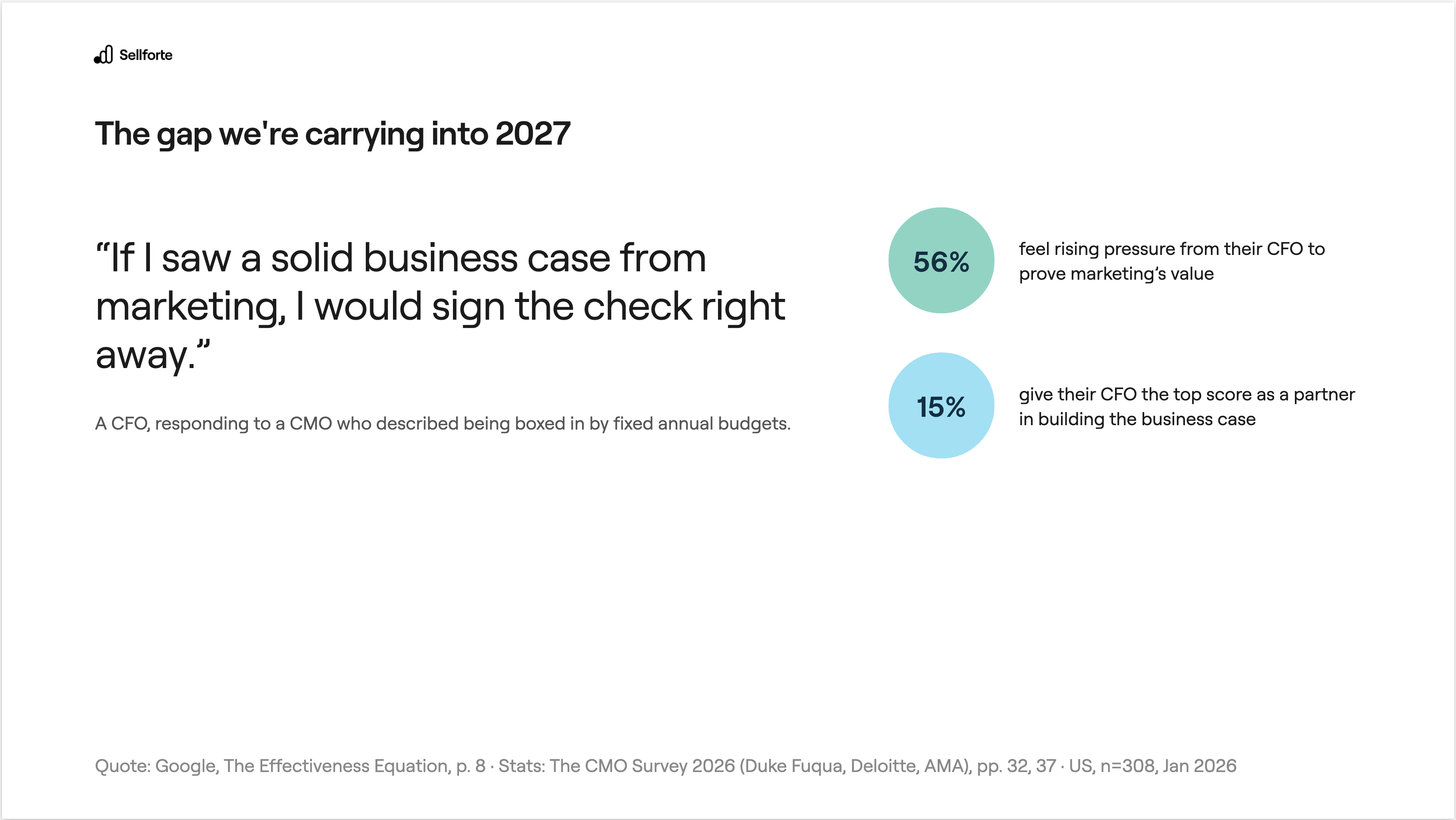 Sources: The CMO Survey 2026 (Duke Fuqua, Deloitte, AMA), Topline Report, pp. 32 and 37; CFO quote from Google, The Effectiveness Equation, p. 8.
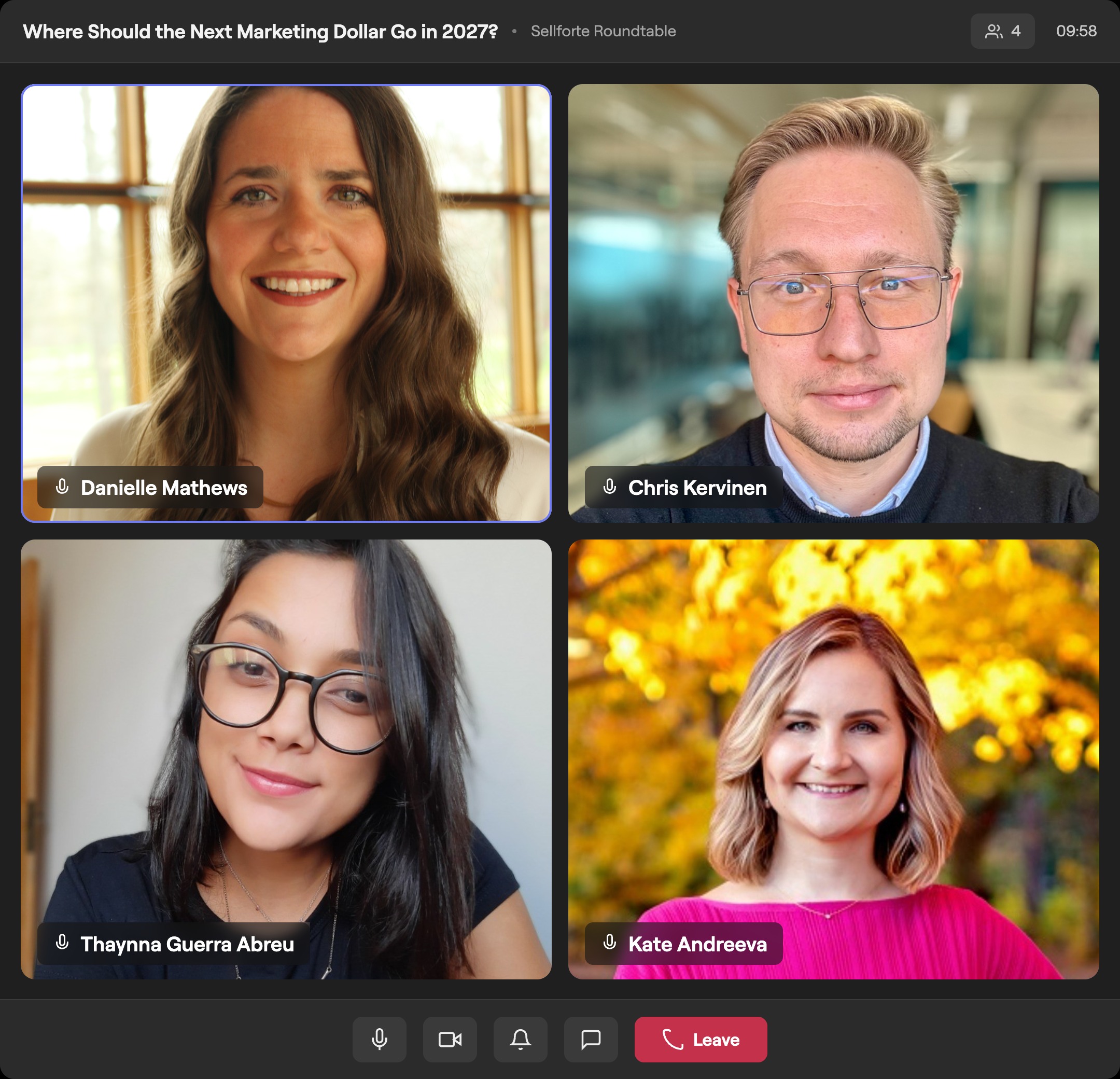
On 30 September 2026, we brought together three perspectives to answer one question: where should the next marketing dollar go in 2027?
- Pura, a US smart home fragrance brand that was DTC-only until 2025, is now in Target, Ulta, Nordstrom, Best Buy, Costco and Amazon, and is looking at international expansion in the next couple of years
- Grupo Azzas 2154, one of Latin America's biggest fashion groups, behind FARM Rio, Animale, Maria Filó, Reserva and Cris Barros, with brands that also operate in the US and Europe
- AMP, a US full-funnel media agency working across national brands in different verticals and at different stages of measurement maturity
Speakers:
- Danielle Mathews, Sr. Director, Integrated Marketing at Pura
- Thaynna Guerra Abreu, Media Specialist at Grupo Azzas 2154
- Kate Andreeva, VP, Campaign Analytics at AMP
- Moderated by Chris Kervinen, Head of Growth & Delivery, US at Sellforte
This post collects their lessons for ecommerce, retail and DTC teams planning 2027: how to split brand and performance, which channels to trust across online and offline sales, and how to get finance to sign off on the budget.
Inside the panel's measurement setups
Each panelist measures at a different stage: a brand in its first year of MMM, a fashion group running MMM across its whole portfolio, and an agency serving clients at very different points of measurement maturity.
Pura sees Meta and Google as its core performance channels. In 2026 the team kept the performance budget pretty much flat to protect .com, made major investments in brand and product marketing, and added its first MMM next to a standard multi-touch attribution tool.
We had to prove incremental value, because our CFO won't want us to invest in anything we can't prove.
— Danielle Mathews, Pura
Grupo Azzas 2154 runs corporate media as an in-house media consultancy for its fashion brands. Thaynna's role spans paid media strategy, MMM and attribution. The team maintains solid GA4 and GTM governance and runs MMM with Sellforte to add counterfactual analysis.
We focus on translating measurement into decisions leadership trusts.
— Thaynna Guerra Abreu, Grupo Azzas 2154
AMP's Campaign Analytics team works with a range of national brands across industries and verticals. In Kate's words, they serve "clients at very different points of measurement maturity, with different media scales and channel mixes."
It all comes down to one question: what's the real incremental value paid media drives for our clients' businesses, and how can we use data to make it work harder and drive growth?
— Kate Andreeva, AMP
7 lessons for planning your 2027 marketing budget
1. Budget decisions need proof from measurement finance trusts
None of the panelists relies on a single number. They back budget decisions with several methods, each used for what it measures best. At AMP, Kate's team splits the work this way:
- Marketing mix modeling (MMM) gives the big picture for cross-channel allocation and the split across funnel stages.
- Attribution is used for real-time optimization while campaigns are in flight, ideally calibrated with incrementality.
- Geo lift or conversion lift tests check a new channel or tactic, confirm an existing channel still contributes, and keep the MMM calibrated.
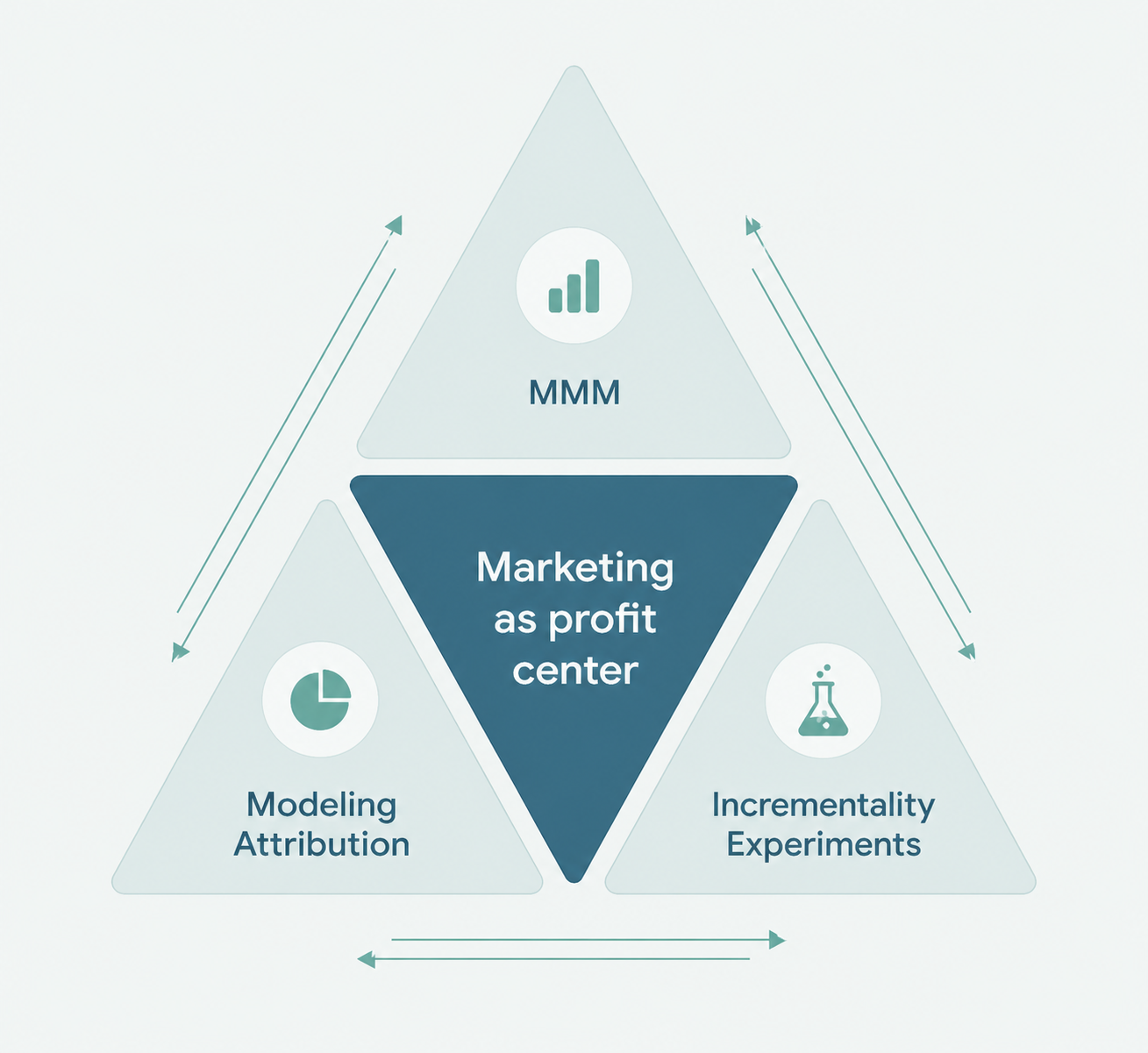
That builds trust in our findings and lets us keep calibrating the MMMs. The strongest measurement programs lean on all three.
— Kate Andreeva, AMP
The proof matters most in budget meetings. Kate compared clients with and without MMM:
Conversations with last-click data only are much harder. You have no data showing what the upper funnel, say premium streaming, contributes. When you're limited to last-click and ROAS, it's natural to lean into the channels showing hard revenue numbers. With an MMM, you have the complete picture of business contribution, including short-term payback for upper- and mid-funnel tactics, and those discussions with CMOs are a lot easier.
— Kate Andreeva, AMP
For 2027 planning: use MMM to set the budget split, attribution to steer it during the year, and lift tests to check the channels you're least sure about. See how bonprix connected all three methods across 16 markets.
2. Last-click undervalues the upper funnel and offline sales
Last-click reporting can't see what happens before the final click, on another device or in a store. That's why upper-funnel marketing is so hard to measure with attribution alone.
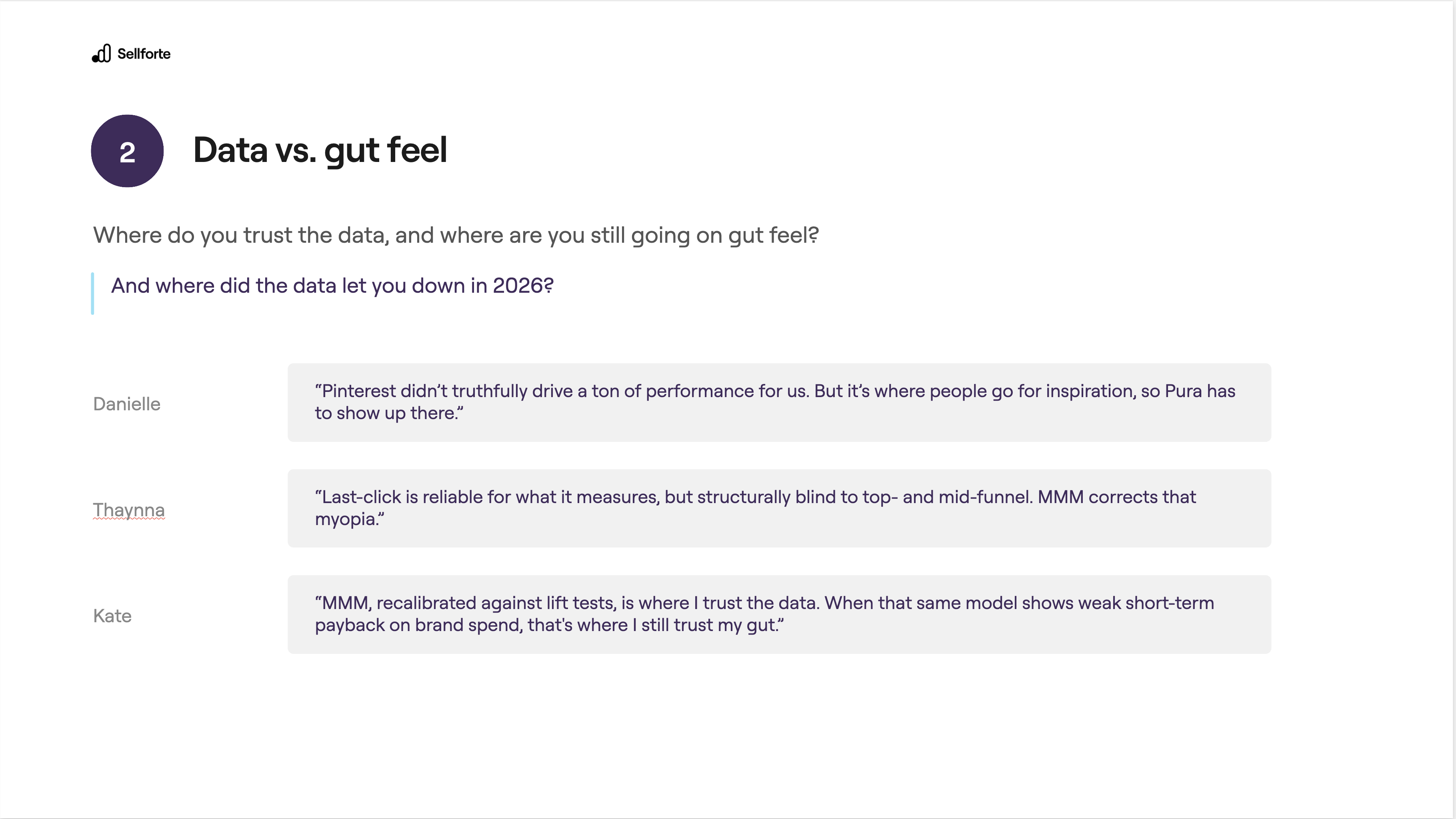
Last-click is reliable for what it measures, and it's still structurally blind to the top, middle, and offline channels that are essential to brand health. Positive ROI only shows up for the bottom of the funnel.
— Thaynna Guerra Abreu, Grupo Azzas 2154
Both brand-side panelists used Pinterest as the example. For Pura it doesn't drive a ton of sales, but Danielle keeps it because people go there for discovery and inspiration. At Grupo Azzas 2154, the ROI looked weak at first. With MMM, the group now sees a good ROI in GA4 and a better ROI in MMM, plus impact on physical store sales. Pinterest is now a strategic partner rather than a test channel.
Pinterest not driving the sale in the moment doesn't mean it isn't keeping us top of mind for when they search later.
— Danielle Mathews, Pura
The same blind spot applies to sales channels. When people inside Pura said they weren't seeing new .com customers tick up with the brand investment, Danielle pointed to the total:
New Pura users overall, buying at retail, receiving it as a gift, or buying on .com, are growing. That's brand.
— Danielle Mathews, Pura
For 2027 planning: before you cut a channel with weak last-click ROAS, check its incremental contribution across every sales channel, including stores. Agree with finance which outcome brand spend is judged on, such as total new customers across all channels.
3. Some channels capture demand and others create it
At the start of 2026, over half of Animale's budget was allocated to Google. Ad costs were running above target, and last-click revenue was missing its goals.
MMM showed that Google was mostly capturing existing demand, while Meta was generating new demand.
— Thaynna Guerra Abreu, Grupo Azzas 2154
The team reduced Google's share by about 50% and increased the Meta budget by a similar margin. Overall revenue nearly doubled, both in last-click and in the incremental view, and ad costs dropped well below target. Google maintained its revenue and efficiency on the smaller budget, which confirmed it had been capturing existing demand. The group is now rolling this out to other brands and channels, including TikTok and retargeting partners.
For 2027 planning: before moving budget between channels, find out which ones create new demand and which ones collect sales that other channels created. A channel can look strong in last-click and still add little.
4. An all-performance budget gets more expensive every year
Finance often sees performance spend as the safe option. Kate explained why it stops being safe:
Leaning too hard into performance doesn't stay cheap. When performance has to absorb all that spend, you quickly hit diminishing returns. The cost to acquire a new customer goes up, and you don't necessarily see incremental revenue or brand growth.
— Kate Andreeva, AMP
Brands that chase only the immediate sale end up competing in the same low-funnel channels as everyone else, mostly capturing existing demand instead of growing new demand.
Anyone with budget can copy your targeting, creative, audiences, and low-funnel tactics. What's hard to copy is the brand, and investing in the brand is what pays off long term.
— Kate Andreeva, AMP
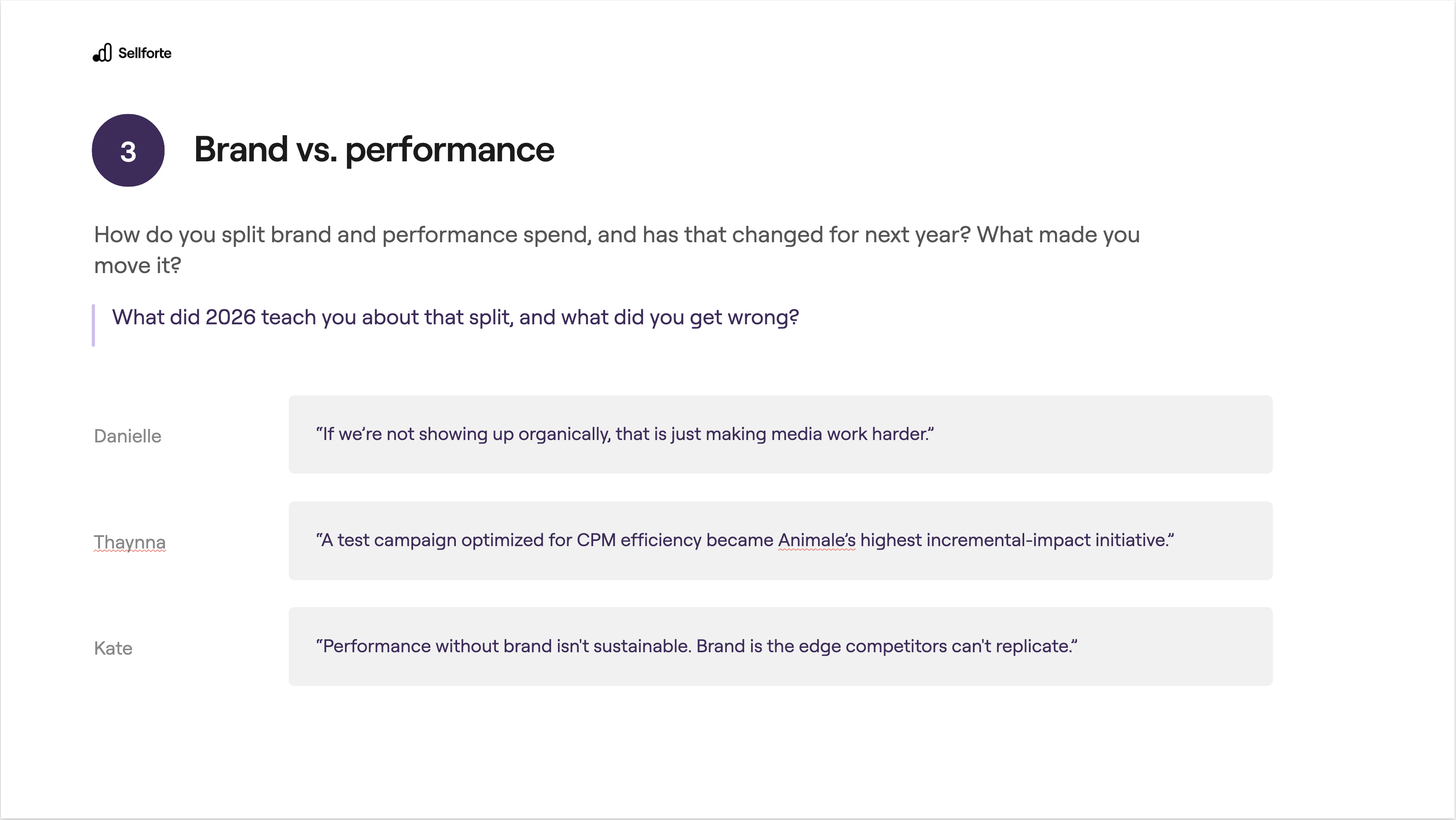
Brand and performance can also work together. In the second half of 2026, Animale had an awareness target that required more investment at the top of the funnel, without sacrificing revenue. The team measured a Google Display awareness campaign with MMM. Optimized for CPM efficiency, it became Animale's highest incremental impact initiative, generating nearly half of the brand's projected incremental revenue with only a small piece of the budget, while delivering the account's lowest CPM.
Sometimes performance needs to help the brand.
— Thaynna Guerra Abreu, Grupo Azzas 2154
For 2027 planning: plan brand and performance as one budget. Buy awareness campaigns on reach and CPM, then measure them on incremental revenue as well.
5. Brand spend keeps paying back the following year
About four months before the roundtable, Pura's finance team asked marketing for proactive cuts in upper and mid funnel. Business then did great, so the team went back to finance and made the case for more brand investment.
Danielle built the case in four steps:
- She anchored the ask in benchmarks. She researched CPG categories and startups to understand typical brand-to-performance ratios. "Using industry data meant finance couldn't say we'd pulled the number out of thin air."
- She set an honest payback window. When finance asked when they'd see the return, she said 12 to 24 months. "It could happen in four to six, but I wanted to set a longer range for brand."
- She taught finance the shopper journey. "Someone sees a CTV ad, then a Meta ad, searches on Google, then walks into Target, sees us on an end cap, and buys."
- She brought MMM evidence. The data showed that brand investment would bring incremental revenue the business wouldn't otherwise achieve, "maybe not in the next month or two, but in the next year."
Another unlock for finance was seeing in the MMM that what we spent in 2025 is still driving sales in 2026.
— Danielle Mathews, Pura
For 2027 planning: judge brand spend over 12 to 24 months, and show finance how much of this year's sales came from last year's brand investment.
6. A number only changes the budget if it arrives in time
Kate named three reasons leaders don't act on measurement:
- Contradictory numbers. Teams need to agree on the number they present to leadership.
- Numbers that arrive too late to change anything. The insight lands after the budget is set.
- Vanity metrics. Impressions, reach, followers and engagement rate that aren't tied to business value.
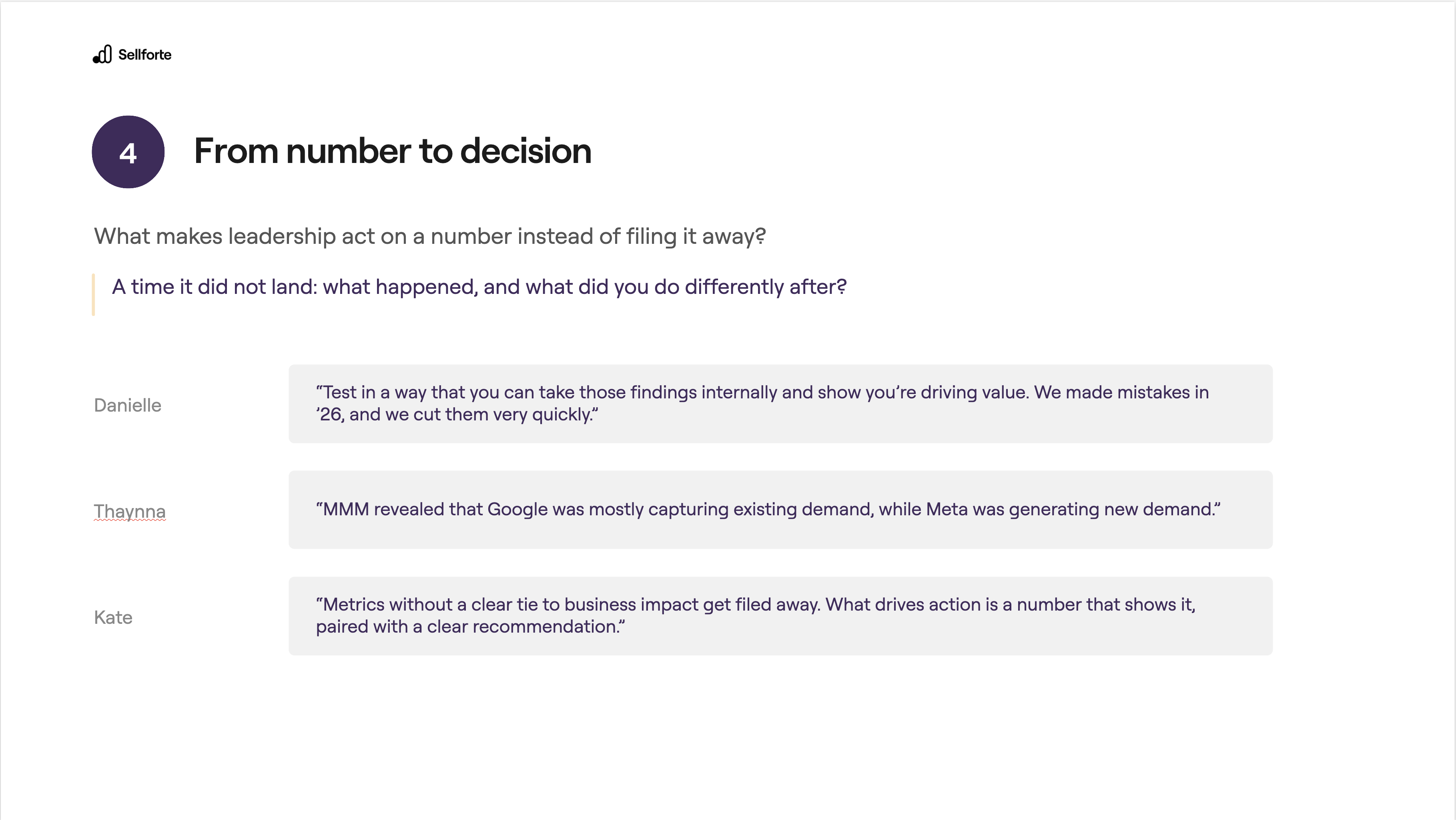
It's better to have a directionally right number when budget decisions are being made than a precise number months later when you can't influence anything.
— Kate Andreeva, AMP
Trust also comes from how you test. Danielle runs every test with a hypothesis, KPIs and a clear readout:
Here's what we tested, here's the hypothesis and objectives, here's what we learned. It didn't work, so we cut it. It worked, so we scaled it. Keep it black and white.
— Danielle Mathews, Pura
Pura made mistakes in 2026 as it expanded into omnichannel media. Danielle's rule is to stay structured about it, "burning cash responsibly, as we say. That builds trust with leadership."
For 2027 planning: agree on one number across your data sources before it goes to leadership, deliver it while the budget is still open, and state it in business terms. In Kate's words: "when we spend X, this is what it drives for the business, and this is how the next dollar should be spent."
7. Plan for the next dollar, and protect what already works
Each panelist gave one takeaway for 2027.
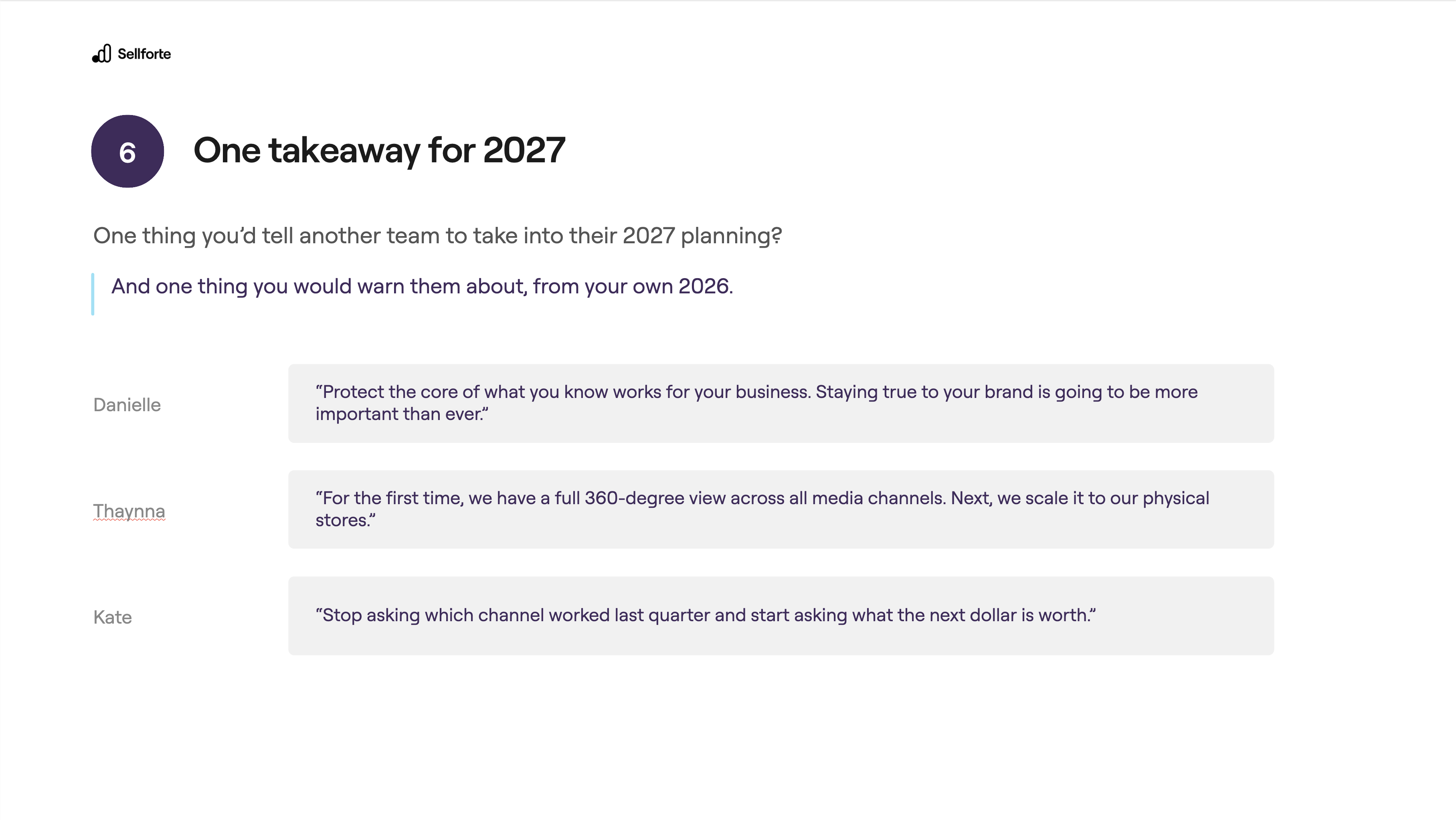
Danielle: protect the core, test the edges. She warned against what she calls measurement anxiety: "the urge to prove every dollar is incremental can push you to overcorrect and cut investments just because they're harder to measure cleanly, like brand."
Keep testing, absolutely, but testing is different from abandoning the fundamentals that drive your revenue today.
— Danielle Mathews, Pura
Thaynna: test, learn, then scale or stop. For the first time, Grupo Azzas 2154 has an incremental 360-degree view across all media channels for all its brands, so it can allocate the next dollar based on the true incremental view.
Kate: use MMM to plan ahead. She wants teams to shift MMM usage from backward-looking reporting to forward-looking action. She cited eMarketer's recent report, which "found that only 28% of marketers say their organization is very effective at converting MMM insights into action."
Stop asking what a channel drove last quarter and start asking what the next dollar is worth.
— Kate Andreeva, AMP
Pura already plans this way. Its blue sky model and the MMM help finance plan the next fiscal year:
So it isn't just "we'll only spend this much because of EBITDA." We can show that we may need to take a little off the top to keep growing.
— Danielle Mathews, Pura
Questions marketing leaders asked the panel
Q1: How did you gain confidence to grow investment in brand marketing?
Danielle started with industry benchmarks for the brand-to-performance ratio and a payback window of 12 to 24 months. Then came a lot of internal education on the shopper journey, and MMM to validate it.
Then we needed a tool to validate it, and for us that was the MMM. It showed what we'd seen within the first six months, and from last year's investment.
— Danielle Mathews, Pura
Kate added that a lot of it is education: how much to invest, why, and what it will do for the business. Then MMM reads out the true value of those upper-funnel tactics.
Q2: What's a good test duration before deciding to cut something?
It depends on who you ask. Danielle's merchandising team would say seven to twelve days, which in media is impossible to learn anything from. On the agency side, it was more like two weeks.
For me, 60 to 90 days. I know it feels slow, but if you can see the outcomes, it works on the brand side.
— Danielle Mathews, Pura
Kate's benchmark from the agency side: "We push for a good readout, and four to six weeks is a good benchmark for test duration." Leave time to measure sales after the test ends, too.
Q3: Do clients with last-click only and clients with advanced measurement weigh gut versus data differently?
Yes, according to Kate. With last-click and ROAS only, teams lean into the channels showing hard revenue numbers. With an MMM, they also see short-term payback for upper- and mid-funnel tactics.
She still leaves room for instinct:
MMM, recalibrated against lift tests, is where I trust the data. When that same model shows weak short-term payback on brand spend, that's where I still trust my gut.
— Kate Andreeva, AMP
Her reason, from the session:
We simply can't afford not to be in that channel, because it gives an edge to our competitors and could do lasting damage to the brand.
— Kate Andreeva, AMP
Q4: When did it become important to link the performance channels to retail sales?
For Pura, the ad platforms showed it first.
We saw the signals in the platforms earlier than finance and the wider organization did. The platforms tell you when they're being starved in the funnel. It was very evident we were farming the same people over and over again, and we needed to bring net-new people to Pura to keep growing.
— Danielle Mathews, Pura
The MMM then showed which channels Pura was over- and under-investing in. Danielle doesn't take it as the Bible, but it let her have the hard conversations with finance about under-investing in brand. She also defended the mid funnel, which she said "always gets cut the most," even though it connects the lower and upper funnel.
How to apply these lessons in your 2027 planning
- Add proof where last-click is blind. Keep attribution for in-flight optimization, add MMM for the budget split, and run lift tests on the channels you're least sure about. You don't need to replace what you have.
- Check what each channel adds before you move money. Find out whether it creates new demand or collects demand other channels created, and include store, marketplace and retail sales in the answer. Animale's Google and Meta rebalance came from that question.
- Plan brand and performance as one budget. Use benchmarks from businesses like yours to set the starting ratio, give brand spend a payback window of 12 to 24 months, and show finance how much of this year's sales came from last year's brand investment.
- Bring one agreed number while the budget is still open. State it in business terms, run tests with a clear hypothesis, cut the ones that fail, and scale the ones that work.
- Plan the next dollar and protect the core. Ask what the next dollar is worth in each channel, keep the investments that already drive revenue, and test new channels at the edges.
How Sellforte helps ecommerce, retail and DTC brands plan 2027
The panel's lessons come down to three needs: one view of what each channel adds across online and offline sales, numbers finance trusts, and answers while the budget is still open.
Sellforte combines marketing mix modeling, incrementality testing and attribution in one platform, built for ecommerce, retail and DTC brands:
- Marketing mix modeling shows the incremental impact of every channel on total sales, including stores, marketplaces and retail partners, and how long brand spend keeps paying back.
- Incrementality testing runs geo and conversion lift tests to check the channels you're least sure about, and feeds the results back into the model.
- Attribution calibrated with incrementality turns the model's view into campaign-level decisions during the year.
- Budget optimization shows where the next dollar should go, before the plan is locked.
Grupo Azzas 2154 uses Sellforte to run MMM across its fashion brands. The Animale results in lessons 3 and 4 came from that work. Read how Grupo Azzas 2154 expanded its partnership with Sellforte.
If you're planning your 2027 budget and want to see where your next marketing dollar should go, let's talk through what it looks like for your business.
👉Book a 30-minute conversation with Sellforte.
Author

Daria Alén is Senior Marketing Manager at Sellforte, where she builds educational programs, webinars, and events for ecommerce and DTC growth teams. She has over 10 years of marketing experience in B2B SaaS and Tech with specialization in go-to-market strategy and marketing analytics. Follow Daria on LinkedIn for more about marketing and growth.