


In ecommerce and retail, measurement is supposed to be simple. You track clicks, conversions, and revenue, then optimize accordingly.
Until you invest in upper funnel marketing.
Suddenly, performance looks weaker, ROAS declines, campaigns appear expensive, and attribution gives very little credit. This is not because upper funnel marketing is ineffective but rather because it works differently from how most ecommerce measurement is designed.
Attribution is built for immediate impact, while upper funnel marketing is built to create future demand.
The mismatch between attribution and upper funnel
Most ecommerce teams rely on attribution models to guide decisions. These models are excellent at answering questions like "what drove a purchase today?" or "which channel should get credit for a conversion?"
But upper funnel marketing, such as paid social prospecting, online video, influencers, or TV, is not meant to convert immediately. Its job is to create awareness, bring new shoppers into the category, and shape future buying decisions.
When you measure long-term impact with short-term tools, upper funnel will almost always look inefficient.
The role of time: why impact is delayed
In ecommerce, especially outside of impulse purchases, the path to conversion is rarely linear or immediate. A typical journey might look like this:
- A customer discovers your brand on TikTok or YouTube
- They compare options or browse competitors
- They return later through search, direct, or email
- They convert via a retargeting ad
Attribution usually credits the final interaction, not the initial exposure. As a result, upper funnel activity drives demand that shows up later in completely different channels.
Upper funnel does not just drive conversions. It drives the demand behind those conversions.
To capture this, you need a different approach. Marketing mix modeling, or MMM, is designed to measure impact over time. It helps you:
- Capture both immediate and delayed effects
- Understand how awareness builds demand over time
- Quantify the true contribution of upper funnel channels
Instead of focusing only on what converted now, MMM reveals what actually drove demand.
💡 To see how upper funnel channels like TikTok actually drive new customer growth and long-term demand beyond attribution, read: How to Measure the True Effectiveness of TikTok Ads
The hidden driver of growth: new customers
For ecommerce and retail brands, growth depends on acquiring new customers. This is where upper funnel marketing plays its biggest role.
In many cases:
- 60 to 80 percent of the impact of brand and awareness channels comes from new customers
- Bottom funnel channels such as retargeting or branded search often contribute only 5 to 15 percent new customers
However, most reporting does not distinguish between new vs. returning customers. This creates a distorted view of performance.
Channels that capture existing demand appear highly efficient. Channels that generate new demand appear costly.
In reality, the channels that look least efficient in attribution are often the ones driving long-term growth.
New customers bring more than a single transaction. They create future revenue, drive repeat purchases, and become part of your CRM ecosystem across email, SMS, and loyalty programs.
Why experimentation completes the picture
Even with better modeling, one piece is still missing. To understand true impact, you need causality.
This is where experiments come in. Whether it is geo-based tests, holdout groups, or incrementality testing on platforms, experiments help isolate the real effect of your marketing.
If you are not measuring incrementality, you are measuring activity, not impact.
The most important principle is simple. Always analyze results separately for new and returning customers.
This makes it possible to clearly see:
- Which channels are driving incremental growth
- Which ones are capturing existing demand
- How upper funnel investment contributes to acquisition
A better way to measure upper funnel marketing
For ecommerce and retail teams, no single method is enough. A more complete approach combines:
- Attribution for short-term optimization
- Marketing mix modeling for total impact and delayed effects
- Experiments for incrementality and new customer growth
This approach is built around Google’s modern measurement framework, often visualized as the measurement triangle of MMM, incrementality experiments, and attribution.
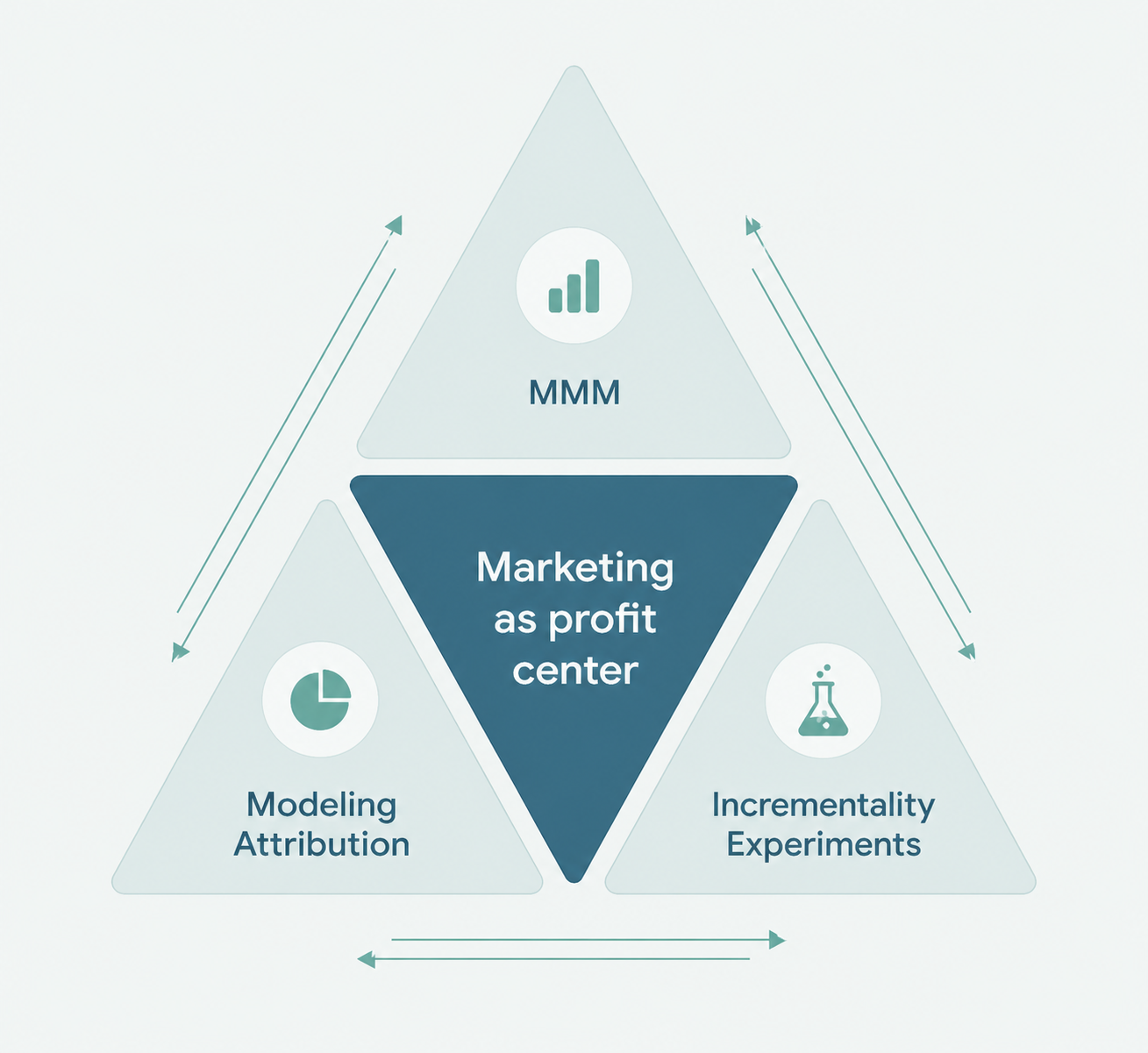
Each method plays a distinct role, and together they create a complete view of performance. Growth comes from combining these perspectives, not choosing one over the other.
Together, these provide a balanced view across both immediate performance and long-term value creation.
The bottom line
Upper funnel marketing is hard to measure in ecommerce because its impact is delayed, its value is tied to new customer acquisition, and its effects are spread across multiple touchpoints.
If you rely only on attribution, you will undervalue it and risk underinvesting in the channels that actually drive growth.
With the right combination of modeling and experimentation, you can move beyond what is easy to track and start measuring what truly matters.
👉 If you want to start measuring and optimizing the true impact of your upper funnel marketing, book a demo with Sellforte.
Author

Edward Ford is VP of Marketing at Sellforte. He has over 15 years of marketing experience in B2B SaaS and Tech with specialization in marketing measurement and intelligence. Before joining Sellforte, Edward spent over 6 years at Supermetrics where he joined as an early-stage employee.
.png)
Why Attribution Alone Falls Short for Ecommerce Marketing Measurement (And What Completes It)

What Changes When Ecommerce and Retail Teams Switch to Incremental ROAS?