

Fressnapf | Maxi Zoo is a pet supplies retailer founded in 1990 in Erkelenz, Germany, and headquartered in Krefeld. The group has more than 2 880 Fressnapf and Maxi Zoo stores and over 20 000 employees, including franchise partners. Customers buy in stores and online, and the marketing mix covers search, display, paid social, brand campaigns and the leaflet.
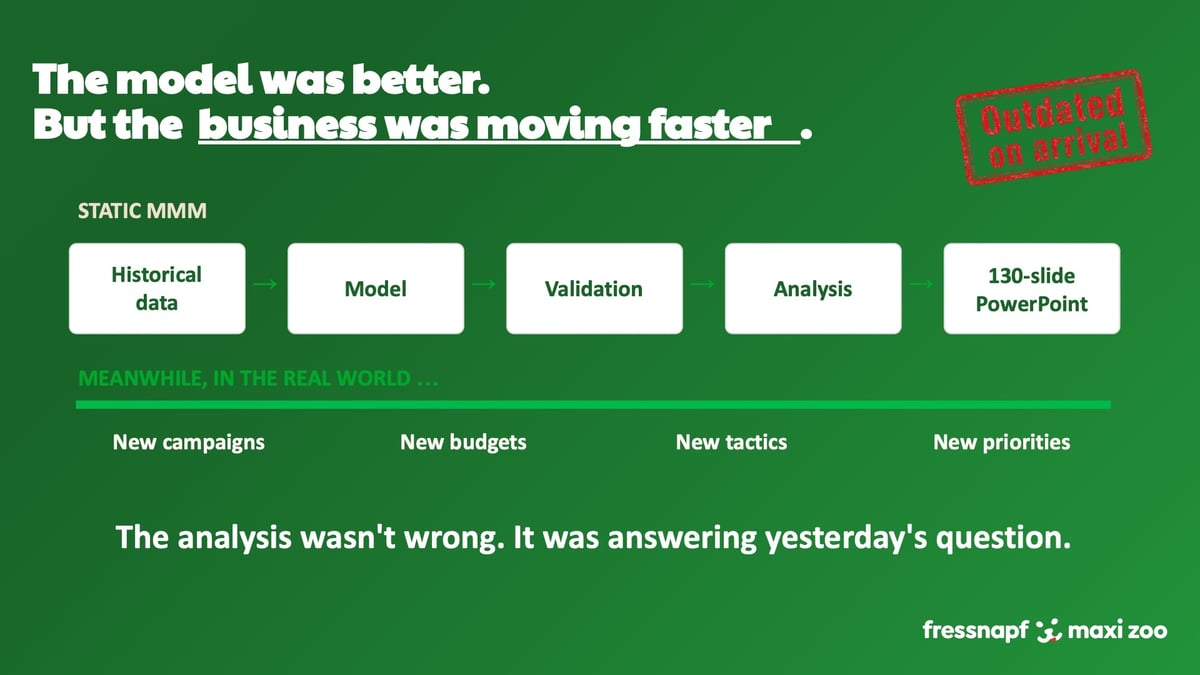
Fressnapf's first marketing mix model (MMM) was a one-off study. The team exported historical data, sent it to an external vendor, went through several rounds of validation and, months later, received a 130-slide PowerPoint. The analysis was valuable. It was also describing a business that had already changed: campaigns, budgets and even the organization were different by the time it arrived.
Fressnapf has since moved to a continuous model that covers ecommerce and store sales together, started using it for budget decisions in a first market, and brought the approach to Germany, its biggest market.
In the Sellforte webinar "Outdated on Arrival: How Fressnapf Moved from Static Marketing Measurement to Continuous Omnichannel Growth Steering," held on November 11, 2026, Maike von Runkel explained how they did it and what is still unfinished.
Speakers:
- Maike von Runkel, Senior Lead Display & Paid Social Performance Marketing at Fressnapf
- Friederike Thackwell, Sr. Industry Manager, Consultancies & Tech Partner at Google
- Juha Nuutinen, CEO and Co-founder of Sellforte
This post collects their lessons for omnichannel retailers: what a continuous model takes inside the organization, which decisions to start with, and how to get finance to work from the same numbers.
Inside Fressnapf's measurement setup
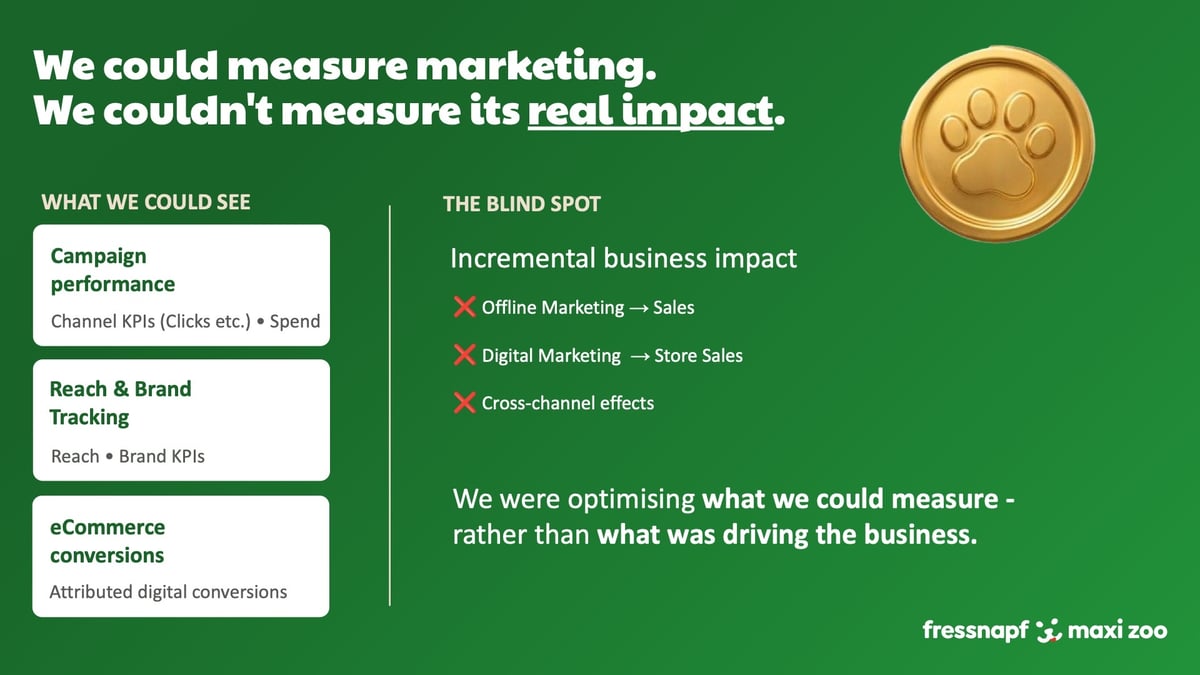
Before MMM, Fressnapf measured marketing with dashboards of campaign KPIs, brand tracking for awareness campaigns, and ecommerce conversions attributed by last click. As a performance marketer, Maike called last click "wonderfully simple": someone clicked, someone bought.
It left three gaps. The team couldn't say whether those sales would have happened anyway. It had very limited visibility into how offline media related to sales, and into what online investments did for the stores. And different teams planned different parts of the customer journey with different KPIs, so a euro couldn't simply move from one area to another.
We were essentially optimizing what we could measure rather than what was actually driving the business.
— Maike von Runkel, Fressnapf
Slide: Maike von Runkel, Fressnapf.
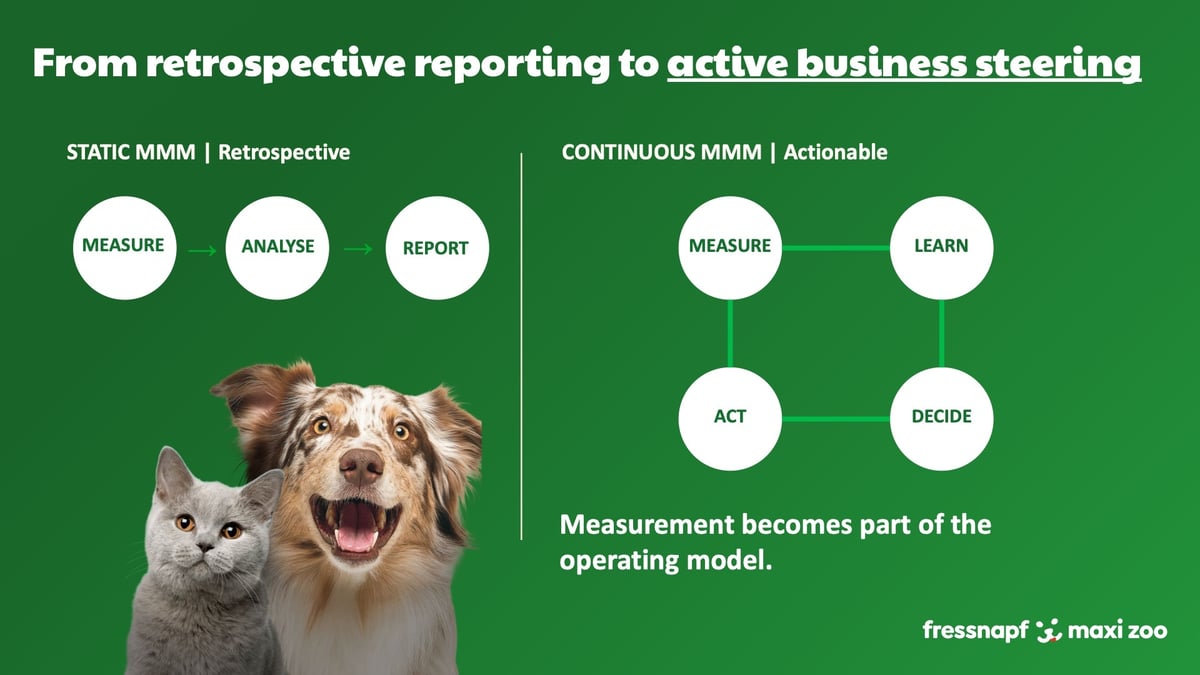
Today the measurement runs continuously with Sellforte. One model estimates the incremental sales each channel drives, and teams look at it through three views: ecommerce, stores and omnichannel.
Slide: Maike von Runkel, Fressnapf.
The measurement is starting to influence what we actually do. It is no longer the destination; it is part of our growth loop.
— Maike von Runkel, Fressnapf
7 lessons from Fressnapf's move to continuous measurement
1. A study can be right and still arrive too late
Friederike opened the session with a weather app. You check it in the morning to see whether you need an umbrella. A 100-page climate report from six months ago is good science, and it doesn't answer that question.
The problem isn't the model. It's the timing. You cannot steer this week's marketing or retail campaign with a six-month-old report.
— Friederike Thackwell, Google
Fressnapf's leaflet shows what that looks like in practice. During the period the study analyzed, the leaflet was a classic print vehicle. While the analysis was running, the team was already testing a shift to digital and changing the format, the frequency, the geographical setup and the partners. In the same months, Fressnapf went through a strategic reorganization with new leadership and new priorities.
Slide: Maike von Runkel, Fressnapf.
The study could say quite precisely what had worked for the old print setup. The marketing manager's reaction, as Maike retold it: "Good to know, but what am I supposed to do with this now?"
The analysis wasn't wrong, but it was answering yesterday's question.
— Maike von Runkel, Fressnapf
We had a measurement system that was very good at explaining the past, but not at helping us steer the future.
— Maike von Runkel, Fressnapf
For your team: before you commission the next study, check how long it will take from data export to recommendation, and how much of your media plan will have changed by then.
2. Continuous MMM is a business transformation, not a marketing project
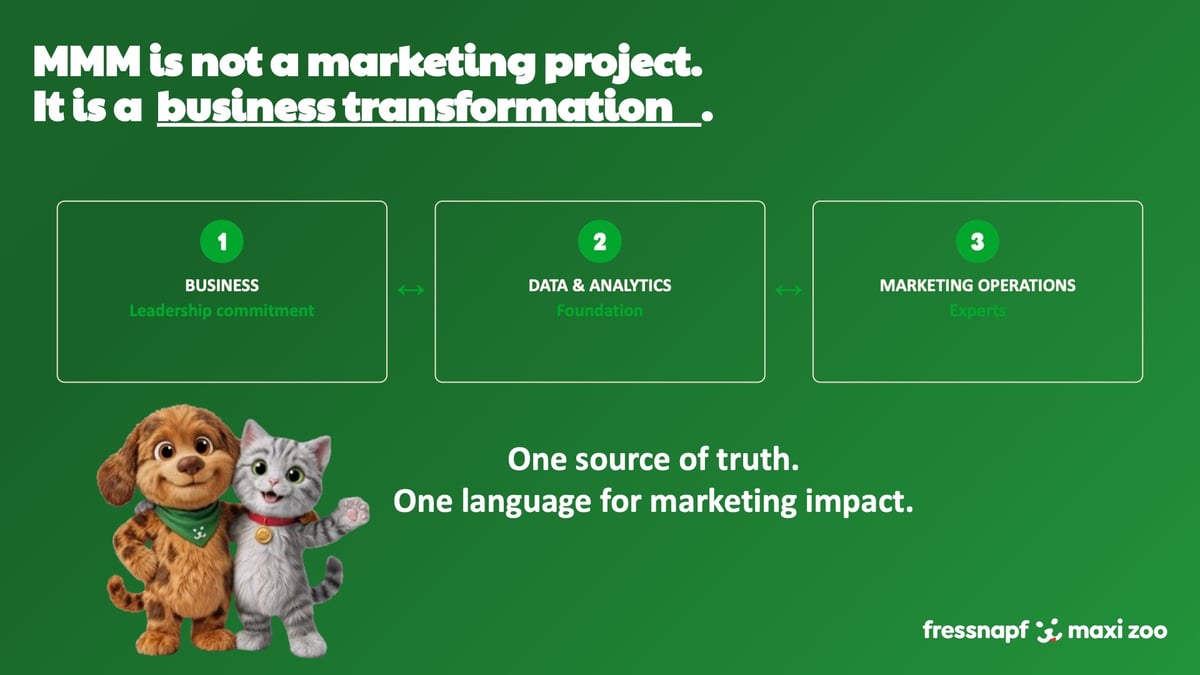
After the study, Fressnapf stopped looking for another study. The team wanted measurement to be part of how marketing runs: learn from new data, decide, measure again. Maike said this was the part they underestimated most.
Continuous MMM is not simply a technology implementation. It is not a marketing project. The model itself is only one part.
— Maike von Runkel, Fressnapf
She named three groups a continuous model depends on:
- Senior management and finance. If measurement is supposed to influence budget allocation, people need to trust it as a way to steer the business, not as another marketing report.
- Data. Data engineering, analytics and a solid data foundation, with dedicated resources. "Trust me on that," Maike added.
- The people who run marketing. The search manager, brand marketing, store marketing and the agencies know when there was a tracking issue, why sales spiked, or when a campaign was unusually strong. A statistical model doesn't.
Slide: Maike von Runkel, Fressnapf.
The third group also has the most to lose. Someone who has optimized a channel on platform ROAS for years is suddenly evaluated on incremental ROAS.
A new KPI doesn't automatically become the new truth just because you put it on a dashboard.
— Maike von Runkel, Fressnapf
For your team: plan the project with finance, data and channel owners from the start, and budget time for the channel owners to question the model.
3. Nobody has to give up their targets overnight
Fressnapf did not announce that from now on everything would be optimized for omnichannel. That would have been too far from how the business and its budgets are managed today.
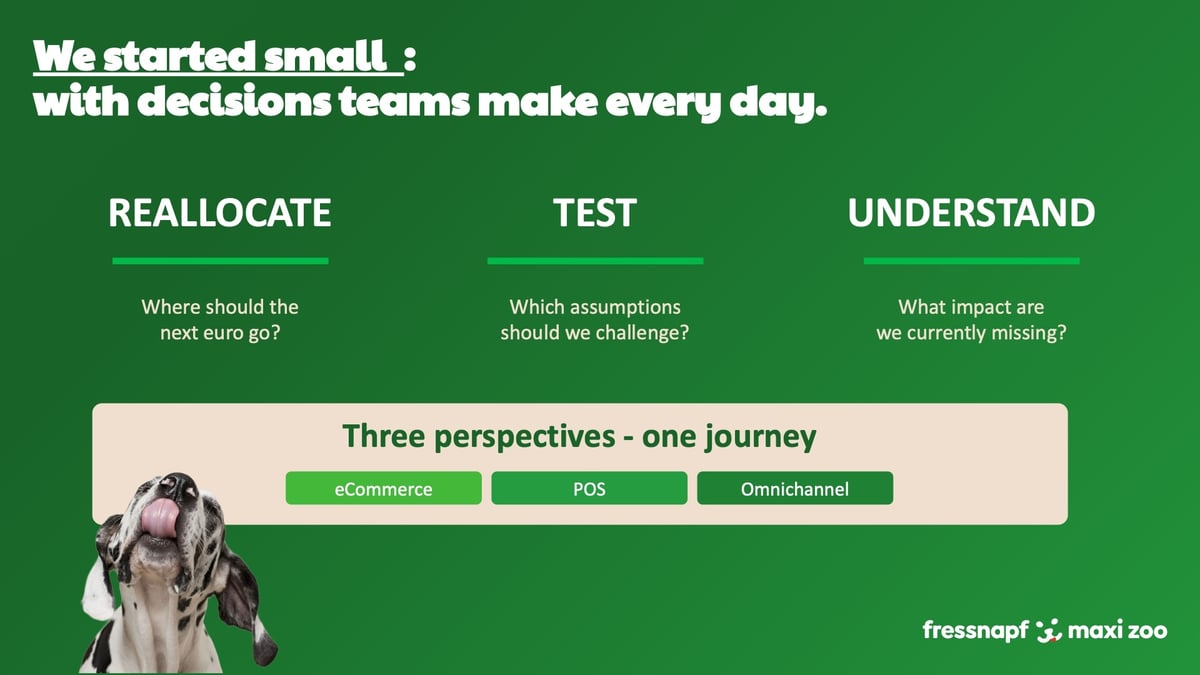
Instead, the team built three views of one model: ecommerce, stores (POS) and omnichannel. A team with an ecommerce target keeps that target and can also see what its investment does in the stores.
Slide: Maike von Runkel, Fressnapf.
We didn't try to transform all of marketing overnight. Instead, we took existing planning and optimization processes and gradually added a different perspective: the incremental business impact.
— Maike von Runkel, Fressnapf
For your team: keep the targets each team has today, and show every team the effect on the total business next to its own number. For Fressnapf, that includes the stores.
4. Start with decisions you already make
Fressnapf started in one market as its MVP and added incremental revenue and incremental ROAS to decisions the team was already making. Maike gave three examples:
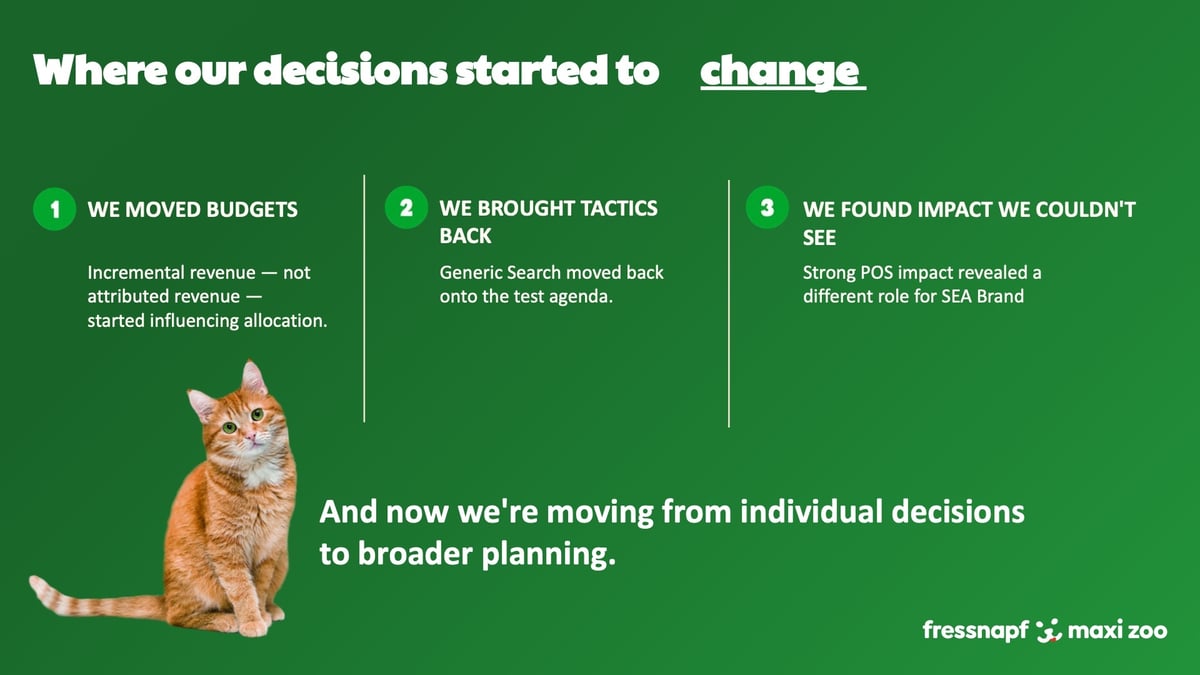
- Budget allocation. The team asks where the next euro can generate more incremental revenue and where spend can come down because the incremental impact is low. That has already moved budget between performance marketing channels.
- Generic search. The team had stopped generic search because last click made it look unprofitable. The model showed it was generating incremental demand. The campaigns were reactivated and have gradually received more budget.
- Brand search. Its incremental ecommerce impact was much more limited than last click suggested. Its impact on store sales was much stronger than expected, so brand search is no longer treated as an ecommerce instrument only.
Slide: Maike von Runkel, Fressnapf.
None of these is a transformation of the whole marketing organization, which was Maike's point. After the first market, Fressnapf brought the approach to Germany and is now looking at further markets. She was also clear about what isn't done: the silos haven't all come down, and not every team uses incremental KPIs yet.
For your team: pick two or three recurring decisions, such as the split between search campaigns, and add the incremental view to those first.
5. For an omnichannel retailer, store sales change the picture
The incremental ecommerce impact was indeed much more limited than last-click attribution suggests, but the impact on POS sales was much stronger than we expected.
— Maike von Runkel, Fressnapf
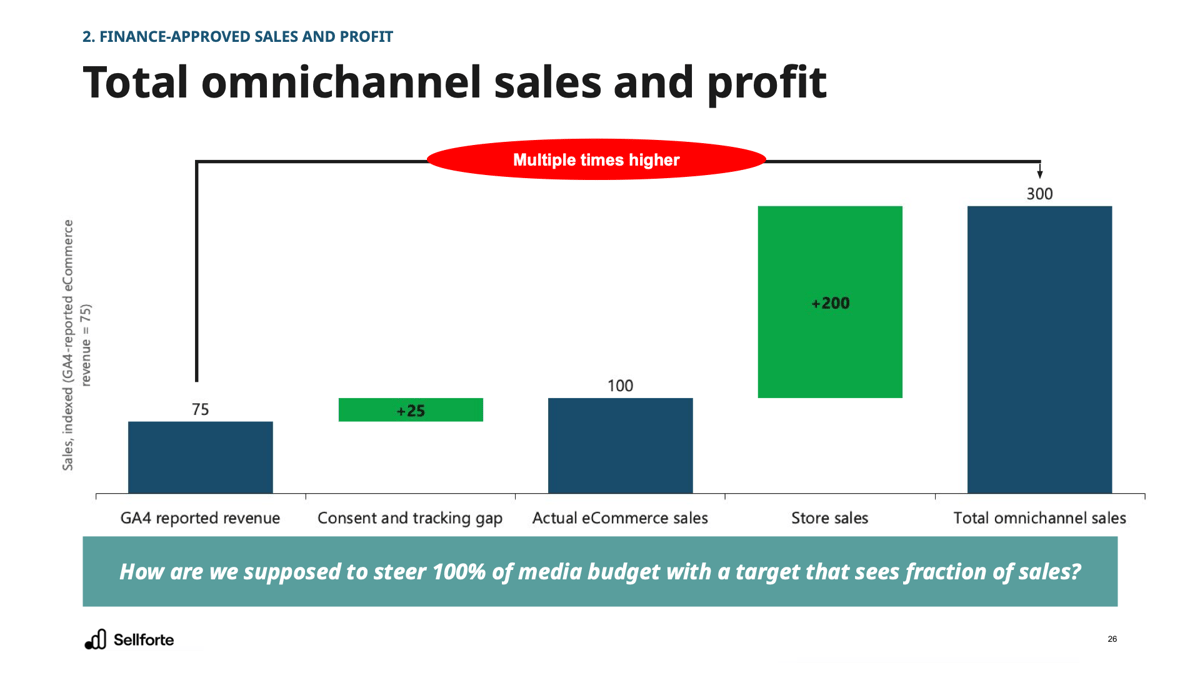
Fressnapf's brand search result is not unusual. Juha Nuutinen showed why with an illustration, not Fressnapf data. In his illustration, web analytics sees 75 of ecommerce demand. Actual ecommerce sales are 100, because some customers don't consent to cookies. Add store sales, which for an omnichannel retailer can be two or three times ecommerce sales, and the total is 300. A team steering on the 75 is steering on a quarter of the business.
Slide: Juha Nuutinen, Sellforte. Illustrative numbers, not Fressnapf data.
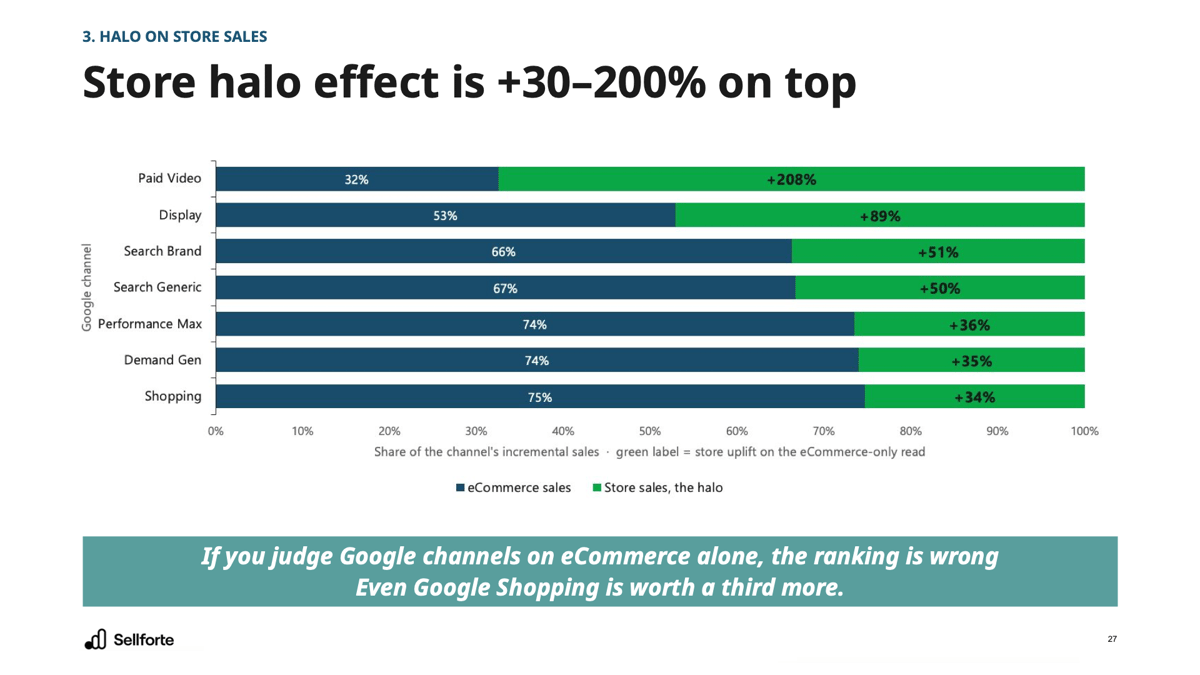
The same applies to single channels. Shopping and Performance Max campaigns send people to the online shop, and in Sellforte's experience something like one-third of the sales they drive still happens in stores. For generic search the store share is larger, and for paid video most of the effect often comes from stores.
Slide: Juha Nuutinen, Sellforte. Illustrative numbers, not Fressnapf data.
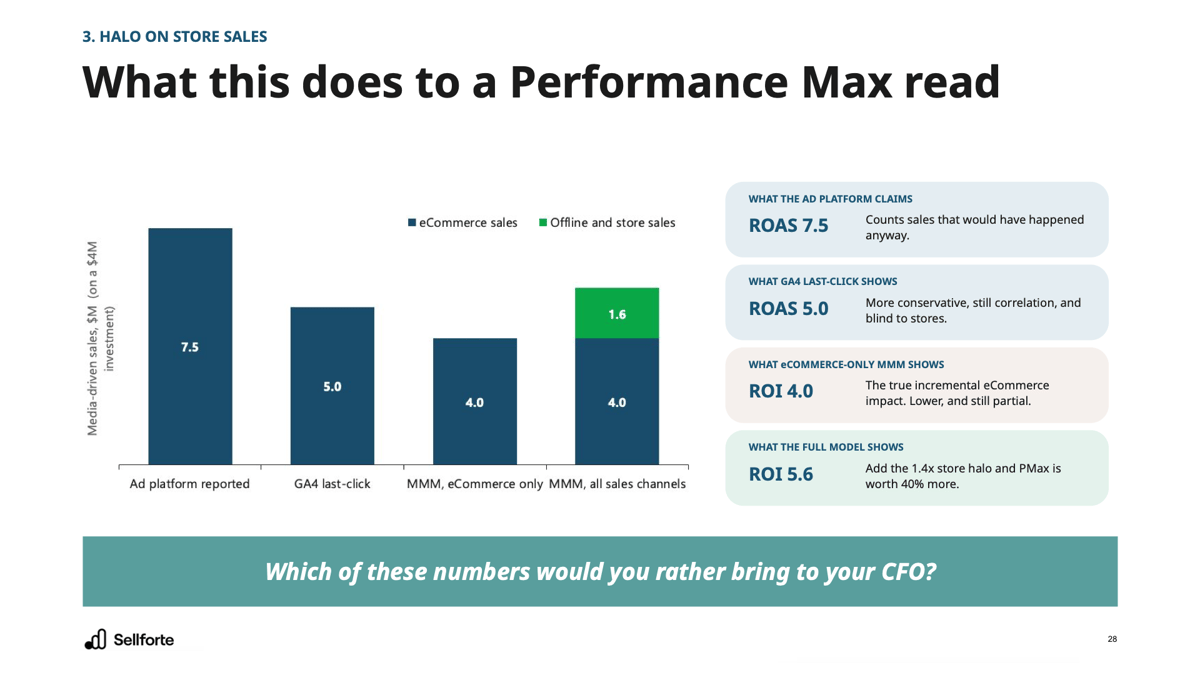
Juha walked through a Performance Max example with illustrative numbers: the ad platform reports a ROAS of 7.5, last click says 5, and the incremental ROAS on ecommerce sales alone is 4. With store sales included, the incremental ROAS is 5.6.
Two of these gaps need no stores at all: in the illustration, a quarter of ecommerce sales is missing from web analytics, and the platform's 7.5 is an incremental 4 before a single store sale is counted.
He summed it up as four effects: digital media on online sales, digital media on store sales, offline media on online sales, and offline media on store sales. Click attribution shows only the first.
For your team: if stores are most of your revenue, put point-of-sale data into the model before you draw any conclusion about a digital channel. For more on which method answers which question, see When should an omnichannel retailer use MMM, MTA, or incrementality testing?
6. Bring finance numbers it already recognizes
Friederike started with the P&L. In most companies, marketing sits under operating expenses, next to office rent and electricity, and gets cut the same way when times are tough. A cloud migration is treated as a long-term asset. In her view, the difference comes down to proof.
We cannot change accounting rules, so we have to give finance the measurement proof they actually trust.
— Friederike Thackwell, Google
What finance usually sees is the tip of the iceberg: online clicks and last-click conversions. The baseline underneath, from brand reputation, customer habit and people walking into stores, is often assumed to be free.
Juha's advice was to start from the company's actual total sales and profit across ecommerce, stores and other channels, the numbers finance and controlling already agree with, and then estimate how much marketing contributes. Platform numbers cause trouble even when finance accepts them. In his example, if brand search shows a ROAS of 30 and generic search 7.5, finance will ask why generic search is running at all.
The Performance Max example from lesson 5 puts the candidates side by side.
Slide: Juha Nuutinen, Sellforte. Illustrative numbers, not Fressnapf data.
I don't even know which is worse: that finance doesn't believe your numbers, or that finance believes your numbers.
— Juha Nuutinen, Sellforte
At Fressnapf, the result is a shared understanding of what drives business results. Finance doesn't tell marketing how to spend, and marketing doesn't have to justify every single channel.
We have a relationship now. Maybe that's the biggest change.
— Maike von Runkel, Fressnapf
For your team: build the measurement on the sales and profit figures in finance's own reporting, and present marketing's contribution as a share of those.
7. Steer on the next euro, and update fast enough for Monday
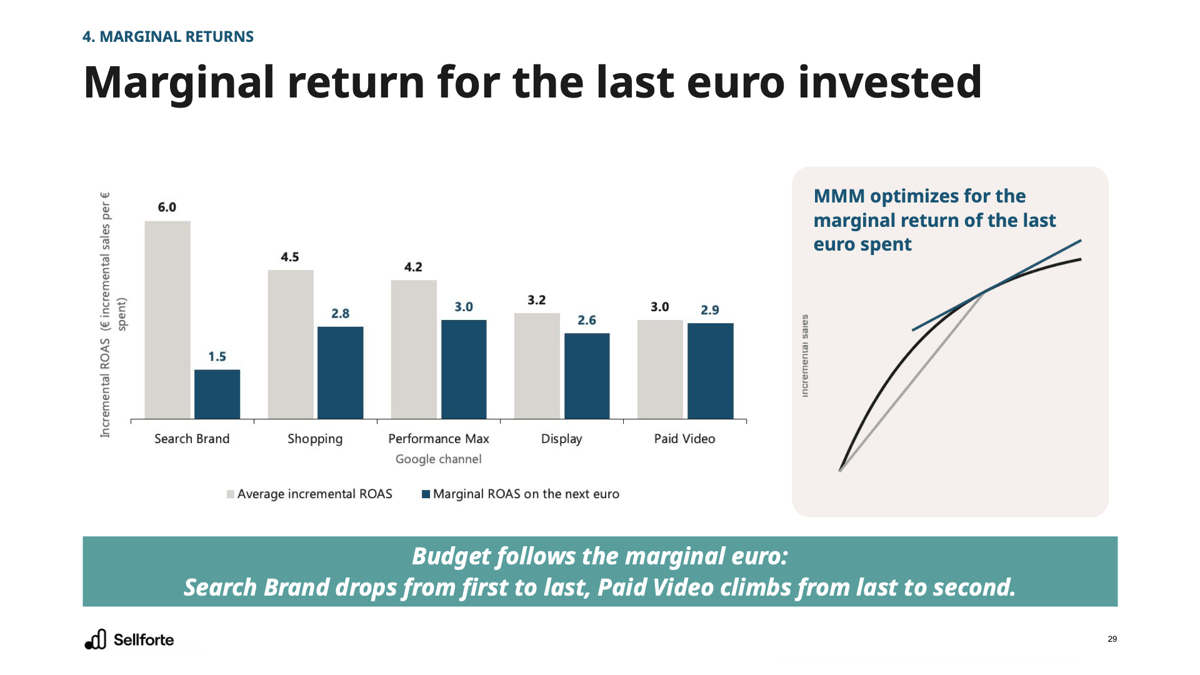
Friederike used the Autobahn to explain the choice. Optimizing for the highest average ROAS is like driving 80 km/h behind a truck: the fuel gauge looks great and you never arrive on time. Flooring it at 200 km/h drains the tank. The useful range is in between, where the average ROAS is a little below its peak and every additional euro still returns more than one.
Juha made the same point by channel. Brand search can have a strong average return, and if you already win most of your brand searches, doubling the budget adds little. Paid video may have a lower average return and still give the best return on the next euro, because it hasn't reached all of your customers yet.
Slide: Juha Nuutinen, Sellforte. Illustrative numbers, not Fressnapf data.
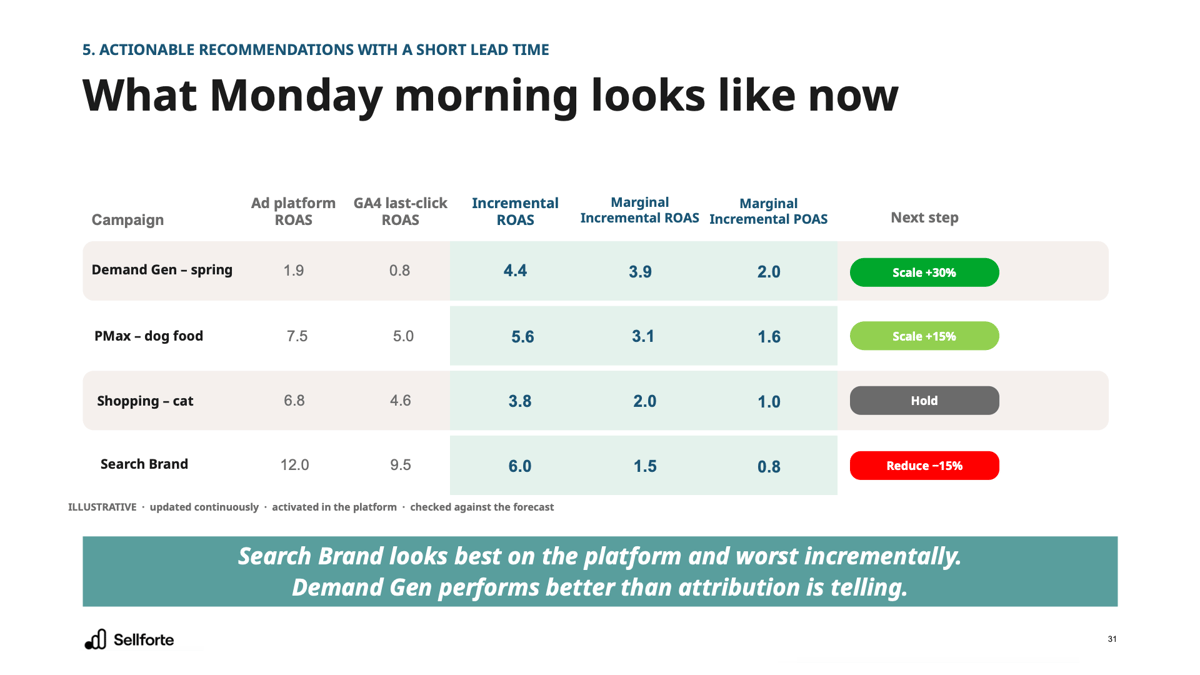
In a continuous setup, incremental ROAS and marginal incremental ROAS sit next to platform ROAS and web analytics every Monday. They are an addition, not a replacement.
The rule is simple: scale as long as the next euro brings back more than one euro of profit.
— Juha Nuutinen, Sellforte
Then make the change in the ad platform and check the following week whether the forecast held. If it did, keep the change. If it didn't, go back.
This weekly rhythm fits channels you can change within days, such as search and paid social. Leaflets, TV and radio are booked further ahead, and many budgets are set monthly, so there the same next-euro view feeds the next planning round.
Slide: Juha Nuutinen, Sellforte. Illustrative numbers, not Fressnapf data.
Measurement is a tool for learning, and the faster we learn, the better.
— Juha Nuutinen, Sellforte
For your team: for channels you can change within days, look at marginal return every week, change one thing, and check the result. For media booked further ahead, use the same view when you plan.
Questions omnichannel marketers asked the speakers
Q1: If a continuous model doesn't change much from day to day, how do you use it?
Continuous doesn't mean changing the media mix every day. Fressnapf still uses platform data and the usual KPIs for day-to-day optimization. The model gives a regularly updated view of incremental and omnichannel impact, which the team uses for planning, for testing new things, and when something out of the ordinary happens.
We want to amend your current measurement, not overhaul it.
— Juha Nuutinen, Sellforte
Friederike added Google's recommendation to combine MMM, attribution and incrementality testing, because attribution alone can't track everything. bonprix's setup is an example of the three working together.
Q2: How do you get senior management on board?
Maike's answer was to focus on the business value, not the technology. Start with a real business problem, involve the stakeholders, and show real decisions, their KPIs and their outcomes. She said Fressnapf is "right in the middle of that."
Juha's version: start small, make the changes you are sure about, measure the effect on total sales and profit, and use that proof as the mandate for the next round of changes.
Q3: How do you drive adoption in the teams?
Involve the teams early and make the results relevant to their daily work. Let them explore their own numbers, understand the model, and challenge what they see.
That creates much more ownership than simply presenting them with a new tool and the results.
— Maike von Runkel, Fressnapf
Q4: How long does it take to get the first useful numbers?
"A bit longer than we had hoped for," Maike said, and "more months than weeks." Most of the time went into the data, not the model: bringing ecommerce, point-of-sale, store, promotion and leaflet data together and agreeing on what each number means. She expects the next market to be much faster than the first.
Juha said he typically counts eight weeks from connecting the data to a regularly updating model, and about 12 weeks when offline spend data or sales data needs a lot of work. Getting a sales data integration ticket through IT can take four weeks on its own.
Q5: How has this changed the relationship with finance?
Maike's short answer was that they now have one (see lesson 6). Her advice was to involve finance early: finance usually doesn't take part in many of these decisions, but it is very important.
Juha added that finance and controlling teams are grateful for numbers they can put into next year's budget without correcting them first.
Q6: How is AI influencing the work?
Fressnapf is exploring it. Maike said a large company is rarely a first mover on AI, especially where sharing data is involved, and that the team is looking at bringing measurement data directly into AI assistants. Juha said that is where Sellforte is heading: customers reading their results from their own AI assistant, not only in the Sellforte interface. See the Sellforte MCP announcement.
How to apply Fressnapf's approach in your organization
- Check the age of your numbers. If the last marketing mix study describes campaigns and a media plan you no longer run, its recommendations are about a business that has moved on.
- Put store sales in the model. For a retailer with stores, an ecommerce-only view misses the store sales that search and video drive.
- Keep the targets teams already have. Give ecommerce, stores and the total business their own views of the same model, so each team sees its number and the effect on the others.
- Bring finance in before the first results. Build on the sales and profit figures finance already reports, and agree together what the model will be used to decide.
- Begin with a few existing decisions. Change one, check the result the following week, and use what you learn for the next one.
This is the approach Sellforte was built to provide. Sellforte unifies marketing mix modeling, incrementality testing and attribution into one always-on system for ecommerce and retail brands. Fressnapf uses it to measure what each channel drives in stores and online. Other brands using Sellforte include Lidl, Douglas, Intersport and Represent.
Watch the full recording of Outdated on Arrival →
If you want to see what continuous measurement across stores and ecommerce would look like for your business, let's talk it through.
👉Book a 30-minute conversation with Sellforte.
Author

Daria Alén is Senior Marketing Manager at Sellforte, where she builds educational programs, webinars, and events for ecommerce and DTC growth teams. She has over 10 years of marketing experience in B2B SaaS and Tech with specialization in go-to-market strategy and marketing analytics. Follow Daria on LinkedIn for more about marketing and growth.

How to Unify Marketing Measurement for Ecommerce: 7 Lessons from bonprix

How should MMM distinguish dynamic pricing from genuine promotions?