


The halo effect is the incremental sales that advertising or a promotion causes outside the scope it targets or is tracked in: in physical stores or on marketplaces instead of the webshop, for products other than the ones advertised, or through other channels such as search. Measurement that ignores the halo understates the activity's true incremental return.
Types of halo effect in marketing
The term comes from psychology. Thorndike (1920) described a "constant error" in ratings of soldiers and employees: raters who formed a favorable general impression of a person also tended to rate them favorably on other, unrelated qualities, and he called this error the halo. In marketing, the halo is a real effect that measurement often misses, because the extra sales land where the campaign is not measured. It takes several forms:
- Cross-channel halo. Online ads drive purchases in physical stores, on marketplaces or in the app. In a randomized experiment with 1.6 million customers of a large retailer, online ads on Yahoo! increased purchases by 5%; 93% of the increase occurred in brick-and-mortar stores, and 78% came from customers who never clicked an ad (Lewis & Reiley, 2014). For a clothing retailer, online advertising, and paid search in particular, had a larger overall sales impact than traditional advertising, mainly because of its cross effects on the offline channel (Dinner et al., 2014).
- Product and brand halo. Advertising one product lifts sales of other products sold under the same brand. Erdem and Sun (2002) found spillover effects of both advertising and sales promotions across categories for umbrella brands in packaged goods. Amazon Ads reports this as "brand halo": conversions on products of the same brand as the promoted products, excluding the promoted products themselves, so that total purchases equal promoted purchases plus brand halo purchases (Amazon Ads, n.d.).
- Promotional halo. A discount on one item brings in shoppers who also buy unpromoted products. Analyzing a year of CVS promotions, Ailawadi et al. (2006) found a positive halo on other categories. Its opposite, cannibalization of other products, is a negative halo, which is why net promotional lift is measured over a wide scope.
- Cross-media halo. TV, video and social ads raise branded searches, whose sales are credited to search unless the model accounts for where the demand came from.
- Category spillover. Advertising can also lift competitors. In randomized field experiments on a restaurant search platform, ads for one restaurant also increased sales leads for competing restaurants (Sahni, 2016). That spillover is a halo for the category, but not a return for the advertiser.
Halo effect formula
Measured as incremental ROAS (iROAS), the halo adds to the direct return of the activity:
Total incremental sales = Direct incremental sales + Halo incremental sales
Total iROAS = Total incremental sales / Spend = Direct iROAS + Halo iROAS
Halo share (%) = Halo incremental sales / Total incremental sales × 100
- Direct incremental sales: incremental sales of the advertised products in the channel the campaign targets, typically the webshop.
- Halo incremental sales: incremental sales anywhere else, such as stores, marketplaces, the app or other products. Only sales the activity caused count; purchases that merely followed an ad exposure are not halo.
Example calculation
An omnichannel retailer spends 100 000 EUR on a social campaign for running shoes that sends traffic to its webshop. With a 40% gross margin, the campaign breaks even at an iROAS of 2.5 (1 / 0.40). Measured over all sales channels and products, the campaign's incremental sales are (illustrative numbers):
| Sales outcome | Incremental sales | iROAS |
| Advertised shoes, webshop (direct) | 210 000 EUR | 2.10 |
| Advertised shoes, physical stores | 120 000 EUR | 1.20 |
| Other products, webshop and stores | 50 000 EUR | 0.50 |
| Marketplaces | 20 000 EUR | 0.20 |
| Halo subtotal | 190 000 EUR | 1.90 |
| Total | 400 000 EUR | 4.00 |
Judged on webshop sales of the advertised shoes alone, the campaign returns 2.10 and looks unprofitable. Including the halo, it returns 4.00, and 47.5% of its incremental sales happen outside the scope it was optimized for. Cutting the campaign on the direct number would remove 400 000 EUR of incremental sales, not 210 000 EUR.
How the halo effect is measured
Most tracking stops at the webshop, so each method captures a different share of the halo:
- Attribution. Click-based models such as last-click attribution only see online purchases that follow a tracked click. They miss store purchases without an identity match and the purchases of people who saw an ad but never clicked, which made up most of the effect in the Lewis and Reiley experiment.
- Platform halo metrics. Reports such as brand halo widen the scope of attribution, but they still count purchases that followed an exposure, not purchases the exposure caused.
- Experiments. A geo lift test compares total sales in test and control regions, so store and marketplace sales are included when the outcome data covers them. A conversion lift study measures only the conversion events shared with the ad platform, so it captures the halo only when store, app or other-product conversions are sent as well.
- Marketing mix modeling. MMM relates media to aggregate sales over time, so it can estimate effects on every sales channel and product group in the data without user-level tracking.
Halo effect in marketing mix modeling
The scope of the outcome data decides how much halo an MMM can find. A model of webshop revenue reports only direct effects. A model with webshop, store, marketplace and app sales as outcomes, each linked to the same media, also estimates the halo. When the advertised category is mapped separately from the purchased category, a campaign's value can include purchases beyond its advertised product. Three rules keep the estimates honest:
- Count each sale once. Halo sales are part of total incremental sales, not an extra layer to add on top of a model that already explains total sales.
- Match the scope when calibrating. An experiment that measured webshop sales only calibrates the direct effect. Transferring it to stores or the app is an assumption that needs wider uncertainty until it is tested, as discussed in whether web-only tests can calibrate app sales.
- Allow negative halo. A campaign or promotion for one product can take sales from another, so net incrementality over the whole scope is what counts.
The chart below from the Sellforte demo (demo data) shows weekly media-driven sales from the MMM, split by sales channel, from mid-August to mid-November 2026. Of 41.0 million USD of modeled incremental sales, 4.5 million USD (11%) come through physical stores, where web analytics cannot see them.
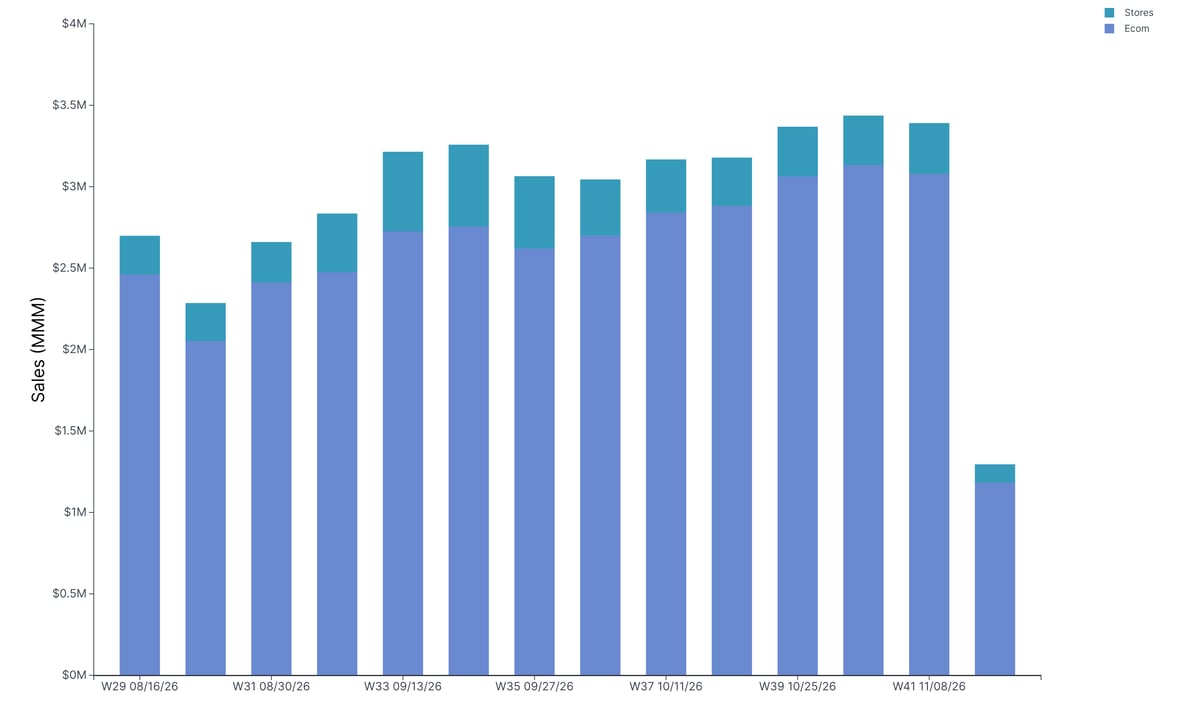
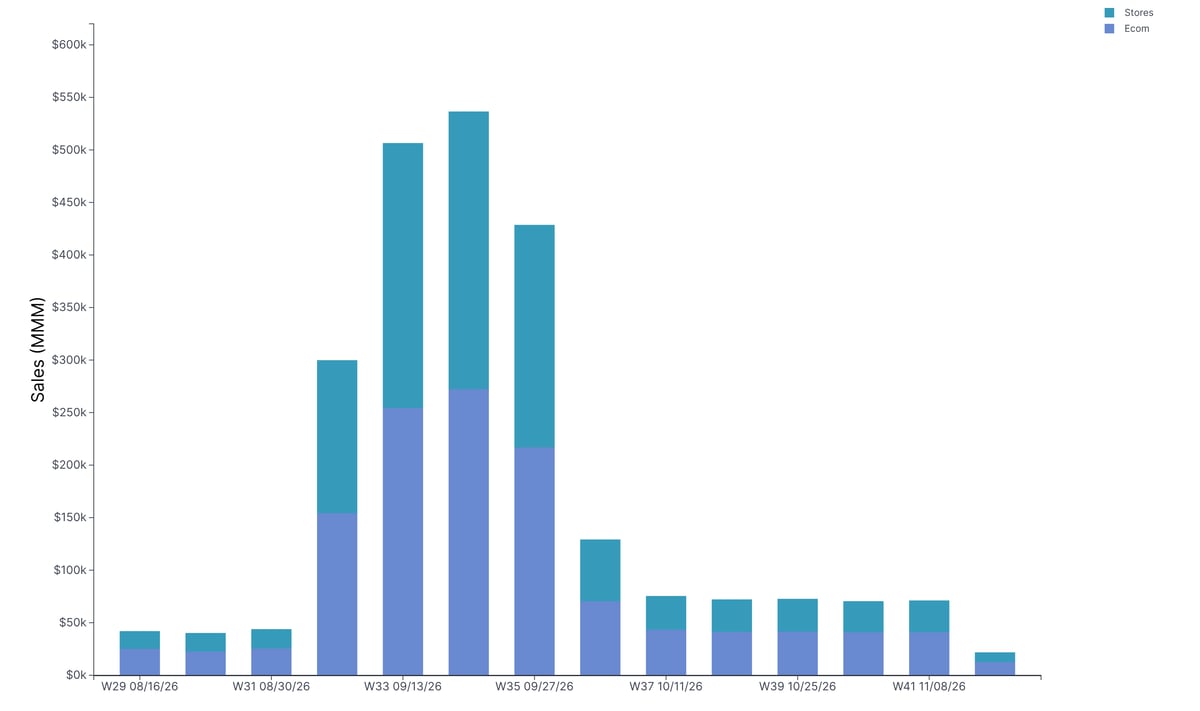
The store share depends on the medium. For Google Ads and Meta, about 9% of the modeled incremental sales come through stores; for TV and digital out-of-home, 46–47%. The second chart, from the same demo (demo data), shows TV alone. Over the period, 1.14 million USD of TV spend, concentrated in a four-week flight in September, drove 2.57 million USD of modeled incremental sales, an iROAS of 2.26, and 1.21 million USD of it came through stores. GA4 attributes 14 thousand USD of sales to the same TV spend.
Key takeaways
- The halo effect is the incremental sales an activity causes outside the scope it targets or is tracked in: other sales channels, other products or other media.
- Total iROAS is direct iROAS plus halo iROAS. Judging a campaign on direct sales alone can make a profitable campaign look like a loss.
- Click-based attribution and platform conversion tracking miss most of the offline and non-click halo, and platform halo metrics are attributed, not incremental.
- MMM and geo experiments capture the halo when their outcome data covers stores, marketplaces, apps and all products. Experiment and model scopes must match when calibrating.
Related terms
- Incrementality
- Promotional lift
- Geo lift test
- Conversion lift study
- Last-click attribution
- Branded search advertising
Further reading on Sellforte
- How can MMM measure the impact of digital advertising on offline store sales?
- How can MMM measure advertising that drives sales in other product categories?
- How to measure Meta correctly? Part 2: Add offline sales impact
- The spillover effect: How TV affects search engine marketing
References
- Ailawadi, K. L., Harlam, B. A., César, J., & Trounce, D. (2006). Promotion profitability for a retailer: The role of promotion, brand, category, and store characteristics. Journal of Marketing Research, 43(4), 518–535. https://doi.org/10.1509/jmkr.43.4.518
- Amazon Ads. (n.d.). Your complete guide to Amazon Attribution. Retrieved 2026-11-23, from https://advertising.amazon.com/library/guides/basics-of-amazon-attribution
- Dinner, I. M., Van Heerde, H. J., & Neslin, S. A. (2014). Driving online and offline sales: The cross-channel effects of traditional, online display, and paid search advertising. Journal of Marketing Research, 51(5), 527–545. https://doi.org/10.1509/jmr.11.0466
- Erdem, T., & Sun, B. (2002). An empirical investigation of the spillover effects of advertising and sales promotions in umbrella branding. Journal of Marketing Research, 39(4), 408–420. https://doi.org/10.1509/jmkr.39.4.408.19120
- Lewis, R. A., & Reiley, D. H. (2014). Online ads and offline sales: Measuring the effect of retail advertising via a controlled experiment on Yahoo! Quantitative Marketing and Economics, 12(3), 235–266. https://doi.org/10.1007/s11129-014-9146-6
- Sahni, N. S. (2016). Advertising spillovers: Evidence from online field experiments and implications for returns on advertising. Journal of Marketing Research, 53(4), 459–478. https://doi.org/10.1509/jmr.14.0274
- Thorndike, E. L. (1920). A constant error in psychological ratings. Journal of Applied Psychology, 4(1), 25–29. https://doi.org/10.1037/h0071663
Authors

Lauri Potka is the Chief Operating Officer at Sellforte, with over 15 years of experience in Marketing Mix Modeling, marketing measurement, and media spend optimization. Before joining Sellforte, he worked as a management consultant at the Boston Consulting Group, advising some of the world’s largest advertisers on data-driven marketing optimization. Follow Lauri in LinkedIn, where he is one of the leading voices in MMM and marketing measurement.


