


Cost per click (CPC) is the average amount an advertiser pays for one click on an ad. It is calculated by dividing media spend by the number of clicks. CPC shows how efficiently a campaign buys traffic, but it says nothing about how many of those clicks lead to sales that would not have happened without the ad.
Cost per click formula
Cost per click (CPC) = Media spend / Number of clicks
Ad platforms report this as average CPC: the total cost divided by total clicks over a period (Google Ads Help, n.d.-a). It differs from the maximum CPC an advertiser bids, because the actual price of each click is set in the ad auction and is often lower than the bid (Google Ads Help, n.d.-b).
Example
If your media spend is $10,000 and you receive 5,000 clicks, your CPC is $2.00.
| Advertising spend | $10,000 |
| Number of Clicks | 5,000 |
| Cost-Per-Click | $2.00 |
CPC vs. CPM vs. CPA
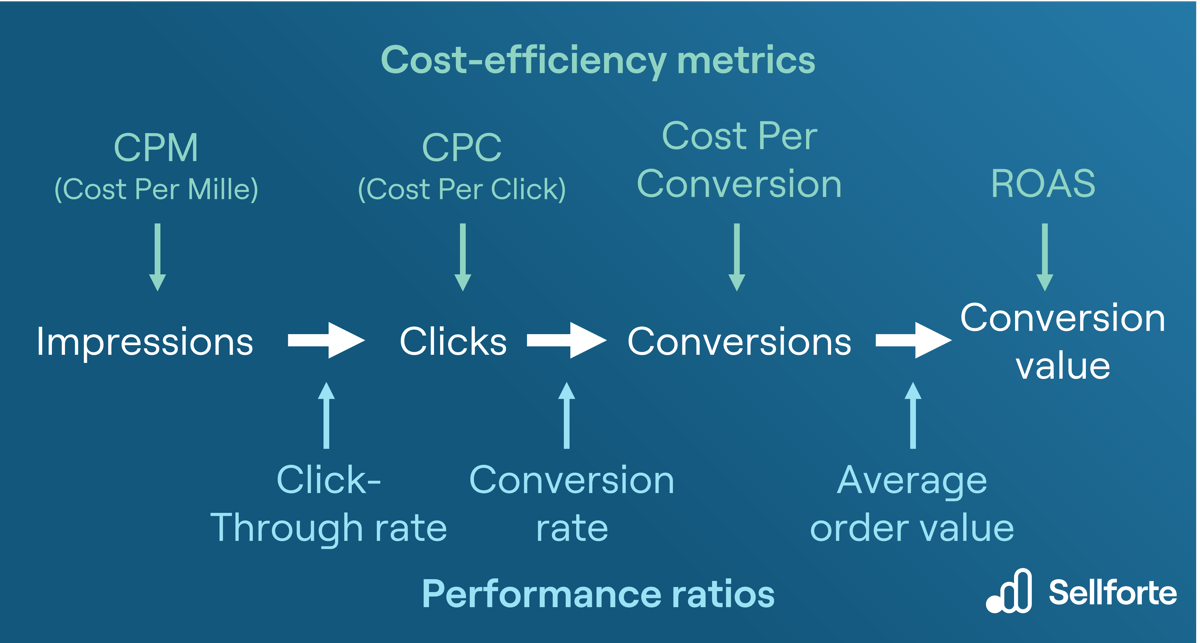
CPC is one of three cost-efficiency metrics that price different steps of the same funnel:
- Cost per mille (CPM): cost of 1,000 impressions. It prices exposure.
- Cost per click (CPC): cost of one click. It prices traffic.
- Cost per conversion (CPA): cost of one attributed conversion. It prices an outcome, as defined by the advertiser's conversion tracking.
The three are linked: CPC = CPM / (1,000 × CTR), where CTR is the click-through rate. A campaign can therefore lower its CPC either by buying cheaper impressions or by earning more clicks per impression.
How CPC is used
- Bidding. In pay-per-click (PPC) buying, the advertiser pays per click and sets a maximum CPC or lets an automated strategy bid towards a target (Google Ads Help, n.d.-b).
- Comparing traffic costs. Marketers compare CPC across channels, campaigns and keywords to see where traffic is cheapest. CPC does not measure traffic quality, that is, how likely visitors are to buy.
- Diagnosing performance changes. When the return of a channel changes, a rise or fall in CPC is one of the first explanatory factors to check, alongside conversion rate and order value.
What influences CPC?
CPC is set in auctions, so it depends on how many advertisers compete for the same audience or keyword, how much they bid, and how the platform rates the ad's relevance. Ad position matters as well. In a field experiment on sponsored search, Agarwal, Hosanagar and Smith found that click-through rate falls with lower positions while conversion rate rises, so the top position was not necessarily the most profitable one (Agarwal, Hosanagar & Smith, 2011). Paying a higher CPC for the top slot is therefore not automatically efficient.
Why a low CPC does not mean high incrementality
A cheap click is only valuable if it changes what the customer does. Many low-CPC clicks come from people who were already on their way to buy, for example users searching for the brand name. In a large field experiment at eBay, the returns to paid search were a fraction of what non-experimental estimates suggested, brand-keyword ads showed no measurable short-term benefit, and most spend on non-brand keywords went to frequent users whose purchases the ads did not change (Blake, Nosko & Tadelis, 2015).
For this reason, CPC should be read next to an incremental measure of return. Marketing mix modeling and controlled experiments estimate how many sales a channel causes, which can rank channels very differently from CPC. See incrementality and branded search advertising for more detail.
How to track CPC
CPC is reported by the ad platform that runs the campaign. For example, in a Google Performance Max campaign, Google Ads records the clicks, spend and CPC. Platforms exclude invalid clicks, which include accidental, duplicate and intentionally fraudulent clicks, and do not charge for them (Google Ads Help, n.d.-c).
To compare CPC across platforms, the data needs to be consolidated in one place. Below are examples of tracking views from the Sellforte demo.
Ad platform-level CPC analysis:

Advertising channel-level CPC analysis:

CPC in the media metric funnel
CPC is one of the cost-efficiency metrics in the media metric funnel, which follows an ad from impressions to clicks, conversions and conversion value. Conversions in the funnel are counted by attribution rules after a click or, for some ad types, after a view without a click, so the funnel describes attributed results rather than incremental ones.
Key takeaways
- CPC = media spend / clicks. It prices traffic, not sales.
- CPC, CPM and CTR are linked: CPC = CPM / (1,000 × CTR).
- A low CPC can hide low incrementality, as with brand search clicks that would have converted anyway.
Related terms
- Cost per mille (CPM)
- Cost per conversion (CPA)
- Click-through rate (CTR)
- Clicks
- Return on advertising spend (ROAS)
- Search engine marketing (SEM)
Further reading on Sellforte
- Should you include branded keyword paid search spend in MMM?
- The 3 danger zones of last-click
- Why should you combine media metrics with MMM insights?
References
- Agarwal, A., Hosanagar, K., & Smith, M. D. (2011). Location, location, location: An analysis of profitability of position in online advertising markets. Journal of Marketing Research, 48(6), 1057–1073. https://doi.org/10.1509/jmr.08.0468
- Blake, T., Nosko, C., & Tadelis, S. (2015). Consumer heterogeneity and paid search effectiveness: A large-scale field experiment. Econometrica, 83(1), 155–174. https://doi.org/10.3982/ECTA12423
- Google Ads Help. (n.d.-a). Average cost-per-click (Avg. CPC): Definition. Retrieved 2026-10-30, from https://support.google.com/google-ads/answer/14074
- Google Ads Help. (n.d.-b). Cost-per-click (CPC): Definition. Retrieved 2026-10-30, from https://support.google.com/google-ads/answer/116495
- Google Ads Help. (n.d.-c). Invalid clicks: Definition. Retrieved 2026-10-30, from https://support.google.com/google-ads/answer/42995
Authors

Lauri Potka is the Chief Operating Officer at Sellforte, with over 15 years of experience in Marketing Mix Modeling, marketing measurement, and media spend optimization. Before joining Sellforte, he worked as a management consultant at the Boston Consulting Group, advising some of the world’s largest advertisers on data-driven marketing optimization. Follow Lauri in LinkedIn, where he is one of the leading voices in MMM and marketing measurement.


