


Conversion rate is the share of ad interactions or website visits that result in a conversion, such as a purchase, sign-up or lead. For a campaign, it is calculated by dividing the conversions attributed to the campaign by the clicks or visits attributed to it. Conversion rate shows how well traffic turns into results, not whether the advertising caused them.
Conversion rate formula
Conversion rate = Number of conversions attributed to a campaign / Number of website visits attributed to a campaign × 100%
Ad platforms usually use ad interactions as the denominator. Google Ads calculates conversion rate as conversions divided by the total ad interactions that can be tracked to a conversion in the same period; 50 conversions from 1,000 interactions is a 5% conversion rate (Google Ads Help, n.d.-a). If several conversion actions are tracked, or every conversion is counted rather than one per interaction, the rate can exceed 100%. Site analytics tools, by contrast, typically divide by sessions or users. State the numerator and denominator whenever you compare conversion rates.
Example calculation for conversion rate
If a campaign delivered 10,000 visitors and 500 of them made a purchase, the conversion rate of the campaign is 5%.
| Number of Conversions (attributed to a campaign) | 500 |
| Number of Website visitors (attributed to a campaign) | 10,000 |
| Conversion Rate (of a campaign) | 5.00% |
How is conversion rate tracked?
Conversion rate is reported by ad platforms, but it is not shown by default in every platform's dashboards, and analyzing it may require customizing reports. Because each platform uses its own attribution rules, rates from different platforms are not directly comparable.
To compare conversion rates across platforms and channels, the data needs to be consolidated in one place. Below is an example of an advertising channel-level view from the Sellforte demo.

How are attributed conversions measured?
Campaign-level conversion rate depends on linking both conversions and visits to campaigns, which relies on conversion tracking and attribution rules:
- Tracking. The advertiser installs the ad platform's tag or pixel on the website, or sends conversions server-side, so conversion events are reported back to the platform.
- Click-through conversions. A conversion is credited to an ad if the user clicked it within the conversion window. In Google Ads the default click-through window is 30 days, adjustable between 1 and 90 days depending on the conversion source (Google Ads Help, n.d.-b).
- View-through conversions. Platforms can also credit conversions after an ad impression without a click, for example for display and video ads (Google Ads Help, n.d.-c). These conversions have no click in the denominator, so including them inflates a per-click conversion rate.
How is conversion rate used?
- Traffic quality. Marketers compare conversion rates across campaigns, audiences and keywords to see which traffic is most likely to convert. A low conversion rate can point to weak targeting, a mismatch between ad and landing page, or a problem on the website itself.
- Bidding and keyword decisions. Conversion rate and click cost together set the cost per conversion: CPA = CPC / conversion rate. In sponsored search, click-through rate falls with lower ad positions while conversion rate rises, so the top position is not necessarily the most profitable (Agarwal, Hosanagar & Smith, 2011).
- Diagnosing performance changes. When the return of a channel changes, a shift in conversion rate is one of the factors to check, alongside CPC and average order value.
Why a high conversion rate does not mean high incrementality
Campaigns that reach people who already intend to buy, such as brand search and retargeting, naturally show high conversion rates. Many of those conversions would have happened without the ad. Experimental studies show the gap: in a large field experiment at eBay, brand-keyword ads showed no measurable short-term benefit (Blake, Nosko & Tadelis, 2015), and across 15 randomized experiments at Facebook, observational methods often failed to reproduce the experimental ad effects (Gordon et al., 2019).
A conversion rate is therefore a diagnostic for traffic quality and website performance. The number of conversions the advertising actually caused is measured with incrementality testing or marketing mix modeling.
Conversion rate in the media metric funnel
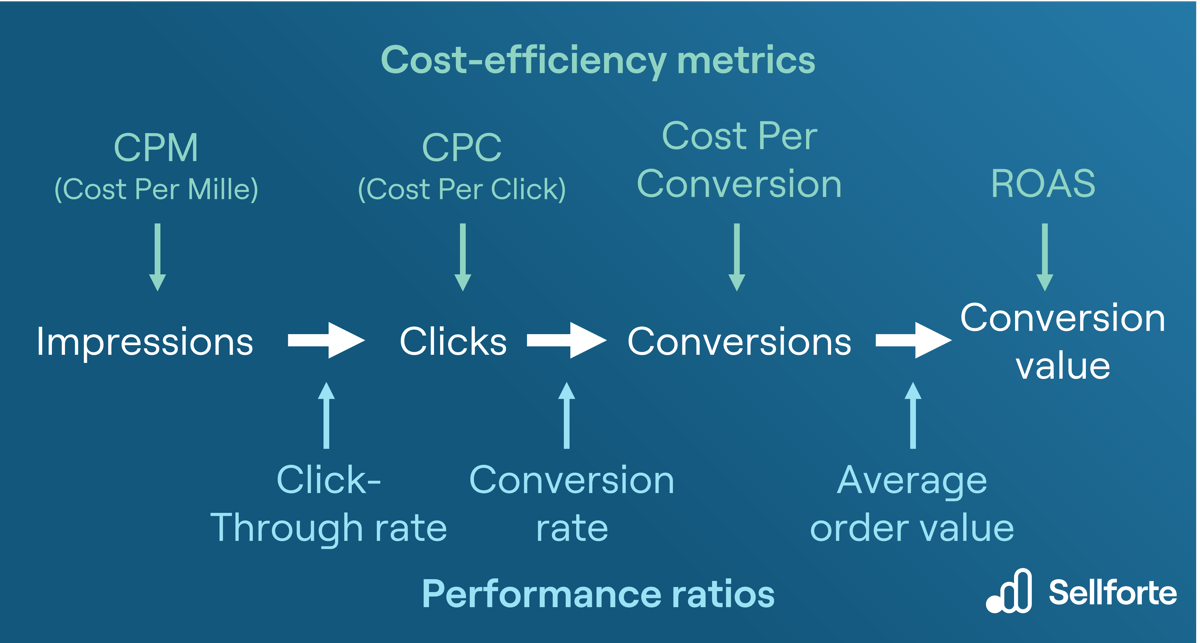
Conversion rate is one of the performance ratios in the media metric funnel, which follows an ad from impressions to clicks, conversions and conversion value. Conversions in the funnel are counted by attribution rules after a click or, for some ad types, after a view without a click, so the funnel describes attributed results rather than incremental ones.
Key takeaways
- Conversion rate = conversions / clicks or visits. Always state which denominator is used.
- CPA = CPC / conversion rate, so conversion rate links click costs to conversion costs.
- High conversion rates often reflect existing purchase intent rather than incremental impact.
Related terms
- Cost per conversion (CPA)
- Click-through rate (CTR)
- Average order value (AOV)
- Direct traffic in GA4
- Incrementality
Further reading on Sellforte
- Why should you combine media metrics with MMM insights?
- How to measure Meta correctly? GA4 vs. MTA vs. MMM
- Is attribution enough on its own?
References
- Agarwal, A., Hosanagar, K., & Smith, M. D. (2011). Location, location, location: An analysis of profitability of position in online advertising markets. Journal of Marketing Research, 48(6), 1057–1073. https://doi.org/10.1509/jmr.08.0468
- Blake, T., Nosko, C., & Tadelis, S. (2015). Consumer heterogeneity and paid search effectiveness: A large-scale field experiment. Econometrica, 83(1), 155–174. https://doi.org/10.3982/ECTA12423
- Google Ads Help. (n.d.-a). Conversion rate: Definition. Retrieved 2026-10-30, from https://support.google.com/google-ads/answer/2684489
- Google Ads Help. (n.d.-b). About conversion windows. Retrieved 2026-10-30, from https://support.google.com/google-ads/answer/3123169
- Google Ads Help. (n.d.-c). About view-through conversions. Retrieved 2026-10-30, from https://support.google.com/google-ads/answer/16542520
- Gordon, B. R., Zettelmeyer, F., Bhargava, N., & Chapsky, D. (2019). A comparison of approaches to advertising measurement: Evidence from big field experiments at Facebook. Marketing Science, 38(2), 193–225. https://doi.org/10.1287/mksc.2018.1135
Authors

Lauri Potka is the Chief Operating Officer at Sellforte, with over 15 years of experience in Marketing Mix Modeling, marketing measurement, and media spend optimization. Before joining Sellforte, he worked as a management consultant at the Boston Consulting Group, advising some of the world’s largest advertisers on data-driven marketing optimization. Follow Lauri in LinkedIn, where he is one of the leading voices in MMM and marketing measurement.


