


Click-through rate (CTR) is the share of ad impressions that result in a click. It is calculated by dividing clicks by impressions and is usually shown as a percentage. CTR indicates how well an ad, search result or email link attracts interest from its audience, but it does not measure sales or the ad's incremental effect.
Click-through rate formula
Click-through rate (CTR) = Number of clicks / Number of impressions × 100%
Google Ads defines CTR in the same way: for example, 5 clicks from 100 impressions is a CTR of 5% (Google Ads Help, n.d.-a). In email marketing, CTR is usually calculated per delivered email rather than per impression.
Example calculation for click-through rate
If your campaign delivered 10,000 impressions and received 100 clicks, your click-through rate is 1%.
| Number of Impressions | 10,000 |
| Number of Clicks | 100 |
| Click-Through Rate | 1.00% |
How is click-through rate tracked?
CTR is a standard metric available on practically every platform that serves ads or links, including ad platforms such as Google Ads and Meta and email marketing tools such as HubSpot. Clicks are counted by the platform, and invalid clicks are filtered out and not charged (Google Ads Help, n.d.-b). The IAB Click Measurement Guidelines set out industry rules for when to count a click and which clicks to filter as invalid (IAB, 2009).
To compare CTR across platforms and channels, the data needs to be consolidated in one place. Below is an example of an advertising channel-level view from the Sellforte demo.

How is click-through rate used?
- Creative and targeting diagnostics. Marketers compare CTR across ads, audiences and placements to find which creative and targeting combinations attract interest. A low CTR can point to weak creative, poor targeting or low visibility.
- Search ad auctions. In Google Ads, expected CTR is one component of Ad Rank, so a higher expected CTR can improve ad position and lower costs (Google Ads Help, n.d.-a).
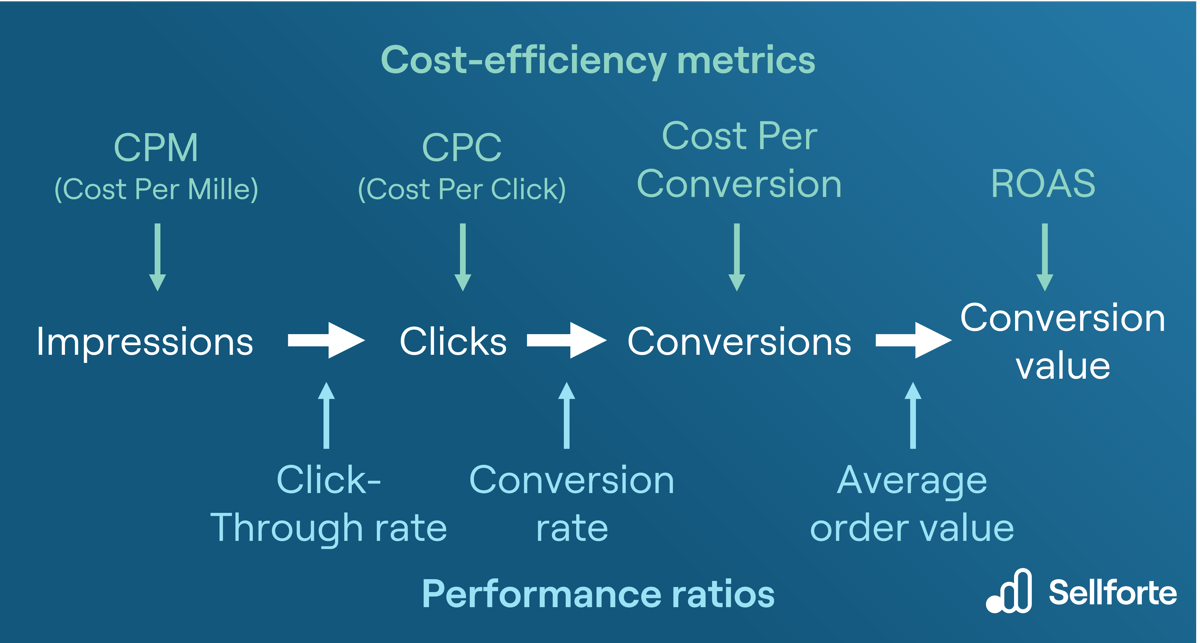
- Diagnosing performance changes. CTR links impression costs to click costs: CPC = CPM / (1,000 × CTR). When the return of a channel changes, CTR is one of the factors to check.
What influences click-through rate?
- Format and channel. Search ads, which answer an active query, typically get much higher CTRs than display or video ads. Google notes that a good CTR depends on what is advertised and on which network (Google Ads Help, n.d.-a). Compare CTRs within the same format.
- Relevance and targeting. Ads that match the user's intent and interests get more clicks.
- Position and visibility. Higher positions in search results and more visible placements get more clicks.
- Creative and copy. Clear headlines, visuals and calls to action affect the click decision.
Why a high CTR does not mean high incrementality
CTR measures interest in the ad, not the sales it causes. Two findings illustrate the gap:
- In sponsored search, CTR falls as ad position drops, while conversion rate rises, so the position with the most clicks was not necessarily the most profitable one (Agarwal, Hosanagar & Smith, 2011).
- Brand search ads usually have high CTRs, but in a field experiment at eBay they showed no measurable short-term sales benefit (Blake, Nosko & Tadelis, 2015).
Many ads also work without a click, for example video and display ads that build awareness. A low CTR therefore does not prove that an ad is ineffective. The sales effect of advertising, with or without clicks, is measured with incrementality testing or marketing mix modeling.
Click-through rate in the media metric funnel
Click-through rate is one of the performance ratios in the media metric funnel, which follows an ad from impressions to clicks, conversions and conversion value. Conversions in the funnel are counted by attribution rules after a click or, for some ad types, after a view without a click, so the funnel describes attributed results rather than incremental ones.
Key takeaways
- CTR = clicks / impressions. It measures interest in the ad, not sales.
- Compare CTRs only within the same format and channel.
- High-CTR ads, such as brand search, can still have low incremental impact.
Related terms
Further reading on Sellforte
- Why should you combine media metrics with MMM insights?
- The 3 danger zones of last-click
- What is incrementality testing?
References
- Agarwal, A., Hosanagar, K., & Smith, M. D. (2011). Location, location, location: An analysis of profitability of position in online advertising markets. Journal of Marketing Research, 48(6), 1057–1073. https://doi.org/10.1509/jmr.08.0468
- Blake, T., Nosko, C., & Tadelis, S. (2015). Consumer heterogeneity and paid search effectiveness: A large-scale field experiment. Econometrica, 83(1), 155–174. https://doi.org/10.3982/ECTA12423
- Google Ads Help. (n.d.-a). Clickthrough rate (CTR): Definition. Retrieved 2026-10-30, from https://support.google.com/google-ads/answer/2615875
- Google Ads Help. (n.d.-b). Click: Definition. Retrieved 2026-10-30, from https://support.google.com/google-ads/answer/31799
- Interactive Advertising Bureau. (2009). Click measurement guidelines (Version 1.0, final release). https://www.iab.com/wp-content/uploads/2015/06/click-measurement-guidelines2009.pdf
Authors

Lauri Potka is the Chief Operating Officer at Sellforte, with over 15 years of experience in Marketing Mix Modeling, marketing measurement, and media spend optimization. Before joining Sellforte, he worked as a management consultant at the Boston Consulting Group, advising some of the world’s largest advertisers on data-driven marketing optimization. Follow Lauri in LinkedIn, where he is one of the leading voices in MMM and marketing measurement.


