


Last-click attribution is a rule-based attribution model that gives 100% of the credit for a conversion to the last ad or channel the customer clicked before converting. It is simple and available by default in most analytics tools and ad platforms, but it measures which channel touched the sale last, not what advertising caused.
How last-click attribution works
An analytics tool or ad platform records the clicks that bring a customer to the website, such as clicks on search ads, social ads, emails or affiliate links. When the customer converts, the model looks back along the path and gives the full conversion value to the final click. Every earlier click, and every ad the customer saw without clicking, gets zero credit:
Last-click revenue of channel c = Σi (Conversion valuei × Lasti,c)
- Conversion valuei: the revenue of tracked conversion i.
- Lasti,c: 1 if the last click before conversion i came from channel c, otherwise 0.
Last-click ROAS for a channel is its last-click revenue divided by its spend. Last click is the simplest special case of multi-touch attribution: one touchpoint gets a weight of 1 and all others get 0.
Most tools use a variant called last non-direct click. A visit where the customer typed the address or used a bookmark is skipped, and the credit goes to the last marketing click before it. In Google Analytics 4 (GA4), the paid and organic last click model ignores direct traffic and gives 100% of the conversion value to the last channel the customer clicked through before converting. A second model, Google paid channels last click, credits the last Google Ads click and falls back to paid and organic last click when the path has no Google Ads click (Google Analytics Help, n.d.). In Google Ads, the last click model gives all credit to the last-clicked ad and its keyword. In 2023, Google retired the first click, linear, time decay and position-based models in both products, so last click and data-driven attribution are the remaining options (Google Ads Help, n.d.; Google Analytics Help, n.d.).
Example calculation
An online store records five orders in one day. The table shows each order's tracked path and the channel that last-click attribution credits:
| Order | Tracked path | Order value | Last-click credit |
| 1 | Meta ad click → brand search ad click | 120 EUR | Brand search |
| 2 | YouTube ad view → newsletter click | 80 EUR | |
| 3 | Meta ad click → direct visit | 100 EUR | Meta (direct visit skipped) |
| 4 | TV spot seen → brand search ad click | 150 EUR | Brand search |
| 5 | Display ad view → generic search ad click | 50 EUR | Generic search |
| Total | 500 EUR | Brand search 270 EUR, Meta 100 EUR, Email 80 EUR, Generic search 50 EUR |
Brand search receives 270 EUR, more than half of the day's revenue. If the store spent 50 EUR on brand search, its last-click ROAS is 270 ÷ 50 = 5.4. YouTube, TV and display get nothing, although each of them appeared in a path. The calculation also ignores the counterfactual: customers who were already searching for the brand could have clicked the organic result instead. If a test showed that 60% of the brand search orders would have happened anyway, the incremental revenue would be 108 EUR and the incremental ROAS (iROAS) 108 ÷ 50 = 2.16, less than half of the last-click figure. All numbers in this example are hypothetical.
Why last-click attribution is biased
- It rewards demand capture. Channels that sit close to the purchase, such as brand search, retargeting, email and coupon or affiliate links, collect the last click whether or not they changed the outcome. In large-scale field experiments at eBay, Blake et al. (2015) found no measurable short-term benefit from brand keyword ads: when the ads were stopped, users switched to the unpaid organic search links, and the returns from paid search were a fraction of conventional non-experimental estimates.
- It ignores demand creation. TV, online video, out-of-home, display and prospecting social ads often work through exposure, and the purchase comes later through a search or a direct visit. Kireyev et al. (2016) found that display ads significantly increased search conversions and also increased search clicks. Under last click, that effect is credited to search.
- It is not causal. Every tracked order goes to some channel, including orders that would have happened without any advertising. Last click therefore measures association with the final step of the journey, not incrementality.
- It distorts incentives. In a game-theoretic analysis, Berman (2018) showed that last-touch attribution over-incentivizes ad exposures, often lowering advertiser profits, and that attribution based on the Shapley value increased profits compared with last touch.
- It misses what it cannot track. Cross-device journeys, consent choices and cookie limits break paths, and store sales driven by online ads never appear in click data.
Last-click attribution vs. marketing mix modeling
Marketing mix modeling (MMM) does not use click paths. It relates spend in each channel to sales over time, controls for base demand, seasonality, promotions and other drivers, and estimates the sales each channel caused as iROAS. The gap between the two views is easiest to see side by side. The charts below from the Sellforte demo (demo data) rank media channels by GA4-attributed ROAS on the left and by MMM iROAS on the right, over the same 14 weeks.
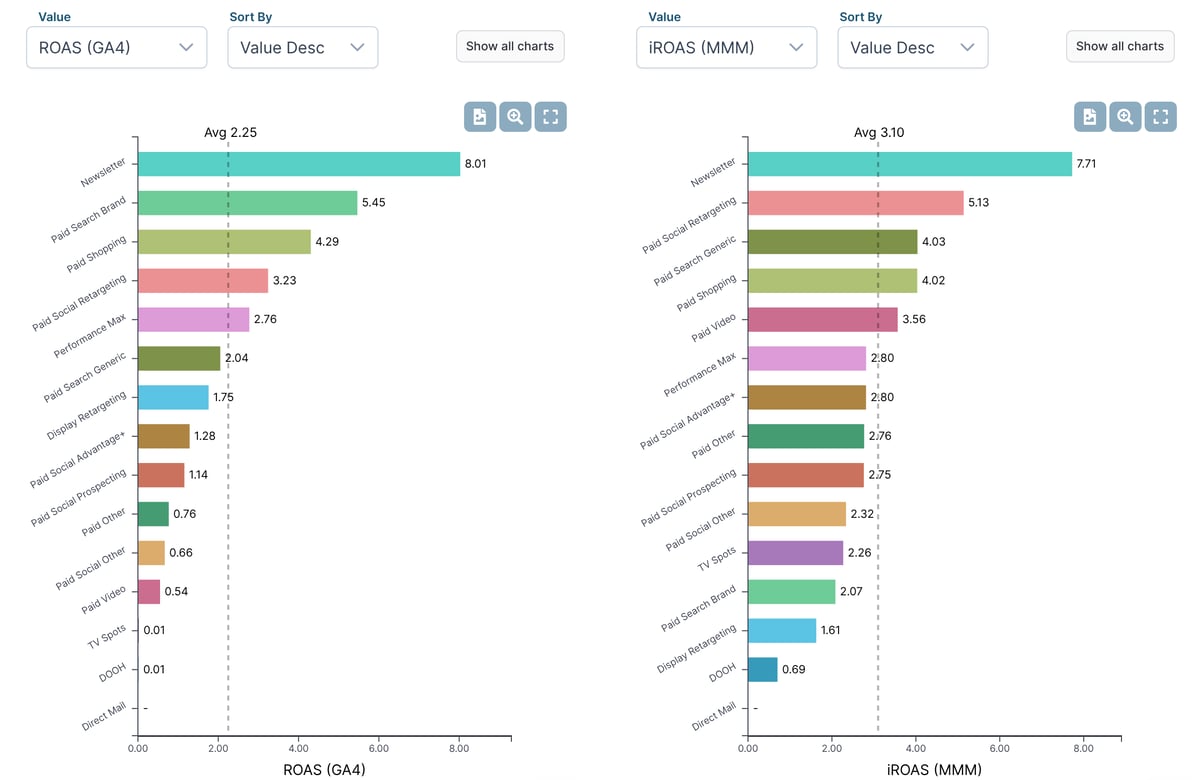
Click-based GA4 attribution ranks paid search brand second with a ROAS of 5.45, while the MMM estimates its iROAS at 2.07, below the 3.10 average. Channels that create demand move the other way: paid video has a GA4 ROAS of 0.54 against an iROAS of 3.56, paid social prospecting 1.14 against 2.75, and TV spots 0.01 against 2.26. In Sellforte's analysis of hundreds of campaigns for one ecommerce brand, last-click ROAS and MMM-based iROAS were not correlated, as described in the 3 danger zones of last-click. For a longer comparison of the two methods, see last-click attribution and media mix modeling compared.
How to use last-click data
Last-click data is still useful. It is available daily at the level of campaigns, keywords and creatives, and it costs nothing extra. The fix is to stop reading it as a measure of causal impact:
- Compare within a channel, not across channels. Last click can help rank keywords or ad sets inside paid search, where the bias is broadly similar, but it cannot fairly compare search with TV or prospecting social.
- Calibrate with incrementality factors. Divide the iROAS from MMM or an experiment by the last-click ROAS of the same channel. In the demo data above, the factor for paid search brand is 2.07 ÷ 5.45 ≈ 0.38, so each unit of attributed revenue corresponds to about 0.38 units of incremental revenue. Channels with almost no clicks, such as TV, cannot be calibrated this way and need MMM directly.
- Test where last click is most likely wrong. A brand search holdout or a geo lift test measures the counterfactual directly, and the result can also be used to calibrate the MMM.
Key takeaways
- Last-click attribution gives 100% of a conversion's credit to the final click. Most tools skip direct visits, which makes it last non-direct click.
- It over-credits channels that capture existing demand, such as brand search and retargeting, and under-credits channels that create demand, such as TV, video and prospecting social.
- Last-click ROAS is not iROAS, because it does not estimate what would have happened without the ad.
- Use last-click data for fast comparisons within a channel, and calibrate it with iROAS from MMM and incrementality experiments before moving budget between channels.
Related terms
- Multi-touch attribution (MTA)
- Return on Advertising Spend (ROAS)
- Incrementality
- Branded search advertising
- Direct traffic in Google Analytics 4
- Counterfactual
Further reading on Sellforte
- Compared: Last-click attribution and Media Mix Modeling (MMM)
- The 3 danger zones of last-click (and how to avoid them)
- Calibrating MTA with incrementality: From attributed ROAS to incremental ROAS
- Attribution says ROAS is 8, experiments say 4. Which should I trust?
References
- Berman, R. (2018). Beyond the last touch: Attribution in online advertising. Marketing Science, 37(5), 771–792. https://doi.org/10.1287/mksc.2018.1104
- Blake, T., Nosko, C., & Tadelis, S. (2015). Consumer heterogeneity and paid search effectiveness: A large-scale field experiment. Econometrica, 83(1), 155–174. https://doi.org/10.3982/ECTA12423
- Google Ads Help. (n.d.). About attribution models. Retrieved 2026-11-19, from https://support.google.com/google-ads/answer/6259715
- Google Analytics Help. (n.d.). [GA4] Get started with attribution. Retrieved 2026-11-19, from https://support.google.com/analytics/answer/10596866
- Kireyev, P., Pauwels, K., & Gupta, S. (2016). Do display ads influence search? Attribution and dynamics in online advertising. International Journal of Research in Marketing, 33(3), 475–490. https://doi.org/10.1016/j.ijresmar.2015.09.007
Authors

Lauri Potka is the Chief Operating Officer at Sellforte, with over 15 years of experience in Marketing Mix Modeling, marketing measurement, and media spend optimization. Before joining Sellforte, he worked as a management consultant at the Boston Consulting Group, advising some of the world’s largest advertisers on data-driven marketing optimization. Follow Lauri in LinkedIn, where he is one of the leading voices in MMM and marketing measurement.


