


Clicks are user interactions in which someone presses or taps a digital element, such as an ad, link, button or call to action. In advertising, clicks usually take the user to the advertiser's site or app. They show active interest and drive traffic, but they do not by themselves measure sales or incremental impact.
How clicks are defined and counted
Each ad platform counts clicks on its own ads. Google Ads, for example, counts a click when someone clicks an ad, filters out invalid clicks and does not charge for them (Google Ads Help, n.d.-a). Invalid clicks include intentionally fraudulent clicks as well as accidental or duplicate ones (Google Ads Help, n.d.-b).
The industry standard is the IAB Click Measurement Guidelines, released in 2009 with the support of the Media Rating Council. They set rules for where a click originates, when it should be counted, and how to filter invalid and fraudulent clicks (IAB, 2009). Platforms still differ in what they count: a click on an ad's link, a click that expands a video, or a "like" may all be reported as clicks in some platforms. When comparing clicks across platforms, check whether the figures count all clicks or only link clicks.
Types of clicks in digital marketing
Paid clicks
- Search ad clicks: clicks on paid search results in Google, Bing or other search engines
- Shopping ad clicks: clicks on product listing ads
- Display and video ad clicks: clicks on banner, rich media and video ads
- Social media ad clicks: clicks on sponsored content on platforms such as Facebook, Instagram, LinkedIn, TikTok or X
- Affiliate clicks: clicks on links placed by partner or affiliate sites
Organic and owned clicks
- Organic search clicks: clicks on unpaid search results
- Organic social clicks: clicks on non-promoted social media content
- Email link clicks: clicks on links in email campaigns
- On-site clicks: clicks on navigation, buttons and calls to action within the advertiser's own website
Key click metrics
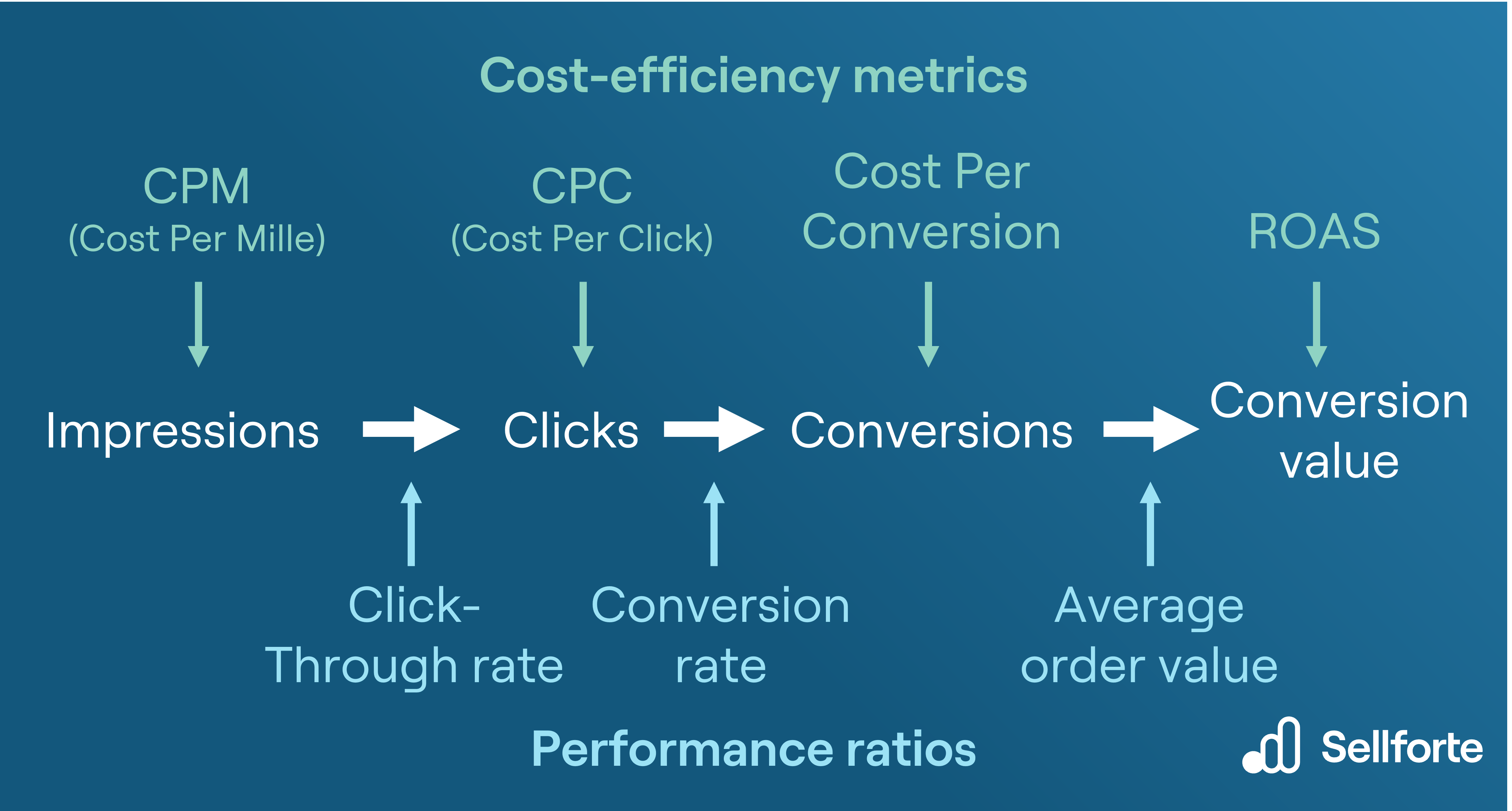
- Click-through rate (CTR) = clicks / impressions × 100%. The share of impressions that lead to a click.
- Cost per click (CPC) = media spend / clicks. The average price paid per click.
- Conversion rate = conversions / clicks × 100%. The share of clicks that lead to a purchase, sign-up or other goal.
In search advertising, click data also feeds into the auction: in Google Ads, expected click-through rate is a component of Ad Rank and so affects ad position and cost.
Why clicks are not the same as incremental sales
Click-based attribution credits existing demand
Many people who click an ad would have bought anyway, for example users who search for the brand name and click the paid result above the organic link. Click-based attribution, such as last-click, credits those sales to the ad. In a large field experiment at eBay, the returns to paid search were a fraction of what non-experimental estimates suggested, and brand-keyword ads showed no measurable short-term benefit (Blake, Nosko & Tadelis, 2015). Last-click attribution tends to favor bottom-of-funnel channels such as branded search and undervalue channels that create demand; see the 3 danger zones of last-click.
Many ads work without a click
Video, display, social and offline media can influence purchases without anyone clicking. Ad platforms partly account for this with view-through conversions, which credit a conversion after an impression without a click. Neither clicks nor view-through conversions show what would have happened without the ad.
More clicks are not always more profit
In sponsored search, click-through rate falls as ad position drops while conversion rate rises, so the position that gets the most clicks was not necessarily the most profitable one (Agarwal, Hosanagar & Smith, 2011).
For these reasons, incrementality-based methods such as marketing mix modeling and incrementality testing are needed to measure how many sales each channel and campaign actually causes.
Other click measurement challenges
- Invalid traffic: bots and accidental clicks inflate click counts. Platforms filter them, but filtering methods differ between platforms.
- Cross-device journeys: a user may click on a phone and buy on a laptop, which click-based tracking can miss.
- Privacy and consent: cookie restrictions and consent requirements reduce the share of clicks that can be linked to later conversions, which makes click-based attribution less complete.
Clicks in the media metric funnel
Clicks are the second step of the media metric funnel, which follows an ad from impressions to clicks, conversions and conversion value. Conversions in the funnel are counted by attribution rules after a click or, for some ad types, after a view without a click, so the funnel describes attributed results rather than incremental ones.
Key takeaways
- A click is a counted interaction with an ad or link; invalid clicks are filtered out.
- Clicks measure interest and traffic, not the sales an ad causes.
- Click-based attribution overstates channels that capture existing demand, such as branded search.
Related terms
- Click-through rate (CTR)
- Cost per click (CPC)
- Impressions
- Conversion rate
- Branded search advertising
Further reading on Sellforte
- The 3 danger zones of last-click
- Last-click attribution and media mix modeling compared
- Why should you combine media metrics with MMM insights?
References
- Agarwal, A., Hosanagar, K., & Smith, M. D. (2011). Location, location, location: An analysis of profitability of position in online advertising markets. Journal of Marketing Research, 48(6), 1057–1073. https://doi.org/10.1509/jmr.08.0468
- Blake, T., Nosko, C., & Tadelis, S. (2015). Consumer heterogeneity and paid search effectiveness: A large-scale field experiment. Econometrica, 83(1), 155–174. https://doi.org/10.3982/ECTA12423
- Google Ads Help. (n.d.-a). Click: Definition. Retrieved 2026-10-30, from https://support.google.com/google-ads/answer/31799
- Google Ads Help. (n.d.-b). Invalid clicks: Definition. Retrieved 2026-10-30, from https://support.google.com/google-ads/answer/42995
- Interactive Advertising Bureau. (2009). Click measurement guidelines (Version 1.0, final release). https://www.iab.com/wp-content/uploads/2015/06/click-measurement-guidelines2009.pdf
Authors

Lauri Potka is the Chief Operating Officer at Sellforte, with over 15 years of experience in Marketing Mix Modeling, marketing measurement, and media spend optimization. Before joining Sellforte, he worked as a management consultant at the Boston Consulting Group, advising some of the world’s largest advertisers on data-driven marketing optimization. Follow Lauri in LinkedIn, where he is one of the leading voices in MMM and marketing measurement.


