


The short answer
Yes. Include relevant distributor advertising in MMM so the model can distinguish its contribution from your own media. Keep spend ownership explicit in reporting and exclude distributor-controlled budgets from decisions your team can change. Your measurement scope can include more advertising than the budget you are responsible for reallocating.
This article is part of Asked by Marketers, a series answering real questions from marketing leaders.
Sellforte's team holds more than 1,450 meetings each year with marketing leaders in Ecommerce and Retail about Marketing Mix Modeling and incrementality testing. Each week, we anonymize at least one question from those conversations and answer it in depth, based on what marketers are actually struggling with, not what keyword tools suggest. About the series →
Why marketers ask this
A brand pays for advertising that can generate sales on its own website and through retail partners. A distributor also advertises the brand's products on a marketplace. The brand wants to know where its money works, but a combined spend total can make it look as though the team controls the distributor's budget too.
Why does MMM need spend that we do not control?
The model needs information about relevant advertising that can affect the sales outcome, regardless of which company pays for it. Otherwise, it has less evidence for separating the brand's contribution from the distributor's.
Suppose your own paid social spend falls while a distributor increases marketplace advertising. Marketplace sales hold steady. Without the distributor input, an analysis may misunderstand why those sales held up and what your paid social reduction actually changed.
Marketing Mix Modeling evaluates sales against the available media and business drivers. For this question, useful inputs include the distributor's relevant advertising activity and the sales outcomes where its effect may appear. Include your own advertising in those sales analyses too, because an ad paid for by the brand can lead to a purchase through a partner.
Adding the data improves the information available to the model. It does not guarantee a clean separation when the two companies always change their advertising together or when the sales history is incomplete.
How should we report our own spend and return?
Tag advertising by owner and keep the brand's spend subtotal visible. A distributor input can remain part of measurement while being excluded from the brand's own paid-media budget report.
Define the return you want to calculate before combining figures. A report about the brand's advertising should compare that advertising's modeled incremental contribution with the brand's corresponding spend. Putting the distributor's sales contribution in the numerator while leaving its spend out of the denominator would answer a different and misleading question.
The sales-value definition also matters. Consumer sales through a retailer and revenue received by the brand are different measures. Label the result according to the outcome actually modeled and agree any conversion to the brand's revenue or contribution before comparing it with direct sales.
| View | How distributor advertising should appear |
|---|---|
| Sales-driver analysis | Included when relevant data are available, so its contribution can be distinguished. |
| The brand's media-spend report | Shown separately or filtered out of the brand-owned subtotal. |
| The brand's budget recommendation | Held outside the adjustable budget unless the brand can actually change it. |
Document the ownership mapping in the data feed. A platform name alone does not tell you who pays: the same marketplace could contain both brand-funded and distributor-funded campaigns.
How should the optimizer handle distributor-controlled spend?
Restrict the optimizer to the budgets your team can change, while keeping the relevant distributor activity accounted for in the measurement setup. Confirm what level of distributor activity the forecast assumes.
Excluding a channel from an optimization decision and removing it from the underlying model are separate operations. The first changes the choices available to the planner. The second changes the information used to estimate sales drivers.
If the distributor has supplied a future plan, record it as an assumption for the scenario. If its plan is unknown, make the assumption explicit when reviewing the forecast. A recommendation based on unchanged distributor support may be less useful if the partner is about to reduce advertising substantially.
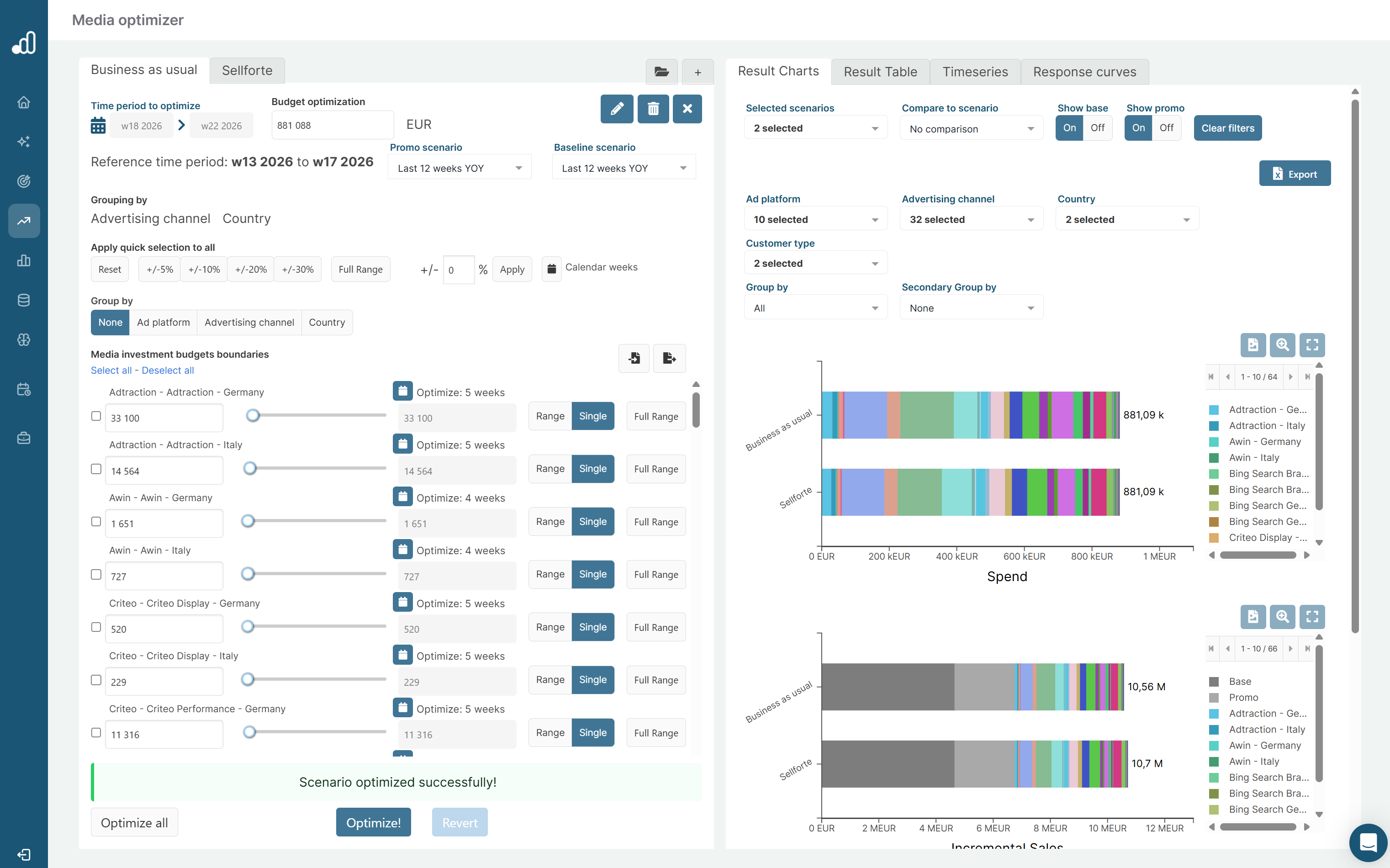
The broader article on setting limits on an MMM optimizer explains how to constrain changes. Here, the first restriction is ownership: a recommendation should not ask your team to reallocate somebody else's budget.
How this looks in practice
Consider a hypothetical brand spending $100,000 on its own media while a distributor spends $30,000 on marketplace advertising. The model uses both inputs and includes available website and marketplace sales. Assume, for illustration, that it estimates $240,000 of incremental consumer sales from the brand's media and $60,000 from distributor advertising.
The brand-media report shows $100,000 of spend and $240,000 of modeled incremental consumer sales, giving a consumer-sales iROAS of 2.4. The distributor's contribution is reported separately. Dividing the combined $300,000 by only the brand's $100,000 would give 3.0, but would mix two owners' contributions with one owner's costs.
For the next plan, the team can reallocate its $100,000. It cannot move the distributor's $30,000. The planner therefore holds that budget outside the adjustable set and states the assumed distributor support. These figures illustrate reporting boundaries; they are not customer results or a forecast of how a budget change would perform.
How Sellforte helps
Sellforte can include relevant advertising inputs in measurement while limiting which budgets enter an optimization decision. Its reporting dimensions can keep the brand's own spend and sales-channel results visible alongside the wider model. Book a demo.
Authors

Lauri Potka is the Chief Operating Officer at Sellforte and has over 15 years of experience in Marketing Mix Modeling, marketing measurement, and media spend optimization. Before joining Sellforte, he worked as a management consultant at the Boston Consulting Group, advising some of the world's largest advertisers on data-driven marketing optimization. Follow Lauri on LinkedIn, where he is one of the leading voices in MMM and marketing measurement.

How should we weight multiple incrementality tests when calibrating an MMM?

Can you trust a generic AI to do reliable media spend optimization with raw marketing data?