


Marketing platforms are very good at taking credit for conversions.
Sometimes, too good.
Imagine a customer clicks a Meta prospecting ad, later clicks a Google Shopping ad, then searches for the brand on Google, clicks a brand search ad, and places a $100 order.
Within their respective attribution systems, Meta can claim $100 of revenue. Google can also claim $100, with credit distributed between Google Shopping and brand search.
Your ad platforms can claim $200 of revenue from a $100 order and GA4 last click can also give all $100 to brand search.
Neither necessarily tells you what caused the sale.
Today, we’re introducing a brand new product designed to solve this exact problem: Sellforte Incremental Pixel.
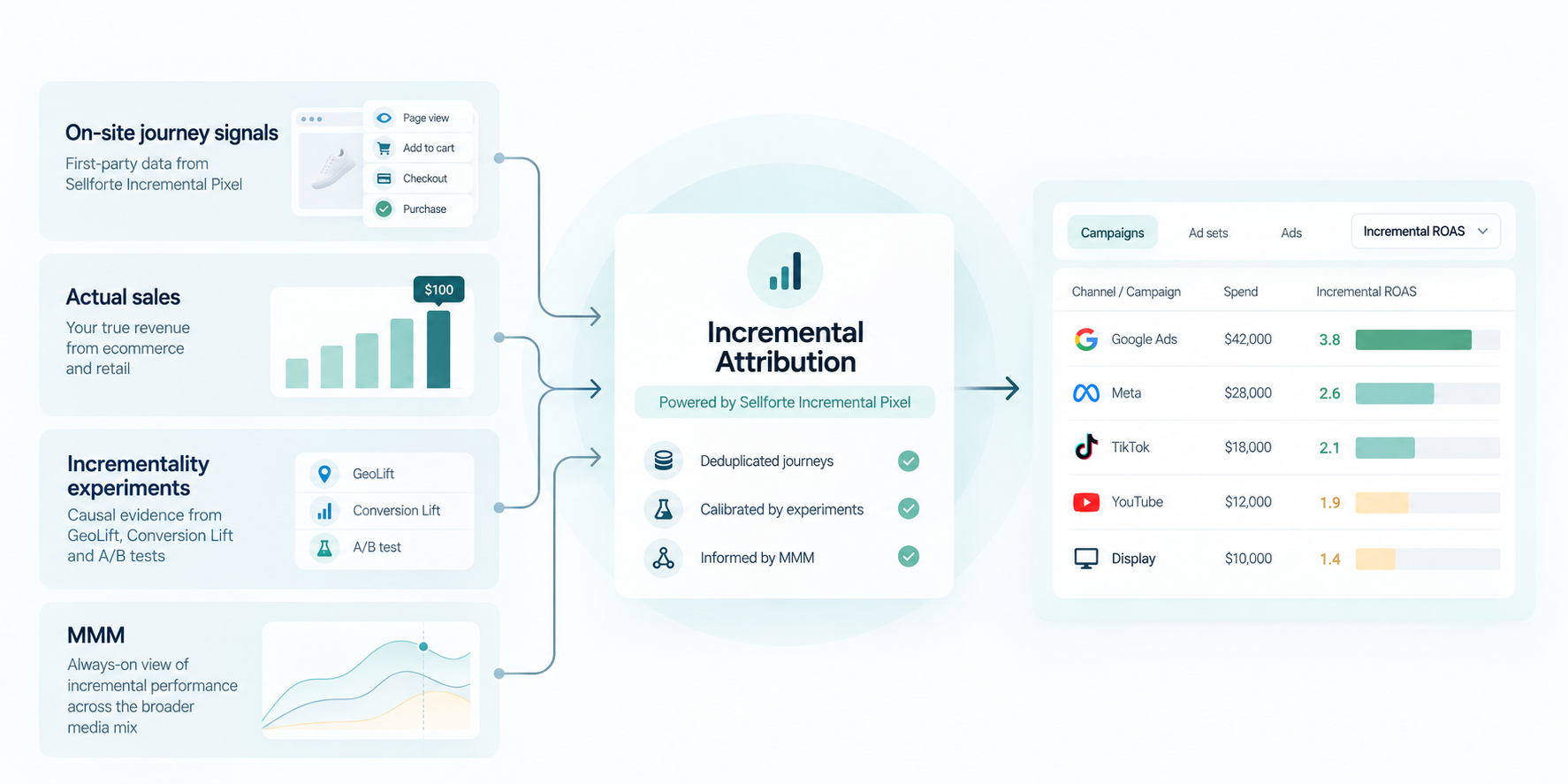
Sellforte Incremental Pixel provides the native journey data behind Sellforte Incremental Attribution, where granular attribution is calibrated using causal evidence from incrementality experiments and MMM.
The goal is simple: count every order once, then give marketing credit based on what actually drove incremental sales.
It also means Sellforte can now provide the complete modern measurement stack within one platform. Attribution gives performance teams the granularity they need for daily decisions, experiments establish causal truth, and MMM provides the broader view needed for strategic investment decisions.
Three customer journeys, two measurement problems
The opening example of a cross-platform journey shows one common attribution problem, but the same issues appear across very different customer journeys. Let's look at two more examples.
Coupon hijack: A customer clicks Google Shopping, later clicks a retargeting ad, then searches for a discount code and clicks through a coupon affiliate before completing a $100 purchase. Google, the retargeting platform, and the affiliate can all claim the conversion, while GA4 rewards the affiliate that appeared immediately before checkout.
Returning customer: An existing customer clicks a newsletter, later clicks a Meta retargeting ad, then converts through Google brand search. Email, Meta, and Google can all claim the same $100 order. But the harder question is whether any of them actually caused the purchase. This customer may have returned anyway.
Together, these journeys show how attribution can fail in different ways.

These examples look different, but they all point to the same two measurement problems.
The first is duplication and the second is causality.
Solving the first problem requires attribution. Solving the second requires incrementality.
Sellforte Incremental Pixel is designed to do both.
Problem one: count every order once
Google, Meta, TikTok, affiliates, retargeting platforms, and other advertising systems all observe different parts of the customer journey. Their attribution systems operate independently so the same sale can legitimately receive credit in several systems at the same time.
That makes each platform useful for operating within its own ecosystem but dangerous to simply add together.
At scale, the problem compounds.
Imagine a brand generates $200 million in actual sales. Google reports $100 million of conversion value, Meta reports $80 million, and TikTok reports another $80 million.
The platforms now claim $260 million against $200 million of actual revenue.
Sellforte Incremental Pixel is Sellforte’s own website tracking layer, capturing customer journeys and conversion events so attribution can be built from the sales and touchpoints Sellforte actually observes.
It creates a cross-channel attribution layer anchored to the sales that actually happened. Instead of starting from the sum of what every advertising platform claims, each conversion enters the attribution system once and credit can be distributed across the observed touchpoints.
One sale stays one sale.
At this point, the measurement is internally consistent. A $100 order is once again worth $100, rather than $200 or $300 across different platforms.
But consistent does not necessarily mean correct.
Attribution can determine how to distribute credit across the touchpoints it observed. It still cannot tell you how much credit marketing deserved in the first place.
That is the second problem.
Pixel and attribution make the numbers add up. Incrementality makes them mean something.
Problem two: credit only what marketing actually caused
A perfectly deduplicated attribution model is still an attribution model.
It can tell you which observable touchpoints were associated with a purchase but association is not the same thing as causation.
This creates a predictable bias. Channels that sit close to the purchase often look disproportionately effective. Brand search, retargeting, affiliates, and other lower-funnel activity have plenty of observable conversions nearby.
Prospecting, video, brand, and other upper-funnel activity can have the opposite problem. They influence demand earlier, often through views rather than clicks, and much of that influence is invisible to a browser-based customer journey.
This is why Sellforte does not treat raw pixel attribution as the answer.
We treat it as a granular daily signal that needs to be calibrated against causal evidence.
That evidence comes from incrementality experiments such as Conversion Lift and GeoLift studies, together with the broader causal measurement provided by MMM.
This lets Sellforte adjust attribution towards what marketing actually drove, rather than simply what happened to appear closest to the conversion.

How incrementality calibration works
Conceptually, there are two steps: attribution determines how conversion credit is distributed, then incrementality evidence corrects that attribution towards causal impact.
Consider an illustrative example:
| Channel | Orders credited by attribution | Incremental orders measured | Incrementality factor |
|---|---|---|---|
| Meta prospecting | 400 | 600 | 1.5 |
| Google brand search | 1 000 | 200 | 0.2 |
Attribution credits Meta prospecting with 400 orders. But a GeoLift or Conversion Lift study indicates that the channel actually generated 600 incremental orders. Its incrementality factor is therefore above 1.
Google brand search has the opposite problem. Attribution gives it 1 000 orders, but causal measurement indicates that only 200 were incremental. Its incrementality factor is 0.2.
Sellforte uses this evidence to adjust the attribution weights.
Two things are especially important here.
Incrementality factors can be greater than 1. A channel can drive more incremental impact than the observable journey suggests. This is particularly important for channels that influence customers through views, cross-device behavior, or other interactions that website tracking cannot fully capture.
Marketing credit does not have to add up to 100% of revenue. If only part of the business would disappear without advertising, only that part should be attributed as incremental marketing impact. The remainder is baseline demand.
That is the key difference between traditional attribution and incremental attribution.
Traditional attribution asks how to distribute a sale between marketing touchpoints. Sellforte asks a second question: how much of the sale should marketing receive credit for in the first place?
With native Sellforte Pixel data, these do not ultimately need to remain two separate modeling steps. The direction is an attribution model where incrementality is built directly into how credit is assigned. The two-step explanation simply makes the underlying measurement logic easier to understand.
The complete modern measurement stack inside Sellforte
For ecommerce and retail teams, the value of bringing attribution, incrementality experiments, and MMM together is a more consistent way to make decisions across the entire measurement stack.
Performance teams need granular attribution to decide which campaigns, ad sets, and ads to optimize today. Marketing leaders need experiments and MMM to understand what actually caused incremental growth and how budgets should be allocated across channels. When these live in separate tools, teams are left reconciling different datasets, methodologies, and definitions of performance.
Sellforte brings these measurement layers together so tactical decisions can be connected back to the same causal evidence used for broader marketing investment decisions.
The modern measurement approach combines three complementary methodologies: attribution, incrementality experiments, and MMM.
Each operates at a different level and serves a different decision.
| Method | Typical granularity | Primary use |
|---|---|---|
| Incrementality experiments | Channel or tactic | Establish causal truth |
| MMM | Channel, market, broader media mix | Strategic budget allocation and planning |
| Sellforte Incremental Attribution | Campaign, ad set, ad | Daily tactical reporting and optimization |
Incrementality experiments give Sellforte causal evidence from controlled tests. MMM provides an always-on view of incremental performance across the broader media mix. Incremental Attribution brings that evidence down to the granular level required for daily performance decisions.
This distinction is important.
Sellforte Incremental Attribution is not designed for annual media planning. MMM does that job.
Incremental Attribution is designed for the decisions performance teams make every day: which campaigns are actually working, which ad sets should receive more budget, and where platform-reported performance is overstating or understating incremental impact.
With Sellforte Incremental Pixel, the journey data, attribution model, incrementality calibration, experiments, and MMM can now all operate within Sellforte’s own measurement system.

What you get with Sellforte Incremental Attribution
The value is visible in the numbers performance teams actually use every day:
- Count every conversion once. Stop adding together overlapping revenue claims from multiple advertising platforms.
- See incremental ROAS and CPA at a granular level. Bring causal measurement closer to campaign, ad set, and ad-level decisions.
- Correct lower-funnel bias. Brand search, retargeting, and affiliates do not automatically win simply because they appeared closest to checkout.
- Recover under-measured upper-funnel impact. Calibration can increase the weight of channels when causal evidence shows they drive more incremental sales than observable journeys suggest.
- Anchor attribution to real sales. Actual sales remain the source of truth rather than the sum of platform-reported conversions.
- Understand customer journeys. Analyze the touchpoints and sequences that lead customers towards conversion.
- Compare different versions of performance. See platform reporting, conventional attribution, and incrementality-adjusted performance in context.
- Bring the data into your own analytics stack. Attribution outputs can be made available for downstream warehouse and BI workflows.
This is why Sellforte Incremental Pixel sits inside Sellforte Incremental Attribution rather than existing as a standalone tracking product.
The Pixel provides Sellforte with the granular journey signal. Incremental Attribution turns that signal into daily performance measurement calibrated against causal evidence.
Already have attribution? Keep it.
Sellforte Incremental Pixel is not a requirement for using Sellforte’s incrementality capabilities.
Many enterprise organizations already have sophisticated event tracking, Snowplow implementations, GA4 setups, data warehouses, or specialist attribution vendors.
There is no reason to rip those systems out simply to add another pixel.
Sellforte can use existing attribution data and calibrate it with incrementality and MMM too.
For companies that want the complete measurement stack within Sellforte, Incremental Pixel provides the native data collection and attribution foundation. For companies that already have an established attribution stack, bring your existing data.
The important part is not where the raw attribution originates but calibrating it towards incremental impact.
The biggest criticisms of pixels, and how we designed around them
Pixel attribution has legitimate limitations. We think the right response is to design around those limitations rather than pretend they do not exist.
Criticism: Pixels measure correlation, not causation
Our approach: We agree.
Seeing a touchpoint before a conversion does not prove that the touchpoint caused the sale. Sellforte therefore uses causal evidence from incrementality experiments and MMM to calibrate attribution rather than treating raw pixel attribution as ground truth.
Criticism: Pixels over-index on the lower funnel
Our approach: This is exactly why the incrementality layer matters.
If raw attribution systematically over-credits brand search or retargeting, causal evidence can reduce their weights. If a prospecting or video channel generates more incremental sales than the observable journey suggests, its weight can increase.
The pixel does not get the final vote.
Criticism: No pixel sees every customer journey
Our approach: Correct.
Consider a customer who sees a YouTube ad, later watches a Meta Reel, then searches for the brand on Google and buys.
If the YouTube and Meta ads were never clicked, Sellforte Incremental Pixel cannot observe those exposures in the on-site journey. The Pixel can see the Google brand search click but it doesn't pretend to reconstruct touchpoints it cannot see.
This is exactly why Pixel attribution alone is not enough.
Incrementality experiments and MMM can measure effects that are invisible at the individual journey level, allowing Sellforte to correct systematic under- or over-measurement without inventing missing touchpoints.
We do not claim to know what the Pixel cannot see. We use causal evidence to correct the aggregate attribution signal.
We are also working towards enriching that signal with additional server-side data and direct platform integrations, including impression and view data where partners make it available.
Criticism: More tracking can conflict with privacy expectations
Our approach: Consent still applies.
Sellforte Incremental Pixel is designed to work with customer consent choices and consent management setups. Incrementality calibration is not a mechanism for circumventing consent or reconstructing individual identities that users have chosen not to share.
Instead, causal measurement helps correct bias at an aggregate level without pretending every individual journey can or should be observed.
From attribution to action
The end goal is not simply a better attribution dashboard.
Sellforte Incremental Attribution is designed to give performance marketers a granular daily view of which campaigns, ad sets, and ads are actually driving incremental sales.
Those insights can then be used for tactical reporting and optimization, including identifying where budgets should move and where platform-reported ROAS is giving the wrong signal.
MMM remains the strategic layer for broader media allocation and longer-term planning. Experiments provide the causal ground truth. Incremental Attribution translates those signals into the level where performance teams actually operate.
That is the complete measurement loop we are building inside Sellforte.
What’s next
Sellforte Incremental Pixel is rolling out as part of Sellforte Incremental Attribution - see our pricing page for more.
We are continuing to expand the attribution layer across channel, campaign, ad set, ad, and customer journey views, while making the resulting data available for downstream analytics workflows.
We are also developing the underlying signal itself. That includes additional server-side data collection and direct platform data integrations that can add impression and view signals that browser-based tracking cannot observe alone.
The longer-term direction is clear: combine the granularity performance marketers need every day with the causal accuracy modern marketing measurement requires, all within Sellforte.
Interested in Sellforte Incremental Attribution?

Introducing Sellforte Incrementality Testing & Incremental Attribution

Why do platform ROAS and incremental ROAS tell such different stories?