
Google Query Volume (GQV) is Google's indexed daily query volume for an advertiser's branded queries and for generic queries in its product categories, nationally and per region. Google provides it through its MMM Data Platform as a supplemental report to a Google Ads or Display & Video 360 data request, and delivers it directly to Sellforte. You do not need to download, upload or format any files. To connect it, tell your Customer Success Manager yes and name the person Google should contact, or see How to enable Sellforte to receive Google Query Volume (GQV) data from Google.
In a marketing mix model, GQV is useful in two ways. Generic query volume is a signal of category search demand. Because paid search activity follows queries, it helps the model avoid attributing existing demand to paid search. Branded query volume is a proxy for brand equity: it reflects demand for your brand, which your marketing partly creates.
What is GQV data?
GQV contains two query sets, identified by the QueryLabel field:
- Branded queries (BRAND): queries that Google maps to your brand entities through Knowledge Graph IDs, based on the brand names in the request.
- Generic queries (GENERIC): queries in the product and service categories Google associates with those brands, excluding the brand names. Google generates this query set automatically, and it cannot be customized.
Specification:
- Indexed, not raw counts. Google scales raw query counts by one randomly generated constant per advertiser and country, the same for every region in that country. Index levels have no absolute meaning and cannot be compared across advertisers or countries; changes over time and differences between regions within a country can. The index stays consistent across refreshes, so models can be refit without breaks.
- Time granularity: daily, or weekly if requested.
- Geo granularity: DMA and state in the US; state, province or region in other countries where Google supports it; otherwise national.
- History: Google documents a lookback of up to three years. The history available for your brands is confirmed during setup.
- Coverage: all Google search queries in the query set, independent of ad impressions or clicks. Queries on other search engines are not included.
- Refresh: recurring deliveries, at most weekly. Daily data does not mean daily deliveries, and the most recent one to two weeks can arrive with a lag.
- No personal data: aggregated index values per day and geo, with no user-level information.
Example rows (illustrative values, not real data):
| QueryLabel | ReportDate | TimeGranularity | GeoCriteriaId | GeoName | GeoType | IndexedQueryVolume |
|---|---|---|---|---|---|---|
| BRAND | 2026-03-02 | DAILY | 20229 | Bavaria | STATE | 0.214 |
| GENERIC | 2026-03-02 | DAILY | 20229 | Bavaria | STATE | 12.873 |
| BRAND | 2026-03-02 | DAILY | 20226 | Berlin | STATE | 0.098 |
| GENERIC | 2026-03-02 | DAILY | 20226 | Berlin | STATE | 6.415 |
GeoCriteriaId and GeoName identify the region with Google's geo target codes, and IndexedQueryVolume is the index value for that query set, day and region.
Why is GQV valuable?
- Lower risk of overstating paid search ROI. Search ads are served only when a matching query occurs, so paid search activity follows query volume. With query volume in the model, demand that would have converted anyway is less likely to be attributed to paid search.
- A better baseline. Generic query volume reflects category demand, including seasonality, trends and external shocks. Including it helps the model separate market-level swings from the effect of your media.
- A daily signal of brand demand. Branded query volume provides a daily, regional time series of search interest in your brand. Analyzing it alongside media activity helps assess whether changes in paid search performance coincide with changes in underlying brand demand.
- The basis for full-funnel modeling. Upper-funnel media builds brand equity, which converts partly through branded search. Branded query volume provides a signal for investigating this indirect effect.
How Sellforte uses GQV in your model
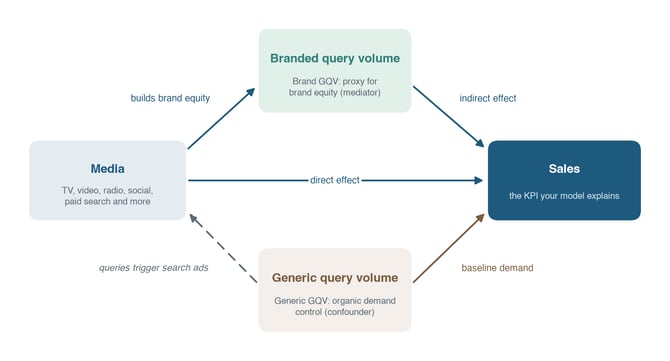
Conceptual diagram: generic query volume is a signal of category demand, and branded query volume mediates part of the media effect on sales. Modeling the mediated path is in development.
Today
We add GQV to your model as base features: generic query volume and, where appropriate, branded query volume. Each has a prior calibrated to a plausible share of sales, with a prior scale that lets the data update it. Before the change goes live, we compare the model with and without GQV (fit, baseline share and channel ROI) and explain material changes. Adding GQV does not always improve fit. Its main purpose is to reduce the risk of attributing existing demand to media.
Branded query volume needs careful treatment, because your marketing can create some of that search demand. Including it as a baseline control can understate the contribution of the campaigns that generated those searches. We therefore assess for each model whether and how to include it, review its effect on channel estimates, and use experimental evidence where available.
We also use branded query volume in analysis: to see which channels and campaigns move it, and in geo experiments to match test and control regions and as a secondary outcome next to sales.
In development
- Reporting of branded and generic query volume next to your media in the Sellforte platform
- Full-funnel modeling: a two-stage model in which media drives branded query volume (stage 1), and branded query volume and media drive sales (stage 2), so that the indirect effect of upper-funnel media is included in channel ROI
Connecting GQV does not activate these features or enroll you in a development pilot. Pilot participation and any case-study permissions are agreed separately.
Limitations
Branded query volume is a proxy for brand equity, not a complete measure of it: it captures search intent on Google, not awareness or consideration that does not lead to a search, and no other search engines. Generic query volume is not purely organic either, as advertising can also stimulate category searches. Both series move for many reasons beyond media (seasonality, news, competitors, word of mouth), and the effect of an individual campaign can be hard to separate from other changes in search demand. Equally, an effect that cannot be detected in branded query volume does not mean the campaign had no effect on sales or other brand outcomes. We therefore look at media effects on branded query volume across many campaigns and periods, and validate them against experiments where possible.
Frequently asked questions
Questions about connecting the data are answered in the how-to article.
Is GQV the same as share of search or Google Trends?
No. Share of search is usually built from Google Trends, which uses a sample of queries, divides each data point by total queries in that geo and time period, and rescales the result to 0 to 100. GQV scales raw query counts by a single constant per advertiser and country, so changes in absolute query volume are preserved. Share of search also compares your brand's searches with a set of competing brands, which your GQV series alone does not provide.
Can we choose the generic queries?
No. Google generates them automatically from the categories it associates with your brands.
Will our results change?
Estimated channel contributions and ROI may change, most often for paid search. We review and explain material changes before the updated model goes live.
Can we get a copy of the data?
Yes. Ask your Customer Success Manager for your GQV files.
We do not buy Google media. Can we still get GQV?
No. Google provides GQV only as a supplemental report to a Google Ads or Display & Video 360 data request.
Further reading
- Google, MMM Data Platform guides: Introduction, Account linking, Requesting data and Google Query Volume (GQV) + FAQs (all updated 2026-09-24)
- Google, Trends Help: FAQ about Google Trends data (checked 2026-11-03)
- Chen, A., Chan, D., Koehler, J., Perry, M., Wang, Y., Sun, Y. and Jin, Y. (2018). Bias Correction For Paid Search In Media Mix Modeling. Google Inc.