


The best Triple Whale alternatives in 2026 are Sellforte, for large and mid-sized ecommerce and retail brands; Northbeam, for small ecommerce brands that need multi-touch attribution; Measured, for US brands that want an expert-led testing program; Fospha, for online brands selling across marketplaces and retail media; Recast, for a channel-level MMM refreshed every week; Analytic Partners, for enterprises that want a consultancy; and Google Meridian, for an open-source model your own team runs.
Reviewed November 2026. Sellforte is our product. Every vendor fact comes from the vendor's own public pages, listed under Sources. Corrective feedback is welcome at research@sellforte.com.
Triple Whale is a popular analytics platform among Shopify and direct-to-consumer brands. It originally started from pixel-based attribution, but has expanded the platform to cover Marketing Mix Modeling and incrementality testing in recent years.
With more than 65,000 customers, Triple Whale has been particularly successful with small brands. However, as brands grow, their needs become more complex. Some want an MMM that updates daily rather than weekly, with in-depth promotion analysis and incremental customer lifetime value driven by media in the same model. Others start ambitious incrementality testing programs and require tools for their data science team to plan and analyze all test types, including A/B tests for own media. For most brands, the importance of optimizing ad spend for each campaign and ad set based on marginal incremental ROAS becomes increasingly critical as the brands grow. These are often the situations where brands start considering alternatives to Triple Whale.
Below we compare seven alternatives. For each one we cover what it is, its key features, how it compares to Triple Whale and why companies use it. For an in-depth, feature-by-feature view of one of them, read Triple Whale vs Sellforte.
1. Sellforte: best for large and mid-sized ecommerce and retail brands
- Founded: 2017
- Similar to: Haus, Measured
- Typical customers: Large and mid-sized retailers and ecommerce brands
- Delivery model: Software with a dedicated Customer Success Manager, plus self-serve model configuration
- Pricing: Published, from $1,900 a month
What is Sellforte?
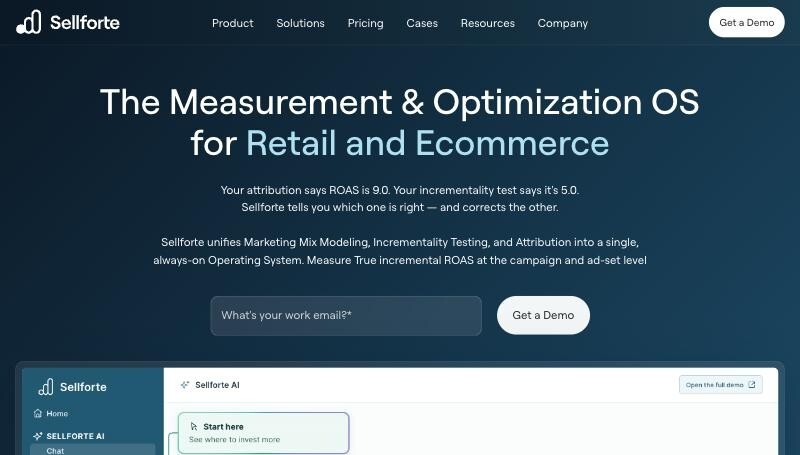
Sellforte is our product: a marketing measurement and optimization platform for retail and ecommerce brands. It combines marketing mix modeling, incrementality testing and incrementality-corrected attribution, and turns the results into budget and bid recommendations for every campaign and ad set. Customers named on its site include C&A, Lidl, bonprix, Douglas, Tchibo and INTERSPORT.
Key features
- Campaign and ad set optimization: Incremental ROAS and marginal incremental ROAS for every campaign and ad set, with budget and bid recommendations. Approved changes go to Meta, Google or TikTok, and Change Intelligence measures what each change did.
- A retail-grade MMM: A Bayesian MMM that updates daily and covers stores, ecommerce, marketplaces and wholesale, with promotions, product groups and the lifetime value of new customers in the model.
- Incrementality testing platform: Geo tests, conversion lift studies and A/B tests, a Test Library and a Test Prioritizer. Test results calibrate the MMM as Bayesian priors.
- Planning and forecasting: Optimizer plans budgets by channel and by week, toward a budget or a return target, within your own spending limits.
- Sellforte MCP: Every product module is available to Claude, ChatGPT, Gemini and other AI assistants, so teams can build their own agentic workflows.
How does Sellforte compare to Triple Whale?
Both combine MMM, incrementality testing and attribution. The differences are in maturity and comprehensiveness of the different solution areas. Sellforte is stronger in MMM and incrementality testing, as its platform has been built with feedback from the largest advertisers over the years. Triple Whale is stronger in MTA, where it originally started from.
Main differences between Sellforte and Triple Whale
- Sellforte calculates incremental ROAS, marginal returns and bid recommendations for every campaign and ad set from its MMM. Triple Whale's MMM works at channel level or on campaign groups you define.
- Sellforte's MMM updates daily and models promotions, product groups and the lifetime value of new customers. Triple Whale's MMM refreshes weekly, and its public pages don't describe these.
- Sellforte analyzes A/B tests next to geo tests and conversion lift studies. Triple Whale offers GeoLift tests and Meta Conversion Lift studies on its Enterprise plan.
- Sellforte publishes its prices. Triple Whale publishes a free plan but quotes its paid plans.
Main similarities between Sellforte and Triple Whale
- Both have their own pixel and multi-touch attribution.
- Both can push approved changes to Meta, Google and TikTok.
- Both have an MCP server for AI assistants.
Good to know
- Triple Whale blends post-purchase survey data into its attribution and sends conversion signals back to Meta and other ad platforms with Sonar Optimize. Sellforte does neither.
- Triple Whale stores data mainly in the US and lists single sign-on as coming soon. Sellforte offers a choice of EU or US hosting and single sign-on with Azure AD and Google.
- Most brands set up Triple Whale in about 15 minutes, and its MMM needs at least 12 months of data. Sellforte onboarding takes 1 to 3 weeks for mid-sized ecommerce businesses and 2 to 4 months for larger enterprises.
For the full feature-by-feature comparison, read Triple Whale vs Sellforte (2026).
Why do companies use Sellforte?
Sellforte's customer stories come back to three reasons:
- Decisions at the level media buyers work: Budgets and bids for each campaign and ad set, every day, from the same model that plans the annual budget.
- An enterprise-grade, battle-tested platform: Sellforte has built its MMM since 2017 with some of the largest retailers and ecommerce brands, such as bonprix, C&A and INTERSPORT. Stores, ecommerce and marketplaces sit in one model, with promotions measured next to media.
- A testing program they run themselves: Teams plan, run and analyze their own tests, and every result improves the model.
Bottom line
Sellforte is the better fit for large and mid-sized retailers and ecommerce brands with advanced measurement and optimization needs, and for whom robust campaign and ad set level optimization is important.
See Sellforte's enterprise-grade measurement and optimization platform
We'll walk you through Sellforte with data like yours: a daily Bayesian MMM with promotions and the lifetime value of new customers, a full incrementality testing suite, and budget and bid recommendations for every campaign and ad set.
2. Northbeam: best for small ecommerce brands that need multi-touch attribution
- Founded: 2019
- Similar to: Triple Whale
- Typical customers: Ecommerce and DTC brands
- Delivery model: Software, with a month-to-month Starter plan
- Pricing: Published, from $1,500 a month
What is Northbeam?
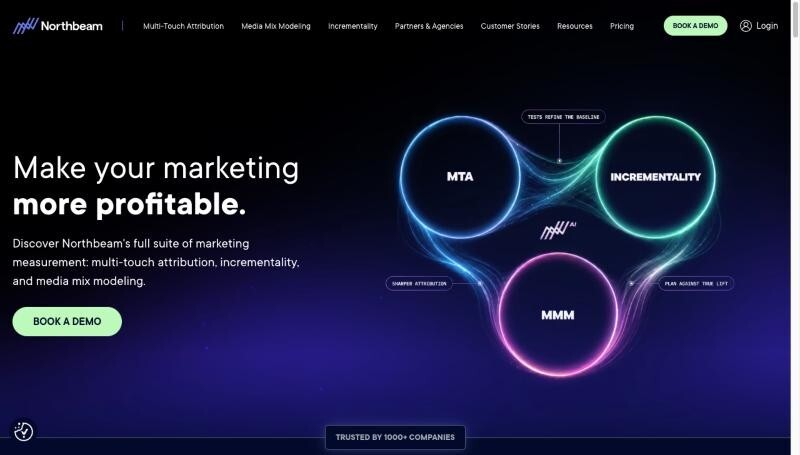
Northbeam is a marketing analytics platform built around multi-touch attribution (MTA). Founded in 2019, it says more than 1,000 companies use it. Alongside MTA it offers MMM+, an MMM that ingests its attribution data, and Northbeam Incrementality, launched in April 2026. Customers named on its site include HexClad, Timex Group, Kizik and Dr. Squatch.
Key features
- Multi-touch attribution: First-party attribution with configurable lookback windows, plus Clicks + Deterministic Views for view-through attribution.
- MMM+: An MMM that uses Northbeam's MTA data, with forecasts and budget allocations you can adjust daily. Optional on the Enterprise plan.
- Northbeam Incrementality: Automated lift tests designed from your MTA data. The first release covered Meta tests in the US, with more channels planned.
- Northbeam Apex: Sends Northbeam's performance data to ad platform algorithms.
- Northbeam MCP: Included in every plan. A read-only connection to the data in your Northbeam dashboards.
How does Northbeam compare to Triple Whale?
These two are the closest match on this list. Both are built around their own pixel and multi-touch attribution for ecommerce brands, and both credit platform-verified ad views. Northbeam corrects its attribution with incrementality and updates MMM+ daily. Triple Whale's MMM refreshes weekly.
Main differences between Northbeam and Triple Whale
- Northbeam publishes starting prices: $1,500 a month for Starter, for Shopify brands spending less than $1.5M a year on ads, and $3,500 a month for Professional. Triple Whale publishes a free plan but quotes its paid plans.
- Northbeam's MMM+ updates daily and is built with Northbeam's data science team. Triple Whale's MMM refreshes weekly, and users build it in a setup wizard.
- Triple Whale's Moby changes budgets and bids in ad platforms by rules you set. Northbeam Apex sends attribution data to ad platform algorithms, but Northbeam's public pages don't describe bid or budget changes.
Main similarities between Northbeam and Triple Whale
- Both are built around their own pixel and multi-touch attribution, and both credit platform-verified ad views.
- Both offer self-serve geo testing, and both include MMM in their top plan.
- Both have read-only MCP servers.
Good to know
- Starter is a month-to-month plan for Shopify brands. Professional and Enterprise are annual contracts.
- MMM+ is built from at least five months of daily data. Triple Whale says its MMM needs at least 12 months.
Comparing Northbeam and Sellforte? Read Northbeam vs Sellforte: MTA, MMM and incrementality testing compared.
Why do companies use Northbeam?
Northbeam's own pages and customer stories point to three reasons:
- Detailed attribution: Multi-touch attribution with view-through measurement and long lookback windows.
- Better signals for ad platforms: Northbeam Apex feeds its measurement back to ad platform algorithms.
- Three methods on one data set: MTA, MMM+ and incrementality tests run on the same first-party data.
Bottom line
Northbeam fits smaller ecommerce brands whose main need is detailed multi-touch attribution, with a published entry price and MMM and testing to add later.
3. Measured: best for US brands that want an expert-led testing program
- Founded: 2017
- Similar to: Haus
- Typical customers: US brands in fashion, DTC, consumer goods and technology
- Delivery model: Software with an analytics expert for every customer
- Pricing: Not published
What is Measured?
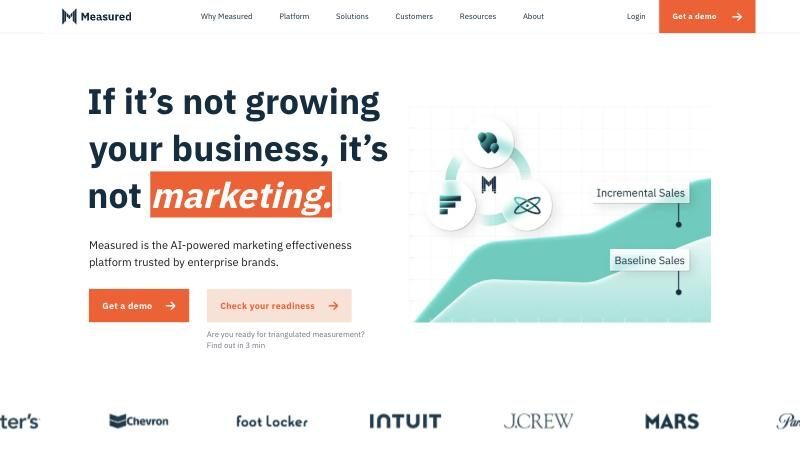
Measured is an incrementality measurement and marketing mix modeling platform, founded in 2017. It offers incrementality testing, the Measured Incrementality Model (a causal MMM calibrated with test results), a Cross-Channel Dashboard, a Media Plan Optimizer and peer Benchmarks. Customers named on its site include Dermalogica, Steve Madden, The North Face, Overstock and Otter.ai.
Key features
- Measured Incrementality Model: A causal MMM calibrated with test results. It sets one adjustment factor per tactic, such as Google YouTube Prospecting, and applies it to platform-reported results. The factors update weekly.
- Geo and A/B tests: Holdout and scale tests by state, DMA, city or zip code, with machine learning market selection and automated setup in ad platforms, plus split tests on first-party audiences.
- Media Plan Optimizer: Budget guidance by channel, with what-if simulations.
- Benchmarks: Compares spend and ROAS against more than 150 brands, backed by a database of more than 30,000 experiments.
- Measured MCP: Launched in May 2026. Brings cross-channel performance data, Media Plan Optimizer plans and geo test results into ChatGPT, Claude, Gemini and other AI platforms.
How does Measured compare to Triple Whale?
Measured is test-first and doesn't use pixels or multi-touch attribution. Triple Whale starts from pixel-based attribution and adds MMM and tests on its Enterprise plan.
Main differences between Measured and Triple Whale
- Measured doesn't use cookies, pixels or user IDs. It corrects platform-reported results with tactic-level factors from its MMM. Triple Whale's foundation is its own pixel and multi-touch attribution.
- Measured pairs every customer with an analytics expert and a strategist for the testing roadmap. Triple Whale is self-serve on its lower plans; its Enterprise plan adds custom onboarding, dedicated success coverage and access to its marketing data scientists, and white-glove data science is an add-on.
- Measured analyzes A/B tests on first-party audiences next to geo tests. Triple Whale offers GeoLift tests and Meta Conversion Lift studies, without A/B test analysis.
Main similarities between Measured and Triple Whale
- Both calibrate their MMM with test results.
- Both have MCP servers.
- Neither publishes the prices of its paid plans.
Good to know
- Measured's adjustment factors update weekly, every Thursday, from the last 52 weeks of data. Users can also rerun the model on demand.
- Measured holds SOC 2 Type 2 and ISO/IEC 27001:2022 certifications and stores all client data in the United States.
Comparing Measured and Sellforte? Read Measured vs Sellforte: MMM, incrementality testing and attribution compared, or see the 8 best Measured alternatives.
Why do companies use Measured?
Measured's own pages and customer stories point to three reasons:
- Testing at the core: An always-on testing program planned with a dedicated strategist, with results that calibrate the model.
- Peer benchmarks: Spend and ROAS compared against more than 150 brands and a database of more than 30,000 experiments.
- Measurement without user tracking: No cookies, pixels or user IDs.
Bottom line
Measured suits US brands, especially in fashion, DTC, consumer goods and technology, that want an expert-led, always-on testing program with peer benchmarks.
4. Fospha: best for online brands selling across marketplaces and retail media
- Founded: 2014
- Similar to: Northbeam, Triple Whale
- Typical customers: Online retail brands spending more than $150k a month on advertising
- Delivery model: Software, with MMM and tests run by Fospha's team
- Pricing: Not published
What is Fospha?
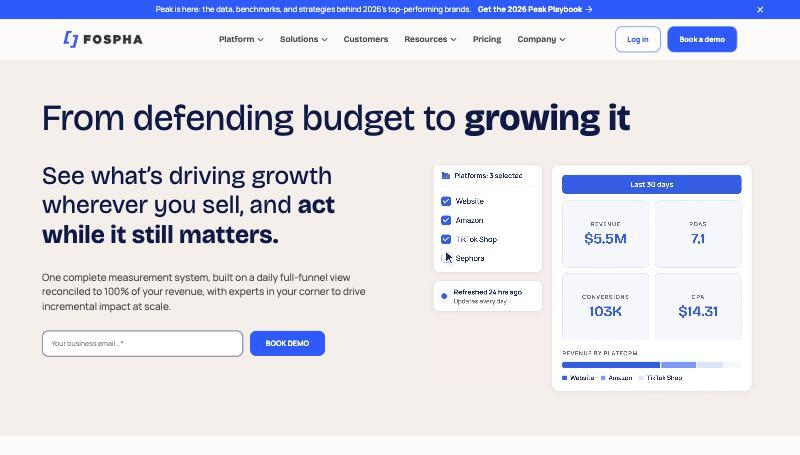
Fospha is a marketing measurement platform for online retail, founded in 2014 by the venture builder Blenheim Chalcot. Its foundation is Media Mix Attribution, which combines attribution with media mix modeling and reconciles the results to total revenue every day, down to the ad level. Around it sit an Omnichannel MMM, geo-lift tests run by its Marketing Science team, a Budget Planner and AI and automation features. Customers named on its site include Gymshark, Lululemon, Huel, Nécessaire and Galeries Lafayette.
Key features
- Media Mix Attribution: Daily, ad-level results that combine attribution with media mix modeling and reconcile to total revenue, across your own site, Amazon, TikTok Shop and other marketplaces.
- Omnichannel MMM: Adds offline marketing and sales, built on top of Media Mix Attribution by Fospha's Marketing Science team.
- Geo-lift tests: Fospha's Marketing Science team designs and runs each test with you, and the results feed its MMM and forecasts.
- AI Actions and Agents: AI Actions push changes to ad platforms after a person approves them, and Agents automate routine actions.
- Fospha MCP: Answers performance questions using the data in the Fospha dashboard, including saturation forecasts and headroom data for budget allocation.
How does Fospha compare to Triple Whale?
Both began as attribution platforms and have since added MMM and incrementality testing. Fospha reconciles its attribution to total revenue with media mix modeling and runs its Omnichannel MMM and tests as services. Triple Whale is self-serve software built around its own pixel, with a free plan to start.
Main differences between Fospha and Triple Whale
- Fospha reconciles its daily, ad-level attribution to total revenue with media mix modeling. Triple Whale's attribution is pixel-based, and Compass puts attribution, MMM and test results side by side for comparison.
- Fospha's Omnichannel MMM and geo-lift tests are run by its Marketing Science team. Triple Whale's MMM and GeoLift tests are self-serve.
- Fospha is built for brands spending more than $150k a month on advertising and prices with a tiered monthly fee plus a percentage of media spend. Triple Whale has a free plan and quotes its paid plans by annual GMV.
Main similarities between Fospha and Triple Whale
- Both blend post-purchase survey data from Fairing and KnoCommerce into their attribution.
- Both can push approved changes to ad platforms.
- Both have MCP servers, and neither publishes the prices of its paid plans.
Good to know
- Fospha says most clients get first results in under 28 days, with 24 months of historical data from day one.
- Fospha lists around 60 integrations, with a strong set of marketplaces and retail media networks such as Amazon, TikTok Shop, Walmart, Target, Sephora and Ulta.
Comparing Fospha and Sellforte? Read Fospha vs Sellforte: MMM, incrementality testing and attribution compared, or see the 6 best Fospha alternatives.
Why do companies use Fospha?
Fospha's own pages and customer stories point to three reasons:
- A daily view reconciled to revenue: Ad-level results every day that add up to total revenue, not to what each ad platform claims.
- Every place they sell: Their own site, marketplaces and retail media networks in one view.
- Experts in their corner: Fospha's Marketing Science team builds the Omnichannel MMM and runs the incrementality tests.
Bottom line
Fospha suits online retail brands spending more than $150k a month on advertising that sell across their own site, marketplaces and retail media, and want experts to run their MMM and tests.
5. Recast: best for a channel-level MMM refreshed every week
- Founded: 2019
- Similar to: Keen Decision Systems, LiftLab
- Typical customers: Enterprise, CPG, fintech and DTC brands
- Delivery model: Software configured by Recast or a certified partner
- Pricing: Not published
What is Recast?
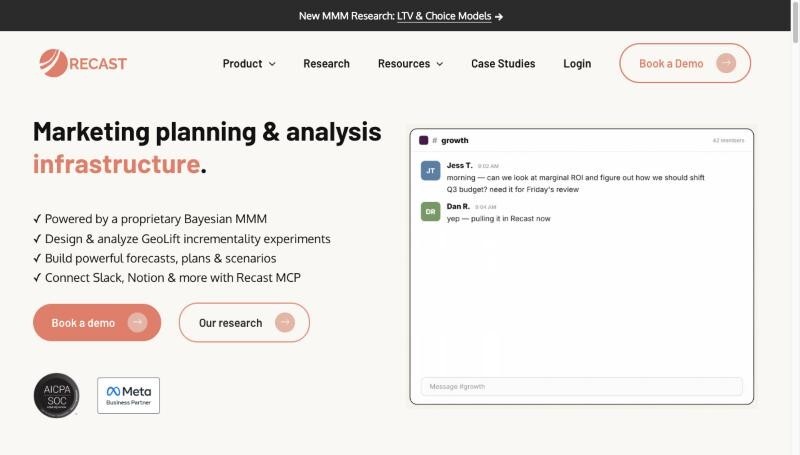
Recast builds a proprietary Bayesian media mix model for enterprise teams, alongside forecasting and planning tools and GeoLift by Recast for experiments. It re-estimates every online and offline channel each week. Customers named on its site include Harry's, PODS, Canva and GetYourGuide.
Key features
- Weekly MMM: Every channel is re-estimated each week as new data arrives.
- Forecast accuracy reports: Weekly out-of-sample forecast accuracy reports for each customer.
- GeoLift by Recast: Plan and read geo experiments, with each lift result feeding back into the MMM.
- APIs and MCP: Access through a web app, public APIs and the Recast MCP server, which reads Recast reports, plans and forecasts.
How does Recast compare to Triple Whale?
Recast is MMM-first and does not do attribution. Triple Whale starts from attribution and adds MMM on its Enterprise plan or as an add-on.
Main differences between Recast and Triple Whale
- Recast reports at channel level, with sub-channels as directional indices relative to their parent channel. Triple Whale reports incremental ROAS by campaign and ad set.
- Recast models promotions, including pull-forward effects, every sales channel and product line, and the lifetime value of new customers. Triple Whale's public pages don't describe these in its MMM.
- Recast or a certified partner configures the model for each customer. Triple Whale users build their own MMM in a setup wizard, and its Enterprise plan adds access to its marketing data scientists, with white-glove data science as an add-on.
Main similarities between Recast and Triple Whale
- Both refresh a Bayesian MMM every week, and geo test results calibrate the model.
- Both have MCP servers.
- Neither publishes the prices of its paid plans.
Comparing Recast and Sellforte? Read Recast vs Sellforte: channel vs campaign-level MMM.
Why do companies use Recast?
Recast's own pages and customer stories point to three reasons:
- A model that stays current: Weekly re-estimation instead of quarterly or annual MMM projects.
- Accountability: Forecast accuracy is reported every week, so teams can see whether the model holds up.
- Planning for finance: Forecasts and plans that reconcile online and offline channels to the P&L.
Bottom line
Recast suits enterprise teams that plan budgets by channel and want a Bayesian MMM refreshed every week. It is not built for campaign and ad set optimization.
6. Analytic Partners: best for enterprises that want a consultancy
- Founded: 2000
- Similar to: Ekimetrics, Circana
- Typical customers: Large enterprises in retail, hospitality, financial services and more
- Delivery model: Consultancy model, supported by a platform
- Pricing: Not published
What is Analytic Partners?
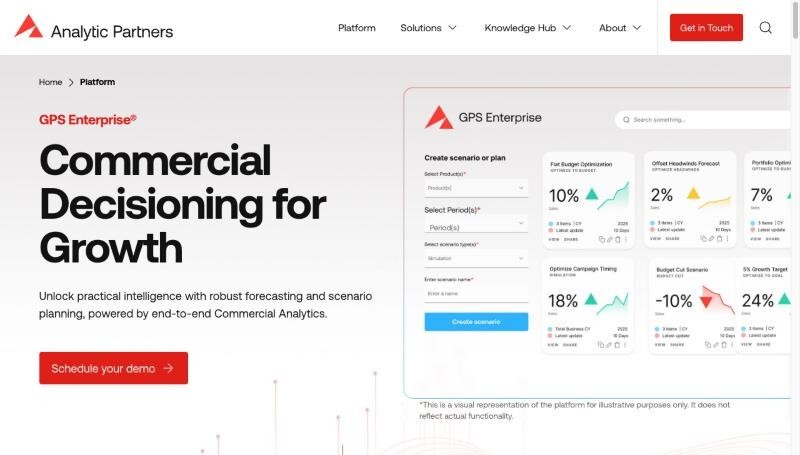
Analytic Partners is a commercial analytics company that has provided marketing measurement, forecasting and optimization since 2000. Its platform, GPS Enterprise, comes with the company's own experts and draws on ROI Genome, its proprietary layer of benchmarks. Customers named on its site include Beiersdorf, Kroger, VF Corp and Nespresso.
Key features
- GPS Enterprise: An end-to-end commercial analytics platform that includes marketing mix modeling.
- ROI Genome: Proprietary benchmarks and insights built from the company's client work.
- Expert-led delivery: Analytic Partners' own analysts work embedded with the client team.
- Beyond marketing: Incrementality testing, brand impact and pricing optimization alongside MMM.
How does Analytic Partners compare to Triple Whale?
Analytic Partners is consultancy-led and covers commercial analytics for the whole executive team. Triple Whale is self-serve software for ecommerce brands, with a free plan to start.
Main differences between Analytic Partners and Triple Whale
- Analytic Partners' scope goes beyond marketing to pricing and other commercial decisions. Triple Whale focuses on ecommerce analytics, attribution and media buying automation.
- Analytic Partners works through analysts embedded in the client team. Triple Whale is self-serve software.
- Analytic Partners runs geo and A/B tests as part of its service. Triple Whale offers self-serve GeoLift tests and Meta Conversion Lift studies, without A/B test analysis.
Main similarities between Analytic Partners and Triple Whale
- Both offer MMM, incrementality testing and scenario planning.
- Neither publishes the prices of its paid plans.
Good to know
- Analytic Partners reports being named a Leader in the 2026 Gartner Magic Quadrant for Marketing Mix Modeling Solutions.
Considering other consultancies? Read 7 best Analytic Partners alternatives.
Why do companies use Analytic Partners?
Analytic Partners' own pages point to three reasons:
- Experts on the team: Analysts embedded in the client business interpret the results and support decisions.
- Benchmarks: ROI Genome adds cross-client benchmarks to each company's own data.
- Company-wide scope: One program for marketing, pricing and other commercial decisions.
Bottom line
Analytic Partners suits large enterprises that want an expert-led commercial analytics program. Teams that want to run measurement software themselves, or need campaign-level results, should look elsewhere.
7. Google Meridian: best open-source alternative
- Launched: 2025, open to everyone
- Similar to: Meta Robyn, PyMC
- Typical customers: Advertisers with in-house data science teams
- Delivery model: Code your team runs, with certified partners available
- Pricing: Free
What is Google Meridian?
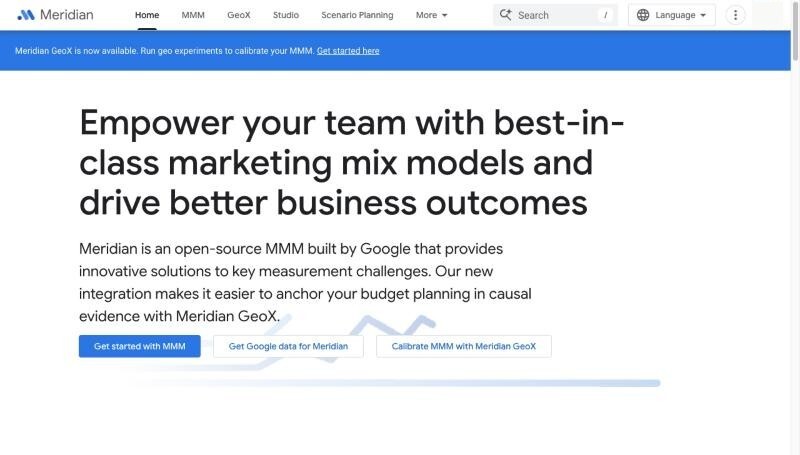
Meridian is the open-source marketing mix model built by Google, available to all marketers and data scientists since January 2025. Google publishes the code and methodology papers, and a partner program offers certified measurement partners to help with implementation.
Key features
- Open source: The code is public and can be adjusted to your business.
- Bayesian MMM: Built-in lagged effects and saturation, with response curves and budget optimization.
- Reach and frequency: Video measured by reach and frequency, not only impressions.
- Meridian GeoX: Turns geo experiment results into priors for the model.
- Google data: Google Ads and Display & Video 360 advertisers can request campaign data through Google's MMM Data Platform.
How does Google Meridian compare to Triple Whale?
Meridian is code, not a service. Your team supplies the data and builds, runs and maintains the model.
Main differences between Google Meridian and Triple Whale
- Meridian is free. Triple Whale has a free plan too, but its MMM comes with the Enterprise plan or as an add-on.
- With Meridian, your team prepares the data, sets the refresh schedule, validates the model and reports to stakeholders. Triple Whale delivers its MMM as self-serve software with a setup wizard.
- Meridian has no attribution.
Main similarities between Google Meridian and Triple Whale
- Both use Bayesian MMM.
- Both use experiment results to calibrate the model.
Good to know
- The team that builds the model takes responsibility for its outputs, including decisions that can affect millions in revenue.
Why do companies use Google Meridian?
Google's pages and partner stories point to three reasons:
- Full control and transparency: Every assumption is visible and can be changed.
- No license fee: The model is free to use.
- Google data: Advertisers can bring Google campaign data into the model.
Bottom line
Google Meridian suits companies with in-house data scientists who want full control of the model and no license fee, and who have time to build and run it.
Which Triple Whale alternative should you choose?
For large and mid-sized ecommerce and retail brands:
- Sellforte, for daily budget and bid recommendations by campaign and ad set, promotions and store sales in the model, and self-serve testing.
For small ecommerce brands that need multi-touch attribution:
- Northbeam, for detailed attribution from $1,500 a month.
For an expert-led testing program in the US:
- Measured, for always-on testing with a dedicated strategist and peer benchmarks.
For online brands selling across marketplaces and retail media:
- Fospha, for daily ad-level results reconciled to total revenue, with experts running the MMM and tests.
For a channel-level MMM refreshed every week:
For an expert-led enterprise program:
For a free, open-source model:
- Google Meridian, if you have data scientists to run it.
Is Sellforte right for you?
Sellforte is built for large and mid-sized retailers and ecommerce brands with advanced measurement and optimization needs. It's a good fit if:
- Your team sets budgets and bids for individual campaigns and ad sets and wants recommendations at that level every day.
- You sell in stores, online, on marketplaces or all of them, and want every sales channel in one model.
- Promotions drive a large share of your sales and need to be measured next to media.
- You want to run your own incrementality tests and have the results improve the model.
Sellforte publishes its prices, and each customer works with a dedicated Customer Success Manager.
Considering Sellforte as your Triple Whale alternative?
Book a demo to see campaign and ad set level results on data like yours, or review the published pricing.
Frequently asked questions
What are the best Triple Whale alternatives?
The best Triple Whale alternatives in 2026 are Sellforte, for large and mid-sized ecommerce and retail brands; Northbeam, for small ecommerce brands that need multi-touch attribution; Measured, for US brands that want an expert-led testing program; Fospha, for online brands selling across marketplaces and retail media; Recast, for a channel-level MMM refreshed every week; Analytic Partners, for enterprises that want a consultancy; and Google Meridian, for an open-source model.
Who are Triple Whale's main competitors?
Triple Whale's main competitors include Sellforte, Northbeam, Measured, Fospha, Recast and Analytic Partners, plus Google's open-source Meridian. Northbeam and Fospha compete most directly, because both began as attribution platforms for ecommerce brands and have since added MMM and incrementality testing.
Is Sellforte a good Triple Whale alternative?
For large and mid-sized retailers and ecommerce brands with advanced measurement and optimization needs, yes. Sellforte gives daily incremental ROAS, marginal incremental ROAS and bid recommendations for every campaign and ad set from its MMM, models promotions, product groups and the lifetime value of new customers, and lets your team run its own geo tests, A/B tests and conversion lift studies. Triple Whale's MMM refreshes weekly at channel level or on campaign groups you define.
What is the best Triple Whale alternative for small ecommerce brands?
Northbeam is the closest fit for small ecommerce brands whose main need is detailed multi-touch attribution, with a month-to-month Starter plan at $1,500 a month for Shopify brands spending less than $1.5M a year on ads. Google Meridian is free, but it needs data scientists to build and run it.
Which Triple Whale alternatives publish their pricing?
Sellforte publishes plans from $1,900 a month, and Northbeam publishes starting prices of $1,500 and $3,500 a month. Google Meridian is free. Fospha, Measured, Recast and Analytic Partners do not publish prices. Triple Whale publishes a free plan and quotes its paid plans by annual GMV.
Which Triple Whale alternative gives campaign and ad set level results from an MMM?
Sellforte calculates incremental ROAS, marginal incremental ROAS and bid recommendations for every campaign and ad set from its MMM. Fospha and Northbeam report campaigns and ad sets through attribution that is reconciled to revenue or corrected with incrementality, Measured applies tactic-level factors from its MMM to platform-reported results, and Recast reports at channel level. Triple Whale's MMM works at channel level or on campaign groups you define.
Which Triple Whale alternatives offer incrementality testing?
All seven do, in different ways. Sellforte is a self-serve testing platform with geo tests, A/B tests, conversion lift studies in its test library and test prioritization. Northbeam offers automated lift tests, Measured runs geo and A/B tests with a dedicated strategist, Recast offers GeoLift by Recast, and Analytic Partners runs geo and A/B tests as part of its expert-led service. Fospha's Marketing Science team designs and runs geo-lift tests for its customers, and Google Meridian turns geo experiment results into model priors with Meridian GeoX.
Which Triple Whale alternatives have an MCP server?
Five of the seven alternatives have one, and so does Triple Whale. Sellforte MCP makes every product module available to AI assistants, including marginal incremental ROAS for each campaign and ad set, budget scenario planning, incrementality test analysis and approved changes to ad platforms. Northbeam's and Triple Whale's MCP servers are read-only connections to attribution and performance data. Measured's MCP covers cross-channel performance, Media Plan Optimizer plans and geo test results, Fospha's covers dashboard data, saturation forecasts and headroom, and Recast's reads its reports, plans and forecasts. Analytic Partners and Google Meridian don't offer an official MCP server.
Is there a free alternative to Triple Whale?
Google Meridian is free and open source, but your team builds, runs and maintains the model. Triple Whale's own free plan includes only first- and last-click attribution, without MMM or incrementality testing.
Sources
Every vendor fact in this article comes from these public pages, read in November 2026.
- Triple Whale: triplewhale.com (homepage, Compass, Marketing Mix Modeling, Attribution, Pricing and Trust Center pages) and kb.triplewhale.com (Compass, Marketing Mix Modeling, Incrementality Testing, Geo Pods, Clicks & Deterministic Views, Sonar Optimize and Triple Whale MCP articles)
- Sellforte: homepage, About, Pricing, Marketing Mix Modeling, Incrementality Testing, Data Security, Sellforte MCP and careers.sellforte.com
- Northbeam: northbeam.io (homepage, MMM+, Incrementality and Pricing pages), docs.northbeam.io (Northbeam MCP Server FAQs and Connect Northbeam to other AI tools) and Northbeam's press releases on Business Wire from October 2025 and April 2026
- Measured: measured.com (homepage, Media Mix Modeling, Incrementality Testing, Media Plan Optimizer, Benchmarks, Security & Compliance and Customers pages), support.measured.com (MIM: Concepts and Overview, Geo Tests: Concepts and Overview, Measured MCP Prompt Library) and the Measured MCP server press release on Business Wire from May 28, 2026
- Fospha: fospha.com (homepage, About, Media Mix Attribution, Marketing Mix Modeling, Incrementality Testing, AI and Automation, Integrations, Budget Planner and Pricing pages, FAQs), trust.fospha.com and the Fospha MCP Server launch press release from April 2026
- Recast: getrecast.com (homepage, Recast MMM page and the Recast MCP launch post from July 2026) and docs.getrecast.com (How to use Sub-channels in Recast, The Recast MCP)
- Analytic Partners: analyticpartners.com (homepage, GPS Enterprise platform page, Marketing Mix Modeling solution page, About page)
- Google Meridian: developers.google.com/meridian (overview and About Meridian pages) and the Google Ads blog post “Meridian is now available to everyone” from January 2025
6 Best Fospha Alternatives for MMM and Incrementality Testing (2026)
8 Best Measured Alternatives for MMM and Incrementality Testing (2026)