


The best Measured alternatives in 2026 are Sellforte, for mid-sized and large retail and ecommerce brands; Haus, for DTC brands focused on geo testing; Triple Whale, for small and mid-sized brands that need multi-touch attribution; Recast, for a channel-level MMM refreshed every week; LiftLab, for full-funnel MMM across brand and performance media; Prescient AI, for DTC brands that want a pure-play MMM; Analytic Partners, for enterprises that want a consultancy; and Google Meridian, for an open-source model your own team runs.
Reviewed November 2026. Sellforte is our product. Every vendor fact comes from the vendor's own public pages, listed under Sources. Corrective feedback is welcome at research@sellforte.com.
Measured is an incrementality measurement and marketing mix modeling platform, founded in 2017. It is built around testing: geo tests and A/B tests calibrate its MMM, the Measured Incrementality Model, which corrects what ad platforms report with adjustment factors for each tactic.
Measured is a strong fit for US brands that want an expert-led, always-on testing program with peer benchmarks. However, as needs grow, some teams look for something else. Some want results that update daily rather than weekly, or an MMM that measures promotions, product groups and the lifetime value of new customers. Others want a testing suite that also covers conversion lift studies, or budget and bid recommendations for each campaign and ad set based on marginal incremental ROAS. European brands may need EU data hosting, and smaller brands may want self-serve software or their own multi-touch attribution. These are often the situations where brands start considering alternatives to Measured.
Below we compare eight alternatives. For each one we cover what it is, its key features, how it compares to Measured and why companies use it. For an in-depth, feature-by-feature view of one of them, read Measured vs Sellforte.
1. Sellforte: best for mid-sized and large retail and ecommerce brands
- Founded: 2017
- Similar to: Haus, Recast
- Typical customers: Mid-sized and large retailers and ecommerce brands
- Delivery model: Software with a dedicated Customer Success Manager, plus self-serve model configuration
- Pricing: Published, from $1,900 a month
What is Sellforte?
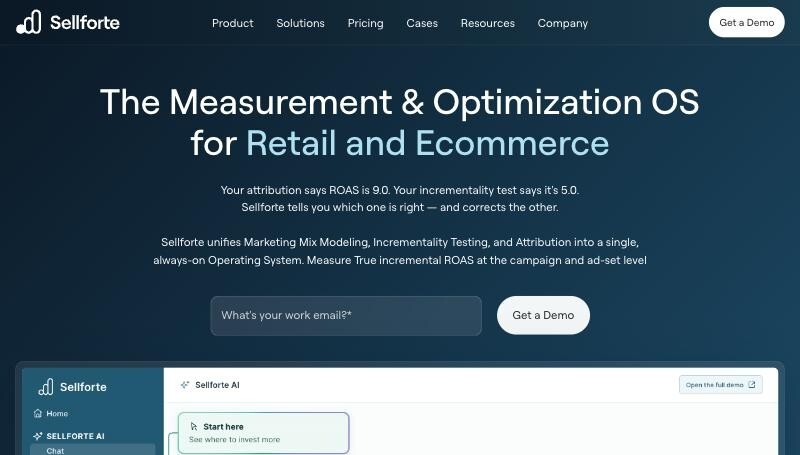
Sellforte is our product: a marketing measurement and optimization platform for retail and ecommerce brands. It combines marketing mix modeling, incrementality testing and incrementality-corrected attribution, and turns the results into budget and bid recommendations for every campaign and ad set. Customers named on its site include C&A, Lidl, bonprix, Douglas, Tchibo and INTERSPORT.
Key features
- Campaign and ad set optimization: Incremental ROAS and marginal incremental ROAS for every campaign and ad set, with budget and bid recommendations. Approved changes go to Meta, Google or TikTok, and Change Intelligence measures what each change did.
- A retail-grade MMM: A Bayesian MMM that updates daily and covers stores, ecommerce, marketplaces and wholesale, with promotions, product groups and the lifetime value of new customers in the model.
- Incrementality testing platform: Geo tests, conversion lift studies and A/B tests, a Test Library and a Test Prioritizer. Test results calibrate the MMM as Bayesian priors.
- Planning and forecasting: Optimizer plans budgets by channel and by week, toward a budget or a return target, within your own spending limits.
- Sellforte MCP: Every product module is available to Claude, ChatGPT, Gemini and other AI assistants, so teams can build their own agentic workflows.
How does Sellforte compare to Measured?
Both calibrate an MMM with incrementality tests and use the results to correct what ad platforms report. The differences are in the breadth of the MMM and the testing suite. Sellforte's MMM updates daily and covers promotions, product groups and the lifetime value of new customers, and its testing suite covers geo tests, conversion lift studies and A/B tests in one library. Measured is further along in automating geo tests and benchmarks results against more than 30,000 experiments.
Main differences between Sellforte and Measured
- Sellforte's MMM updates daily and models promotions, product groups and the lifetime value of new customers, across stores, ecommerce, marketplaces and wholesale. Measured's adjustment factors update weekly, and its public pages don't describe these.
- Sellforte imports and analyzes conversion lift studies next to geo tests and A/B tests, keeps every result in one Test Library and ranks the next tests with its Test Prioritizer. Measured runs geo tests and A/B tests on first-party audiences, and its public pages don't describe conversion lift studies.
- Measured automates more of the geo testing workflow. It picks test markets by simulating hundreds of market combinations, sets up and ends tests in ad platforms through their APIs, and benchmarks results against a database of more than 30,000 experiments.
- Sellforte turns its results into budget and bid recommendations for every campaign and ad set, and can push approved changes to Meta, Google and TikTok. Measured's Media Plan Optimizer plans budgets by channel.
- Sellforte publishes its prices and offers a choice of EU or US hosting. Measured doesn't publish prices and stores all client data in the United States.
Main similarities between Sellforte and Measured
- Both calibrate their MMM with incrementality test results.
- Both analyze geo tests and A/B tests.
- Both have an MCP server for AI assistants.
Good to know
- Measured pairs every customer with an analytics expert and a strategist for the testing roadmap, and benchmarks spend and ROAS against more than 150 brands. Sellforte comes with a dedicated Customer Success Manager and offers self-serve model configuration.
For the full feature-by-feature comparison, read Measured vs Sellforte: MMM, incrementality testing and attribution compared.
Why do companies use Sellforte?
Sellforte's customer stories come back to three reasons:
- Decisions at the level media buyers work: Budgets and bids for each campaign and ad set, every day, from the same model that plans the annual budget.
- An enterprise-grade, battle-tested platform: Sellforte has built its MMM since 2017 with some of the largest retailers and ecommerce brands, such as bonprix, C&A and INTERSPORT. Stores, ecommerce and marketplaces sit in one model, with promotions measured next to media.
- A testing program they run themselves: Teams plan, run and analyze their own tests, and every result improves the model.
Bottom line
Sellforte is the better fit for mid-sized and large retailers and ecommerce brands with advanced measurement and optimization needs, and for whom robust campaign and ad set level optimization is important.
See Sellforte's enterprise-grade measurement and optimization platform
We'll walk you through Sellforte with data like yours: a daily Bayesian MMM with promotions and the lifetime value of new customers, a full incrementality testing suite, and budget and bid recommendations for every campaign and ad set.
2. Haus: best for DTC brands focused on geo testing
- Founded: 2021
- Similar to: LiftLab, Recast
- Typical customers: US DTC and consumer brands, plus fintech, sports betting and streaming
- Delivery model: Software with a Measurement Strategist on Core and above; Basics is self-serve
- Pricing: Not published
What is Haus?
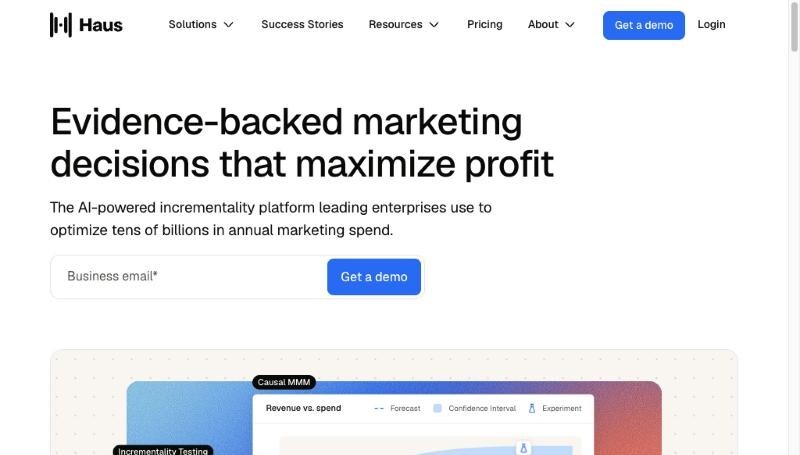
Haus is an incrementality platform, founded in 2021. It offers Incrementality Experiments (GeoLift, Fixed Geo Tests and Time Tests), Causal MMM (launched in October 2025), Causal Attribution for daily incrementality reporting, and Architect, an AI agent that recommends the next best action. Haus says its customers run more than 4,000 experiments a year. Customers named on its site include Intuit, SharkNinja, Sonos, Wayfair and Mejuri.
Key features
- Incrementality Experiments: GeoLift tests with synthetic control, Fixed Geo Tests, multi-cell tests and Time Tests, with placebo tests on historical data before each experiment.
- Causal MMM: An MMM that treats experiment results as ground truth, updated weekly, with scenario planning. Included in the Plus and Enterprise plans.
- Causal Attribution: Adjusts platform-reported results down to the ad level with incrementality factors from experiments, refreshing data daily.
- Architect: An AI agent that suggests the next best action for channels, campaigns and ads, which a marketer reviews, edits and approves.
- Haus MCP: Brings Haus experiment data into AI tools.
How does Haus compare to Measured?
Haus and Measured are the closest pair on this list. Both started from geo experiments, both calibrate an MMM with test results and both correct platform-reported results with incrementality factors. The differences are in how far down the results go and how the service is packaged.
Main differences between Haus and Measured
- Haus's Causal Attribution corrects platform-reported results down to the ad level, with factors from experiments. Measured applies one adjustment factor per tactic to every campaign in that tactic.
- Haus offers a self-serve Basics plan for US Shopify and Amazon sellers, and adds a Measurement Strategist from its Core plan up. Measured pairs every customer with an analytics expert.
- Haus offers more test types, including multi-cell tests, Fixed Geo Tests and Time Tests for changes that can't be split by region. Measured runs holdout and scale tests by state, DMA, city or zip code, plus A/B tests on first-party audiences.
Main similarities between Haus and Measured
- Both started from geo experiments and calibrate an MMM with the results, and both refresh it weekly.
- Both hold SOC 2 Type 2 and ISO/IEC 27001:2022 certifications.
- Both have MCP servers, and neither publishes its prices.
Good to know
- Causal MMM comes with the Plus and Enterprise plans. Basics covers geo tests in the US only, and international testing starts from Core.
- Retail and marketplace sales breakouts are an add-on to Haus's plans.
Comparing Haus and Sellforte? Read Haus vs Sellforte: Incrementality Testing and MMM Compared (2026).
Why do companies use Haus?
Haus's own pages and customer stories point to three reasons:
- Experiments at the core: GeoLift tests with synthetic control and placebo checks, and more than 4,000 experiments a year across its customers.
- One causal source of truth: Causal MMM and Causal Attribution are anchored to the same experiments, so budget plans and ad-level reporting agree.
- A path from self-serve to enterprise: From a self-serve plan for US Shopify brands to an embedded Measurement Strategist and a dedicated data scientist on Enterprise.
Bottom line
Haus suits DTC and consumer brands, mostly in the US, that want geo experiments at the center of their measurement and an MMM built on them. Its public pages don't describe marginal returns or bid recommendations for campaigns and ad sets.
3. Triple Whale: best for small and mid-sized brands that need multi-touch attribution
- Founded: 2021
- Similar to: Northbeam, Fospha
- Typical customers: Small and mid-sized Shopify and DTC brands
- Delivery model: Self-serve software with a free plan; Enterprise adds dedicated success coverage
- Pricing: Free plan; paid plans quoted by annual GMV
What is Triple Whale?
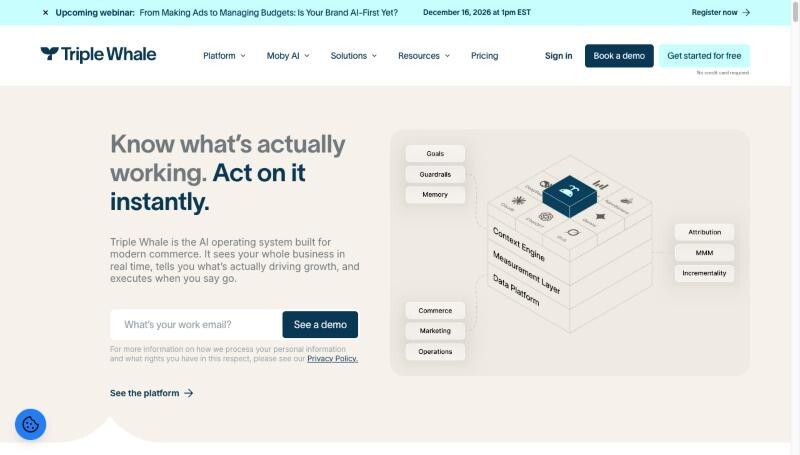
Triple Whale is an ecommerce analytics and AI platform, founded in 2021 by former ecommerce operators. It started from pixel-based multi-touch attribution for Shopify brands and has added marketing mix modeling, incrementality testing and Moby, an AI that can change budgets and bids in ad platforms. Triple Whale says more than 65,000 brands use it.
Key features
- Triple Pixel and multi-touch attribution: First click, last click, linear, Triple Attribution and Total Impact models, with platform-verified ad views.
- Marketing mix modeling: A Bayesian MMM that refreshes weekly, on the Enterprise plan or as an add-on. Compass adds connected online and offline retail sales, in beta.
- Incrementality testing: Self-serve GeoLift tests on Geo Pods built from U.S. counties, and Meta Conversion Lift studies, on the Enterprise plan.
- Moby: An AI that turns rules your team sets into budget, bid and status changes on Meta, Google, TikTok and other platforms.
- Triple Whale MCP: A read-only connection to attribution, spend, ROAS and revenue data.
How does Triple Whale compare to Measured?
Triple Whale's foundation is its own pixel and multi-touch attribution. Its MMM and incrementality testing are included in the Enterprise plan and available as add-ons on its other paid plans. Measured is test-first and doesn't use pixels or multi-touch attribution.
Main differences between Triple Whale and Measured
- Triple Whale's foundation is its own pixel and multi-touch attribution, and it sends conversion signals back to Meta and other ad platforms with Sonar Optimize. Measured doesn't use cookies, pixels or user IDs.
- Triple Whale is self-serve on its lower plans, with a free plan to start. Measured pairs every customer with an analytics expert and a strategist for the testing roadmap.
- Triple Whale sets up and reads Meta Conversion Lift studies. Measured analyzes A/B tests on first-party audiences, which Triple Whale doesn't.
- Triple Whale's Moby changes budgets and bids in ad platforms by rules you set. Measured can set up and end geo tests in ad platforms, but doesn't change bids or budgets.
Main similarities between Triple Whale and Measured
- Both calibrate their MMM with test results and refresh it weekly.
- Both have MCP servers.
- Neither publishes the prices of its paid plans.
Good to know
- Most brands set up Triple Whale in about 15 minutes, and its MMM needs at least 12 months of data.
- Triple Whale stores data mainly in the US and lists single sign-on as coming soon.
Comparing Triple Whale and Sellforte? Read Triple Whale vs Sellforte (2026), or see the 7 best Triple Whale alternatives.
Why do companies use Triple Whale?
Triple Whale's own pages point to three reasons:
- A fast, self-serve start: About 15 minutes to set up for most brands, with a free plan.
- Attribution built for Shopify brands: Its own pixel, several attribution models and platform-verified ad views.
- Automation: Moby applies budget and bid changes by your rules, and Sonar Optimize sends enriched conversion signals back to ad platforms.
Bottom line
Triple Whale suits small and mid-sized Shopify and DTC brands that need multi-touch attribution and a fast self-serve start, with MMM and testing available as they grow.
4. Recast: best for a channel-level MMM refreshed every week
- Founded: 2019
- Similar to: Keen Decision Systems, LiftLab
- Typical customers: Enterprise, CPG, fintech and DTC brands
- Delivery model: Software configured by Recast or a certified partner
- Pricing: Not published
What is Recast?
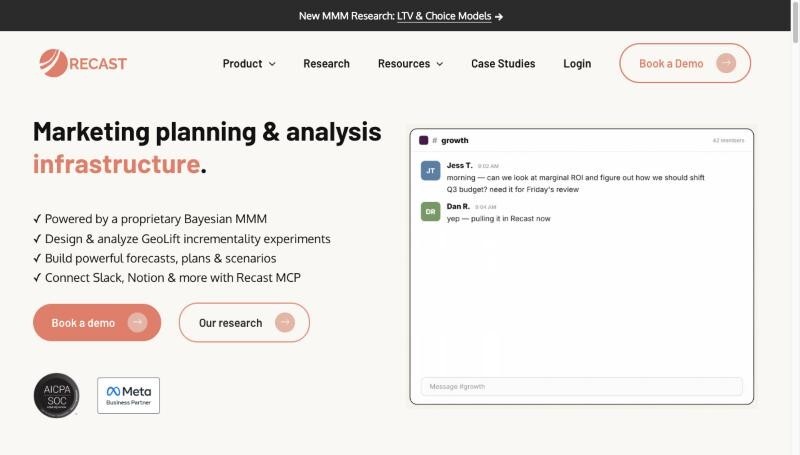
Recast builds a proprietary Bayesian media mix model for enterprise teams, alongside forecasting and planning tools and GeoLift by Recast for experiments. It re-estimates every online and offline channel each week. Customers named on its site include Harry's, PODS, Canva and GetYourGuide.
Key features
- Weekly MMM: Every channel is re-estimated each week as new data arrives.
- Forecast accuracy reports: Weekly out-of-sample forecast accuracy reports for each customer.
- GeoLift by Recast: Plan and read geo experiments, with each lift result feeding back into the MMM.
- APIs and MCP: Access through a web app, public APIs and the Recast MCP server, which reads Recast reports, plans and forecasts.
How does Recast compare to Measured?
Recast is MMM-first and re-estimates every channel each week. Measured is test-first and uses its MMM to correct platform-reported results by tactic.
Main differences between Recast and Measured
- Recast reports at channel level, with sub-channels as directional indices relative to their parent channel. Measured reports down to campaigns, applying one adjustment factor per tactic.
- Recast models promotions, including pull-forward effects, every sales channel and product line, and the lifetime value of new customers. Measured's public pages don't describe these.
- Recast runs geo tests through GeoLift by Recast. Measured also analyzes A/B tests on first-party audiences and draws on a database of more than 30,000 experiments.
Main similarities between Recast and Measured
- Both refresh their model weekly and calibrate it with geo test results.
- Both come with expert support. Recast or a certified partner configures the model, and Measured pairs every customer with an analytics expert.
- Both have MCP servers, and neither publishes its prices.
Good to know
- Recast publishes weekly out-of-sample forecast accuracy reports for each customer.
Comparing Recast and Sellforte? Read Recast vs Sellforte: channel vs campaign-level MMM.
Why do companies use Recast?
Recast's own pages and customer stories point to three reasons:
- A model that stays current: Weekly re-estimation instead of quarterly or annual MMM projects.
- Accountability: Forecast accuracy is reported every week, so teams can see whether the model holds up.
- Planning for finance: Forecasts and plans that reconcile online and offline channels to the P&L.
Bottom line
Recast suits enterprise teams that plan budgets by channel and want a Bayesian MMM refreshed every week. It is not built for campaign and ad set optimization.
5. LiftLab: best for full-funnel MMM across brand and performance media
- Founded: 2018
- Similar to: Haus, Recast
- Typical customers: Enterprise omnichannel, DTC and consumer brands
- Delivery model: Platform with LiftLab's marketing science team handling configuration and calibration
- Pricing: Not published
What is LiftLab?
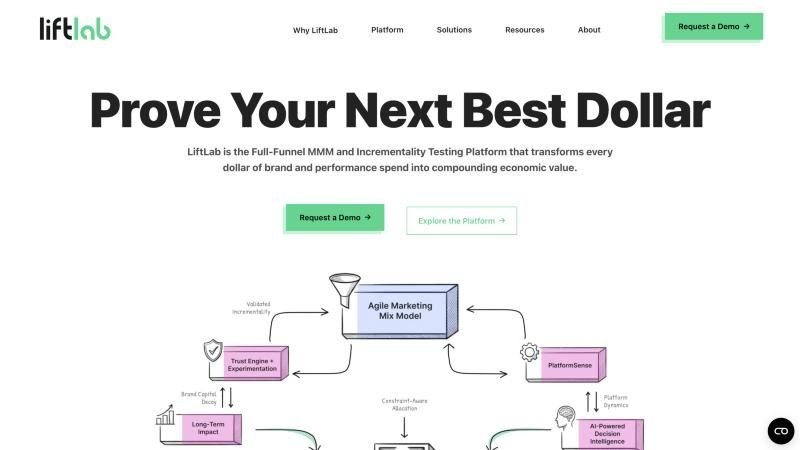
LiftLab calls itself a full-funnel MMM and incrementality testing platform. Founded in 2018 in Oakland, California, it combines a two-stage Agile Marketing Mix Model, which separates ad auction costs from consumer response, with geo experiments, daily ad platform signals and scenario planning. Customers named on its site include Pandora, Cinemark, Quicken, SKIMS and Thrive Market.
Key features
- Agile Marketing Mix Model: A two-stage MMM. The first stage models how spend becomes media exposure, including CPM and CPC changes, and the second models how exposure drives short-term sales and long-term brand equity.
- Trust Engine and Incrementality Testing Suite: Geo experiments, switchback tests and Go Dark with Pacing tests, with results feeding back into the model. The model ranks which channels to test next by their confidence intervals.
- PlatformSense: Applies live ad platform signals to the response curves every day, to flag CPM shifts, auction volatility and creative fatigue.
- Scenario Planner: Conserve, Maintain and Accelerate scenarios, within spend floors, channel caps and CAC ceilings your team sets.
- Long-Term Value of Ads (LVA): Turns short-term returns on brand media into an estimate of their long-term value.
How does LiftLab compare to Measured?
LiftLab and Measured both pair an MMM with geo experiments, and neither uses multi-touch attribution. LiftLab puts more weight on brand media and ad auction dynamics. Measured puts more weight on its testing program, test automation and peer benchmarks.
Main differences between LiftLab and Measured
- LiftLab's MMM separates ad auction costs from consumer response, and PlatformSense applies daily platform signals to it. Measured's adjustment factors update weekly.
- LiftLab estimates the long-term value of brand media with LVA, and its model separates promotional lift from media. Measured's public pages don't describe promotion measurement.
- Measured sets geo tests up in ad platforms automatically and has an MCP server. LiftLab's public pages don't describe either.
- Measured analyzes A/B tests on first-party audiences. LiftLab adds switchback tests and Go Dark with Pacing tests, which map response curves.
Main similarities between LiftLab and Measured
- Both calibrate their MMM with geo experiments, and neither uses multi-touch attribution.
- Both recommend which channels to test next.
- Both hold SOC 2 Type II and ISO/IEC 27001:2022 certifications, and neither publishes its prices.
Good to know
- LiftLab says customers get first model outputs 3 to 4 weeks after kick-off, and calibrated outputs once the first experiment reads out, about 10 weeks in.
- LiftLab's marketing science team configures, calibrates and validates the model, acting as an embedded measurement function.
- We couldn't verify LiftLab's campaign and ad set level optimization capabilities from its website. If this matters to you, we recommend confirming it directly with LiftLab.
Why do companies use LiftLab?
LiftLab's own pages and customer stories point to three reasons:
- Brand and performance in one model: Short-term returns and the long-term value of brand media side by side, so brand spend can be defended next to performance spend.
- Response curves that stay current: Ad auction dynamics are separated from consumer response, and PlatformSense adds daily platform signals.
- Constraint-aware planning: Scenarios built around pre-committed spend, channel caps, CAC ceilings and locked media contracts.
Bottom line
LiftLab suits enterprise and omnichannel brands that invest heavily in brand media and want an expert-supported MMM with geo experiments.
6. Prescient AI: best for DTC brands that want a pure-play MMM
- Founded: 2019
- Similar to: Recast, LiftLab
- Typical customers: DTC and omnichannel consumer brands spending $100k or more a month on ads
- Delivery model: Self-serve software with dedicated customer success
- Pricing: Not published; three tiers on annual contracts
What is Prescient AI?
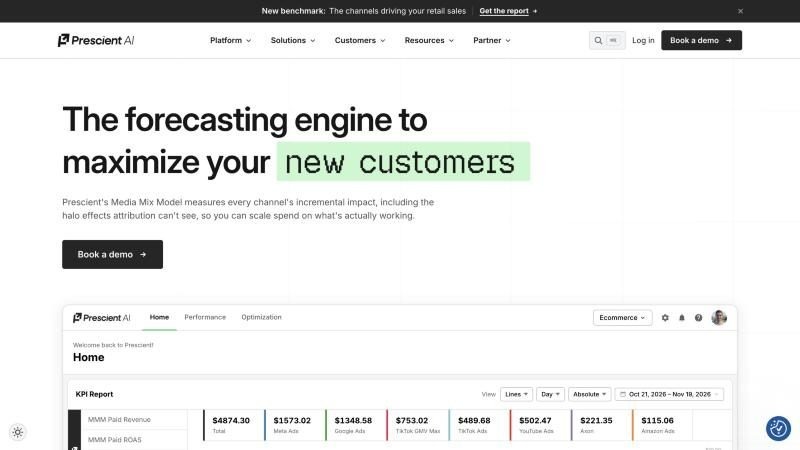
Prescient AI is a marketing mix modeling platform for DTC and omnichannel brands. Founded in 2019, it started by building models for the music industry and moved to ecommerce after COVID-19 closed live touring. Its model updates daily, works down to campaign level and measures halo effects, such as a TikTok campaign driving Amazon sales. Customers named on its site include HexClad, BrüMate, Saatva, Summer Fridays and OluKai.
Key features
- Daily MMM: Models update daily, across channel, tactic and campaign levels.
- Halo effects: Measures how each channel lifts others, such as Meta awareness campaigns lifting branded search on Google, across DTC, Amazon and retail sales.
- Optimization: Fixed or flexible budget scenarios with 7, 14 or 28 day forecasts, showing how much to move to which campaigns, with confidence intervals.
- Saturation curves: Curves for every channel and campaign, with scale, hold or reduce recommendations by channel.
- Validation layer: Runs the model with and without each experiment or outside data source, such as geo-lift results and post-purchase surveys, and compares backtest accuracy before using it.
How does Prescient AI compare to Measured?
Prescient AI is a pure-play MMM. It doesn't run incrementality tests itself, but imports test results to validate the model. Measured is test-first and calibrates its model with the tests it designs and runs.
Main differences between Prescient AI and Measured
- Prescient's model updates daily and works down to campaign level, with saturation curves for every campaign. Measured's adjustment factors update weekly and are set per tactic.
- Measured designs and runs geo tests and A/B tests with a dedicated strategist. Prescient imports geo-lift, holdout and conversion lift results to validate its model.
- Prescient's MCP server covers public product information and can't access customer data. Measured's MCP server brings customer performance data, plans and test results into AI assistants.
Main similarities between Prescient AI and Measured
- Neither uses multi-touch attribution.
- Both offer budget scenarios and forecasts.
- Neither publishes its prices.
Good to know
- Prescient says brands go live in 1 to 2 weeks, without a data warehouse or data team. Each sales channel, such as DTC, Amazon, retail and wholesale, gets its own model.
Why do companies use Prescient AI?
Prescient AI's own pages and customer stories point to three reasons:
- A daily, campaign-level MMM: Results update every day, down to individual campaigns.
- Halo effects: How spend on one channel lifts sales on others, including Amazon and retail.
- A fast start: Live in 1 to 2 weeks, with more than 112 integrations and no data team required.
Bottom line
Prescient AI suits DTC and omnichannel consumer brands that want a self-serve MMM updated daily, with halo effects on Amazon and retail. Teams that want to run their own incrementality tests need a separate testing tool.
7. Analytic Partners: best for enterprises that want a consultancy
- Founded: 2000
- Similar to: Ekimetrics, Circana
- Typical customers: Large enterprises in retail, hospitality, financial services and more
- Delivery model: Consultancy model, supported by a platform
- Pricing: Not published
What is Analytic Partners?
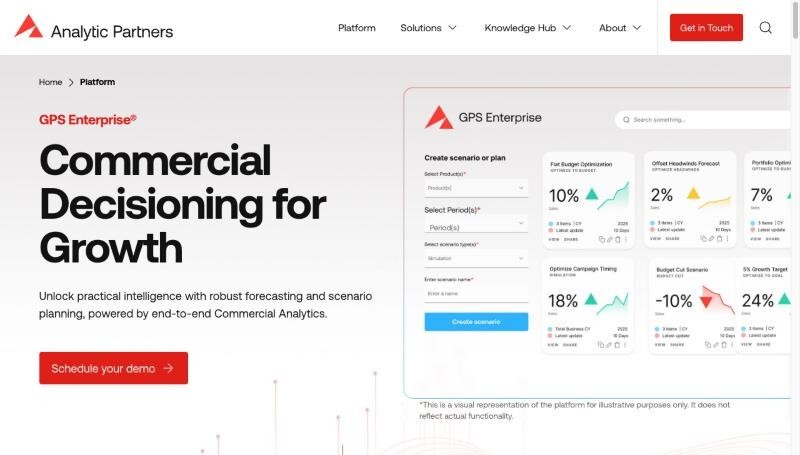
Analytic Partners is a commercial analytics company that has provided marketing measurement, forecasting and optimization since 2000. Its platform, GPS Enterprise, comes with the company's own experts and draws on ROI Genome, its proprietary layer of benchmarks. Customers named on its site include Beiersdorf, Kroger, VF Corp and Nespresso.
Key features
- GPS Enterprise: An end-to-end commercial analytics platform that includes marketing mix modeling.
- ROI Genome: Proprietary benchmarks and insights built from the company's client work.
- Expert-led delivery: Analytic Partners' own analysts work embedded with the client team.
- Beyond marketing: Incrementality testing, brand impact and pricing optimization alongside MMM.
How does Analytic Partners compare to Measured?
Analytic Partners is consultancy-led and covers commercial analytics for the whole executive team. Measured is software with expert support, focused on incrementality testing and marketing mix modeling.
Main differences between Analytic Partners and Measured
- Analytic Partners' scope goes beyond marketing to pricing and other commercial decisions. Measured focuses on marketing measurement.
- Analytic Partners works through analysts embedded in the client team. Measured is software, with an analytics expert for every customer.
- Measured corrects platform-reported results by tactic and campaign and has an MCP server. Analytic Partners' public pages don't describe campaign-level results or an MCP server.
Main similarities between Analytic Partners and Measured
- Both offer MMM, geo tests, A/B tests and scenario planning.
- Both draw on benchmarks from their client base: ROI Genome at Analytic Partners, peer Benchmarks at Measured.
- Neither publishes its prices.
Good to know
- Analytic Partners reports being named a Leader in the 2026 Gartner Magic Quadrant for Marketing Mix Modeling Solutions.
Considering other consultancies? Read 7 best Analytic Partners alternatives.
Why do companies use Analytic Partners?
Analytic Partners' own pages point to three reasons:
- Experts on the team: Analysts embedded in the client business interpret the results and support decisions.
- Benchmarks: ROI Genome adds cross-client benchmarks to each company's own data.
- Company-wide scope: One program for marketing, pricing and other commercial decisions.
Bottom line
Analytic Partners suits large enterprises that want an expert-led commercial analytics program. Teams that want to run measurement software themselves, or need campaign-level results, should look elsewhere.
8. Google Meridian: best open-source alternative
- Launched: 2025, open to everyone
- Similar to: Meta Robyn, PyMC
- Typical customers: Advertisers with in-house data science teams
- Delivery model: Code your team runs, with certified partners available
- Pricing: Free
What is Google Meridian?
Meridian is the open-source marketing mix model built by Google, available to all marketers and data scientists since January 2025. Google publishes the code and methodology papers, and a partner program offers certified measurement partners to help with implementation.
Key features
- Open source: The code is public and can be adjusted to your business.
- Bayesian MMM: Built-in lagged effects and saturation, with response curves and budget optimization.
- Reach and frequency: Video measured by reach and frequency, not only impressions.
- Meridian GeoX: Designs geo experiments, choosing test and control markets and projecting the budget needed, and turns the results into priors for the model.
- Google data: Google Ads and Display & Video 360 advertisers can request campaign data through Google's MMM Data Platform.
How does Google Meridian compare to Measured?
Meridian is code, not a service. Your team supplies the data and builds, runs and maintains the model.
Main differences between Google Meridian and Measured
- Meridian is free. Measured is commercial software and doesn't publish its prices.
- With Meridian, your team prepares the data, sets the refresh schedule, validates the model and reports to stakeholders. Measured pairs every customer with an analytics expert.
- Meridian GeoX chooses test markets, but your team sets each test up in the ad platforms and runs the analysis. Measured sets tests up and ends them in ad platforms automatically.
Main similarities between Google Meridian and Measured
- Both use experiment results to calibrate the model.
- Neither uses multi-touch attribution.
Good to know
- The team that builds the model takes responsibility for its outputs, including decisions that can affect millions in revenue.
Why do companies use Google Meridian?
Google's pages and partner stories point to three reasons:
- Full control and transparency: Every assumption is visible and can be changed.
- No license fee: The model is free to use.
- Google data: Advertisers can bring Google campaign data into the model.
Bottom line
Google Meridian suits companies with in-house data scientists who want full control of the model and no license fee, and who have time to build and run it.
Which Measured alternative should you choose?
For mid-sized and large retail and ecommerce brands:
- Sellforte, for daily budget and bid recommendations by campaign and ad set, promotions and store sales in the model, and self-serve testing.
For DTC brands focused on geo testing:
- Haus, for a high volume of geo experiments and an MMM built on them, with a self-serve plan for US Shopify brands.
For small and mid-sized brands that need multi-touch attribution:
- Triple Whale, for its own pixel, a free plan and a fast self-serve setup.
For a channel-level MMM refreshed every week:
For brand and performance media in one model:
- LiftLab, for the long-term value of brand media next to short-term returns.
For a DTC-focused, pure-play MMM:
- Prescient AI, for daily, campaign-level results and halo effects on Amazon and retail.
For an expert-led enterprise program:
For a free, open-source model:
- Google Meridian, if you have data scientists to run it.
Is Sellforte right for you?
Sellforte is built for mid-sized and large retailers and ecommerce brands with advanced measurement and optimization needs. It's a good fit if:
- Your team sets budgets and bids for individual campaigns and ad sets and wants recommendations at that level every day.
- You sell in stores, online, on marketplaces or all of them, and want every sales channel in one model.
- Promotions drive a large share of your sales and need to be measured next to media.
- You want to run your own incrementality tests and have the results improve the model.
Sellforte publishes its prices, and each customer works with a dedicated Customer Success Manager.
Considering Sellforte as your Measured alternative?
Book a demo to see campaign and ad set level results on data like yours, or review the published pricing.
Frequently asked questions
What are the best Measured alternatives?
The best Measured alternatives in 2026 are Sellforte, for mid-sized and large retail and ecommerce brands; Haus, for DTC brands focused on geo testing; Triple Whale, for small and mid-sized brands that need multi-touch attribution; Recast, for a channel-level MMM refreshed every week; LiftLab, for full-funnel MMM across brand and performance media; Prescient AI, for DTC brands that want a pure-play MMM; Analytic Partners, for enterprises that want a consultancy; and Google Meridian, for an open-source model.
Who are Measured's main competitors?
Measured's main competitors include Sellforte, Haus, Triple Whale, Recast, LiftLab, Prescient AI and Analytic Partners, plus Google's open-source Meridian. Haus and LiftLab compete most directly, because both pair an MMM with geo experiments and neither relies on multi-touch attribution.
Is Sellforte a good Measured alternative?
For mid-sized and large retailers and ecommerce brands with advanced measurement and optimization needs, yes. Sellforte's MMM updates daily and models promotions, product groups and the lifetime value of new customers, its testing suite covers geo tests, conversion lift studies and A/B tests, and it turns the results into budget and bid recommendations for every campaign and ad set. It also offers EU or US hosting and publishes its pricing. Measured is further along in automating geo tests, and benchmarks results against more than 30,000 experiments.
What is the closest alternative to Measured?
Haus is the closest match. Both started from geo experiments, calibrate an MMM with the results and correct platform-reported results with incrementality factors, and both hold SOC 2 Type 2 and ISO/IEC 27001:2022 certifications. Haus also offers a self-serve plan for US Shopify brands and goes down to the ad level with Causal Attribution.
Which Measured alternatives publish their pricing?
Sellforte publishes plans from $1,900 a month, and Google Meridian is free. Triple Whale publishes a free plan but quotes its paid plans by annual GMV. Haus, Recast, LiftLab, Prescient AI and Analytic Partners do not publish prices, and neither does Measured.
Which Measured alternative gives campaign and ad set level results from an MMM?
Sellforte calculates incremental ROAS, marginal incremental ROAS and bid recommendations for every campaign and ad set from its MMM. Prescient AI also models campaigns, with saturation curves and budget recommendations at campaign level. Haus corrects platform-reported results down to the ad level with factors from experiments, and Triple Whale reports campaigns and ad sets through attribution. Recast reports at channel level, and LiftLab's campaign-level capabilities aren't clear from its website.
Which Measured alternatives update results daily?
Sellforte and Prescient AI update their MMM daily, and LiftLab applies daily ad platform signals to its response curves with PlatformSense. Haus's Causal Attribution refreshes data daily, while Haus's Causal MMM, Recast's MMM and Triple Whale's MMM refresh weekly, like Measured's adjustment factors.
Which Measured alternatives have an MCP server?
Sellforte MCP makes every product module available to AI assistants, including marginal incremental ROAS for each campaign and ad set, budget scenario planning, incrementality test analysis and approved changes to ad platforms. Haus's MCP brings its experiment data into AI tools, Triple Whale's is a read-only connection to attribution and performance data, and Recast's reads its reports, plans and forecasts. Prescient AI's MCP covers public product information only. LiftLab's public pages don't mention an MCP server, and Analytic Partners and Google Meridian don't offer an official one. Measured's own MCP covers cross-channel performance, Media Plan Optimizer plans and geo test results.
Is there a free alternative to Measured?
Google Meridian is free and open source, but your team builds, runs and maintains the model and runs its own tests. Triple Whale has a free plan, but it includes only first- and last-click attribution, without MMM or incrementality testing.
Sources
Every vendor fact in this article comes from these public pages, read in November 2026.
- Measured: measured.com (homepage, Media Mix Modeling, Incrementality Testing, Media Plan Optimizer, Benchmarks, Security & Compliance and Customers pages), support.measured.com (MIM: Concepts and Overview, Geo Tests: Concepts and Overview, Geo Tests: Setting Up Your Geo Test, Measured MCP Prompt Library) and the Measured MCP server press release on Business Wire from May 28, 2026
- Sellforte: homepage, About, Pricing, Marketing Mix Modeling, Incrementality Testing, Geo Tests, Data Security, Sellforte MCP and careers.sellforte.com
- Haus: haus.io (homepage, Incrementality Experiments, Causal MMM, Causal Attribution, Pricing and About pages), trust.haus.io, the Haus blog (A First Look at Causal MMM, February 2025; Introducing Causal MMM, October 2025; Introducing Causal Attribution, July 2026) and the video Haus MCP Explained on YouTube
- Triple Whale: triplewhale.com (homepage, About, Compass, Marketing Mix Modeling, Attribution, Pricing and Trust Center pages) and kb.triplewhale.com (Compass, Marketing Mix Modeling, Incrementality Testing, Geo Pods, Clicks & Deterministic Views, Sonar Optimize and Triple Whale MCP articles)
- Recast: getrecast.com (homepage, Recast MMM page, GeoLift by Recast page and the Recast MCP launch post from July 2026) and docs.getrecast.com (How to use Sub-channels in Recast, The Recast MCP) and geolift-docs.getrecast.com (How to design an optimal GeoLift test)
- LiftLab: liftlab.com (homepage, About, Agile Marketing Mix Modeling, Incrementality Testing Suite and FAQ pages, John Wallace's author page and llms.txt)
- Prescient AI: prescientai.com (homepage, About, Media Mix Model, Optimization, Scale with Confidence, Validation, Pricing and Developers pages)
- Analytic Partners: analyticpartners.com (homepage, GPS Enterprise platform page, Marketing Mix Modeling solution page, About page)
- Google Meridian: developers.google.com/meridian (overview, About Meridian and Meridian GeoX design pages) and the Google Ads blog post “Meridian is now available to everyone” from January 2025
7 Best Triple Whale Alternatives for MMM, Incrementality Testing and Attribution (2026)
6 Best Fospha Alternatives for MMM and Incrementality Testing (2026)