


Bonprix is one of Europe's largest ecommerce companies. Headquartered in Hamburg and part of the Otto Group, the business reaches millions of active customers across more than 25 markets, with five own-brand labels in fashion, accessories, and home & living. Its marketing mix runs the full range, from paid search and social to TV, radio, print catalog, and app push.
Bonprix had attribution and incrementality testing running side by side, and wanted to bring them into a single view that could drive media decisions. The dynamic attribution model that ran daily bidding had been refined for years and was trusted inside the team. Incrementality experiments produced credible answers in isolation. What was missing was a way to reconcile the two signals into a single input for budget decisions, and an earlier in-house MMM attempt hadn't bridged that gap.
Bonprix has now built a unified measurement system across 16 markets, calibrating MMM, incrementality testing, and attribution into one continuous system. The setup runs with board-level buy-in, finance alignment, and a direct path from measurement insight to daily bidding decisions.
In the Sellforte webinar "bonprix x Google x Sellforte: Building a Modern Marketing Measurement System," Anika Kreißl walked through how they built it and how it runs.
Speakers:
- Anika Kreißl, Teamlead Display, Retargeting & Affiliate and Measurement Project Lead at bonprix
- Friederike Thackwell, Senior Industry Manager at Google
- Juha Nuutinen, CEO and Co-Founder of Sellforte
Inside bonprix's measurement stack
Bonprix had been running dynamic attribution for around eight years and incrementality tests for several, including tests on digital channels and on print budgets. The decision was to add MMM on top of what already existed, without replacing anything.
We want to achieve a unified view on marketing measurement and also a full-funnel measurement, so we can answer the question: where should we spend the next euro.
— Anika Kreißl, bonprix
Bonprix partnered with Sellforte to build out the MMM layer, integrate it with the existing dynamic attribution model, and feed incrementality test results into both.
We didn't replace our existing measurement. We're building a system where all three complement and calibrate each other.
— Anika Kreißl, bonprix
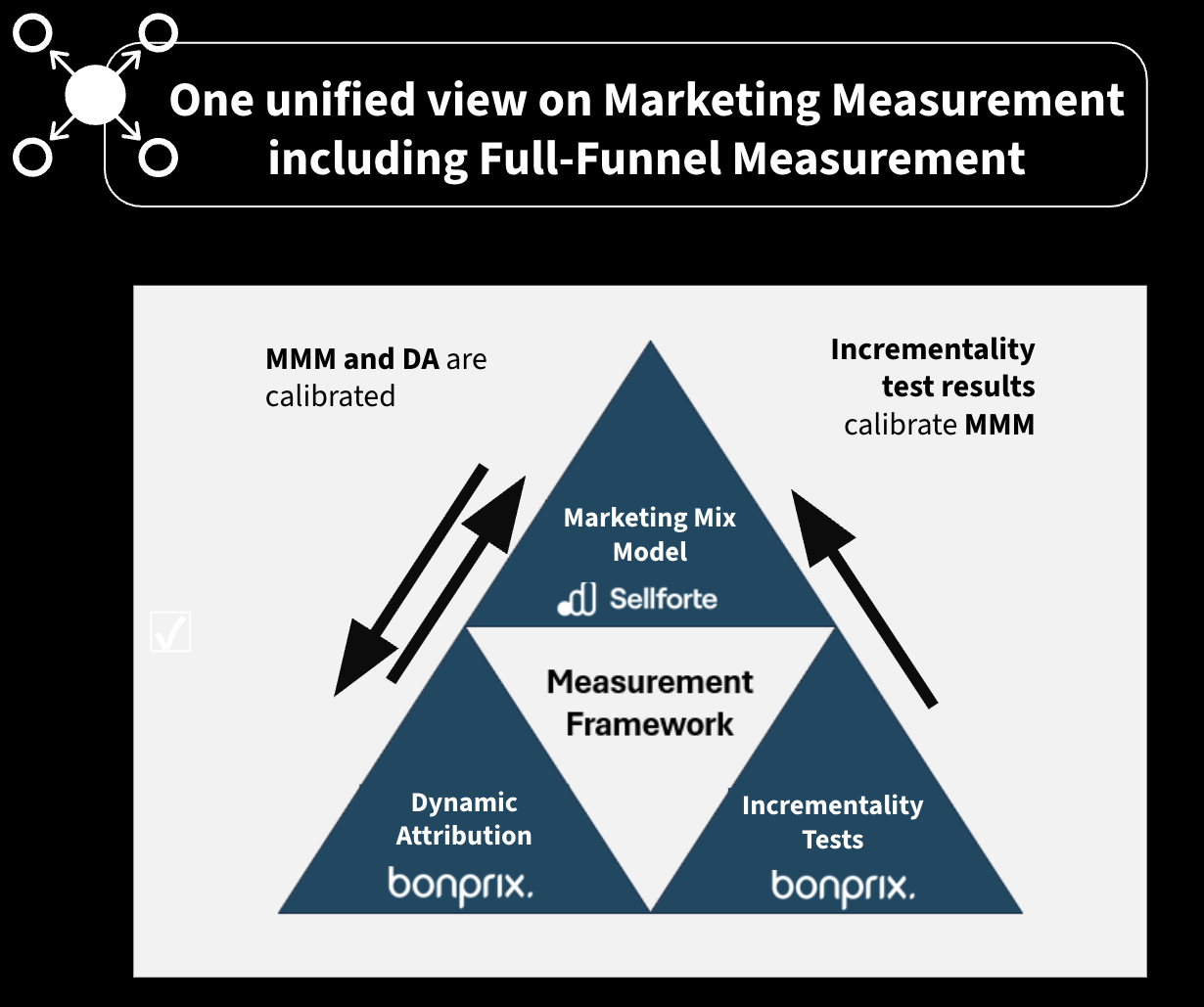
The result is one measurement system, calibrated across 16 markets. Incrementality experiments produce the causal truth. The MMM, run continuously in Sellforte, scales those learnings across channels and markets. Calibration factors from the MMM flow back into bonprix's dynamic attribution model, which feeds daily bidding decisions in the ad platforms.
Finance, marketing, and the bidding platforms now use the same numbers.
7 key lessons
The biggest opportunity in marketing measurement for ecommerce companies right now is making the three methods you already use (attribution, MMM, and incrementality) work as one system.
Here's what bonprix learned building it.
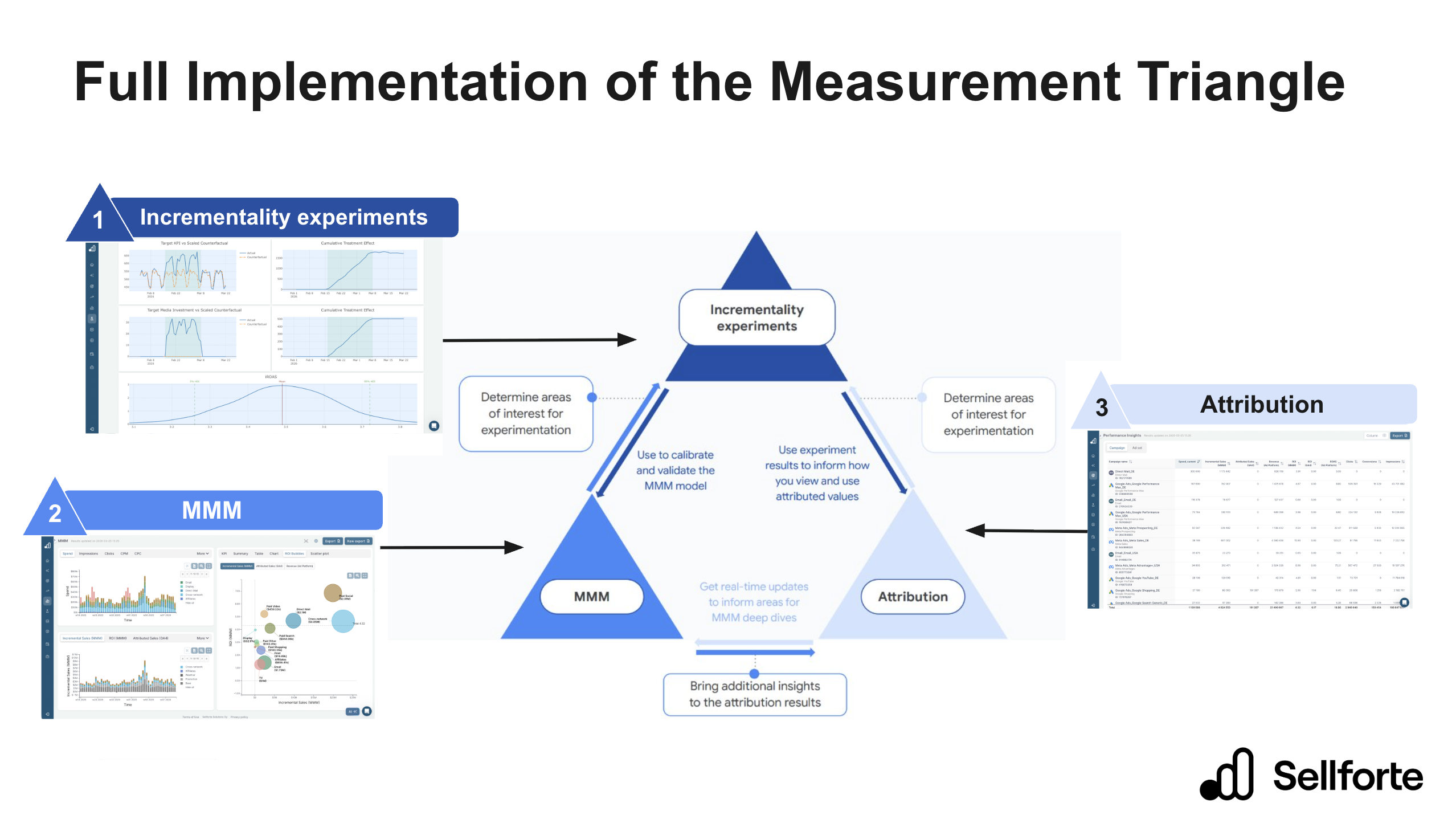
1. The measurement triangle only creates value when its three sides calibrate each other
Attribution gives the daily pulse for real-time bidding, MMM provides the strategic compass that captures what attribution misses (including offline channels and brand impact), and incrementality acts as the truth serum that proves what happens when a channel turns off.
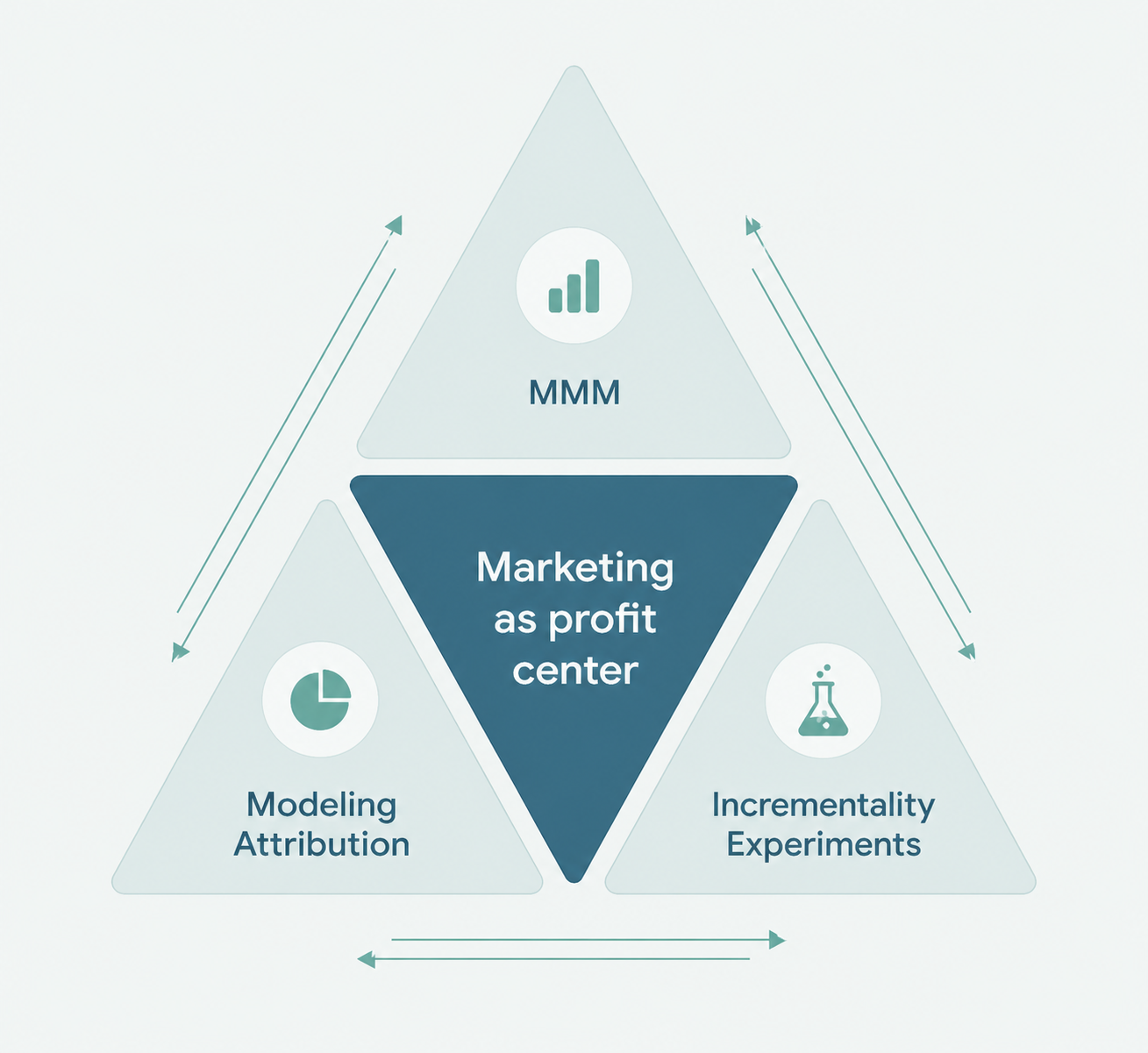
Most teams use all three, but few have them feeding each other. The unlock isn't methodological purity, which is why the goal is giving finance, marketing, and the ad platforms the same number to work with.
The magic happens when these three talk to each other. If a test proves a channel is 20% more effective than the dashboard says, you don't just trust it, you calibrate.
— Friederike Thackwell, Google
2. A unified measurement system doesn't require starting from zero
Most ecommerce brands already have an attribution model their business is built around. Replacing it is expensive, slow, and politically hard.
The calibration approach keeps the existing model and anchors it to incrementality truth using multipliers. The procedure looks like this:
- Run incrementality experiments at the channel or campaign-group level
- Compare the experiment's incremental ROAS against what attribution reported for the same period
- Calculate a calibration multiplier (incremental ROAS divided by attributed ROAS)
- Apply the multiplier to the attribution signal before it flows into bidding
Bonprix kept its dynamic attribution model, which had been in place for around eight years, and added MMM on top.
The unlock was making the three methods bonprix already had work together as one system.
3. Incrementality experiments reveal the causal truth of marketing
Incrementality experiments isolate what marketing actually drove versus what would have happened without it. They remove the bias attribution and platform-reported metrics carry by design. At bonprix this means a library of tens of conversion lift tests, multiple catalog experiments, and many geo-lift experiments, each with clear acceptance criteria.
Everything begins with incrementality experiments, because this is the only place where you get the real causal truth of how your marketing investments are performing.
— Juha Nuutinen, Sellforte
An experiment library on its own doesn't change daily decisions. The library is the truth source, and the integration layer is what makes it actionable.
4. MMM tells you where to spend the next euro
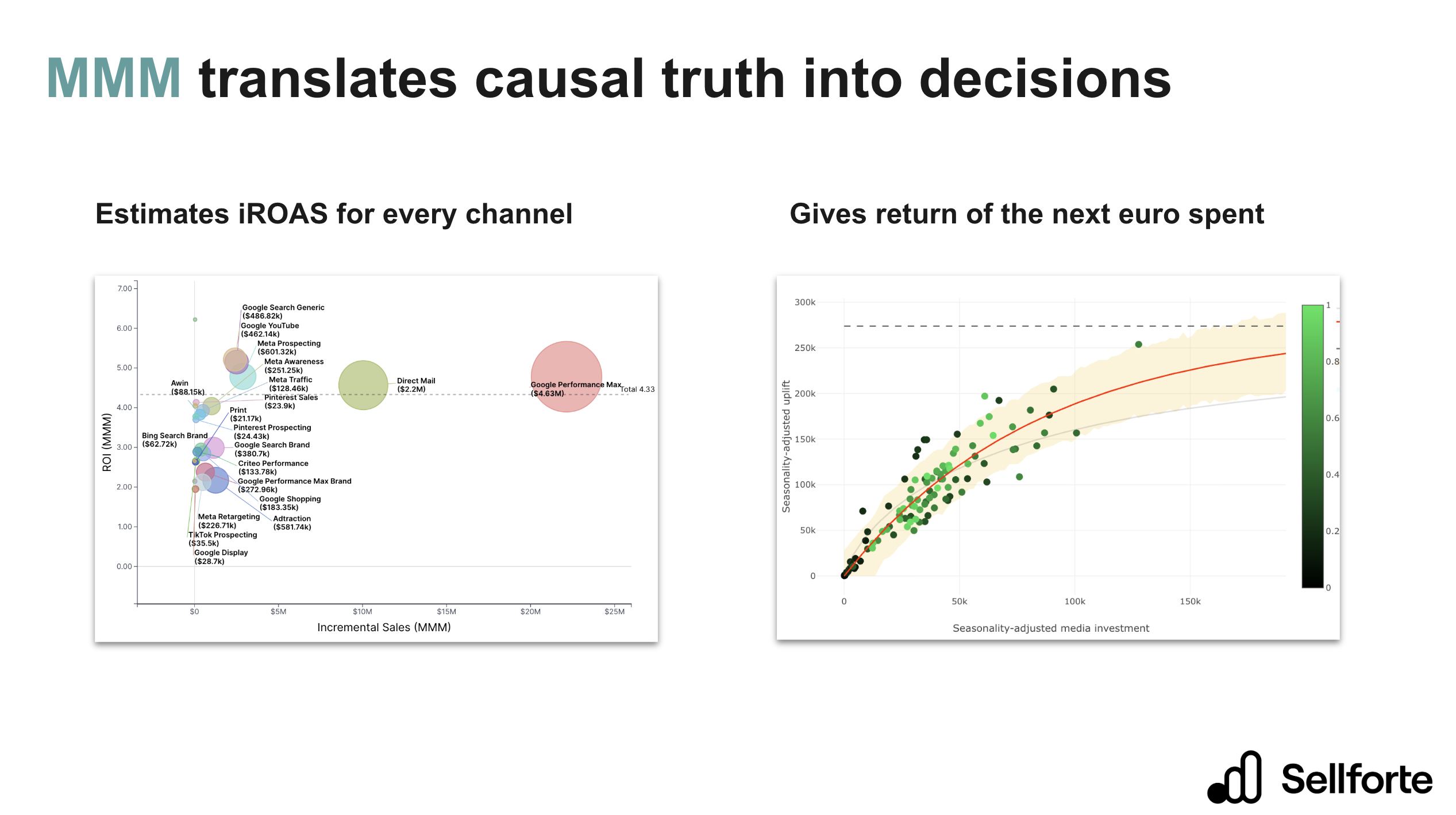
MMM estimates incremental ROAS across all channels in your media mix, including ones that can't easily be tested like TV, radio, out-of-home, and influencers. It gives the marginal return of the next euro spent, which is the number budget allocation needs.
That marginal-return number is what answers the question bonprix anchored the whole project on: where should we spend the next euro?
Marketing mix modeling gives you not only the average ROAS, but this incremental marginal return for the next euro spent. That is arguably the thing you want to optimize for. Not the average ROAS, but where to invest the next dollar or next euro.
— Juha Nuutinen, Sellforte
5. Attribution turns insights into execution
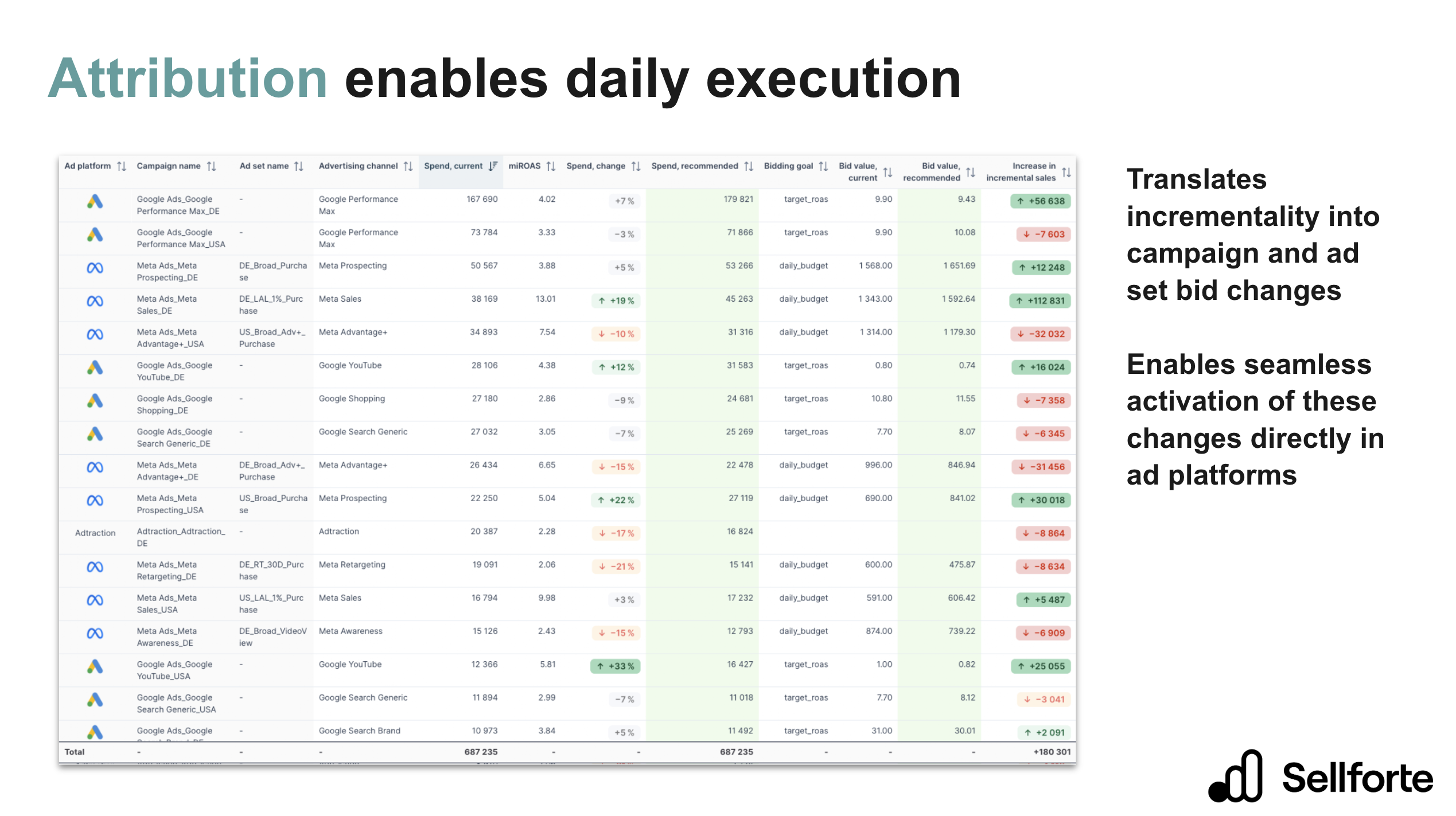
Attribution brings MMM and incrementality learnings into campaign-level bid changes and activation in ad platforms. The integration layer is what makes the truth source actionable.
You still need to run and optimize your campaigns every day. The challenge is always the same: you want to convert the causal truth from the experiment into concrete bid recommendations for the ad platform where you are buying the ads.
— Juha Nuutinen, Sellforte
If incrementality says Google Performance Max ROAS is 5 and attribution says 10, the bidding signal gets multiplied by 50%. Different campaign groups get different multipliers, so Google Search brand might need 30% while YouTube might need 300%. Calibration happens at the campaign-group level, not the platform level, which means one multiplier across all paid channels gives the wrong answer everywhere.
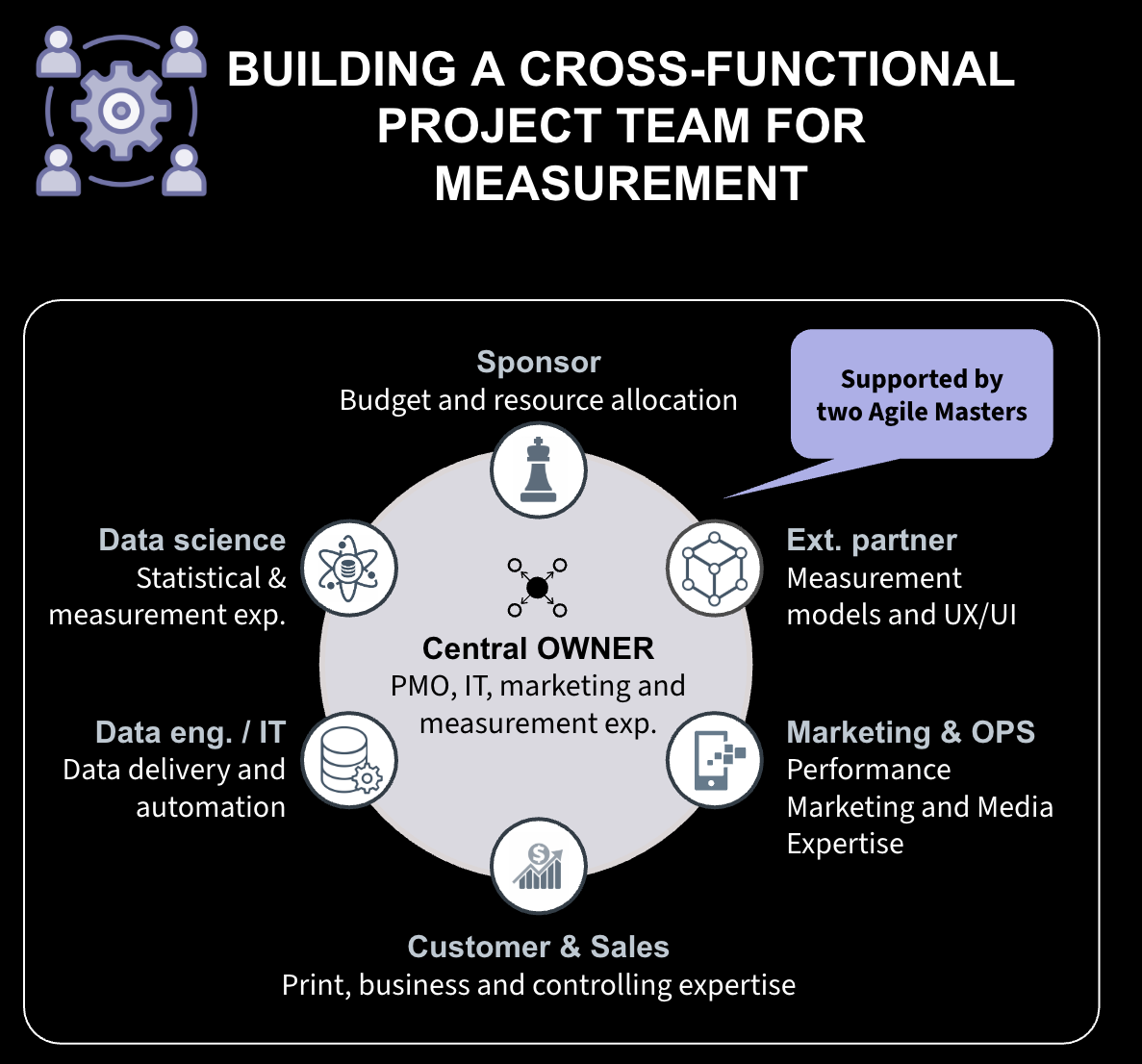
6. Treat measurement as a C-level capability, not a marketing reporting task
At bonprix, this means leadership buy-in, finance alignment, dedicated resources, and clear ownership beyond the marketing team. The project ranked top three internally.
The operating cadence looks like this:
- Weekly meetings with the project group and the VPs of sales and marketing
- Biweekly meetings with the CMO and CTO, with monthly meetings still in place today
- Ongoing alignment with VP Finance, including a business case that quantified what better budget allocation across 16 markets could deliver
- A growing FAQ document that captures every internal question and answers it once for everyone
- Onboarding 40 to 50 people across the organization in small group sessions
Building trust with finance was non-negotiable. Bonprix built a business case showing what better budget allocation across markets could deliver, then committed to holding those numbers.
If you give finance a super good business case, and prove that you can hold the numbers you have been promising, that's non-negotiable. Then it's working.
— Anika Kreißl, bonprix
7. Waiting for perfect data slows down impact
Bonprix launched at 90% readiness and iterated. Each new country goes live, and each new incrementality test calibrates the model further. The MVP in use beats the perfect model that never launched.
"We decided to start with an MVP instead of waiting for the full perfect view. 90% certainty was enough. The board agreed."
— Anika Kreißl, bonprix
Change management was what made shipping at 90% possible. The cadence, FAQ, and onboarding sessions from the previous lesson are what let the team commit to launching before everything was perfect.
Change management is not the side story. It's what makes everything else work. The best model is useless if it doesn't change decisions.
— Anika Kreißl, bonprix
Questions ecommerce measurement leaders asked bonprix
Q1: How do you handle SEO, TV, and influencers when you can't run experiments on them?
Some channels are notoriously hard to test: SEO, CRM, TV, out-of-home, print, influencers, AI-driven search. If they're missing from the model, their contribution leaks into paid search and inflates the credit there.
The bonprix approach is to include them as locked variables, which means modelling their contribution, forecasting their performance, and blocking the optimizer from changing them. Geographic experiments are run where possible.
LLM-driven traffic is still small for most ecommerce brands. The trajectory is clear, so the right time to start tracking it is before it becomes significant.
Q2: Can MMM ingest offline data and measure store visits?
Yes. Demand, defined as revenue before returns, is typically the primary KPI, while store traffic and web traffic can be included alongside as secondary KPIs. Customer lifetime value is often modeled as well, because the value of a purchase from a new customer is different from a returning customer.
How granular the offline data is determines what you can do with it. At the simplest level, the model can use spend and circulation data from direct mail or newspaper print as inputs. With more data, including which customers received which mailings and what geographic areas were targeted, the model can run causal A/B testing of direct mail through geo-lift experiments.
If you don't model these channels, you give the credit to paid search or promotions. Always include them. Then control how much the optimizer can change them.
— Juha Nuutinen, Sellforte
Q3: How do you measure brand equity inside the triangle?
Marketing produces three different time-horizon effects. The short and immediate effect is what attribution captures in a two-week or thirty-day window. The mid-term effect shows up in geo-lift experiments, where sales keep declining for 30 to 60 days after a test region's advertising is paused. The long-term effect is brand equity, which doesn't show up cleanly in either.
The approach is to model brand equity separately. Build a brand index from survey data on awareness, consideration, and preference, then model that index against marketing spend. The brand model can optionally tie back to the demand model to capture the full 360-day effect of marketing activities.
This is where short-term and long-term effects can be reconciled in one system, rather than argued about in separate meetings.
Q4: How does calibration change day-to-day decisions?
Calibrated attribution numbers flow into the ad platforms used for daily bidding. Budget changes happen on a mid-to-high level on a daily basis, jointly managed by marketing operations and the sales department. The day-to-day complexity is handled by the system.
Every incrementality test bonprix has run, and plans to run, feeds into the MMM. From there, calibration factors flow back into the dynamic attribution model, and the cycle repeats with each new test.
Every incrementality test we have been doing in the past and we are planning to do, we are putting up into the MMM. It all makes sense now. It goes into the MMM and the rest follows.
— Anika Kreißl, bonprix
How to apply bonprix's approach in your organization
The opportunity for most ecommerce brands is the same as it was for bonprix: attribution, MMM, and incrementality testing already exist as separate initiatives. The unlock is making them feed each other.
Operationalizing the measurement triangle means turning those methods into one continuous system, where incrementality experiments establish causal truth, MMM scales those learnings across channels and markets, and attribution translates them into daily bidding and campaign decisions.
This is the approach Sellforte was built to provide. Sellforte unifies MMM, incrementality testing, and attribution into one system for retail and ecommerce, helping teams move from defending numbers to moving budget where it drives incremental growth.
Bonprix is one of the brands building this kind of system. Other Sellforte customers including Represent, C&A, and Douglas are aligning measurement, budgeting, and optimization around incremental growth too.
If you're looking to build a unified marketing measurement view across attribution, MMM, and incrementality, let's talk through what it looks like in your organization.
👉Book a 30-minute conversation with Sellforte.
Author

Daria Alén is Senior Marketing Manager at Sellforte, where she builds educational programs, webinars, and events for ecommerce and DTC growth teams. She has over 10 years of marketing experience in B2B SaaS and Tech with specialization in go-to-market strategy and marketing analytics. Follow Daria on LinkedIn for more about marketing and growth.

Best MMM Tools for Ecommerce Brands: Top 10 Software for 2026

Best Real-Time MMM Tools for Ecommerce Brands: Software That Delivers Instant Marketing Insights
.png)