


It is not easy to optimize spend allocation across digital channels in ecommerce. You're being shown conflicting ROAS estimates from ad platform attribution, last-click attribution and/or multi-touch attribution, and have to make the difficult decision which one to trust.
An alternative approach has recently emerged. Marketing mix modeling (MMM) has advanced to a level where it can provide campaign & ad set level recommendations that performance marketers in ecommerce businesses need for driving growth and profit.
In this article, we'll review the top 10 marketing mix modeling tools for ecommerce brands. We'll break down the pros and cons of each solution, and discuss the situations each option is best suited for.

1. Sellforte: The Next-Gen Leader in Marketing Mix Modeling
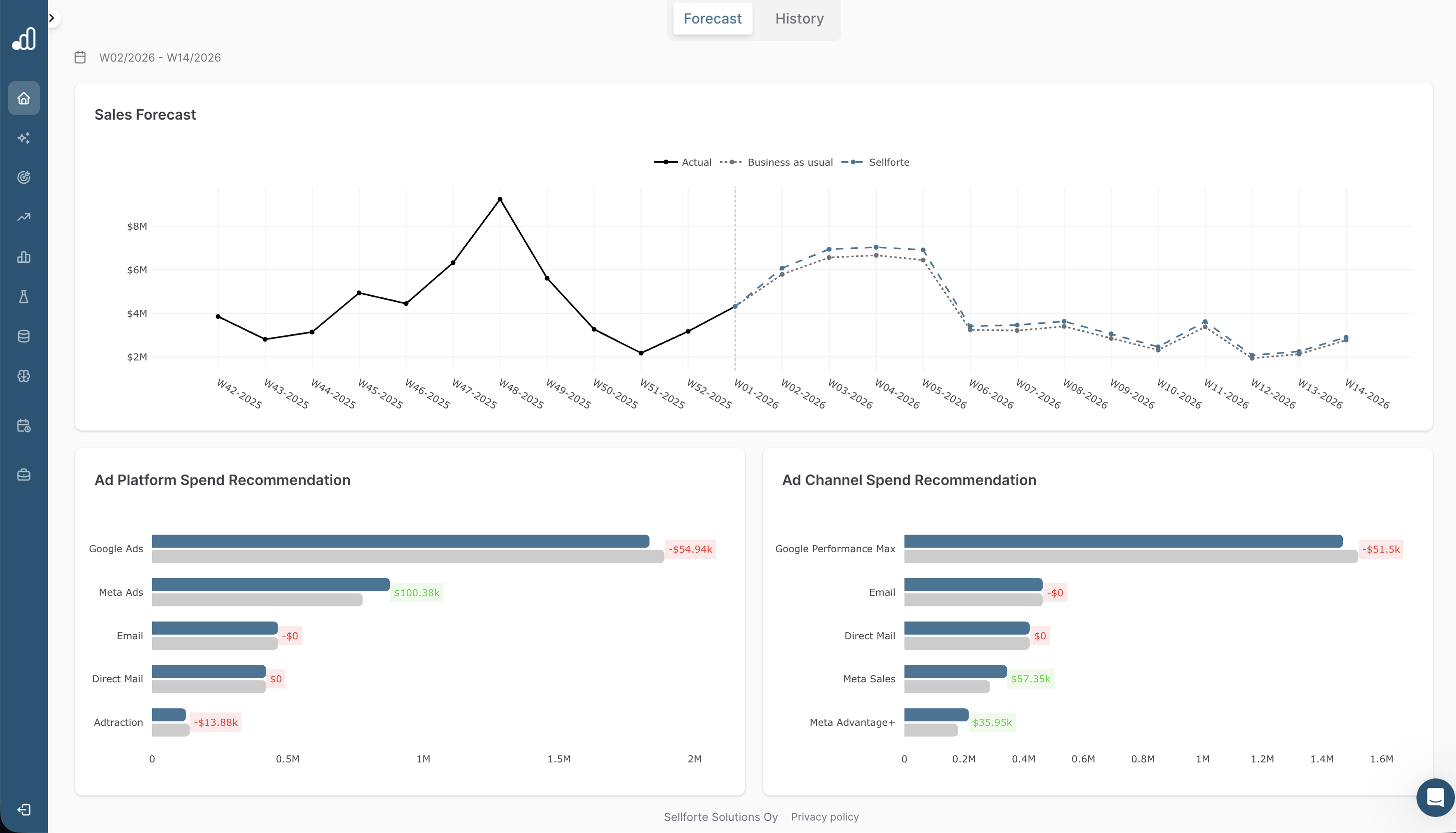
Overview: Sellforte is a Next-Gen Marketing Mix Modeling platform, specializing in Ecommerce, DTC and Retail. Sellforte is the most advanced MMM solution, providing spend & bidding recommendations for each campaign & ad set.
Pros:
- Battle-tested platform: Strong public references across large enterprise ecommerce businesses (such as bonprix) and rapidly growing ecommerce brands (such as Represent)
- Most advanced technology: Sellforte provides optimal spend and bid value for each campaign & ad set, based on Marginal Incremental ROAS (miROAS)
- Optimization focus, supported by AI: Advanced features for spend optimization, ranging from use-case specific optimization views to AI Agents
- Built for mid-sized and large ecoms, including enterprise-grade MMM features such as measuring offline media, modeling all sales channels (ecom, retail, Amazon,..), modeling Promotions, Experiments, Optimizer
Cons:
- Purely focused on Ecommerce, DTC and Retail. Might not be the right solution for B2B companies or FMCG brands without own online or retail store
- Focused on measuring and optimizing media spend, and not catering to other ecommerce use-cases, such as inventory management
Best for: Mid-sized and large Ecommerce businesses who want the most advanced MMM solution for optimizing media spend on channel-level and campaign/ad set level.
💡Pro tip
Try public Sellforte demo at https://demo.sellforte.com/
2. Analytic Partners: GPS Enterprise

Overview: US-based Analytic Partners is one of the most well-known consultancies for marketing measurement, often earning them a seat at Marketing Mix Modeling RFPs with large ecommerce businesses. While still appearing high in Gartner's reports, Analytic Partners has started to fall behind competitors in terms of technology and methodology.
Pros:
- Strong enterprise references
- Mentioned as a leading consultancy in Gartner's reports
- Beyond MMM, covers other commercial use-cases as well, such as customer segmentation or pricing analysis
Cons:
- No campaign / ad set level measurement or optimization
- No daily updates
- More consultancy than software (service quality depends on people assigned on the customer)
- Consultancy-cost structure makes them 4-8x more expensive than MMM product companies, such as Sellforte
Best for: Large ecommerce businesses who want MMM to help with high-level budget guidance, but not necessarily with granular campaign optimization.
3. Ekimetrics: One.Vision
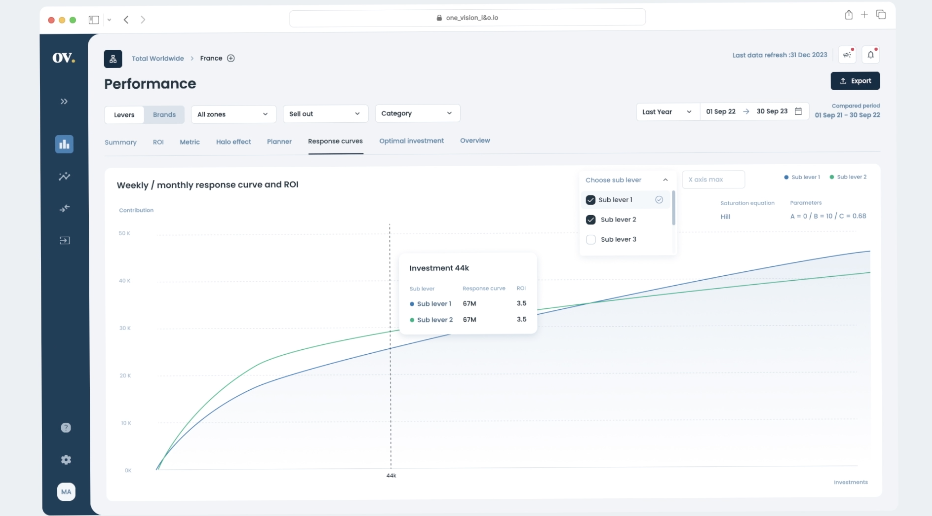
Overview: France-based Ekimetrics is a well-known Marketing Mix Modeling consultancy in Europe, often part of MMM tender processes for European enterprises.
Pros:
- Strong enterprise references in UK and France
- More software-focused than other consultancy providers
- Beyond MMM, covers other commercial use-cases as well, such as customer analytics
Cons:
- No campaign / ad set level measurement or optimization
- More consultancy than software (service quality depends on people assigned on the customer)
- Growth has stagnated since 2024 (based on headcount in LinkedIn)
- Consultancy-cost structure makes them more expensive than MMM product companies, such as Sellforte
Best for: UK and France -based enterprises who want MMM to help with high-level budget guidance, but not necessarily with granular campaign optimization.
4. Measured
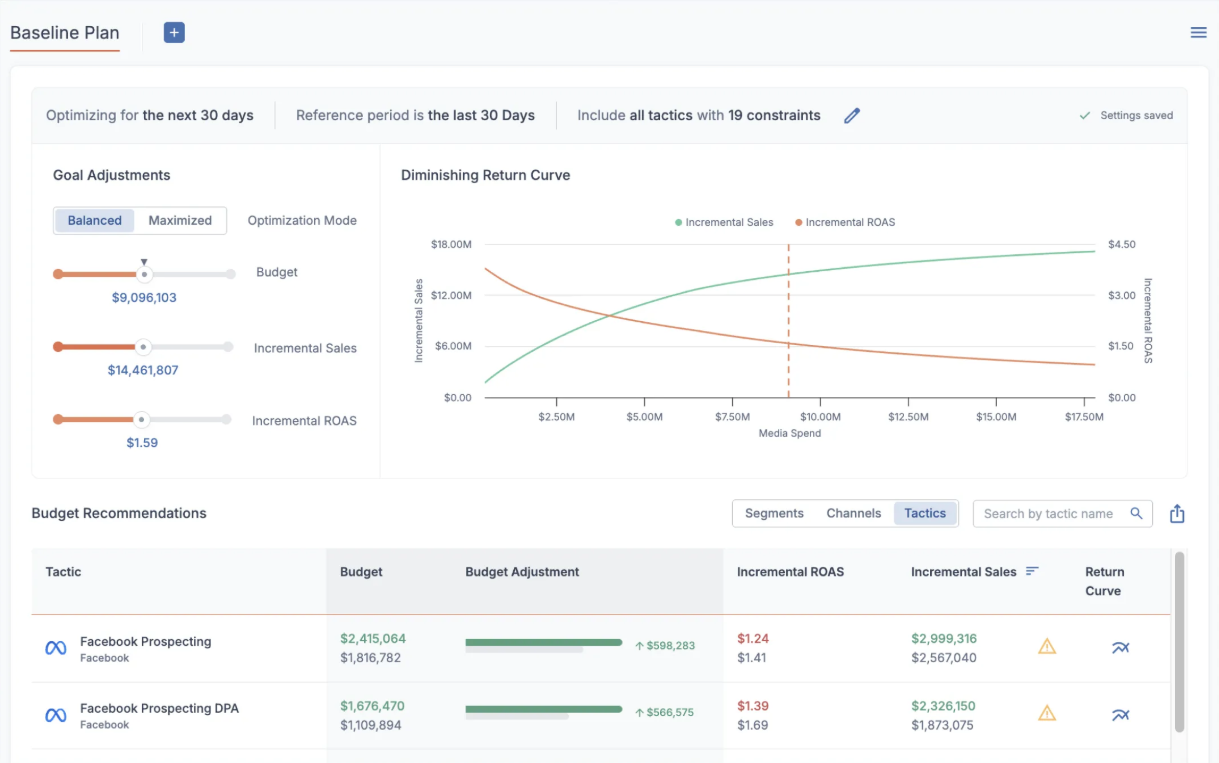
Overview: Measured is a media mix modeling platform that helps brands understand incremental sales impact of media and optimize spend.
Pros:
- Measures incremental ROAS and estimates response curves across channels
- Incrementality testing included in the platform
- MMM is calibrated with incrementality tests
Cons:
- Lacks tactical optimization features: No bidding recommendations for campaigns & ad sets.
- Optimizer tool has limited forward-looking window. For example, it does not provide optimal annual spend allocation
- Lighter modeling than full Marketing Mix Models: Promotions not measured or included in the model
Best for: Mid-sized ecommerce businesses who are not promotion-intensive and not looking for a platform that provides bidding recommendations for campaigns & ad sets.
5. Keen Decision Systems
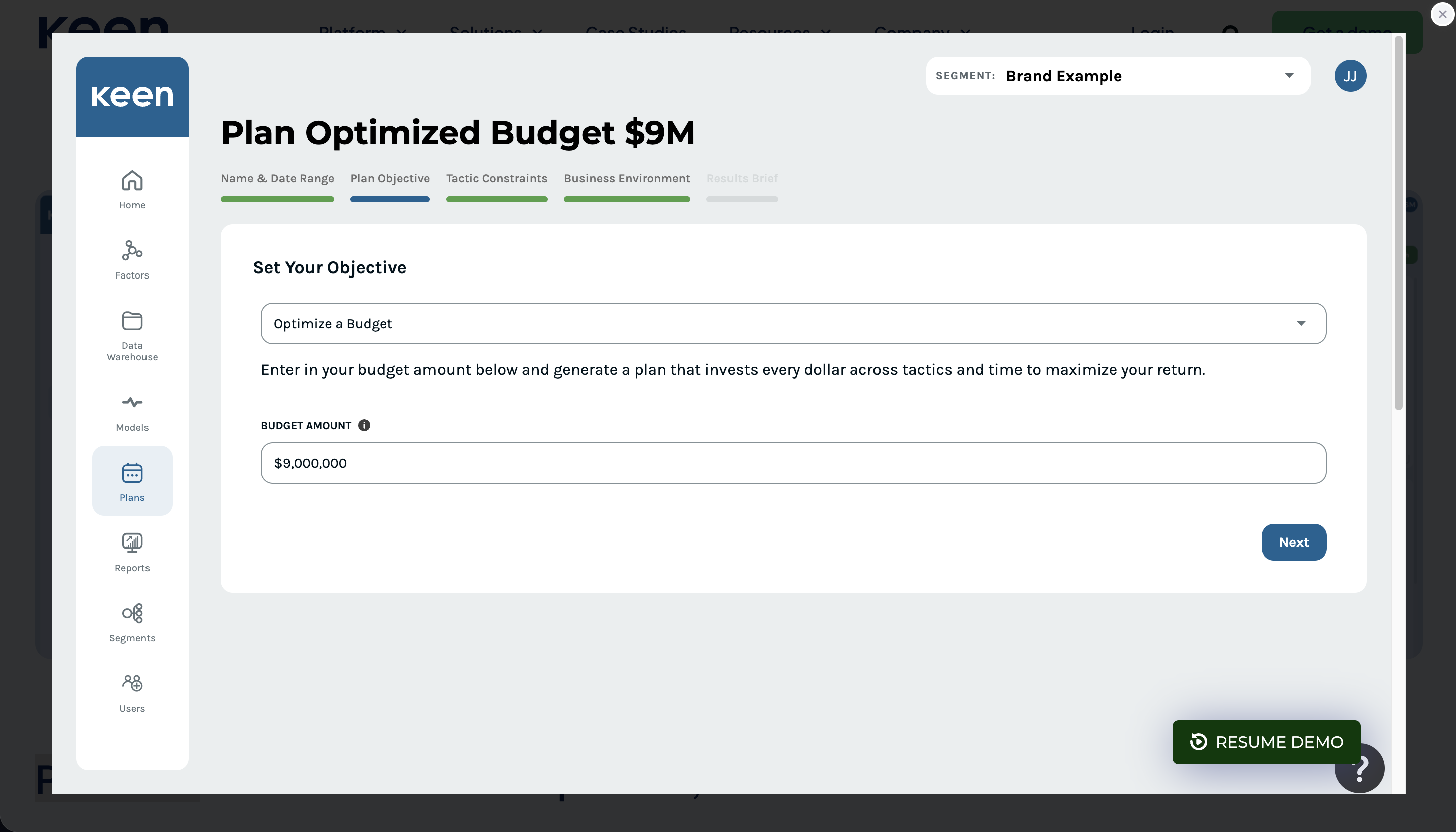
Overview: Keen’s platform centers on marketing mix modeling and optimization with an explicit goal of connecting marketing investment to revenue/profit and bridging marketing + finance planning.
Pros:
- Measures the ROI of media across channels
- Has an optimizer tool for media planning
- Dedicated features for CPG / FMCG brands, such a demand planning
Cons:
- Limited ability to support digital teams in optimization due to lack of campaign & ad set level measurement and recommendations
- No daily updates
- No analysis of marketing experiments
- Headcount has remained stable (source: LinkedIn) 2024-2026, suggesting challenges to grow
Best for: Mid-sized brands, especially in CPG / FMCG, who want to understand channel level performance, but not optimize digital spend on a granular level.
6. Recast
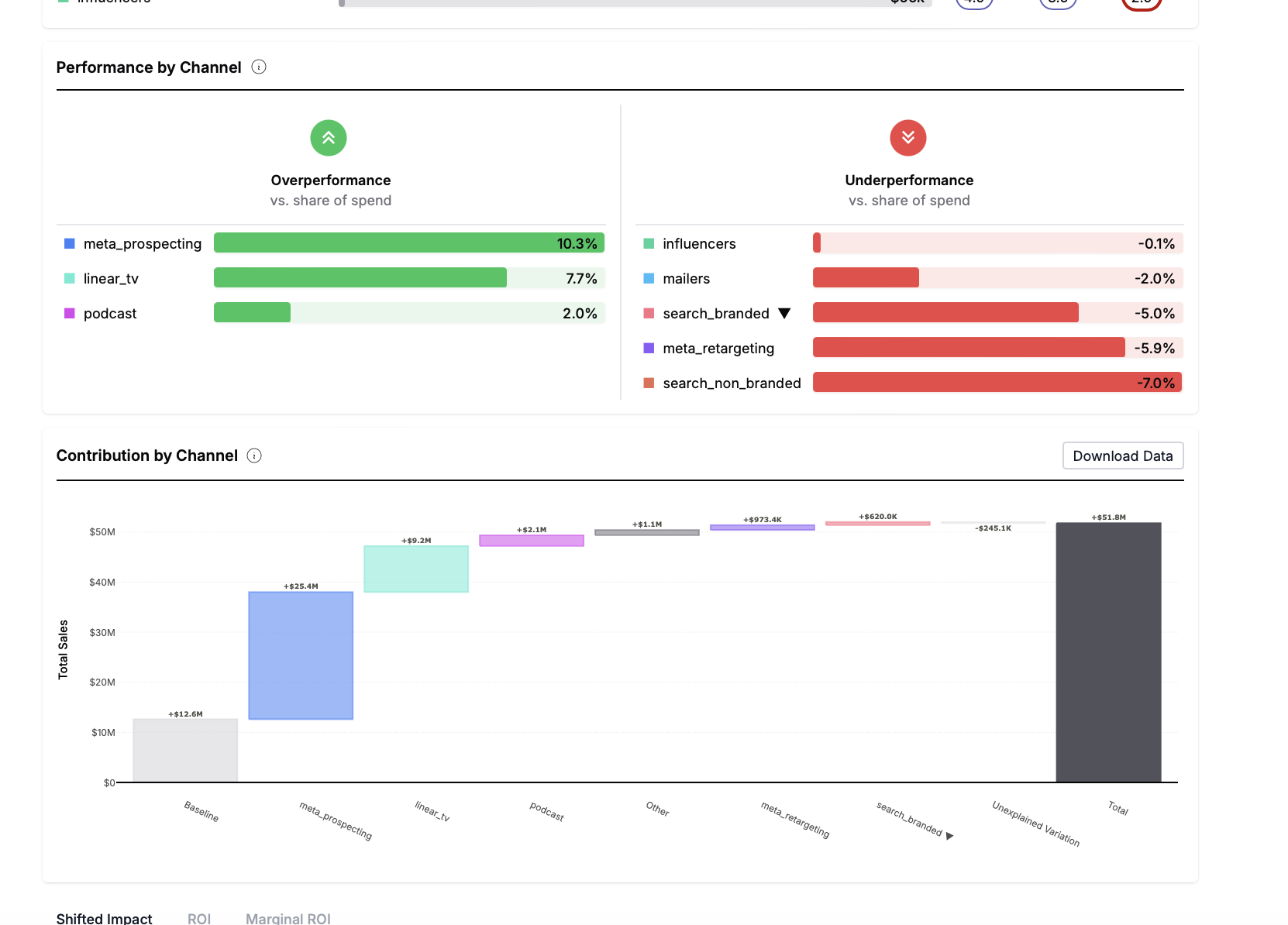
Overview: Recast offers MMM and geo testing, positioning itself as a robust and science-backed MMM.
Pros:
- Helps marketers measure media ROI on channel level
- Analysis of geo experiments included in the platform
- Heavy customization of models to each customer
Cons:
- Measurement available only on a high-level: Does not measure incremental sales or Incremental ROAS for campaigns & ad sets
- Technologically, has started falling behind the industry: No AI in the platform; Does not use signals based on digital data (such as as attribution data, clicks & impressions) in the analysis
- Slow compared to modern MMMs: No daily updates
Best for: Mid-sized brands for whom channel-level measurement is sufficient, and are not looking to optimize digital channels at the campaign & ad set level.
7. Liftlab
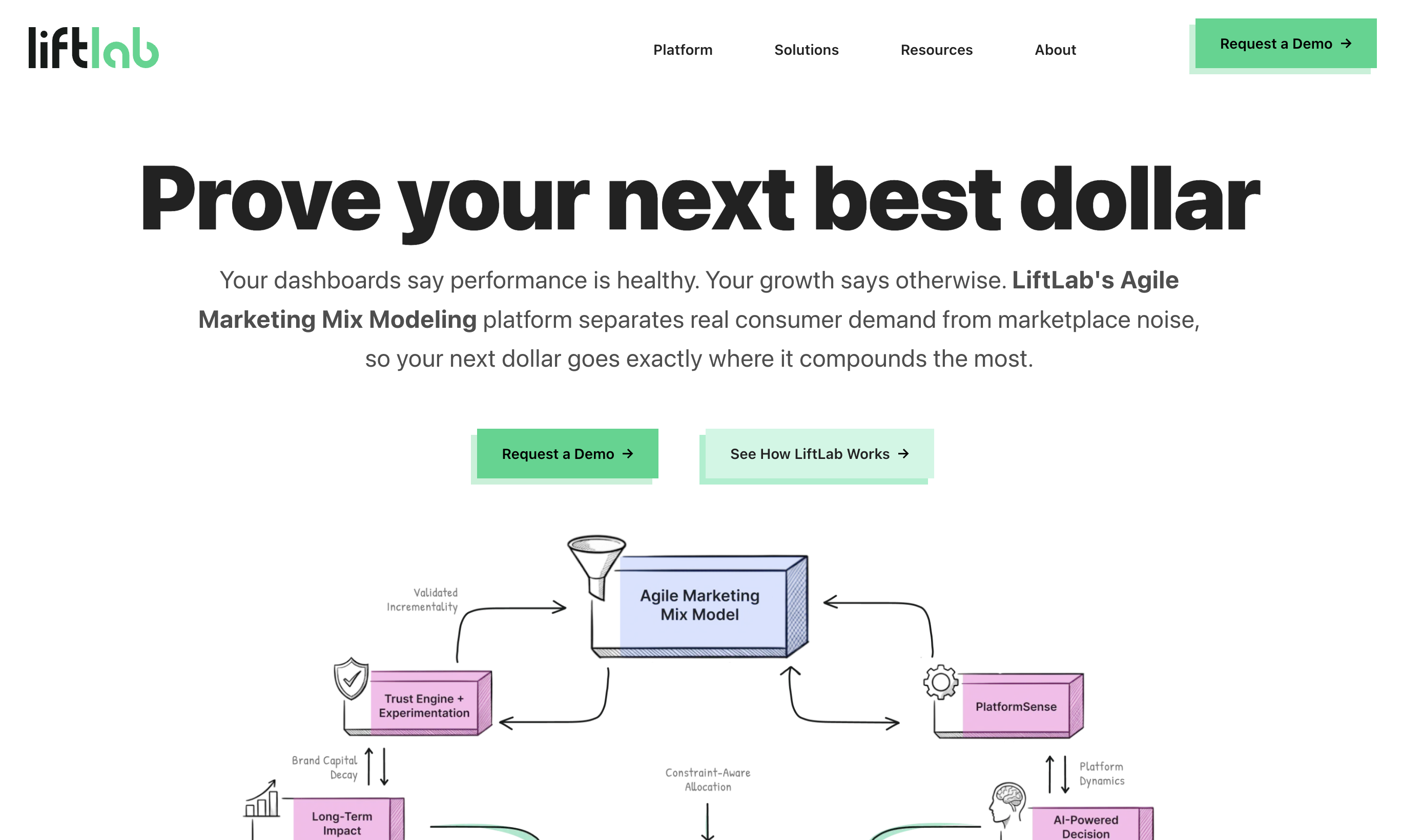
Overview: LiftLab positions itself an agile marketing mix modeling platform, combining MMM, experimentation, and AI-assisted insights.
Pros:
- Enables marketers to measure media ROI on channel level
- Experiments are part of the platform
- Similar to Sellforte, Liftlab is among the small number of MMM providers who have introduced AI to their platform
Cons:
- Lacks campaign & ad set level spend and bidding recommendations
- Modeling is lighter than with more comprehensive marketing mix models, e.g., weather not included
- No daily updates
Best for: Mid-sized ecommerce brands who are looking for support in allocating spend across channels (but not necessarily across campaigns and ad sets)
8. Triple Whale

Overview: Triple Whale is known as an ecommerce analytics and multi-touch attribution platform for Shopify vendors, but it has also expanded into MMM.
Pros:
- Combines MTA and MMM in one platform. Easy to adopt for brands already using Triple Whale for MTA or other use-cases
- Good integrations for ecommerce brands, especially Shopify
- Is building AI capabilities to the solution
- Provides campaign-level measurement
Cons:
- MMM is more lightweight compared to MMM-first platforms. As an example, promotions are missing from the model, increasing bias toward bottom-of-funnel channels
- Does not scale with the business: Not capable of serving larger ecommerce brands due to simple modeling approach
- Does not provide campaign-level Marginal Incremental ROAS (miROAS), decreasing credibility of recommendations
- Does not include analysis of marketing experiments
Best for: Small ecommerce teams that want an approachable entry point into MMM without adding a standalone measurement platform, especially if they’re already using Triple Whale for attribution and reporting.
9. Fospha
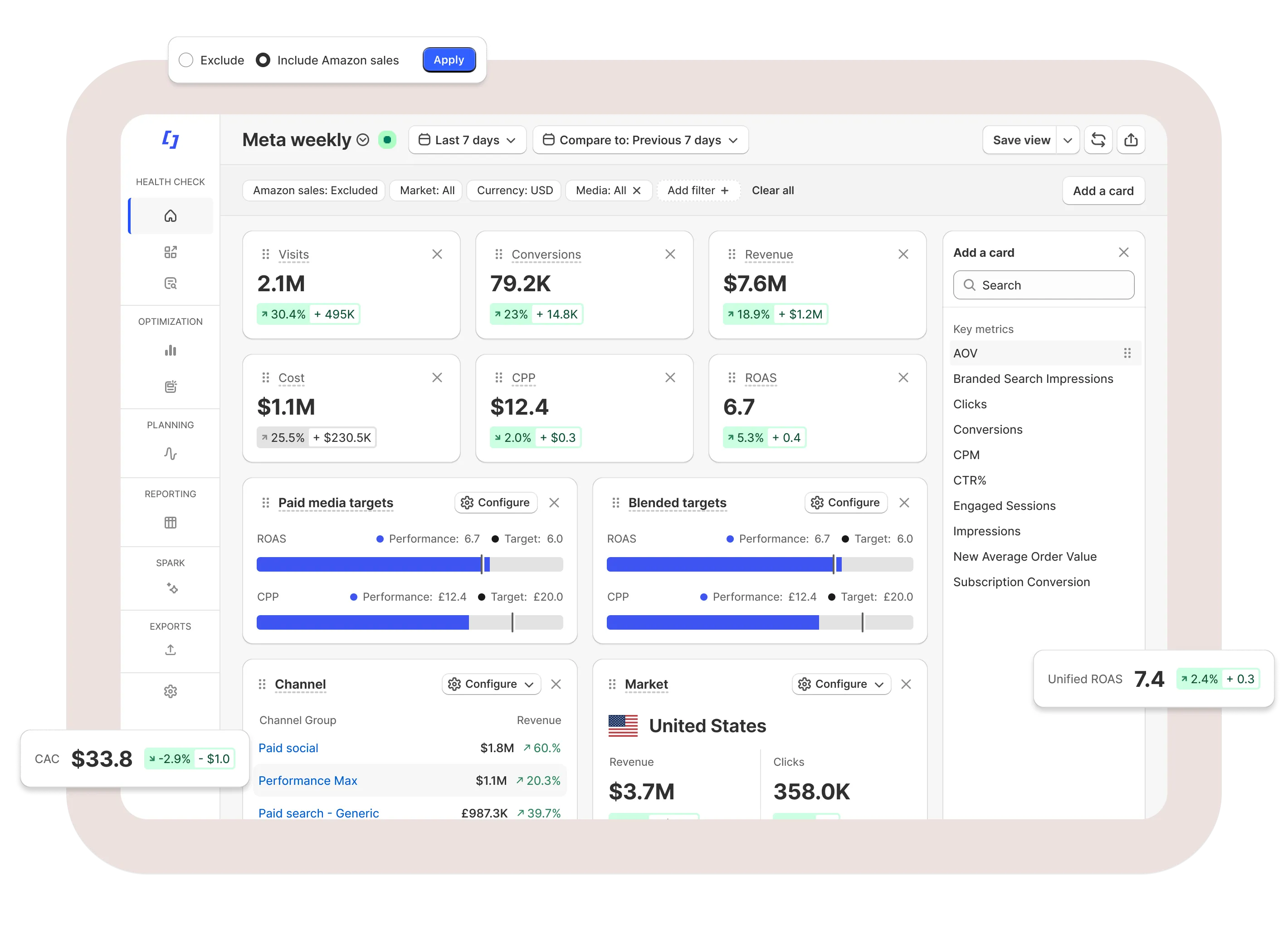
Overview: Fospha is known as multi-touch attribution platform, but it has also expanded into MMM.
Pros:
- Several small UK-based ecommerce businesses as references
- Deep partnerships with TikTok and Snapchat. Several case studies showing customers increase TikTok and Snapchat spend
- Promises fast onboarding due to integrations
- Provides campaign-level measurement
Cons:
- Gaps in optimization tools: No robust scenario planning tool, no campaign / ad set level recommendations based in miROAS
- Does not have AI in the platform
- Does not scale with the business: Not capable of serving larger ecommerce brands due to simple modeling approach
- Does not include analysis of marketing experiments
Best for: Small ecommerce brands, especially in UK, who want to try MMM for the first time.
10. Prescient AI
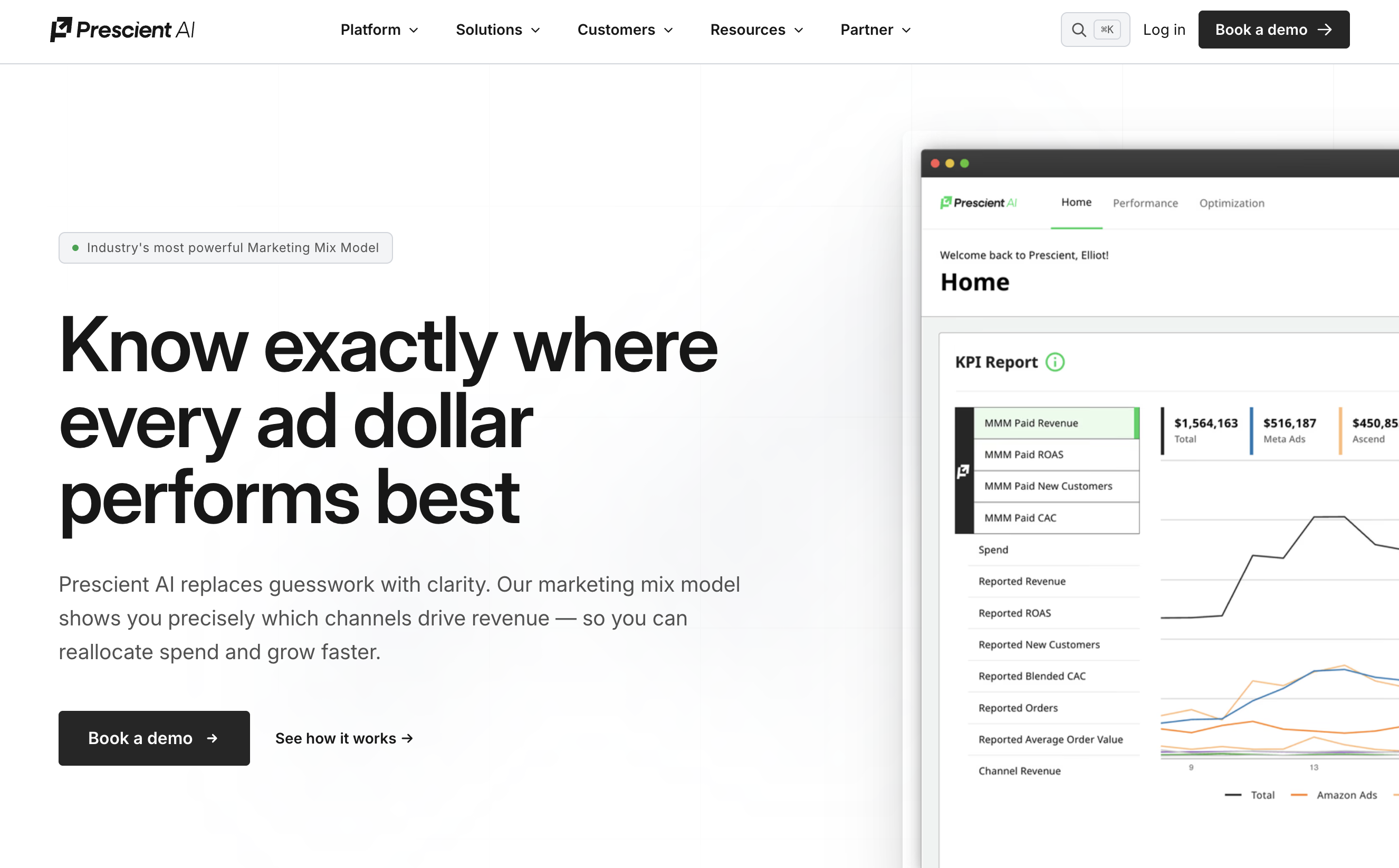
Overview: Prescient AI is a US-based MMM platform. Contrary to Fospha and Triple Whale who started as an MTA platform, Prescient AI focused on MMM from the start.
Pros:
- Several small US-based ecommerce businesses as references
- Contrary to many MMM-first providers, provides campaign-level measurement
- Promises fast onboarding due to integrations
Cons:
- Does not provide campaign-level Marginal Incremental ROAS (miROAS) or campaign and ad set level bidding recommendations
- Does not have analysis of marketing experiments
- Does not have AI in the platform
- Does not scale with the business: Not capable of serving larger ecommerce brands due to simple modeling approach
Best for: Small US-based ecommerce and DTC brands who are trying MMM for the first time, and who don't need bidding recommendations for campaigns and ad sets.
Conclusions
When choosing an MMM for an ecommerce brand, it is important to choose the right vendor for your needs.
For small ecommerce businesses with more than $0-$50M in sales:
-
Choose Sellforte if it is important to have the most advanced and robust spend optimization capabilities in the market, and a tool which can serve the brand from a small business all the way to a larger enterprise.
-
Consider also Triple Whale, Fospha, Prescient AI if you are interested in testing MMM for the first time with a simple solution, and it is not critical to have the most advanced spend optimization capabilities. We have seen smaller brands moving to Sellforte later as they have started growing and started requiring more complex/demanding MMM needs.
For mid-sized ecommerce businesses with $50M-$1B in sales:
-
Choose Sellforte if granular spend optimization across campaigns & ad sets is important (in addition to optimizing spend allocation on the higher channel-level).
- Consider also Measured, Recast, Liftlab, Keen, if channel-level insights are sufficient.
For large ecommerce businesses with more than $1B in sales:
-
Choose Sellforte whose enterprise-grade MMM covers all media spend optimization use-cases from channel-level budget planning to tactical campaign optimization.
-
Consider also Analytics Partners, Ekimetrics or one of the other high-touch consultancy options if high-level channel optimization is sufficient and consulting support is critical. In this model, you need to trust MTA, GA4, ad platform attribution, or other tool for campaign-level spend optimization.
To learn more, book a demo with Sellforte.
Authors

Lauri Potka is the Chief Operating Officer at Sellforte, with over 15 years of experience in Marketing Mix Modeling, marketing measurement, and media spend optimization. Before joining Sellforte, he worked as a management consultant at the Boston Consulting Group, advising some of the world’s largest advertisers on data-driven marketing optimization. Follow Lauri in LinkedIn, where he is one of the leading voices in MMM and marketing measurement.
%20Works%20for%20Online%20DTC%20Brands.png)
MMM for Ecommerce: How Marketing Mix Modeling (MMM) Works for Online DTC Brands
.png)
Top 5 SMB MMM Software for Small Ecommerce Brands ($0–$50M Annual Revenue)
.png)